
Military Edge Computing Market Outlook: Size, Share, Trends, Growth Analysis, Competitive Landscape & Forecast, 2026-2033

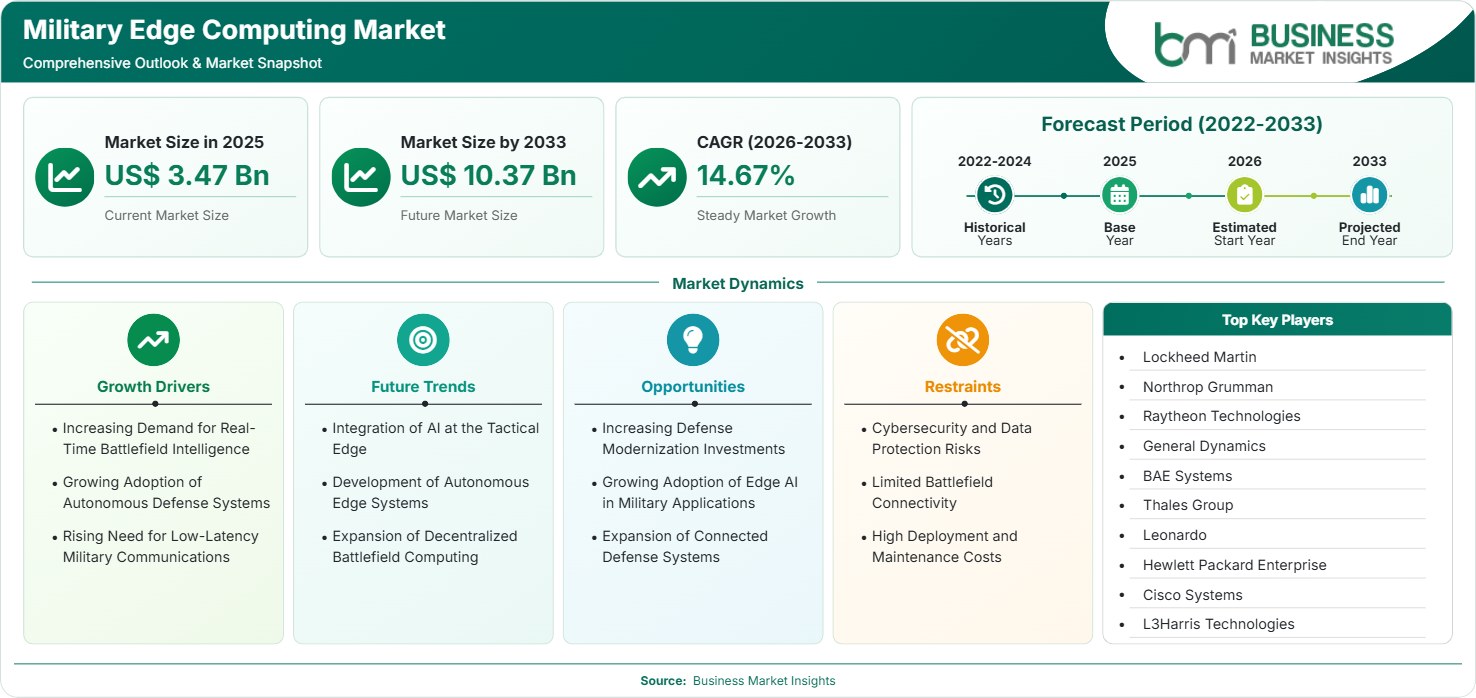
The Military Edge Computing Market size was valued at US$ 3.47 Billion in 2025 and is projected to reach US$ 10.37 Billion by 2033, growing at a CAGR of 14.67% during 2026–2033, driven by real-time battlefield intelligence requirements, autonomous defense systems, secure communications modernization, AI-enabled decision-making, and growing investments in connected military operations.

Report Coverage
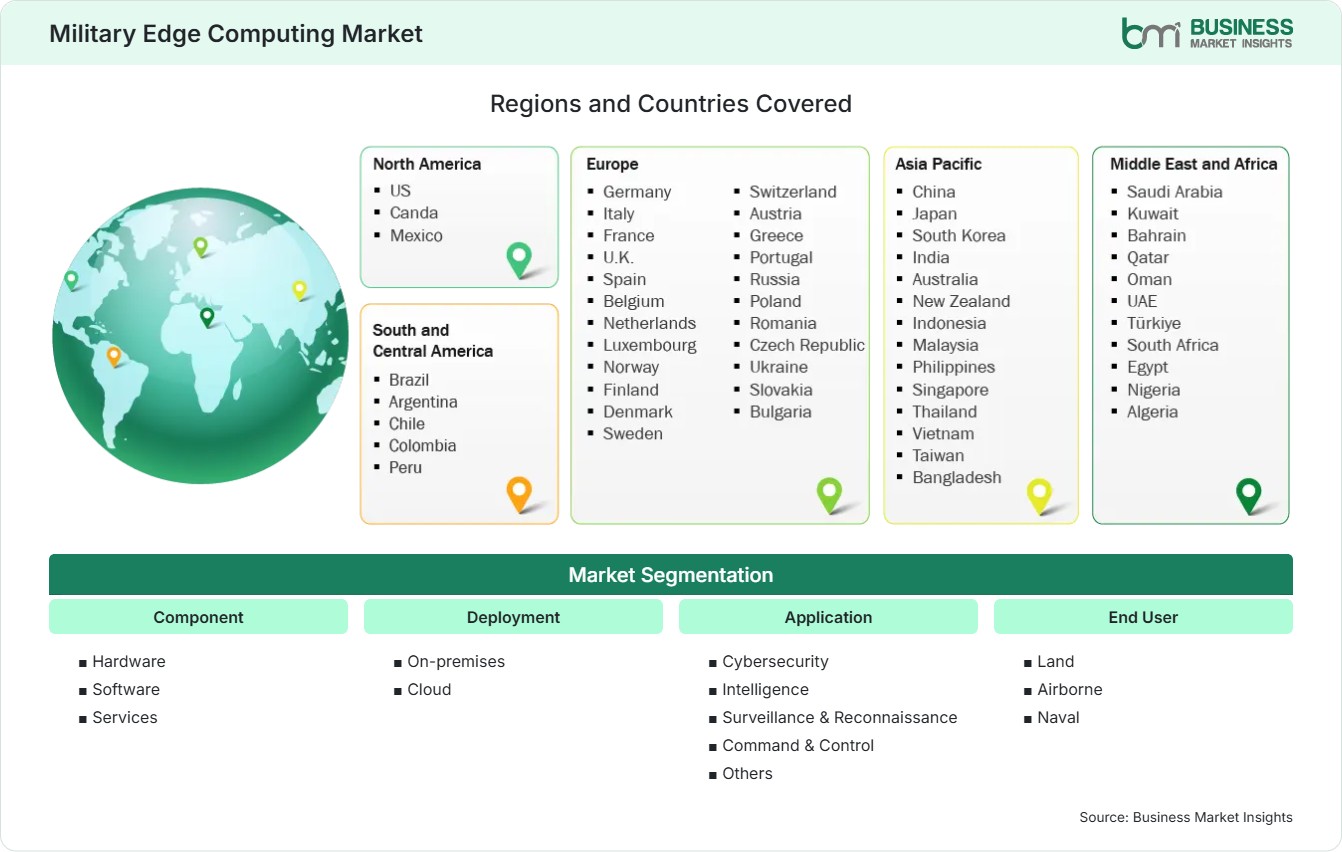
  • Component: Hardware, Software, Services
  • Deployment: On-premises, Cloud
  • Application: Cybersecurity, Intelligence, Surveillance & Reconnaissance, Command & Control, Others
  • End User: Land, Airborne, Naval
US$ 3.47 Bn Market size in 2025
US$ 10.37 Bn Market Size by 2033
14.67% CAGR, 2026 - 2033
2026-2033 Forecast Period

AI Overview

Military Edge Computing Market Summary

  • North America Region: North America holds a market share of 41%–44% in 2025, growing with a CAGR of 13.6%–14.5% during 2026–2033, supported by defense digitization programs, AI-driven command systems, battlefield networking technologies, ISR modernization, cybersecurity investments, tactical cloud deployments, and multi-domain military operations. The U.S. leads regional demand and expands at a CAGR of 13.8%–14.8% through continued defense technology modernization.
  • Fastest Growing Region: Asia Pacific holds a market share of 22%–25% in 2025, growing with a CAGR of 16.4%–17.6% during 2026–2033, driven by increasing defense budgets, indigenous military technology programs, border-security modernization, unmanned systems adoption, and deployment of AI-enabled tactical platforms.
  • Leading Segment: Hardware accounts for 48%–51% share in 2025, expanding at 14.0%–15.0% CAGR through 2033, supported by demand for rugged processors, edge servers, networking devices, secure storage systems, and battlefield computing infrastructure.
  • High Growth Segment: Intelligence, Surveillance & Reconnaissance (ISR) represents 31%–34% share in 2025, advancing at 15.8%–16.8% CAGR during 2026–2033, driven by sensor proliferation, drone deployments, real-time analytics requirements, and multi-domain awareness initiatives.
  • Key Market Opportunity: Expansion of AI-enabled tactical decision systems and distributed battlefield networks creates opportunities for secure edge computing platforms capable of processing mission-critical data with minimal latency.
  • Major Market Players: Lockheed Martin Corporation, Northrop Grumman Corporation, RTX Corporation, General Dynamics Corporation, BAE Systems plc, Thales Group, Leonardo S.p.A., Hewlett Packard Enterprise Company, Cisco Systems, Inc., L3Harris Technologies, Inc.
Strategic Insights

Military Edge Computing Market: Strategic Insights

Military Edge Computing Market Strategic Framework
FREE PDF
Request your free sample
Request free sample
Stakeholder View

Key Takeaways

  • Defense prime contractors, semiconductor suppliers, communication experts, AI software developers, and secure network firms will be more involved in the formation of tactical computing systems.
  • Intelligence collection, ISR systems, autonomous systems, and C&C applications are the areas for future growth.
  • Intelligence collection, ISR systems, autonomous systems, and C&C applications are the areas for future growth.
  • The Asia Pacific region is a large investment opportunity because of increasing defense budget spending, security program upgrades, and indigenous military technology development.
  • Strategic partnerships between defense contractors and enterprise technology providers are accelerating deployment of advanced computing architectures across military networks.
  • Procurement priorities are shifting toward scalable, interoperable, and secure computing systems capable of supporting multi-domain operations and connected defense environments.
Geographic Outlook

Military Edge Computing Market Regional Highlights

North America Military Edge Computing Market

North America represents 41%–44% Military Edge Computing Market share in 2025 and is expected to expand at a CAGR of 13.6%–14.5% through 2033. Strong defense budgets, advanced military modernization programs, and extensive adoption of digital command infrastructure support regional leadership. Military agencies increasingly deploy edge-enabled systems to improve operational intelligence, cybersecurity resilience, and real-time decision-making. Investments in autonomous systems, tactical cloud environments, and next-generation communication networks continue strengthening adoption across land, airborne, and naval applications.

  • Multi-domain operations initiatives are accelerating deployment of distributed computing systems capable of supporting integrated decision-making across air, land, maritime, cyber, and space domains.
  • Significant investment in AI-driven intelligence processing supports real-time analysis of sensor data generated by drones, surveillance systems, and battlefield platforms.
  • Defense agencies prioritize cyber-resilient edge architectures to enhance operational continuity in contested communications environments.
  • Tactical cloud deployments continue expanding across military networks to improve flexibility, scalability, and data accessibility during missions.
  • Autonomous platform development programs strengthen demand for onboard processing capabilities and low-latency decision-support technologies.

US Military Edge Computing Market

The United States accounts for approximately 78%–82% of North American revenue and is projected to record a CAGR of 13.8%–14.8% through 2033. Continued investment in Joint All-Domain Command and Control initiatives, AI-enabled defense technologies, and next-generation military communications supports adoption. Edge computing solutions are increasingly integrated into unmanned platforms, ISR systems, and mission-critical battlefield networks. The country remains a major innovation hub for defense-oriented computing architectures and secure digital warfare capabilities.

  • AI integration programs emphasize localized processing capabilities that reduce response times and improve operational awareness in dynamic combat environments.
  • Unmanned aerial and autonomous systems increasingly rely on onboard computing resources for navigation, targeting, and intelligence missions.
  • Advanced military communication modernization programs support deployment of secure and interoperable edge infrastructure.
  • Defense R&D spending continues accelerating technological innovation across tactical analytics, network resilience, and distributed command systems.

Europe Military Edge Computing Market

Europe holds 25%–28% Military Edge Computing Market share in 2025 and is expected to grow at a CAGR of 14.2%–15.2% through the forecast period. Regional demand is driven by defense modernization, NATO interoperability requirements, cybersecurity investments, and increasing deployment of advanced surveillance technologies. France, Germany, and the United Kingdom remain leading markets, while Poland demonstrates particularly strong growth momentum. Military organizations increasingly prioritize secure computing capabilities that support rapid information processing and operational coordination across coalition environments.

  • NATO interoperability initiatives encourage adoption of standardized digital architectures capable of supporting multinational military operations.
  • Germany leads spending on digital battlefield modernization and advanced command infrastructure capabilities.
  • Poland is among the fastest-growing markets due to substantial investments in defense modernization and security enhancement programs.
  • Cybersecurity requirements are driving implementation of resilient and protected edge computing platforms.
  • ISR modernization projects continue supporting deployment of distributed intelligence and surveillance processing systems.

Asia Pacific Military Edge Computing Market

Asia Pacific accounts for 22%–25% Military Edge Computing Market share in 2025 and represents the fastest-growing regional market with a CAGR of 16.4%–17.6% through 2033. Rising geopolitical tensions, network-centric warfare initiatives, indigenous defense manufacturing programs, and increasing investments in AI-enabled military systems support market expansion. China remains the largest regional market, while India demonstrates the strongest growth trajectory. Regional armed forces are increasingly adopting distributed computing technologies to enhance battlefield intelligence, surveillance capabilities, cyber defense, and operational coordination across complex security environments.

  • China continues investing heavily in military modernization programs involving autonomous platforms, advanced ISR systems, and intelligent command architectures requiring edge-processing capabilities.
  • India records strong growth due to defense digitization initiatives, indigenous technology development programs, and increasing procurement of network-enabled warfare solutions.
  • Regional governments increasingly prioritize AI-enabled operational awareness platforms capable of supporting real-time decision-making under contested conditions.
  • Expansion of unmanned aerial, maritime, and ground systems creates substantial demand for onboard computing and distributed analytics technologies.
  • Defense communication upgrades across Asia Pacific support deployment of resilient edge infrastructures designed for operational continuity and low-latency data processing.

Rest of World Military Edge Computing Market

The Rest of World region accounts for 8%–10% share in 2025 and is anticipated to expand at a CAGR of 15.0%–16.2% through 2033. Middle Eastern countries are driving military technology investments through defense modernization initiatives and smart battlefield programs. South & Central America continue improving command infrastructure and surveillance capabilities. The UAE and Saudi Arabia emerge as leading adopters, while Brazil demonstrates increasing investment in network-enabled defense technologies and digital operational capabilities.

  • Saudi Arabia is strengthening adoption through defense transformation programs focused on AI-enabled command systems and advanced battlefield communications.
  • The United Arab Emirates continues investing in autonomous defense technologies and integrated digital military infrastructure.
  • Brazil is expanding surveillance, cybersecurity, and mission-command capabilities through modernization of military information systems.
  • Governments across emerging defense markets are pursuing resilient edge architectures to improve operational effectiveness in remote environments.
  • Growing emphasis on border security, intelligence gathering, and mission-critical communications supports long-term procurement opportunities.
Global Market Geography
FREE PDF
Request your free sample
Request free sample
Segment Analysis

Military Edge Computing Market Segmentation

Component

Hardware remains the dominant segment with 48%–51% share in 2025 and is expected to register a CAGR of 14.0%–15.0% through 2033. Demand is fueled by ruggedized processors, field-deployable servers, secure storage technologies, embedded systems, and tactical networking infrastructure. The Military Edge Computing Market scope continues expanding as defense forces seek resilient computing architectures capable of supporting mission-critical applications across diverse operational theaters without dependence on centralized processing resources.

  • Hardware: Encompasses rugged processors, computing modules, storage devices, edge servers, communication gateways, and networking equipment engineered for demanding military operating environments.
  • Software: Includes analytics platforms, AI algorithms, cybersecurity applications, mission-management systems, and operational intelligence tools supporting distributed decision-making processes.
  • Services: Covers integration, maintenance, cybersecurity consulting, training, deployment support, and lifecycle management functions essential for military computing programs.

Deployment

On-premises deployments maintain leadership with 67%–70% share in 2025 and CAGR of 13.8%–14.7% due to strict security requirements and operational control needs. Military organizations continue prioritizing isolated computing environments for sensitive missions, while cloud-enabled architectures gain traction in hybrid operational settings.

  • On-premises: Favored for classified workloads, security-sensitive applications, mission assurance requirements, and direct operational control over computing infrastructure.
  • Cloud: Increasingly adopted to support scalable analytics, information sharing, mission planning, hybrid operations, and distributed military computing environments.

Application

Intelligence, Surveillance & Reconnaissance (ISR) accounts for 31%–34% share in 2025 and registers the fastest growth with 15.8%–16.8% CAGR. Data-intensive operational requirements and sensor proliferation continue driving deployment. The evolution of ISR capabilities reflects broader Military Edge Computing Market trends emphasizing real-time analytics and operational responsiveness.

  • Cybersecurity: Supports threat detection, network protection, anomaly monitoring, and defense against increasingly sophisticated cyber threats.
  • Intelligence, Surveillance & Reconnaissance (ISR): Enables rapid processing of sensor information, drone intelligence, and operational data for enhanced situational awareness.
  • Command & Control (C2): Improves battlefield decision-making by providing timely intelligence distribution and operational coordination capabilities.

End User

Land-based military operations represent the largest end-user segment with 45%–48% share in 2025 and CAGR of 14.5%–15.4% through 2033. Digital battlefield initiatives, mobile command systems, and autonomous ground platforms continue strengthening adoption.

  • Land: Modernization of armored vehicles, tactical command posts, autonomous ground systems, and battlefield communication networks drives deployment.
  • Airborne: Advanced aircraft, unmanned aerial systems, and ISR platforms increasingly require onboard analytics and low-latency computing capabilities.
  • Naval: Edge technologies support maritime surveillance, fleet coordination, threat assessment, and distributed naval operational architectures.
Market Forces

Military Edge Computing Market Dynamics

Key Market Drivers

Increasing Demand for Real-Time Battlefield Intelligence

Modern military operations generate vast quantities of data from satellites, unmanned systems, sensors, radar networks, and tactical communications platforms. Traditional central processing system designs may cause latency issues, which could hamper mission response times. With edge computing, processing of data happens near the area of operation, resulting in greater situational awareness and faster decision making. The Military Edge Computing Market growth is impacted by the demand for integration of intelligence from several sources in real time. There is a growing demand in the defense sector for the ability to analyze battlefield conditions, detect potential threats, and execute mission objectives without depending on any distant data centers.

Growing Adoption of Autonomous Defense Systems

Autonomous and semi-autonomous defense platforms increasingly depend on distributed computing capabilities to perform navigation, surveillance, target recognition, and mission management functions. UAVs, autonomous naval craft, and robotic land vehicles are responsible for creating significant amounts of data that need instant processing at the site itself. Edge computing decreases dependency on communications and provides uninterrupted operation in contested/disconnected environments. There is further investment by the military in autonomous systems to increase force multiplication and efficiency. The demand for localized processing is growing with defense departments using more advanced platforms that can function independently but coordinate with command-and-control structures at the same time.

Rising Need for Low-Latency Military Communications

Military communications systems increasingly operate across highly dynamic and contested environments where rapid information exchange is critical. Architectures enabled by edge computing shorten latencies due to local processing of operational information without forwarding it to central locations. Such an approach increases the efficiency of control and command tasks, mission planning, threat detection, and battlefield coordination. The Military Edge Computing Market trends reveal increased focus on reliable communication networks that would facilitate instant data access in different environments. Modern armies are implementing networking solutions together with distributed computing in order to guarantee uninterrupted operations. Possibilities of conducting low-latency communications in electronic warfare are the operational strength and the driver of demand for edge-enabled defense architecture.

Key Market Opportunities

Increasing Defense Modernization Investments

Governments worldwide continue increasing defense budgets to modernize military capabilities and strengthen national security strategies. Deployments of digital warfare capabilities, enhanced communication devices, AI-based computing platforms, and integrated operational environments have created a conducive environment for edge computing adoption. Defense agencies are looking for technologies that offer increased accessibility, flexibility, and efficiency. With modernization efforts for various areas like land, air, and naval sectors now including distributed computing systems, procurement projects that focus on network centric warfare and information dominance are creating future demand for advanced edge computing solutions. Suppliers that offer solutions with the ability to deliver security, interoperability, and scalability will have an opportunity to capitalize on the continued investments in defense technologies.

Growing Adoption of Edge AI in Military Applications

Artificial intelligence is becoming a central element of military modernization strategies. Applications such as predictive threat analysis, autonomous navigation, battlefield intelligence analysis, and mission optimization rely on local computing facilities. Edge AI allows algorithms to run on operating systems while avoiding delays and connection issues. Thus, edge AI brings an opportunity for hardware specialization, analytics, and mission solutions. There is a growing need among defense organizations to develop systems that allow faster and more accurate decisions. As the use of AI grows in intelligence, surveillance, and tactical applications, the use of edge-based architecture will grow in the forecast period.

Expansion of Connected Defense Systems

Modern defense concepts increasingly rely on interconnected platforms capable of sharing intelligence and coordinating actions across multiple domains. For interconnected ecosystems involving soldiers, vehicles, planes, sensors, command centers, and autonomous devices, there is a need for distributed data processing. There is high growth potential in the Military Edge Computing Market Forecasts because of the move by military forces towards interconnected digital battlefields. Some of the new operational principles include supremacy of information, immediate data exchange, and synchronization of missions. Edge computing becomes an important constituent of such systems through its ability to facilitate quick analysis and communications. The opportunity in such interconnected defense ecosystems will be tremendous.

Market Restraints and Challenges

Cybersecurity and Data Protection Risks

Factor: Edge environments expand the number of connected devices, sensors, platforms, and decentralized processing nodes operating across military networks. Impact: Greater exposure means that there is increased susceptibility to intrusions by cyber attackers, manipulation of data, installation of malware, and unauthorized access attempts. For instance, defense systems need to have strong encryption capabilities and authentication, along with constant monitoring of security needs. The task gets even harder for the defense when there is presence of cyber and electronic warfare in the environment. Data integrity and operation flexibility entail significant expenditure on cybersecurity.

Limited Battlefield Connectivity

Factor: Military operations frequently occur in remote or contested environments were communication networks face disruption, degradation, or complete denial. Impact: Network connectivity may be insufficient to allow synchronization between remote edge node systems and central control infrastructures, resulting in consistency issues and coordination problems. Even though the use of edge computing helps organizations rely less on network connectivity, certain mission-critical tasks involve data transfer within larger military systems. Companies should develop extremely resilient architectures that will work even if there is no communication for extended periods of time.

Company Analysis

Competitive Landscape

The Military Edge Computing Market analysis highlights competition focused on secure battlefield networking, AI-enabled tactical processing, ruggedized computing infrastructure, cyber resilience, and multi-domain operational integration.

Company Name

Overview

Products and Services relevant to this market

Lockheed Martin Corporation

Major defense contractor delivering integrated mission systems and advanced military technologies.

Tactical computing systems, ISR platforms, command networks, mission-management solutions, defense integration services.

Northrop Grumman Corporation

Defense technology provider specializing in advanced military systems and autonomous platforms.

Edge-enabled ISR systems, autonomous technologies, secure communications, battlefield analytics platforms.

RTX Corporation

Global aerospace and defense company supplying mission-critical military solutions.

Defense networking solutions, sensors, mission systems, tactical processing architectures, cybersecurity capabilities.

General Dynamics Corporation

Defense contractor supporting communications, mission systems, and digital modernization programs.

Battlefield computing systems, secure networks, command-and-control technologies, military communications platforms.

BAE Systems plc

Provider of advanced defense electronics and mission-support technologies.

Ruggedized computing, electronic warfare systems, secure processing platforms, mission-critical software solutions.

Thales Group

International defense and security company with expertise in communications and digital defense.

Tactical communications, defense networking, cybersecurity solutions, battlefield information systems.

Leonardo S.p.A.

European defense contractor supporting aerospace, electronics, and operational intelligence programs.

ISR technologies, command systems, surveillance solutions, operational computing platforms.

Hewlett Packard Enterprise Company

Enterprise technology provider expanding secure edge-computing capabilities for defense environments.

Edge servers, secure infrastructure, mission-critical computing, hybrid cloud and analytics solutions.

Cisco Systems, Inc.

Networking leader providing secure connectivity and digital infrastructure solutions.

Tactical networking, cybersecurity platforms, communications infrastructure, edge connectivity technologies.

L3Harris Technologies, Inc.

Defense communications specialist supporting advanced battlefield information networks.

Secure communications, ISR systems, mission networks, tactical edge-processing capabilities.

Trust & Transparency

Research Methodology

The market analysis combines proprietary research with secondary data from government agencies, company disclosures, regulatory filings, industry databases and expert interviews. Market estimates are validated through data triangulation, cross-market benchmarking and analyst review.

View Full Research Methodology

Questions Answered

Frequently Asked Questions

What does a Military Edge Computing Market Report include?

A report typically evaluates market size, technology developments, competitive positioning, regional opportunities, application analysis, procurement trends, and long-term forecast dynamics.

What are the primary challenges facing adoption?

Cybersecurity risks, battlefield connectivity limitations, interoperability concerns, and integration with legacy defense systems remain key implementation challenges.

How does edge computing support autonomous defense systems?

It provides localized processing capabilities that allow autonomous platforms to analyze information, make decisions, and execute missions even when connectivity is limited.

Which application segment leads demand for Military Edge Computing Market?

Intelligence, Surveillance & Reconnaissance (ISR) is the leading application because military forces require immediate processing of sensor, radar, imagery, and drone-generated information.

Why is edge computing important in military operations?

Edge computing enables data processing near operational environments, reducing latency and improving decision-making speed. This is particularly important for ISR, autonomous systems, command operations, and tactical communications.

Access the Full Military Edge Computing Market Report

Get segment-level forecasts, regional estimates, competitive benchmarking, company profiles and downloadable Excel datasets.

Access the full Military Edge Computing Market Report
350 pages PDF & Excel | 2026-09-15
Similar Research

Related Market Reports