Market Summary
Executive Summary and Global Market Analysis
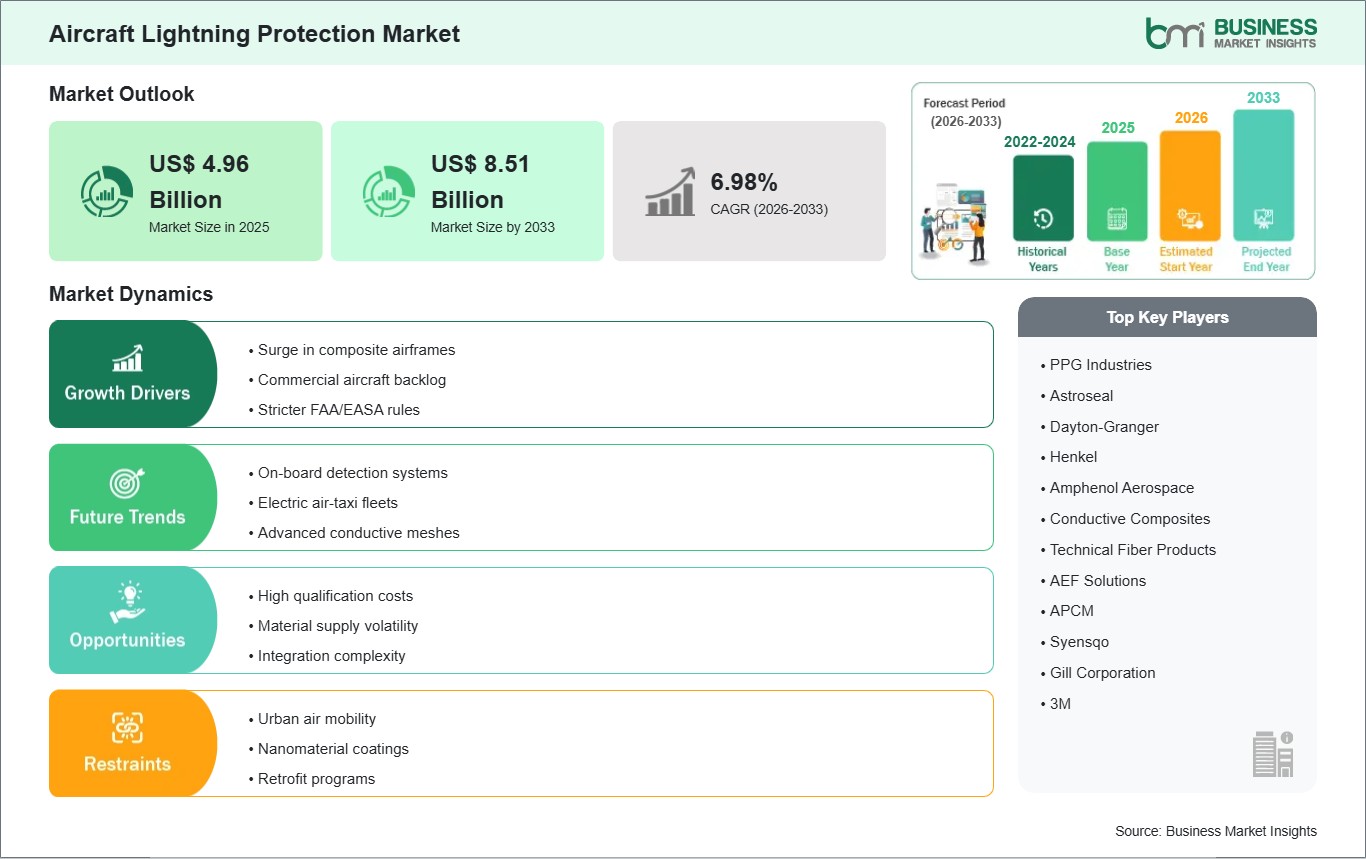
Aircraft lightning protection systems are used to protect aircraft structures and onboard electronic systems from the effects of lightning strikes during flight operations. These systems include expanded metal foils, interwoven wire fabrics, plated carbon fiber materials, and other conductive solutions integrated into aircraft structures. They play an important role in the safe dissipation of electrical energy to avoid any damage to vital parts. This is driven by the increasing number of applications for composite materials in the construction of new airframe designs, stricter safety standards in the aviation industry, and higher demand for state-of-the-art commercial, military, and future-generation aircraft.
There are several challenges that could affect market growth. Advanced lightning protection materials can increase aircraft manufacturing costs, particularly for composite-intensive aircraft structures. Integration of protection devices within light weight aircrafts is quite an engineering task and involves thorough testing to fulfill all required standards of certification. The growing sophistication of today's aircraft electronic systems is another reason that highlights the importance of protection devices. Moreover, keeping up with the standards of lightning protection for an aircraft's entire lifetime can become quite difficult.
Despite these challenges, the market is expected to benefit from ongoing advancements in aerospace materials and aircraft design technologies. New opportunities are emerging through the development of lightweight conductive materials that provide improved protection without significantly increasing aircraft weight. The growing adoption of composite airframes, electric aviation technologies, UAVs, and advanced air mobility platforms is creating additional demand for innovative protection solutions. Increased research into multifunctional materials and integrated structural protection systems is expected to support future market growth while helping manufacturers improve aircraft efficiency, safety, and operational reliability.
Segment Analysis
Aircraft Lightning Protection Market Segmentation
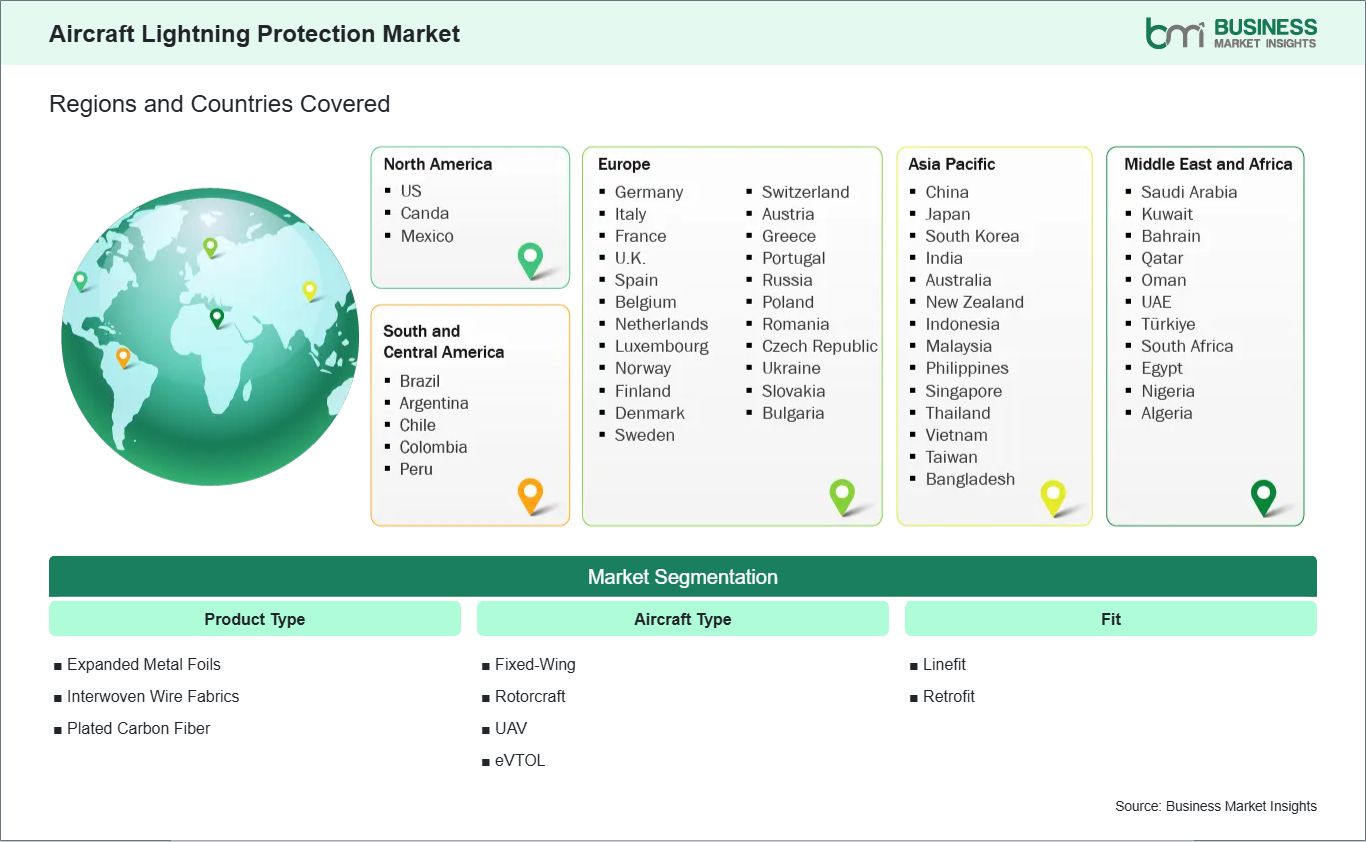
The Aircraft Lightning Protection Market is segmented based on product type, aircraft type, and fit. Growing use of composite structures and increasing aviation safety requirements are supporting demand across these segments.
By Product Type
- Expanded Metal Foils: Widely used in composite aircraft structures due to their effective conductivity and proven lightning protection performance.
- Interwoven Wire Fabrics: Provide structural flexibility and conductive pathways for dissipating lightning energy across aircraft surfaces.
- Plated Carbon Fiber: Offers lightweight protection capabilities while supporting the growing use of advanced composite materials.
By Aircraft Type
- Fixed-Wing: Represents a major application segment due to widespread deployment across commercial and military aviation.
- Rotorcraft: Requires specialized protection solutions because of unique operational and structural requirements.
- UAV: Adoption is increasing as unmanned aircraft become more common in commercial and defense applications.
- eVTOL: Emerging segment benefiting from investments in advanced air mobility and electric aviation technologies.
By Fit
- Linefit: Installed during aircraft manufacturing and integrated directly into aircraft structures.
- Retrofit: Driven by modernization programs and upgrades of existing aircraft fleets.
Market Forces
Aircraft Lightning Protection Market Drivers and Opportunities
Rising Adoption of Composite Aircraft Structures
The increasing use of composite materials in modern aircraft is a key factor supporting demand for aircraft lightning protection systems. Composite structures offer advantages such as reduced weight, improved fuel efficiency, and enhanced durability. However, unlike traditional metallic airframes, composite materials have lower electrical conductivity and require specialized lightning protection solutions to safely dissipate electrical energy from lightning strikes. Aircraft manufacturers are incorporating advanced conductive materials into airframes to ensure compliance with aviation safety standards. Regulatory authorities require extensive testing and certification of aircraft lightning protection systems to verify their effectiveness under operational conditions. This has encouraged continued investment in innovative protection technologies capable of supporting increasingly complex aircraft designs.
The growing production of commercial aircraft, military platforms, UAVs, and advanced air mobility vehicles is further increasing the need for reliable protection systems. As composite-intensive aircraft become more common, the demand for efficient, lightweight, and durable lightning protection solutions is expected to remain an important driver for the Aircraft Lightning Protection Market.
Advanced Air Mobility and Electric Aviation
The emergence of advanced air mobility platforms and electric aircraft is creating new opportunities for aircraft lightning protection technologies. These aircraft rely heavily on lightweight composite structures and advanced electrical systems, making effective lightning protection an essential design requirement. Manufacturers are increasingly seeking solutions that provide protection while minimizing additional weight and preserving aircraft performance. Research efforts are focused on developing multifunctional materials that combine structural reinforcement with electrical conductivity. These innovations can help reduce component complexity while improving aircraft efficiency. The growing adoption of eVTOL aircraft for urban air mobility applications is also creating demand for protection technologies specifically designed for next-generation aircraft architectures.
In addition, increasing investments in UAV technologies across commercial, industrial, and defense sectors are expanding the potential application base for lightning protection systems. Future opportunities are expected to arise from smart materials, integrated protection networks, and advanced manufacturing techniques that support safer and more efficient aircraft operations while meeting evolving regulatory requirements.
Size and Share Analysis
Aircraft Lightning Protection Market Size and Share Analysis
The Aircraft Lightning Protection Market is projected to grow from US$ 4.96 Billion in 2025 to US$ 8.51 Billion by 2033 , registering a CAGR of 6.98% from 2026 to 2033.
By product type, expanded metal foils account for a significant share due to their widespread use in composite aircraft structures and their proven ability to dissipate lightning strike energy effectively. Interwoven wire fabrics are gaining adoption because of their flexibility and compatibility with advanced aerospace materials, while plated carbon fiber is witnessing increasing demand as manufacturers seek lightweight protection solutions for modern aircraft designs.
By aircraft type, fixed-wing aircraft dominate the market owing to their extensive use across commercial and military aviation sectors. Rotorcraft continue to generate steady demand due to operational safety requirements, while UAV and eVTOL segments are expanding with the growing adoption of unmanned systems and advanced air mobility platforms. By fit, linefit installations account for a major share as protection systems are increasingly integrated during aircraft manufacturing, while retrofit demand is supported by fleet modernization and upgrade programs.
Report Coverage
Aircraft Lightning Protection Market Report Coverage and Deliverables
The "Aircraft Lightning Protection Size and Forecast (2022-2033)" report provides a detailed analysis of the market covering below areas:
- Aircraft Lightning Protection Market size and forecast at global, regional, and country levels for all the key market segments covered under the scope
- Aircraft Lightning Protection Market trends, as well as market dynamics such as drivers, restraints, and key opportunities
- Aircraft Lightning Protection Market analysis covering key market trends, global and regional framework, major players, regulations, and recent market developments
- Industry landscape and competition analysis covering market concentration, heat map analysis, prominent players, and recent developments for the market
- Detailed company profiles, including SWOT analysis
Geographic Insights
Aircraft Lightning Protection Market Geographic Insights
The Aircraft Lightning Protection Market shows diverse regional adoption patterns influenced by aircraft manufacturing activities, increasing use of composite materials, aviation safety requirements, and investments in advanced aerospace technologies.
North America represents a mature market with strong adoption of aircraft lightning protection solutions across commercial, military, and business aviation sectors. The region includes the United States and Canada, where aerospace manufacturers continue to develop advanced aircraft platforms incorporating lightweight composite structures. Strong regulatory frameworks and established aerospace infrastructure support the integration of certified lightning protection systems. Ongoing investments in next-generation aircraft, defense modernization programs, and advanced air mobility technologies are further contributing to market demand.
Asia Pacific is experiencing significant growth due to expanding aviation industries, increasing aircraft procurement activities, and investments in aerospace manufacturing capabilities. The region includes countries such as China, India, Japan, and South Korea, where governments and industry participants are strengthening domestic aerospace production. The growing number of commercial aircraft deliveries and increasing adoption of composite-intensive airframes are supporting demand for advanced lightning protection technologies. Expanding UAV development programs and growing interest in urban air mobility concepts are also contributing to market expansion across the region.
Both regions are contributing significantly to the growth of the Aircraft Lightning Protection Market through technological advancements, increasing aircraft production, aviation infrastructure development, and rising emphasis on aircraft safety and reliability.
Industry Activity
Recent Developments
The Aircraft Lightning Protection Market is analyzed using a mix of primary and secondary research sources, including corporate publications, industry associations, and verified databases. This approach ensures accurate tracking of innovation trends and strategic developments influencing the market.
- In July 2024, Toray Advanced Composites introduced developments in lightning strike protection technologies for aerospace composite structures. The company highlighted solutions designed to improve conductivity and protection performance while supporting lightweight aircraft manufacturing objectives. The development reflects continued innovation in composite-compatible lightning protection materials.
- In October 2023, Solvay SA announced a comprehensive composite materials supply partnership with electric aviation manufacturer BETA Technologies to support its advanced air mobility platforms. Under this collaboration, Solvay delivers optimized structural composites and specialized polymers designed to construct lightweight primary and secondary aircraft structures. These advanced materials are specifically engineered to provide integrated electromagnetic interference shielding and lightning strike protection for electric vertical takeoff and landing airframes.
Trust & Transparency
Research Methodology
The market analysis combines proprietary research with secondary data from government agencies, company disclosures, regulatory filings, industry databases and expert interviews. Market estimates are validated through data triangulation, cross-market benchmarking and analyst
review.
View Full Research Methodology
Key Sources Referred:
World Bank - Global Trade Indicators
World Trade Organization (WTO)
International Monetary Fund (IMF)
International Trade Administration (ITA)
Company Websites
Company Annual Reports
Company Investor Presentations