Market Summary
Executive Summary and Global Market Analysis
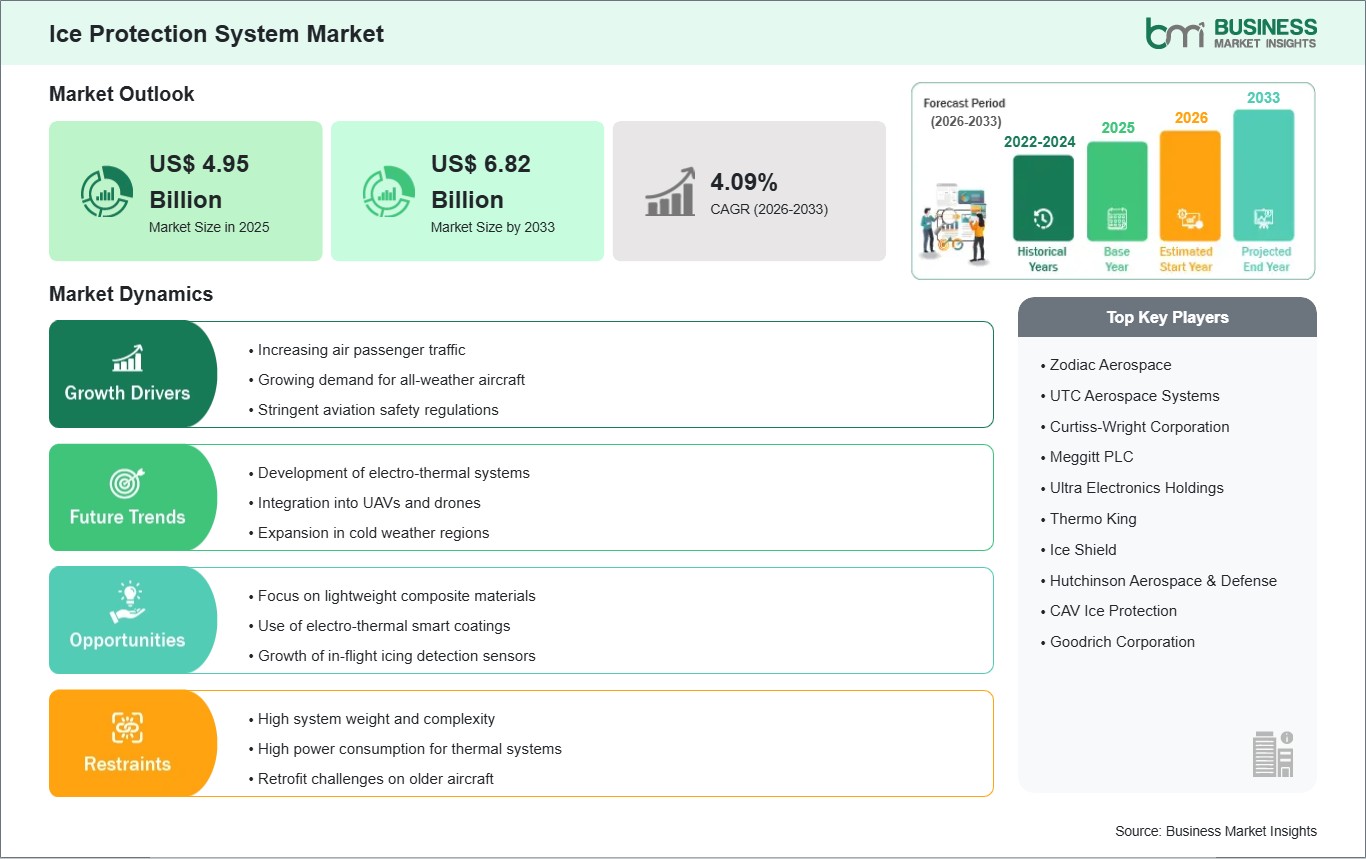
Ice Protection Systems refer to aircraft and industrial systems engineered to prevent ice formation on critical surfaces or remove ice once formed, ensuring safe operation in icing conditions. By utilizing technologies such as electro-thermal heating, pneumatic de-icing boots, and fluid-based anti-icing, these systems generate reliable ice protection for engine inlets, wings, propellers, windshields, and sensors. This technology is fundamental to the operational architecture of all-weather aviation, enabling safe flight operations in atmospheric icing conditions that would otherwise be hazardous. The integration of advanced sensors and monitoring systems has further improved the effectiveness of ice protection systems by providing real-time data on icing conditions, allowing pilots to activate systems only when necessary, thereby conserving energy and reducing operational costs.
However, several factors may restrain market progression. The high system weight and complexity associated with ice protection systems remain a primary concern for airframers seeking to maximize fuel efficiency and payload. The industry also faces persistent technical challenges regarding the high power consumption of electro-thermal systems, which can impact aircraft electrical system capacity. Additionally, the increasing use of composite materials, which exhibit poorer heat conductivity than metals, requires novel ice protection approaches and adds development complexity. The significant retrofit challenges and costs for integrating ice protection onto older aircraft, compounded by the volatility of raw material prices affecting capital investment decisions, increase the total cost of ownership and the complexity of fleet upgrades.
Despite these hurdles, the market outlook remains highly favorable as the sector transitions toward more-electric and intelligent ice protection architectures. Opportunities are emerging through the development of advanced materials such as graphene-based heating elements and nanotechnology coatings that enable ultra-thin, energy-efficient ice protection systems . The expansion of unmanned aircraft systems (UAS) and urban air mobility platforms is gaining significant traction, with ice protection systems being adapted for compact, lightweight applications in drone operations. Furthermore, the growth of wind energy installations in cold climates aligns with global goals for renewable energy expansion, creating new applications for blade ice protection systems. The adoption of hybrid ice protection systems, which combine electro-thermal heating with chemical coatings or mechanical methods, is playing a pivotal role in enhancing system redundancy and reliability for mission-critical operations. Collectively, these innovations position the Ice Protection System industry for sustained long-term development as a cornerstone of safe, efficient, and resilient aviation and industrial operations in extreme environments.
Segment Analysis
Ice Protection System Market Segmentation
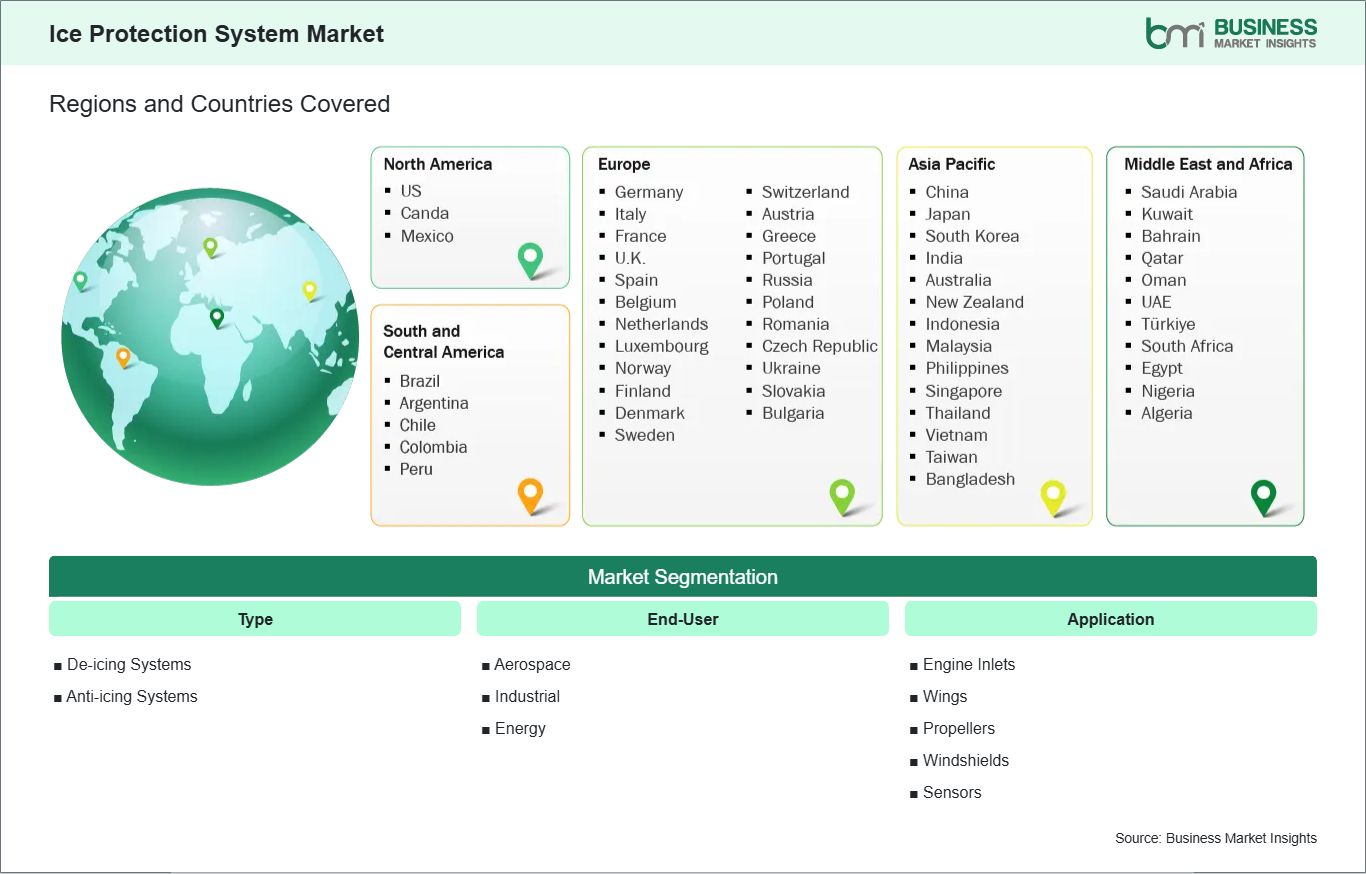
The Ice Protection System market is segmented based on type, end-user, and application, reflecting the growing demand for reliable ice mitigation solutions across aviation and industrial sectors.
By System Type
- De-icing Systems: Remove ice after formation using pneumatic boots, electro-thermal heaters, or mechanical methods; widely adopted in general aviation and regional aircraft where ice encounters are intermittent; valued for lower continuous power consumption compared to anti-icing systems
- Anti-icing Systems: Prevent ice formation proactively through continuous heating or fluid application; preferred for commercial aviation and critical flight surfaces where zero ice tolerance is required for safety and schedule reliability
By End-User
- Aerospace: Largest end-user segment encompassing commercial aviation, military aviation, general aviation, and rotary wing platforms; driven by stringent safety regulations, fleet expansion, and all-weather operational requirements
- Industrial: Includes manufacturing facilities, cold-storage warehouses, and infrastructure requiring ice prevention on critical equipment such as conveyors, ventilation systems, and outdoor machinery
- Energy: Fastest-growing segment driven by wind turbine blade ice protection, power transmission line de-icing, and solar panel snow removal applications; essential for maintaining energy output and preventing equipment damage in cold climates
By Application
- Engine Inlets: Ice protection for nacelles and inlet cowls; prevents ice ingestion that could damage fan blades or affect compressor performance; mission-critical for turbofan and turboprop aircraft
- Wings: Leading edge ice protection for lift-generating surfaces; most critical application for flight safety; includes slats, leading edges, and wing surfaces requiring continuous or on-demand protection
- Propellers: Ice protection for rotating surfaces on turboprop and piston aircraft; requires specialized designs to manage centrifugal forces while maintaining effective ice shedding
- Windshields: Electric heating to maintain pilot visibility; essential for safe operation in freezing precipitation and high-altitude icing conditions
- Sensors: Ice protection for air data probes including pitot tubes, angle-of-attack vanes, temperature sensors, and externally mounted avionics; critical for accurate flight instrument readings and automated flight control systems
Market Forces
Ice Protection System Market Drivers and Opportunities
Rising Air Passenger Traffic and All-Weather Aircraft Demand
The ice protection system market is being driven by the growing global demand for air travel and the corresponding need for all-weather operational capability across commercial and military aviation fleets. Unlike aircraft without ice protection, equipped aircraft can safely operate in known icing conditions, enabling reliable schedule adherence and expanding route networks into colder geographies. Rising adoption of ice protection systems on next-generation aircraft is amplifying demand, as OEMs increasingly integrate electro-thermal and hybrid systems that offer weight savings and reduced maintenance compared to legacy pneumatic boots. Stringent aviation safety regulations from authorities such as the Federal Aviation Administration (FAA) and European Union Aviation Safety Agency (EASA) are reinforcing the importance of certified ice protection systems for flight into known icing conditions. Additionally, the expansion of regional aviation in northern latitudes and the growth of air cargo operations through cold-climate hubs are fueling demand. The increasing utilization of business jets and turboprops for high-frequency operations in winter conditions further propels adoption. Collectively, air traffic growth and regulatory compliance are fueling sustained expansion in the global ice protection system market.
Rising Integration of Smart Sensors, Electrification, and Energy Sector Applications
Opportunities in the ice protection system market are expanding through the integration of smart ice detection sensors, more-electric aircraft architectures, and emerging energy sector applications. AI-enabled ice detection and predictive activation systems are opening lucrative opportunities by delivering real-time icing condition monitoring, automated system engagement, and prognostic maintenance alerts. The growing emphasis on more-electric and all-electric aircraft is fueling demand for electro-thermal ice protection systems that eliminate bleed air extraction, improving overall aircraft fuel efficiency and reducing emissions. In the renewable energy sector, ice protection systems for wind turbine blades are increasingly deployed to maintain energy output during winter months, reducing downtime and preventing ice throw hazards. The expansion of wind energy installations in cold climates, particularly in Northern Europe, North America, and China, is creating sustained demand for industrial ice protection solutions. Additionally, the aftermarket for retrofitting older aircraft with modern ice protection systems is creating significant opportunities, particularly for general aviation and regional turboprop fleets. Vendors who focus on lightweight, energy-efficient, and smart ice protection solutions across aerospace, industrial, and energy end-user segments are well-positioned to capture growth. The convergence of aircraft electrification, renewable energy expansion, and climate adaptation underscores a transformative trajectory for the global ice protection system market.
Size and Share Analysis
Ice Protection System Market Size and Share Analysis
The Ice Protection System Market is projected to grow from US$ 4.95 Billion in 2025 to US$ 6.82 Billion by 2033 , registering a CAGR of 4.09% from 2026 to 2033.
By type, anti-icing systems hold a larger market share compared to de-icing systems, reflecting a preference for proactive ice prevention in commercial aviation where zero ice tolerance is required for safety and schedule reliability. De-icing systems remain significant in general aviation and regional applications where ice encounters are less frequent and system weight is a key consideration. The anti-icing segment is expected to witness faster growth due to increasing adoption in next-generation commercial a ircraft platforms.
By end-user, the aerospace segment dominates the market, accounting for the largest share driven by the large installed base of commercial and military aircraft, continuous fleet expansion, and the safety-critical nature of ice protection for passenger operations. The energy segment is projected to register the fastest growth over the forecast period, fueled by the global expansion of wind energy capacity in cold climates and increasing recognition of ice-induced production losses. Industrial applications contribute steadily, with demand from manufacturing facilities and cold-climate infrastructure.
By application, wing ice protection accounts for the largest market share as maintaining lift-generating surface integrity is paramount for flight safety across all aircraft types. Engine inlet protection follows closely, driven by the catastrophic consequences of ice ingestion on engine performance and safety. Propeller ice protection maintains a steady share in regional aviation and turboprop platforms. Windshield ice protection is essential for pilot visibility across all aircraft categories and represents a consistent replacement market. Sensor ice protection is a growing segment as modern flight control systems rely on accurate air data for safe operation, and ice-induced sensor errors remain a significant safety concern.
Report Coverage
Ice Protection System Market Report Coverage and Deliverables
The "Ice Protection System Market Size and Forecast (2022–2033)" report provides a detailed analysis of the market covering below areas:
- Ice Protection System Market size and forecast at global, regional, and country levels for all market segments covered under the scope
- Ice Protection System Market trends, as well as drivers, restraints, and opportunities
- Ice Protection System Market analysis covering key trends, global and regional framework, major players, regulations, and recent developments
- Industry landscape and competition analysis covering market concentration, heat map analysis, prominent players, and recent developments
- Detailed company profiles, including SWOT analysis
Geographic Insights
Ice Protection System Market Geographic Insights
The Ice Protection System Market shows diverse regional adoption patterns influenced by aviation activity levels, climate conditions, regulatory frameworks, defense spending, and renewable energy deployment.
North America maintains a dominant market position driven by the presence of major aerospace manufacturers (Boeing, Bombardier), a large commercial and general aviation fleet, and significant defense spending on military aircraft with all-weather capability requirements. The region comprises the United States and Canada, where investments are being made in more-electric aircraft technologies, smart ice detection systems, and advanced electro-thermal ice protection solutions. The region focuses on enhancing ice protection efficiency and reducing system weight through advanced materials and integration with aircraft thermal management systems. It has well-established OEM, aftermarket, and MRO sectors, allowing for widespread adoption across aerospace end-users. The expansion of wind energy capacity in cold-climate regions of the US and Canada is also contributing to energy segment growth.
Europe demonstrates strong growth potential driven by stringent environmental regulations, ambitious carbon reduction targets, and the presence of major OEMs including Airbus, Leonardo, and Dassault. The region focuses on decarbonization initiatives, with more-electric aircraft architectures driving adoption of bleed-air-free electro-thermal ice protection systems. Countries such as Germany, France, the United Kingdom, and Italy lead in research and development for smart ice detection and composite-compatible ice protection technologies. The expansion of cross-border aviation connectivity in Nordic countries with severe winter conditions, coupled with significant wind energy installations in cold climates across Scandinavia and the North Sea, is also contributing to market growth across aerospace and energy end-user segments.
Report Guidance
Ice Protection System Market Report Guidance
The report includes qualitative and quantitative data for the Ice Protection System market across type, end-user, application, and geography.
- The report starts with the key takeaways (chapter 2), highlighting the key trends and outlook of the Ice Protection System market.
- Chapter 3 focuses on the research methodology of the study.
- Chapter 4 includes ecosystem analysis.
- Chapter 5 highlights the major industry dynamics in the Ice Protection System market, including factors that are driving the market, prevailing deterrents, potential opportunities, as well as future trends. Impact analysis of these drivers and restraints is also covered in this section.
- Chapter 6 discusses the Ice Protection System market scenario, in terms of historical market revenues, and forecast till the year 2033.
- Chapters 7 to 10 cover Ice Protection System market segments by type, end-user, application, and geography across North America, Europe, Asia Pacific, Middle East and Africa, and South and Central America. They cover the market revenue, forecast, and factors driving the market.
- Chapter 11 describes the competitive analysis along with the heat map analysis for the key players operating in the market.
- Chapter 12 describes the industry landscape analysis. It provides detailed descriptions of business activities such as market initiatives, new developments, mergers, and joint ventures globally, along with a competitive landscape.
- Chapter 13 provides detailed profiles of the major companies operating in the Ice Protection System market. Companies have been profiled on the basis of their key facts, business descriptions, products and services, financial overview, SWOT analysis, and key developments.
- Chapter 14, i.e., the appendix, is inclusive of a brief overview of the company, list of abbreviations, and disclaimer.
Industry Activity
Recent Developments
The Ice Protection System Market is evaluated by gathering qualitative and quantitative data post primary and secondary research, which includes important corporate publications, association data, and databases. A few of the key developments in the Ice Protection System Market are:
- In May 2026, A new aircraft sensor system that can detect dangerous ice build-up in real time while continuing to provide critical flight data is being developed by University of Surrey start-up Surrey Sensors Limited in collaboration with Canada-based Flight Test Centre of Excellence dba Certification Center Canada. Backed by funding from Innovate UK and the National Research Council of Canada, the project aims to deliver next-generation air data probe systems for aviation. These small devices sit on aircraft and measure the speed and direction of the airflow – both essential for safe flight – and can continue working reliably even in extreme conditions.
- In March 2026, llins Aerospace, an RTX (NYSE: RTX) business, announces the successful completion of the HECATE project, part of the European Union's Clean Aviation Joint Undertaking with support from UK Research and Innovation. This initiative achieved Technology Readiness Level 5, or TRL5, successfully proving the electrical architecture design for future hybrid-electric aircraft performance in real-world conditions.
Trust & Transparency
Research Methodology
The market analysis combines proprietary research with secondary data from government agencies, company disclosures, regulatory filings, industry databases and expert interviews. Market estimates are validated through data triangulation, cross-market benchmarking and analyst
review.
View Full Research Methodology
Key Sources Referred:
International Air Transport Association (IATA)
Federal Aviation Administration (FAA)
Company Annual Reports and Investor Presentations
Company Websites and Product Catalogs
European Union Aviation Safety Agency (EASA)
Global Wind Energy Council (GWEC)
Society of Automotive Engineers (SAE)