
Hyperscale Cloud Market Outlook: Size, Share, Trends, Growth Analysis, Competitive Landscape & Forecast, 2026-2033

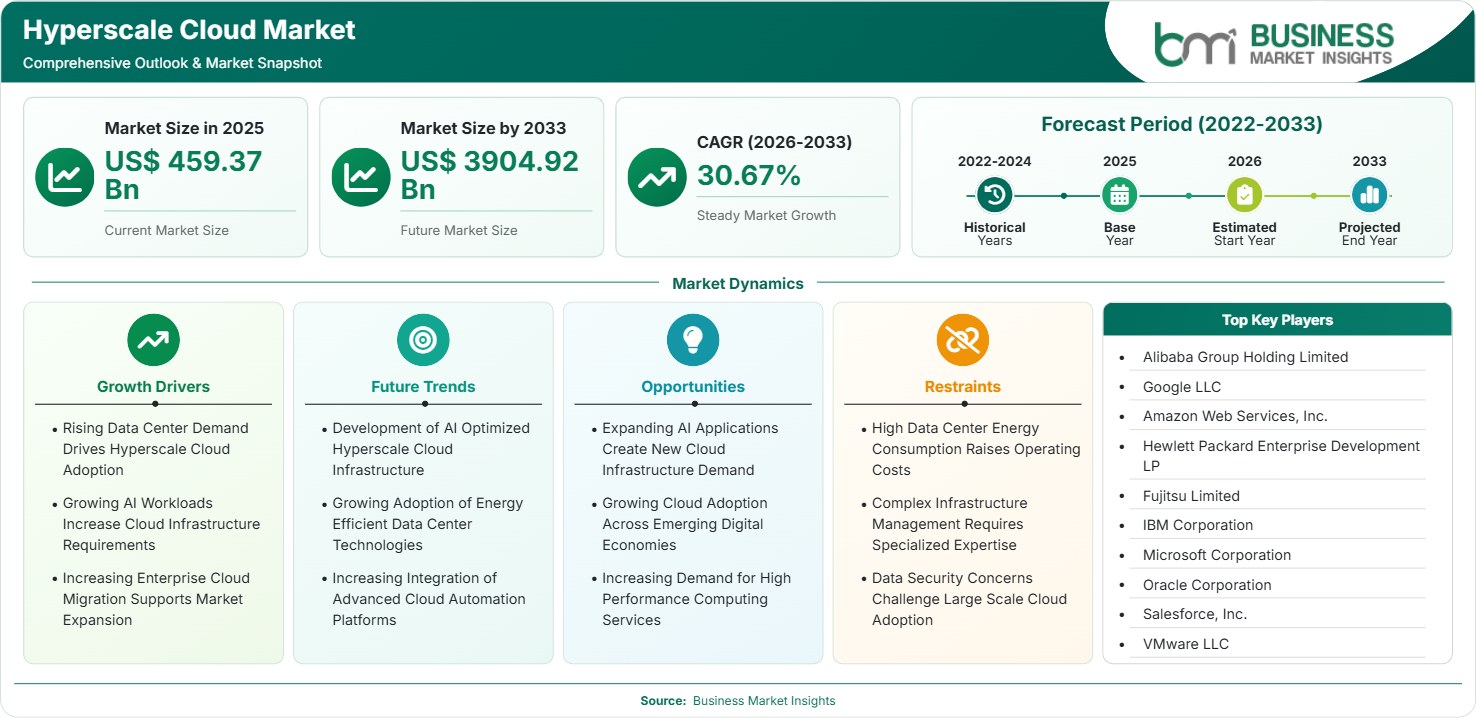
The Hyperscale Cloud Market size was valued at US$ 459.37 Billion in 2025 and is projected to reach US$ 3904.92 Billion by 2033, growing at a CAGR of 30.67% during 2026–2033. Rising AI workload deployment, enterprise cloud migration, hyperscale data center investments, sovereign cloud requirements, and growing demand for scalable computing infrastructure continue creating substantial expansion opportunities globally.

Report Coverage
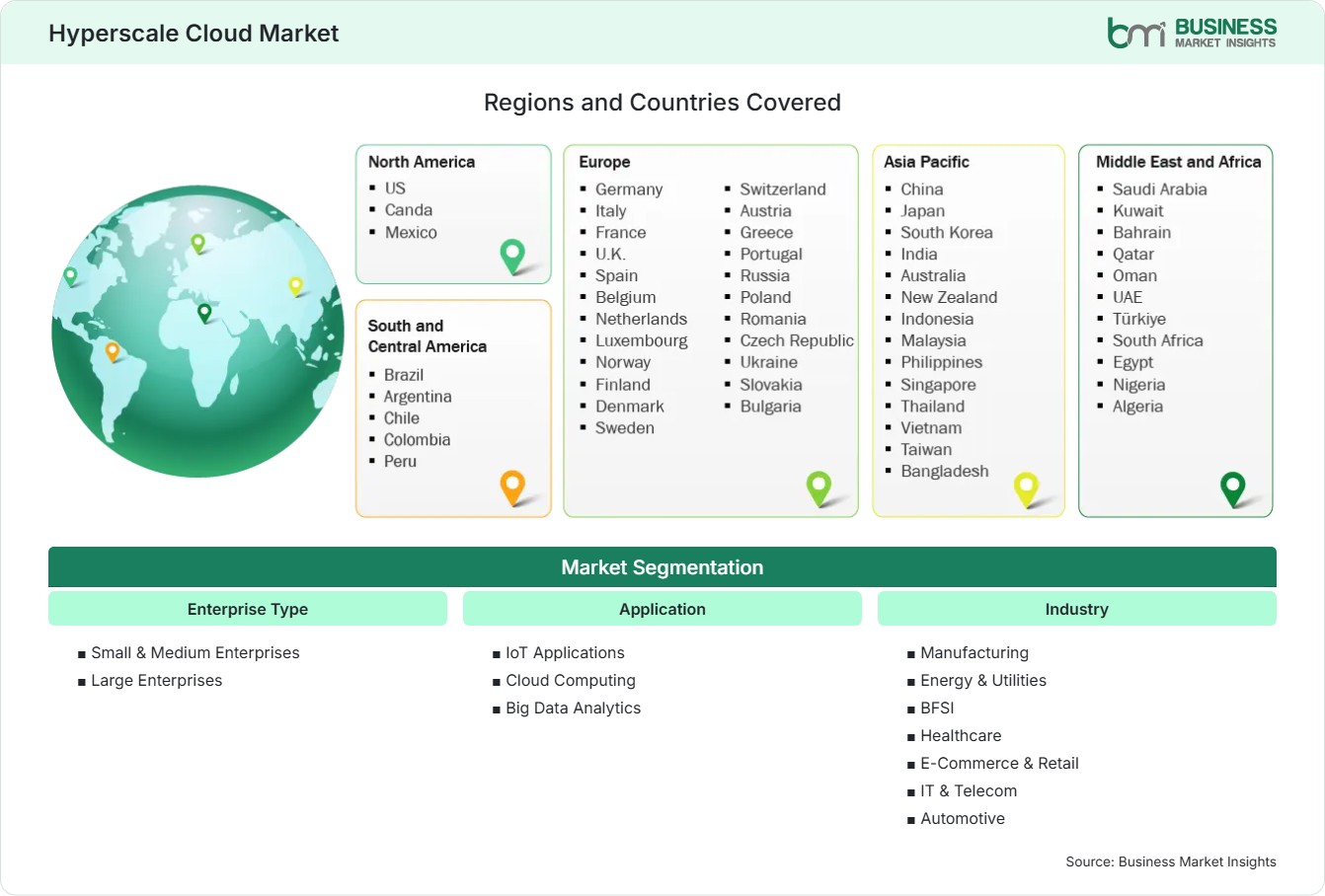
  • Enterprise Type: Small & Medium Enterprises, Large Enterprises
  • Application: IoT Applications, Cloud Computing, Big Data Analytics
  • Industry: Manufacturing, Energy & Utilities, BFSI, Healthcare, E-Commerce & Retail, IT & Telecom, Automotive
US$ 459.37 Bn Market size in 2025
US$ 3904.92 Bn Market Size by 2033
30.67% CAGR, 2026 - 2033
2026-2033 Forecast Period

01 AI Overview

Hyperscale Cloud Market Summary

  • North America Region: North America holds a market share of 44%–47% in 2025, growing at a CAGR of 29%–31% during 2026–2033. Strong hyperscale infrastructure deployment, AI training demand, enterprise digital transformation, cloud-native modernization initiatives, and sustained investments from leading providers support long-term expansion opportunities across industries and government sectors. The U.S. remains the regional growth engine, supported by extensive hyperscale capacity expansion and AI-focused cloud investments, registering a CAGR of 29%–31%.
  • Fastest Growing Region: Asia Pacific accounts for 24%–27% share in 2025 and is projected to grow at a CAGR of 33%–36% during 2026–2033. Accelerating enterprise digitization, growing AI adoption, expanding cloud regions, supportive government programs, and increasing internet-driven workloads create substantial infrastructure scaling opportunities throughout emerging economies.
  • Leading Segment: Large Enterprises represent 67%–70% share in 2025 and are expected to expand at a CAGR of 29%–31% during 2026–2033. Large-scale application modernization, advanced analytics deployment, global workforce digitization, and mission-critical workload migration continue driving sustained demand for high-capacity cloud environments worldwide.
  • High Growth Segment: Big Data Analytics captures 26%–29% share in 2025 and is forecast to grow at a CAGR of 34%–37% during 2026–2033. Increasing data generation, AI model training requirements, predictive intelligence initiatives, and real-time analytics adoption support strong demand for scalable cloud computing resources.
  • Key Market Opportunity: Expansion of AI-ready cloud infrastructure enables providers to monetize advanced computing services, sovereign cloud offerings, industry-specific platforms, and GPU-intensive workloads while supporting enterprise modernization and digital transformation objectives globally.
  • Major Market Players: Alibaba Group Holding Limited, Google LLC, Amazon Web Services, Inc., Hewlett Packard Enterprise Development LP, Fujitsu Limited, IBM Corporation, Microsoft Corporation, Oracle Corporation, Salesforce, Inc., and VMware LLC.
02 Strategic Insights

Hyperscale Cloud Market: Strategic Insights

Hyperscale Cloud Market Strategic Framework
FREE PDF
Request your free sample
Request free sample
03 Stakeholder View

Key Takeaways

  • The industry ecosystem is increasingly centered on hyperscale providers, semiconductor vendors, colocation operators, network equipment suppliers, and renewable energy developers, creating a tightly integrated digital infrastructure value chain.
  • Big data analytics workloads and industry-specific cloud deployments present the highest upside, particularly across BFSI, healthcare, retail, and telecommunications sectors where large-scale data processing requirements continue increasing.
  • Innovation is shifting toward AI-native cloud architectures, GPU-as-a-service models, liquid-cooled infrastructure, cloud-based machine learning platforms, and optimized high-performance computing environments.
  • Asia Pacific offers one of the strongest investment cases due to accelerating cloud adoption, increasing enterprise digitization, expanding internet penetration, and significant government support for digital infrastructure development.
  • Strategic partnerships, cloud platform acquisitions, sovereign cloud alliances, and AI infrastructure funding continue accelerating as providers seek differentiated capabilities and geographic expansion opportunities.
  • Power availability and sustainable infrastructure deployment are becoming major competitive differentiators, influencing future site selection, investment priorities, and long-term capacity planning.
04 Geographic Outlook

Hyperscale Cloud Market Regional Highlights

North America Hyperscale Cloud Market

North America accounted for approximately 44%–47% of global revenue in 2025 and is projected to grow at a CAGR of 29%–31% through 2033. The region benefits from mature cloud ecosystems, extensive hyperscale data center capacity, strong enterprise technology spending, and early AI adoption. The Hyperscale Cloud Market share remains highest within this region.

  • AI model training demand is accelerating deployment of advanced GPU infrastructure, prompting cloud providers to expand data center capacity and improve computing density for enterprise and public-sector applications.
  • Large enterprises continue migrating mission-critical workloads to cloud environments, supporting long-term infrastructure investments and strengthening regional demand for scalable computing resources.
  • Expansion of cloud-native software development increases demand for elastic storage, advanced networking, and integrated analytics services across technology-intensive industries.
  • Sustainability initiatives encourage investments in renewable-powered facilities and energy-efficient data center designs to support long-term operational scalability.

US Hyperscale Cloud Market

The United States represented approximately 79%–83% of North American revenue in 2025 and is expected to expand at a CAGR of 29%–31% through 2033. The country hosts the largest concentration of hyperscale cloud campuses globally and remains a leading destination for AI infrastructure spending.

  • Large-scale investments in AI infrastructure are increasing cloud capacity and creating demand for advanced networking, storage, and accelerated computing platforms.
  • Federal digital modernization initiatives and cybersecurity requirements encourage greater cloud deployment across government agencies and regulated sectors.
  • Enterprise adoption of multicloud architectures strengthens demand for interoperability solutions and advanced cloud management capabilities.
  • Continuous expansion of hyperscale campuses supports emerging workloads related to generative AI, analytics, and digital services.

Europe Hyperscale Cloud Market

Europe accounted for 23%–26% of global revenue in 2025 and is forecast to expand at a CAGR of 28%–30% during 2026–2033. Germany leads regional deployment activity, while Spain and Poland are emerging as higher-growth markets with CAGR ranges of 31%–33%.

  • Demand for sovereign cloud solutions is increasing among government agencies and regulated industries requiring enhanced data governance.
  • Growing adoption of AI and advanced analytics accelerates investments in scalable cloud infrastructure across manufacturing and financial services sectors.
  • Expansion of regional cloud zones improves latency performance and supports compliance with European data regulations.
  • Renewable energy integration is becoming a strategic priority for cloud operators expanding data center capacity.
  • Cross-border digital transformation initiatives continue supporting cloud adoption among medium and large enterprises.

Asia Pacific Hyperscale Cloud Market

Asia Pacific represented 24%–27% of global revenue in 2025 and is projected to record the fastest CAGR of 33%–36% through 2033. China remains the largest regional market, while India demonstrates the strongest growth momentum with CAGR ranging between 36%–39%.

  • Rapid digital transformation among enterprises creates substantial demand for cloud-native platforms and scalable computing resources.
  • AI adoption across manufacturing, retail, financial services, and telecommunications supports investments in advanced cloud infrastructure.
  • Government initiatives encouraging digital economies and domestic cloud ecosystems strengthen long-term market expansion.
  • Increasing internet penetration and e-commerce activity continue generating high-volume data workloads requiring hyperscale architectures.
  • Regional providers and global hyperscalers are expanding cloud regions to improve service availability and regulatory compliance.

Rest of World Hyperscale Cloud Market

The Rest of World region accounted for approximately 7%–9% of global revenue in 2025 and is expected to expand at a CAGR of 30%–33% through 2033. South & Central America benefits from increasing enterprise digitization and growing cloud adoption among financial institutions and retailers. Brazil remains the leading market, while Chile exhibits higher growth potential with CAGR of 33%–35%.

  • National digital transformation programs are encouraging investments in cloud infrastructure and localized data hosting capabilities.
  • Growing demand for digital banking, e-commerce, and government cloud services supports long-term infrastructure expansion.
  • New hyperscale facilities are emerging in Gulf countries to support regional cloud demand and AI initiatives.
  • Improved connectivity and data center investments are strengthening enterprise cloud adoption across developing economies.
  • Increasing partnerships between global providers and regional technology firms accelerate cloud ecosystem development.
Global Market Geography
FREE PDF
Request your free sample
Request free sample
05 Segment Analysis

Hyperscale Cloud Market Segmentation

Enterprise Type

Enterprise Type accounted for a critical portion of revenue generation, with Large Enterprises representing approximately 67%–70% market share in 2025 and growing at 29%–31% CAGR through 2033. The Hyperscale Cloud Market scope within this segment is expanding as organizations modernize IT environments, deploy AI workloads, and adopt multicloud strategies.

  • Small & Medium Enterprises: SMEs increasingly leverage cloud-based infrastructure to access enterprise-grade computing resources, improve operational flexibility, reduce capital expenditure requirements, and accelerate digital transformation initiatives across diverse business functions.
  • Large Enterprises: Large organizations continue driving demand through large-scale application migration, AI deployment, global collaboration platforms, and advanced data analytics initiatives requiring highly scalable cloud environments.

Application

Application-based demand reflects evolving enterprise technology priorities. Cloud Computing remains the leading segment with approximately 38%–41% share in 2025, while Big Data Analytics represents the highest-growth category with a 34%–37% CAGR. Increasing digitalization, AI adoption, and enterprise data generation are influencing Hyperscale Cloud Market trends across workload deployment strategies and infrastructure investment decisions.

  • IoT Applications: Growing deployment of connected devices generates massive data volumes requiring scalable cloud platforms for real-time processing, monitoring, analytics, and operational intelligence capabilities.
  • Cloud Computing: Enterprises continue migrating workloads to cloud environments to improve scalability, optimize costs, enhance operational agility, and support distributed workforce requirements.
  • Big Data Analytics: Organizations increasingly utilize cloud infrastructure for large-scale data processing, predictive modeling, machine learning, and real-time decision support applications.

Industry

Industry-based adoption patterns are shaped by workload intensity, regulatory requirements, data processing needs, and digital transformation maturity. The BFSI segment accounted for approximately 20%–23% share in 2025, supported by large-scale cloud migration and analytics deployment, while Healthcare is among the faster-growing industries with a CAGR of 32%–35% through 2033.

  • Manufacturing: Smart factory initiatives, industrial IoT deployments, predictive maintenance programs, and digital supply chain management are increasing demand for scalable cloud environments.
  • Energy & Utilities: Grid modernization, renewable energy integration, asset monitoring, and predictive analytics applications require flexible cloud infrastructure and advanced data processing capabilities.
  • BFSI: Financial institutions increasingly rely on cloud platforms for fraud detection, digital banking, risk analytics, customer engagement, and regulatory reporting functions.
  • Healthcare: Electronic health records, medical imaging, genomics research, telehealth services, and AI-enabled diagnostics are driving cloud infrastructure investments.
  • E-Commerce & Retail: Personalized customer experiences, inventory optimization, omnichannel operations, and recommendation engines generate substantial cloud workload requirements.
  • IT & Telecom: Telecommunications operators and technology firms depend on hyperscale environments to support 5G deployment, software development, and digital service delivery.
  • Automotive: Connected vehicles, autonomous driving research, engineering simulations, and mobility platforms are increasing cloud computing demand across automotive ecosystems.
06 Market Forces

Hyperscale Cloud Market Dynamics

Key Market Drivers

Acceleration of AI and Generative AI Infrastructure Demand

The fast commercialization of AI is driving changes in the infrastructure needs of various industries. In line with industry announcements made by leading hyperscale players, AI workloads have emerged among the fastest-growing types of cloud consumption. Organizations today need GPU-based computing systems to build, deploy, and enhance large language models and ML applications. International Data Corporation expects continued growth of global AI investments to be robust throughout the decade. It would lead to a demand for scalable cloud platforms. Leading hyperscalers are making huge investments in advanced processors, networking, and dense data center facilities. This development drives the Hyperscale Cloud Market growth since organizations can enjoy flexible computing resources without having to invest in building infrastructure.

Enterprise Migration Toward Cloud-Native Architectures

Companies are still working towards enhancing their legacy IT environment through improved scalability, security, and agility. The trend towards developing cloud native architecture, containerized apps, and microservices architecture is growing as a standard part of digital transformation projects. Enterprises prefer consumption-based models where they can easily scale while minimizing complexities in infrastructure management. Modern cloud solutions also enable organizations to incorporate analytics, automation, and cybersecurity in their systems. In light of efforts by organizations towards digital resilience and speed in software release cycles, there is a steady rise in demand for hyperscale computing infrastructure. This is one of the major Hyperscale Cloud Market Trends impacting investments in developed and emerging economies.

Expansion of Data-Intensive Applications Across Industries

The growth of data is still continuing to rise because of the connectivity of devices, streaming media, digital trade, automation in industries, and analytics in organizations. Industry predictions show that the amount of data produced will more than double within the next ten years. Companies need platforms that can process, store, and analyze huge amounts of data in a real-time fashion. Hyperscale cloud infrastructures have the computational power that is needed for performing advanced analytics, machine learning, digital twins, and operational intelligence. Various industries such as manufacturing, health care, telecom, and financial services now depend on cloud platforms for getting value out of their increased data.

Key Market Opportunities

Emergence of Sovereign and Industry-Specific Cloud Platforms

Increasingly, governments and regulated sectors are recognizing the importance of data residency, cybersecurity, and compliance. This is driving a need for sovereign cloud environments built specifically for regional regulations. Financial services companies, healthcare organizations, governmental institutions, and critical infrastructure operators want their cloud capabilities to be localized but still have the benefits of scalability and innovation. The hyperscale operators are meeting these needs by forming partnerships with regional players and building custom clouds. The opportunity does not end at infrastructure; it includes security services, governance platforms, and applications for specific industries. As regulations change in Europe, the Asia Pacific, and the Middle East, there is likely to be a significant rise in the demand for sovereign cloud deployments. Long-term Hyperscale Cloud Market Forecasts indicate that sovereign cloud solutions will become an increasingly important revenue stream for major providers.

AI-as-a-Service and Advanced Analytics Monetization

Organizations are looking to gain access to sophisticated AI capabilities without having to build their own infrastructure. This provides hyperscale companies with avenues to monetize AI development platforms, machine learning solutions, inference engines, and sector-specific analytic offerings. Cloud-based AI solutions offer companies a way to innovate fast and at an affordable cost. The demand will be rising in areas such as customer service automation, predictive maintenance, fraud detection, medical diagnosis, and software development. Companies that can provide customers with the ability to use AI within cloud computing environments will be able to realize more valuable recurring revenue streams. The continued growth in generative AI usage and intelligent automation will open up major market opportunities.

Growth of Edge Computing and Distributed Cloud Models

The rise in the use of connected devices, autonomous systems, and real-time applications is leading to a greater need for computing environments with lower latency. Edge computing offers a complement to the hyperscale approach by using distributed data processing near users with centralized cloud-based analysis and orchestration. Service providers, manufacturers, logistics companies, and smart cities are among the organizations that will increasingly require a distributed computing architecture. The hyperscale cloud providers are now providing regional cloud zones, edge computing, and management systems to cater to such needs. The combination of 5G technology and edge computing will open up even more scope for the growth of cloud services.

Market Restraints and Challenges

Power Availability Constraints and Infrastructure Costs

Factor: Expansion of data centers to hyperscale dimensions involves significant requirements for power generation, availability of land, cooling needs, and network connections. Several important target markets face challenges with respect to power and permit requirements. Impact: Infrastructural roadblocks may cause delays in capacity augmentation, result in increased operating costs, and hinder services' availability. According to industry reports, there is a trend of rising energy consumption linked to massive AI processing, which causes providers to allocate substantial funds into improving their efficiency and acquiring renewable energy sources. This may restrict the deployment of AI in high-demand regions and cause geographic mismatches regarding the availability of infrastructural resources.

Cybersecurity Risks and Regulatory Complexity

Factor: Multi-jurisdictional organizations have to adhere to changes in cybersecurity regulations, privacy laws, and data localization laws. Fragmentation of regulations makes it difficult for cloud service providers that serve multinational corporations. Impact: Compliance costs, governance requirements, and security investments can increase operational burdens for both providers and customers. Failure to meet regional standards may restrict market access or delay service deployment. The growing sophistication of cyber threats further necessitates continuous investment in threat detection, encryption, identity management, and resilience capabilities. These challenges require substantial financial and technical resources, particularly as enterprises migrate increasingly sensitive workloads to cloud environments. Managing regulatory diversity while maintaining operational efficiency remains a persistent challenge across the industry.

07 Company Analysis

Competitive Landscape

The competitive environment remains highly concentrated among global cloud leaders investing aggressively in infrastructure expansion, AI capabilities, and digital ecosystem development. Current Hyperscale Cloud Market analysis indicates that providers are differentiating through AI integration, sovereign cloud offerings, sustainability initiatives, and industry-specific solutions.

Company Name

Overview

Products and Services relevant to this market

Alibaba Group Holding Limited

Major Asia-based cloud provider with extensive regional infrastructure and enterprise digital transformation capabilities.

Elastic computing, cloud storage, AI platforms, database services, networking, cybersecurity, and industry cloud solutions.

Google LLC

Global technology company expanding cloud infrastructure and AI-driven cloud services worldwide.

Google Cloud Platform, AI services, analytics tools, Kubernetes solutions, data management, and cybersecurity services.

Amazon Web Services, Inc.

Largest hyperscale cloud provider with broad global infrastructure and service portfolio.

Compute services, storage platforms, AI tools, analytics, networking, databases, and serverless computing solutions.

Hewlett Packard Enterprise Development LP

Enterprise infrastructure specialist supporting hybrid cloud and digital transformation initiatives.

Hybrid cloud platforms, edge computing, storage systems, networking solutions, and cloud management services.

Fujitsu Limited

Technology provider offering cloud-enabled digital transformation and enterprise modernization solutions.

Cloud infrastructure services, managed services, analytics platforms, cybersecurity, and industry-focused digital solutions.

IBM Corporation

Global enterprise technology company emphasizing hybrid cloud and AI integration.

Hybrid cloud environments, AI platforms, consulting services, automation tools, and cloud security solutions.

Microsoft Corporation

Leading hyperscale provider with broad enterprise adoption and global cloud presence.

Microsoft Azure, AI services, analytics, cloud security, application development, and infrastructure management tools.

Oracle Corporation

Enterprise software and cloud provider focused on mission-critical workloads and databases.

Oracle Cloud Infrastructure, database services, analytics, enterprise applications, and cloud security offerings.

Salesforce, Inc.

Cloud software leader providing customer-centric enterprise applications and platform services.

CRM platforms, analytics solutions, AI-powered business applications, workflow automation, and cloud integration tools.

VMware LLC

Virtualization and multicloud technology provider supporting enterprise cloud transformation.

Multicloud management, virtualization software, cloud migration solutions, networking, and infrastructure optimization services.

10 Trust & Transparency

Research Methodology

The market analysis combines proprietary research with secondary data from government agencies, company disclosures, regulatory filings, industry databases and expert interviews. Market estimates are validated through data triangulation, cross-market benchmarking and analyst review.

View Full Research Methodology

11 Questions Answered

Frequently Asked Questions

Why are sovereign cloud initiatives becoming important?

Governments and regulated industries increasingly require local data control, cybersecurity compliance, and regulatory alignment. Sovereign cloud solutions address these needs while providing access to advanced cloud capabilities and scalable infrastructure.

What does a Hyperscale Cloud Market Report typically evaluate?

A comprehensive study evaluates industry size, technology developments, competitive positioning, regional opportunities, investment trends, regulatory influences, segment performance, adoption patterns, and long-term strategic growth prospects.

How does artificial intelligence influence cloud infrastructure investments?

AI workloads require substantial computing power, advanced networking, and scalable storage. This drives investment in GPU clusters, optimized data centers, AI platforms, and high-performance cloud environments capable of supporting model training and inference.

What differentiates hyperscale cloud infrastructure from conventional cloud environments?

Hyperscale environments are designed for massive scalability, automated resource management, high-density computing, and global deployment capabilities. They support significantly larger workloads while maintaining operational efficiency and service reliability.

What industries are adopting hyperscale cloud platforms most rapidly?

Healthcare, BFSI, telecommunications, e-commerce, manufacturing, and technology sectors are among the fastest adopters due to rising demand for analytics, AI, digital services, and scalable infrastructure supporting large-scale operational workloads.

Access the Full Hyperscale Cloud Market Report

Get segment-level forecasts, regional estimates, competitive benchmarking, company profiles and downloadable Excel datasets.

Access the full Hyperscale Cloud Market Report
350 pages PDF & Excel | 2026-08-26