
Hydrocarbon Market Size, Share, Trends & Forecast Report, 2026–2033

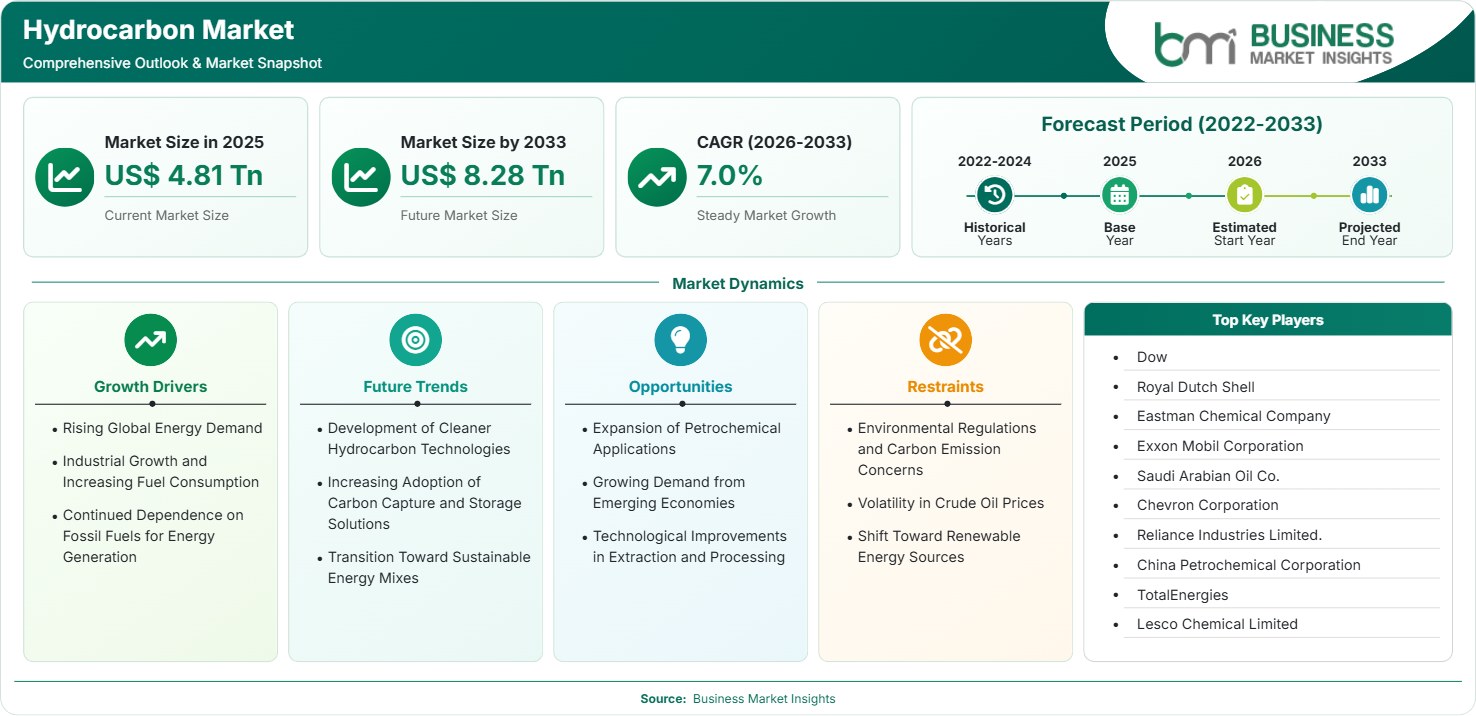
The Hydrocarbon Market size was valued at US$ 4.81 Trillion in 2025 and is projected to reach US$ 8.28 Trillion by 2033, growing at a CAGR of US$ 7.0% during 2026–2033, driven by rising energy consumption, petrochemical expansion, industrial demand, and technological advancements in extraction and processing.

Report Coverage
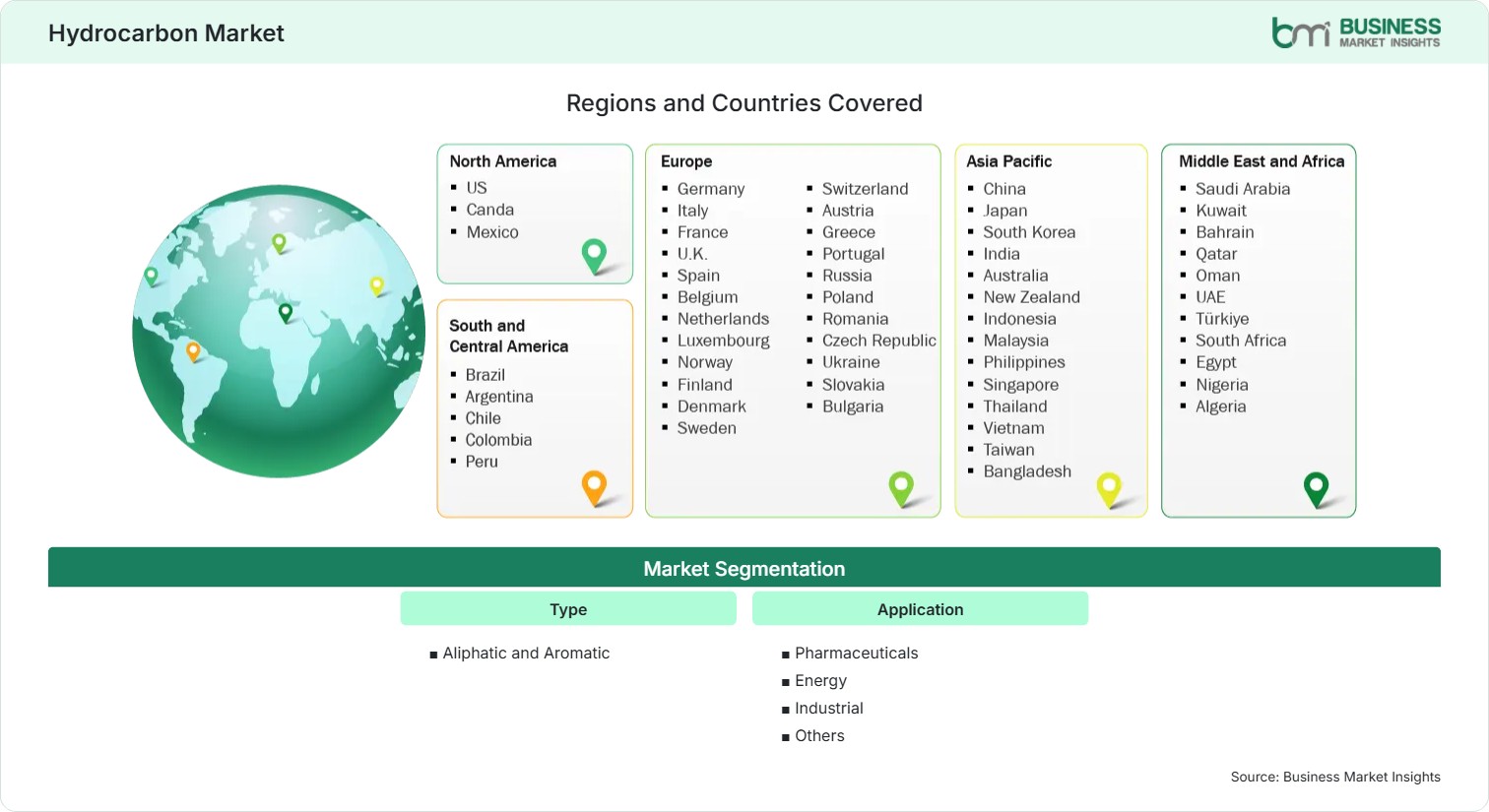
  • Type: Aliphatic and Aromatic
  • Application: Pharmaceuticals, Energy, Industrial, and Others
US$ 4.81 Tn Market size in 2025
US$ 8.28 Tn Market Size by 2033
7.0% CAGR, 2026 - 2033
2026-2033 Forecast Period

01 AI Overview

Hydrocarbon Market Summary

  • North America Region: North America holds a market share of 28%–31% in 2025, growing with a CAGR of 6.2%–6.8% influenced by shale production, refining capacity, and petrochemical investments. The US market advances through energy infrastructure modernization, achieving a CAGR of 6.5%–6.9% during 2026–2033.
  • Fastest Growing Region: Asia Pacific maintains a market share of 34%–37% in 2025, expanding with a CAGR of 7.5%–8.2% supported by industrialization, refining investments, and increasing energy requirements across China, India, and Southeast Asia.
  • Leading Segment: Aliphatic hydrocarbons account for a market share of 55%–58% in 2025, growing with a CAGR of 6.8%–7.3% due to extensive usage in fuels, solvents, chemicals, and industrial manufacturing processes.
  • High Growth Segment: Industrial applications represent a market share of 32%–35% in 2025, advancing with a CAGR of 7.4%–7.9% driven by manufacturing expansion, chemical processing, and infrastructure development worldwide.
  • Key Market Opportunity: Expanding petrochemical capacity, cleaner processing technologies, and demand from emerging economies create opportunities through integrated value chains, advanced refining systems, and diversified hydrocarbon applications across industries.
  • Major Market Players: Dow, Shell plc, Eastman Chemical Company, Exxon Mobil Corporation, Saudi Arabian Oil Company, Chevron Corporation, Reliance Industries Limited, China Petrochemical Corporation, TotalEnergies SE, and Lesco Chemical Limited.
02 Strategic Insights

Hydrocarbon Market: Strategic Insights

Hydrocarbon Market Strategic Framework
FREE PDF
Request your free sample
Request free sample
03 Stakeholder View

Key Takeaways

  • Integrated supply chains are becoming a competitive advantage as companies combine exploration, refining, petrochemical production, and distribution networks to improve operational resilience and reduce exposure to supply disruptions.
  • Industrial and petrochemical applications provide strong expansion potential because hydrocarbons serve as essential feedstocks for polymers, solvents, synthetic materials, and specialty chemicals used across manufacturing sectors.
  • Technology investments are shifting toward digital monitoring, predictive maintenance, advanced catalysts, and processing optimization to improve efficiency while addressing environmental performance requirements.
  • Asia Pacific presents a compelling investment landscape due to rapid industrialization, increasing energy consumption, and expanding refining capacity in China, India, and Southeast Asian economies.
  • Strategic partnerships, capacity expansions, and portfolio diversification are influencing investment strategies as major energy companies strengthen positions across fuels, chemicals, and emerging low-carbon solutions.
  • Downstream diversification is becoming increasingly important as companies seek stable revenue streams through specialty chemicals, advanced materials, and industrial applications beyond traditional fuel markets.
04 Geographic Outlook

Hydrocarbon Market Regional Highlights

North America Hydrocarbon Market

North America is a well-evolved energy ecosystem having a market share of 28%-31% for 2025 and CAGR of 6.2%-6.8% for 2026-2033. The region has been favored by an abundance of production infrastructure, refined capacity, and petrochemical integration. The Hydrocarbons market share has been driven by technology and availability of resources.

  • Shale production growth continues improving domestic supply availability through advanced drilling techniques, hydraulic fracturing improvements, and enhanced operational efficiency across major producing basins.
  • Refinery modernization projects are increasing processing flexibility, enabling companies to handle diverse crude sources while improving output quality for fuel and chemical applications.
  • Petrochemical investments in the United States and Canada are strengthening downstream demand through expanded polymer, solvent, and specialty chemical manufacturing capabilities.
  • Energy companies are adopting digital platforms and automation systems to optimize production processes, reduce operational costs, and improve asset performance across facilities.

US Hydrocarbon Market

The United States holds a market share of 24%–27% in 2025, expanding at a CAGR of 6.5%–6.9% between 2026–2033. The country remains a major producer and consumer due to shale resources, refining infrastructure, and industrial demand. The Hydrocarbon Market growth in the US is influenced by energy security strategies and petrochemical investments.

  • Domestic crude and natural gas production continues benefiting from technological advancements that increase recovery rates and improve operational efficiency across unconventional resource developments.
  • Gulf Coast refining and chemical clusters support downstream expansion through integrated facilities, export capabilities, and increasing demand from manufacturing industries.
  • Infrastructure investments in pipelines, storage terminals, and processing facilities enhance supply reliability while supporting regional and international energy trade.

Europe Hydrocarbon Market

Europe holds a market share between 18% and 21%, with a CAGR of 5.4% to 6.1% from 2026 to 2033. Supply diversification, refining, and industrial uses of gas are emphasized by the region irrespective of the policy changes for energy transition. Important suppliers in this region include Norway and the UK.

  • Norway continues contributing regional supply stability through offshore production assets, advanced extraction practices, and long-term energy export relationships with European markets.
  • The United Kingdom is improving offshore asset efficiency through modernization programs, digital technologies, and investment in mature field optimization.
  • Germany’s chemical sector maintains hydrocarbon demand through manufacturing activities requiring feedstocks for industrial materials, polymers, and specialty chemicals.
  • France supports downstream consumption through integrated industrial facilities and investments focused on refining efficiency and chemical production capabilities.

Asia Pacific Hydrocarbon Market

Asia Pacific dominates regional consumption with a market share of 34%–37% in 2025 and a CAGR of 7.5%–8.2% from 2026–2033. Rapid industrialization, urban development, and expanding manufacturing capacity drive regional demand. The Hydrocarbon Market share remains concentrated in China, India, Japan, and Southeast Asian economies.

  • China maintains a leading position through extensive refining capacity, petrochemical investments, and large-scale industrial consumption supporting domestic and regional supply chains.
  • India is experiencing strong demand growth due to infrastructure expansion, transportation requirements, and investments in refining and chemical manufacturing facilities.
  • Southeast Asian countries are attracting investments through new energy infrastructure projects, refinery upgrades, and increasing industrial production activities.
  • Japan and South Korea continue focusing on advanced chemical applications, efficiency improvements, and high-value downstream hydrocarbon products.

Rest of World Hydrocarbon Market

South and Central America, along with the Middle East and Africa, represent a market share of 14%–17% in 2025, expanding at a CAGR of 7.0%–7.6% during 2026–2033. Resource availability, export potential, and infrastructure investments influence regional development. The Hydrocarbon Market share benefits from large reserves and increasing industrial applications.

  • Saudi Arabia continues strengthening integrated energy operations through refinery expansion, petrochemical diversification, and investments in advanced processing facilities.
  • Brazil is increasing production capacity through offshore developments, improved exploration technologies, and expanding energy infrastructure networks.
  • Middle Eastern producers are prioritizing downstream diversification to increase value creation through petrochemicals and specialty chemical manufacturing.
  • African markets are developing energy infrastructure through exploration activities, foreign investments, and initiatives focused on improving domestic supply access.
  • Latin American economies are attracting investment through resource development opportunities, export expansion strategies, and modernization of energy transportation systems.
Global Market Geography
FREE PDF
Request your free sample
Request free sample
05 Segment Analysis

Hydrocarbon Market Segmentation

Type

Type is classified as aliphatic and aromatic hydrocarbons where aliphatic type holds a 2025 market share of 55%–58%, and a CAGR of 6.8%–7.3% during 2026–2033. Growing application in fuel, solvent, lubricant, and chemical production will drive growth in the segment. The Hydrocarbon Market scope is growing continuously as the industry focuses on effective feedstocks.

  • Aliphatic: Aliphatic hydrocarbons maintain broad adoption due to applications in fuels, solvents, and industrial chemicals. Their favorable processing characteristics support demand across transportation, manufacturing, and chemical production industries.
  • Aromatic: Aromatic hydrocarbons serve essential roles in petrochemical manufacturing, polymers, and specialty chemicals. Demand is supported by applications requiring benzene, toluene, and xylene derivatives across multiple industries.

Application

The Applications Segment reveals varying demand trends in the Pharmaceutical, Energy, Industrial, and various other industries where applications in the Industrial segment will account for 32%-35% market share in 2025 and CAGR 7.4%-7.9% between 2026 and 2033. Increasing manufacturing operations, chemical processes, and infrastructural development continue to influence adoption. Hydrocarbon Market Trends show increasing preference towards high value-added applications and integrated production processes.

  • Pharmaceuticals: Hydrocarbon derivatives support pharmaceutical manufacturing through solvents, intermediates, and processing materials. Growing healthcare production capacity increases demand for reliable chemical inputs and specialized applications.
  • Energy: Energy applications remain fundamental due to extensive use in fuels, power generation, and transportation systems. Continued global energy requirements maintain demand across established hydrocarbon supply networks.
  • Industrial: Industrial applications expand through manufacturing, construction materials, chemicals, and processing industries. Increasing production capacity and infrastructure investment create sustained demand for hydrocarbon-based materials and solutions.
  • Others: Additional applications include consumer products, coatings, adhesives, and specialty formulations. Diverse industrial requirements support continued utilization of hydrocarbon derivatives in niche and emerging markets.
06 Market Forces

Hydrocarbon Market Dynamics

Key Market Drivers

Rising Global Energy Demand

Growing population, industrial expansion, and increasing transportation requirements continue supporting hydrocarbon consumption worldwide. According to the International Energy Agency, global energy demand has continued rising with emerging economies contributing a major portion of incremental consumption. The market growth is influenced by persistent requirements for reliable fuels and chemical feedstocks. The Hydrocarbon Market trends indicate that producers are focusing on supply optimization, integrated operations, and efficiency improvements to meet changing demand patterns while balancing energy transition objectives.

Industrial Growth and Increasing Fuel Consumption

Expanding manufacturing, construction, transportation and chemical industries have led to an increased use of hydrocarbons in many different areas. Industry-based economies need petroleum-based raw material, solvents, and energy for production. An increase in infrastructure development in Asia Pacific and other emerging markets will improve the consumption pattern. The market continues benefiting from industrial value chains that depend on refined products and chemical derivatives. Companies are investing in refining capacity, downstream facilities, and supply networks to serve growing industrial requirements.

Continued Dependence on Fossil Fuels for Energy Generation

Fossil fuels continue to be an essential part of the world’s energy systems due to well-established infrastructure, higher energy content, and the availability of distribution networks. Despite increased use of renewable sources of energy, many economies still depend on hydrocarbons for power generation, transport, and industries. The industry is evolving by improving its operations, installing new technology, and pursuing efficiency measures. Companies have begun to use more environmentally friendly production methods to stay competitive amid changing expectations and energy security concerns.

Key Market Opportunities

Expansion of Petrochemical Applications

Increasing demand for plastics, synthetic materials, specialty chemicals, and advanced industrial products is creating opportunities for downstream hydrocarbon utilization. Petrochemical facilities are expanding globally as companies seek higher-value applications beyond traditional fuel markets. Hydrocarbon Market Forecasts indicate that refining and chemical complexes may be able to capitalize on their diversified products. Advanced process technology investment, also specialty chemical production, will create more opportunities for manufacturers in the coming years. Growing industries in consumer goods, packaging, automotive, and electronics are providing the demand base for petrochemicals.

Growing Demand from Emerging Economies

Growth opportunities have emerged in emerging nations owing to urbanization, industrialization, and increasing energy needs. Refineries and chemical plants are being built in countries such as those from the Asia Pacific, Middle East, and Latin America regions. Manufacturing industries need a consistent supply of fuels and feedstocks. These companies target such markets through collaboration and expansion. This has been made possible by the efforts of governments aimed at promoting industries and energy availability.

Technological Improvements in Extraction and Processing

Technological improvements in exploration techniques, digital monitoring, automation, and efficiencies in processing are revolutionizing the oil industry. There is widespread use of artificial intelligence and advanced recovery mechanisms to optimize resource management and simplify operations. These technologies help to increase productivity while tackling costs and environmental concerns. Current processing systems can even allow better quality products and increased operating flexibility at refining and chemical production plants.

Market Restraints and Challenges

Environmental Regulations and Carbon Emission Concerns

Factor: Increasing environmental regulations and stricter emission reduction requirements are influencing hydrocarbon production strategies. Impact: The businesses encounter additional costs, investments, and changes to achieve their goals concerning carbon emission reductions. Various governments around the world have been working on the implementation of such regulations that will promote carbon emissions reduction, clean energy use, and sustainable industries. Such rules are pushing companies to apply carbon capture systems, increase efficiency, and lower their environmental impact. The shift towards less carbon-intensive energy is creating problems for the conventional oil and gas companies.

Volatility in Crude Oil Prices

Factor: Fluctuations in global crude oil prices caused by geopolitical conditions, supply-demand imbalances, and economic uncertainty create market instability. Impact: Price volatility impacts profit potential for producers, decisions regarding investments, and long-term project plans. Organizations involved in exploring, refining, and chemicals need to adapt their approach and portfolio based on varying levels of income. Inconsistent price environment might cause delays in capital intensive projects and impact supply chain decisions. Producers have been adopting more emphasis on efficiency, business integration, and risk management.

07 Company Analysis

Competitive Landscape

The Hydrocarbon Market analysis highlights a competitive environment shaped by integrated energy companies, chemical producers, and diversified industrial players. Leading participants are strengthening positions through refining capacity expansion, petrochemical integration, technology investments, and supply chain optimization. Companies are focusing on operational efficiency, downstream diversification, and sustainable processing initiatives to maintain competitiveness across global hydrocarbon value chains.

Company Name

Overview

Products and Services relevant to this market

Dow

Global materials science company providing advanced chemical solutions across industrial markets.

Hydrocarbon-based chemicals, solvents, specialty materials, and industrial chemical solutions.

Shell plc

Integrated energy company operating across exploration, refining, chemicals, and energy solutions.

Crude oil processing, fuels, petrochemicals, lubricants, and chemical feedstocks.

Eastman Chemical Company

Specialty materials manufacturer serving diverse industrial and consumer applications globally.

Hydrocarbon derivatives, specialty chemicals, solvents, and advanced material products.

Exxon Mobil Corporation

Major integrated energy company with extensive upstream and downstream operations.

Crude oil production, refining, petrochemicals, fuels, and chemical intermediates.

Saudi Arabian Oil Company

Global energy producer with large-scale upstream and downstream capabilities.

Hydrocarbon production, refining, petrochemicals, and chemical manufacturing solutions.

Chevron Corporation

Multinational energy company involved in exploration, production, and refining activities.

Oil production, refined fuels, petrochemical products, and industrial energy solutions.

Reliance Industries Limited

Indian conglomerate operating major refining and petrochemical facilities.

Petroleum refining, petrochemicals, polymers, and hydrocarbon-based industrial materials.

China Petrochemical Corporation

Chinese integrated energy and chemical enterprise with extensive operations.

Refining, fuel production, petrochemicals, synthetic materials, and chemical products.

TotalEnergies SE

Global energy company with integrated oil, gas, and chemical operations.

Hydrocarbon exploration, refining, petrochemicals, fuels, and industrial applications.

Lesco Chemical Limited

Chemical manufacturer serving industrial markets with specialized chemical products.

Hydrocarbon chemicals, solvents, industrial formulations, and chemical intermediates.

08 Industry Activity

Recent Developments

June 2026

Bharat Petroleum Corporation Limited (BPCL) announced the acquisition of a 40% stake in the Shell–Tiki Tar venture to expand its value-added bitumen business. The partnership combines BPCL’s distribution network with Shell’s technology and Tiki Tar’s manufacturing capabilities for hydrocarbon-based road construction materials.

February 2026

Northern Oil and Gas, Inc. completed the acquisition of non-operated upstream and midstream interests in Ohio Utica shale assets through a joint transaction with Infinity Natural Resources. The deal expanded the company’s hydrocarbon production portfolio and increased its exposure to U.S. shale resources.

November 2025

PETRONAS (Petroliam Nasional Berhad) entered into an investment agreement with Eni S.p.A. to establish a regional upstream joint venture focused on hydrocarbon assets in Malaysia and Indonesia. The partnership aims to combine technical expertise, regional resources, and upstream capabilities to accelerate exploration and production activities across key hydrocarbon basins.

June 2025

PETRONAS (Petroliam Nasional Berhad) expanded its upstream collaboration with TotalEnergies SE through a Strategic Cooperation Agreement and two Farm Out Agreements covering exploration and production opportunities in Malaysia, while also advancing cooperation in Indonesia. The agreement strengthens joint activities in hydrocarbon exploration, gas, LNG, and resource development.

10 Trust & Transparency

Research Methodology

The market analysis combines proprietary research with secondary data from government agencies, company disclosures, regulatory filings, industry databases and expert interviews. Market estimates are validated through data triangulation, cross-market benchmarking and analyst review.

View Full Research Methodology

11 Questions Answered

Frequently Asked Questions

What insights are covered in the Hydrocarbon Market Report?

The Hydrocarbon Report evaluates market structure, regional performance, segmentation dynamics, competitive strategies, emerging opportunities, and factors influencing future industry development.

What role does innovation play in this sector?

Innovation supports improved extraction methods, refinery efficiency, emissions management, predictive maintenance, and development of advanced hydrocarbon-based materials for industrial applications.

Which industries create the strongest demand for hydrocarbons?

Energy, industrial manufacturing, pharmaceuticals, transportation, and chemical production sectors create significant demand because hydrocarbons serve as fuels and essential industrial feedstocks.

How are companies improving competitiveness in hydrocarbon production?

Companies are improving competitiveness through integrated operations, digital technologies, advanced processing systems, supply chain optimization, and diversification into higher-value chemical applications.

What factors are shaping the future direction of the Hydrocarbon market?

The market direction is influenced by energy demand, industrial expansion, petrochemical applications, technology improvements, and efforts to improve operational efficiency while addressing environmental requirements.

Access the Full Hydrocarbon Market Report

Get segment-level forecasts, regional estimates, competitive benchmarking, company profiles and downloadable Excel datasets.

Access the full Hydrocarbon Market Report
350 pages PDF & Excel | 2026-07-27