Market Summary
Executive Summary and Global Market Analysis
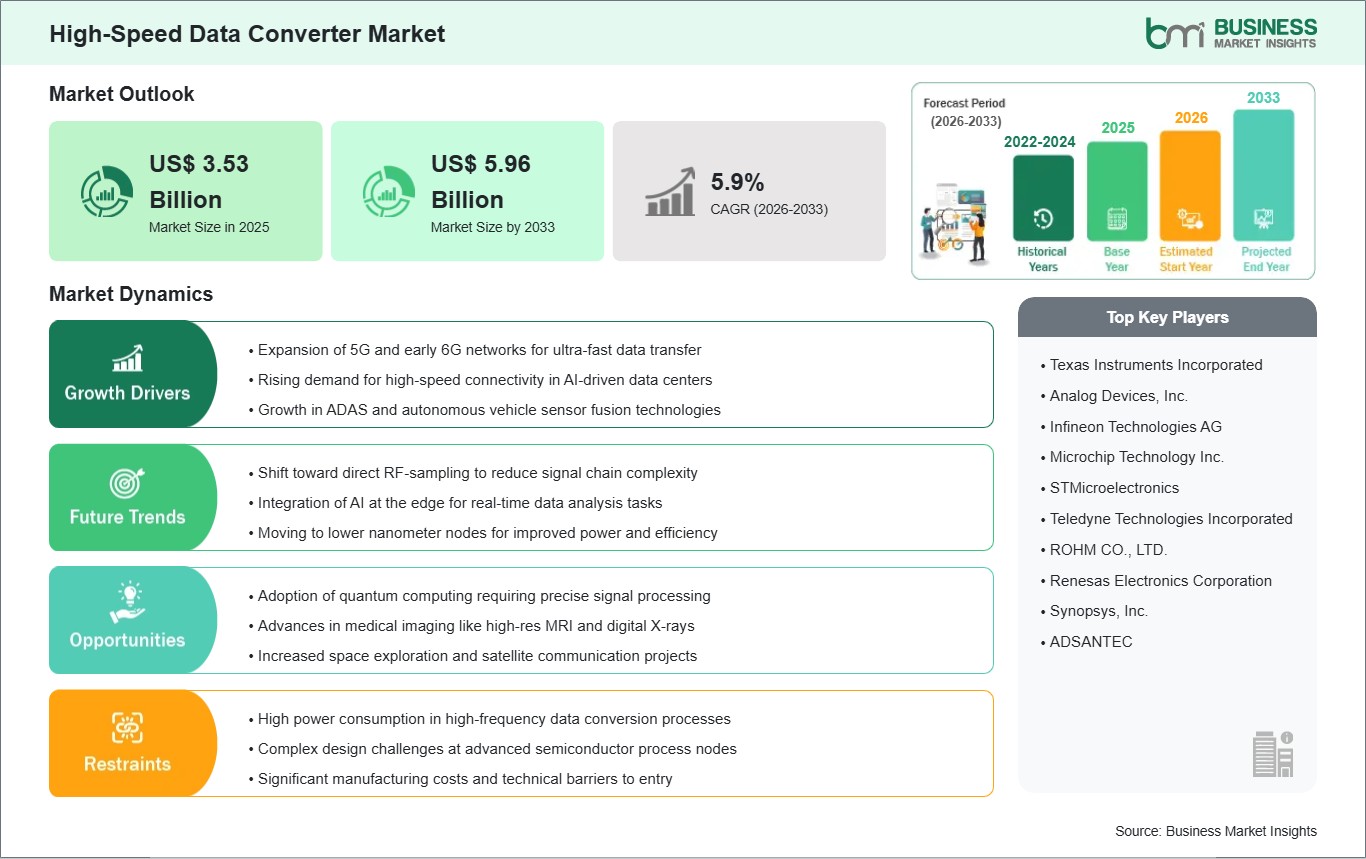
High-speed data Converters are fundamental semiconductor components designed to facilitate the seamless transition between the continuous analog world and the discrete digital domain. These devices, primarily comprising Analog-to-Digital Converters (ADC) and Digital-to-Analog Converters (DAC), enable the high-frequency sampling and processing of signals required for modern electronic systems. They are essential for a wide spectrum of industries, including telecommunications, where they underpin the massive data throughput of 5G networks; automotive, for processing real-time sensor data in autonomous driving; and medical imaging, where high resolution is paramount for diagnostic accuracy. The rapid expansion of data centers currently drives the market, the proliferation of Internet of Things (IoT) devices, and the increasing complexity of signal processing in aerospace and defense applications.
However, several challenges can restrain market growth, such as the high manufacturing and development costs associated with advanced semiconductor nodes (like 5-nanometer and 7-nanometer processes) and the significant power consumption of converters operating at multi-gigasample-per-second (GSPS) rates. Additionally, the industry faces technical hurdles related to maintaining signal integrity and high dynamic range at extreme speeds, alongside global supply chain fluctuations that impact chipset availability.
Despite these hurdles, the market holds significant opportunities driven by the global transition toward 6G research, the surging demand for AI-driven edge computing, and the integration of data converters into System-on-Chip (SoC) architectures. Innovations in energy-efficient designs and the expansion of smart manufacturing frameworks are also expected to open new avenues for market expansion.
Segment Analysis
High-Speed Data Converter Market Segmentation
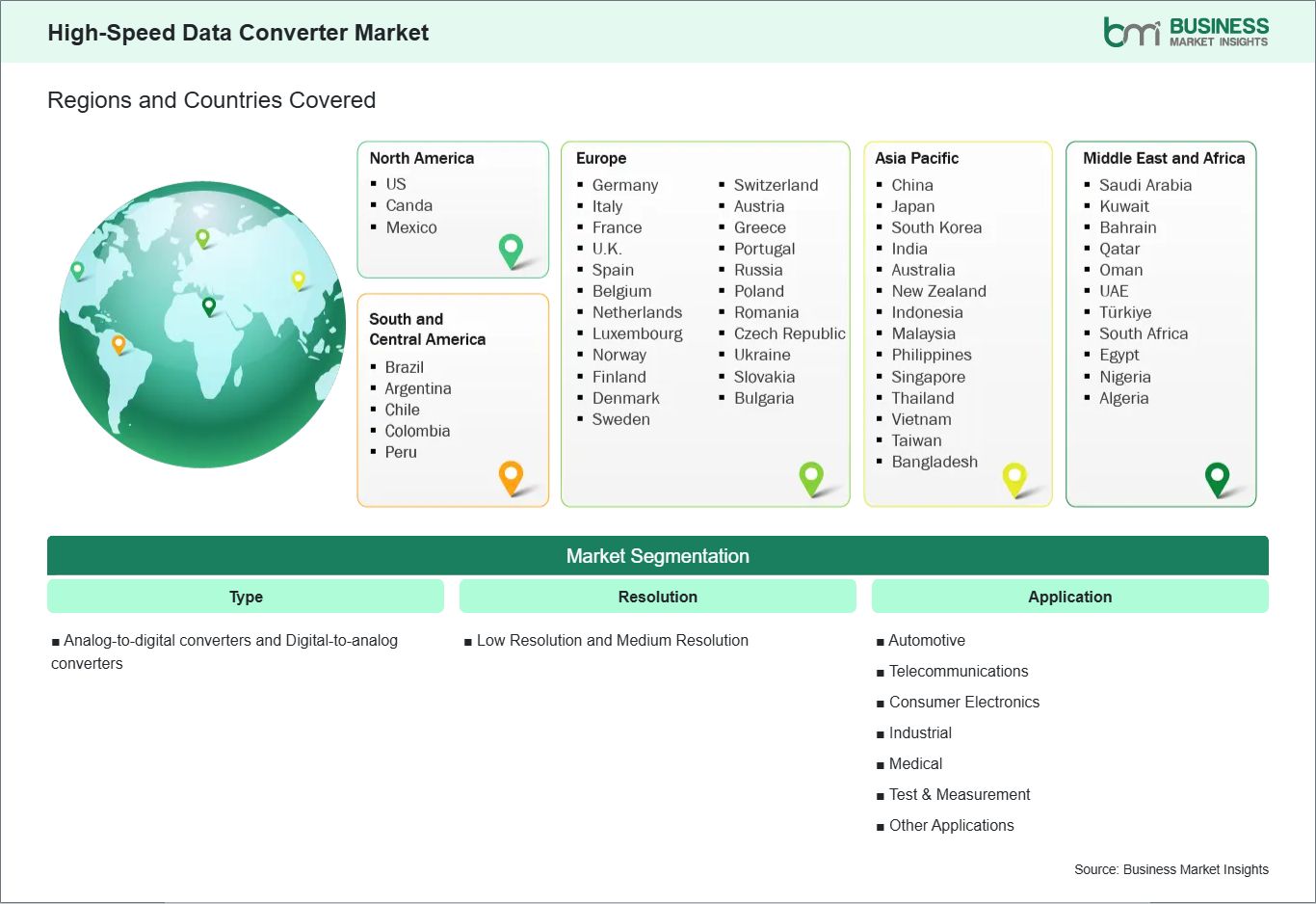
Key segments that contributed to the derivation of the High-Speed Data Converter market analysis are type, resolution, and application.
- By Type, the market is segmented into Analog-to-digital converters and Digital-to-analog converters.
- By Resolution, the market is divided into Low Resolution and Medium Resolution.
- By Application, the market is categorized into Automotive, Telecommunications, Consumer Electronics, Industrial, Medical, Test &Measurement, and Others.
Market Forces
High-Speed Data Converter Market Drivers and Opportunities
Expansion of 5G and Future 6G Infrastructure
The global acceleration of advanced telecommunications infrastructure, specifically the widespread deployment of 5G and the foundational research into 6G, serves as a primary driver for the high-speed data converter market. These next-generation networks utilize millimeter-wave (mmWave) and sub-6GHz frequencies that require significantly higher bandwidth and sampling rates—often exceeding several gigasamples per second (GSPS). High-speed Analog-to-Digital Converters (ADCs) and Digital-to-Analog Converters (DACs) are indispensable in this ecosystem, as they enable direct RF sampling and massive MIMO (Multiple Input, Multiple Output) antenna systems to process hundreds of data streams simultaneously.
By 2026, the transition toward 5G Standalone (SA) architectures and the emergence of "5G Advanced" will demand converters with even lower latency and higher spectral efficiency to support real-time applications such as industrial automation and ultra-reliable low-latency communications (URLLC). This technological shift necessitates a move toward advanced semiconductor nodes to balance the extreme processing power with thermal management. Consequently, telecommunication providers are increasing their capital expenditure on high-performance signal chains, directly propelling the demand for sophisticated, integrated data conversion solutions that can handle the immense data throughput of a hyper-connected global economy.
>Emergence of AI-Driven Edge Computing and Industry 4.0
The rapid proliferation of Artificial Intelligence (AI) at the edge presents a substantial growth opportunity for the high-speed data converter market. As industries transition from centralized cloud processing to localized, real-time intelligence, the need to digitize vast amounts of analog sensor data instantaneously has become critical. In smart manufacturing and Industry 4.0, high-speed converters facilitate predictive maintenance and automated quality control by processing high-frequency vibrational, thermal, and acoustic data. This enables AI models to perform on-device inference without the latency associated with cloud transmission, which is vital for mission-critical operations where milliseconds matter.
Furthermore, the integration of high-speed converters into System-on-Chip (SoC) designs allows for a "sensing-to-inference" pipeline within a single compact footprint. This is particularly lucrative in the medical and automotive sectors, where high-resolution imaging and Lidar/Radar sensing require ultra-precise, high-speed data acquisition. As AI-powered edge devices become standard by 2033, there is a growing opportunity for manufacturers to develop application-specific converters that emphasize energy efficiency and embedded digital signal processing (DSP). This shift not only reduces the bill of materials for end-users but also creates a specialized market for high-performance, low-power conversion hardware tailored for the next era of autonomous and intelligent systems.
Size and Share Analysis
High-Speed Data Converter Market Size and Share Analysis
The High-SpeedData Converter market demonstrates steady growth, with size and share analysis revealing evolving trends and competitive positioning among key players. The report further examines subsegments categorized within type, resolution, and application, offering insights into their contribution to overall market performance.
Based on type, the Analog-to-digital converters subsegment commands a significant portion of the market share, serving as the essential interface for capturing real-world environmental data across almost every modern electronic system.
In terms of resolution, the Medium Resolution subsegment are widely preferred due to their ability to provide high-fidelity signal processing while maintaining the energy efficiency necessary for portable and industrial hardware.
Within the applications, the Telecommunications subsegment remains a primary contributor, driven by the infrastructure requirements of hyperscale data centers and next-generation mobile networks that require constant hardware upgrades. Simultaneously, the Automotive segment is seeing an increased share as manufacturers integrate sophisticated sensors for autonomous navigation, ensuring that data conversion remains central to the future of intelligent mobility and electronic systems.
Report Coverage
High-Speed Data Converter Market Report Coverage and Deliverables
The "High-Speed Data Converter Market Size and Forecast (2022 - 2033)" report provides a detailed analysis of the market covering below areas:
- High-Speed Data Converter market size and forecast at global, regional, and country levels for all the key market segments covered under the scope
- High-Speed Data Converter market trends, as well as market dynamics such as drivers, restraints, and key opportunities
- High-Speed Data Converter market analysis covering key market trends, global and regional framework, major players, regulations, and recent market developments
- Industry landscape and competition analysis covering market concentration, heat map analysis, prominent players, and recent developments for the High-SpeedData Converter market
- Detailed company profiles, including SWOT analysis
Geographic Insights
High-Speed Data Converter Market Geographic Insights
The geographical scope of the High-SpeedData Converter market report is divided into five regions: North America, Asia Pacific, Europe, the Middle East &Africa, and South &Central America.
In North America, market activity is anchored by intensive research in aerospace and defense sectors, where high-speed signal integrity is a critical requirement for radar and satellite systems. Europe maintains a specialized focus on the integration of advanced converters within high-end medical imaging and automotive electronics, particularly for safety-critical systems. The Asia-Pacific region serves as a major hub for both production and consumption, driven by its massive electronics manufacturing ecosystem and aggressive nationwide deployments of advanced wireless infrastructure. In the Middle East &Africa, the market is expanding through the modernization of telecommunications infrastructure and the development of large-scale smart city projects. Meanwhile, South &Central America are witnessing steady development driven by the digital transformation of regional industrial sectors and the expansion of automated processing facilities. This diversified regional growth ensures a resilient market as local economies continue to modernize their digital and industrial frameworks.
Industry Activity
Recent Developments
The High-Speed Data Converter market is evaluated by gathering qualitative and quantitative data post primary and secondary research, which includes important corporate publications, association data, and databases. A few of the key developments in the High-Speed Data Converter market are:
- In January 2026, Texas Instruments (TI) introduced new automotive semiconductors and development resources at CES 2026 to enhance safety and autonomy across various vehicle models. At the heart of this launch, TI debuted the AWR2188, a single-chip, eight-by-eight 4D imaging radar transceiver that featured an integrated High-Speed Data Converter for enhanced data processing. This advanced converter, paired with a radar chirp signal slope engine, allowed for 30% faster performance than previous solutions, enabling engineers to simplify high-resolution radar systems. These devices, alongside the scalable TDA5 high-performance computing system-on-a-chip (SoC) family and the DP83TD555J-Q1 Ethernet physical layer (PHY), joined TI's broader portfolio for next-generation advanced driver assistance systems (ADAS) and software-defined vehicles (SDVs).
- In February 2025, STMicroelectronics unveiled its next generation of proprietary technologies designed for higher-performing optical interconnects within datacenters and AI clusters. To address the exponential growth of AI computing needs, the company introduced new silicon photonics and next-gen BiCMOS technologies that leveraged a High-Speed Data Converter architecture to manage ultra-fast signal transitions. These innovations were scheduled to ramp up from the second half of 2025 to support 800Gb/s and 1.6Tb/s optical modules, helping hyperscalers and leading optical module providers overcome significant performance and energy efficiency challenges across computing and memory interconnections.
Trust & Transparency
Research Methodology
The market analysis combines proprietary research with secondary data from government agencies, company disclosures, regulatory filings, industry databases and expert interviews. Market estimates are validated through data triangulation, cross-market benchmarking and analyst
review.
View Full Research Methodology
Key Sources Referred:
World Bank - Global Trade Indicators World Trade Organization (WTO) International Monetary Fund (IMF) International Trade Administration (ITA) Company website Company annual reports Company investor presentations