Market Summary
Executive Summary and Global Market Analysis
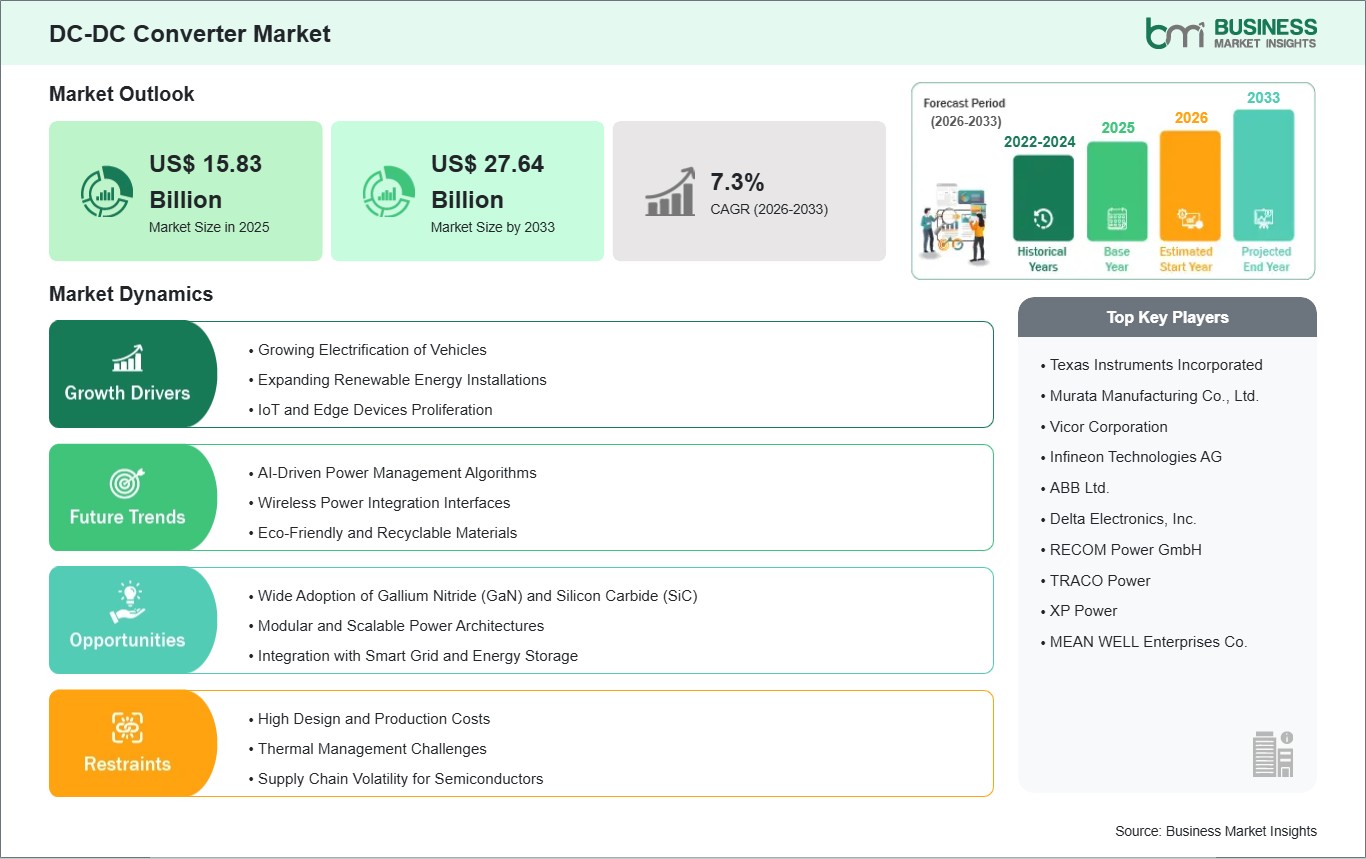
The global DC-DC converter market serves as the critical backbone for modern electronic systems, efficiently stepping up, stepping down, or isolating DC voltage levels to match the precise requirements of various components. These converters are indispensable in virtually every electronic device and system that operates on DC power, enabling functionality, efficiency, and reliability. The market is experiencing strong growth propelled by several mega-trends: the rapid electrification of vehicles, which demands complex power management architectures; the rollout of 5G telecommunications infrastructure requiring highly efficient, high-density power solutions for base stations; and the exponential growth of data centers and cloud computing, where power efficiency at the rack and server level is paramount. Additionally, the proliferation of portable and battery-powered consumer electronics continues to drive demand for compact, high-efficiency converters.
However, the market contends with challenges such as intense price competition, especially in consumer segments, the thermal management complexities associated with increasing power densities, and stringent electromagnetic compatibility (EMC) and safety standards. Despite these hurdles, significant opportunities are emerging from the advancement of wide-bandgap semiconductor materials (like GaN and SiC) enabling smaller, more efficient converters, the integration of digital control and power management bus protocols (e.g., PMBus), and the growing demand for high-voltage converters in renewable energy systems (solar, wind) and industrial automation.
Segment Analysis
DC-DC Converter Market Segmentation
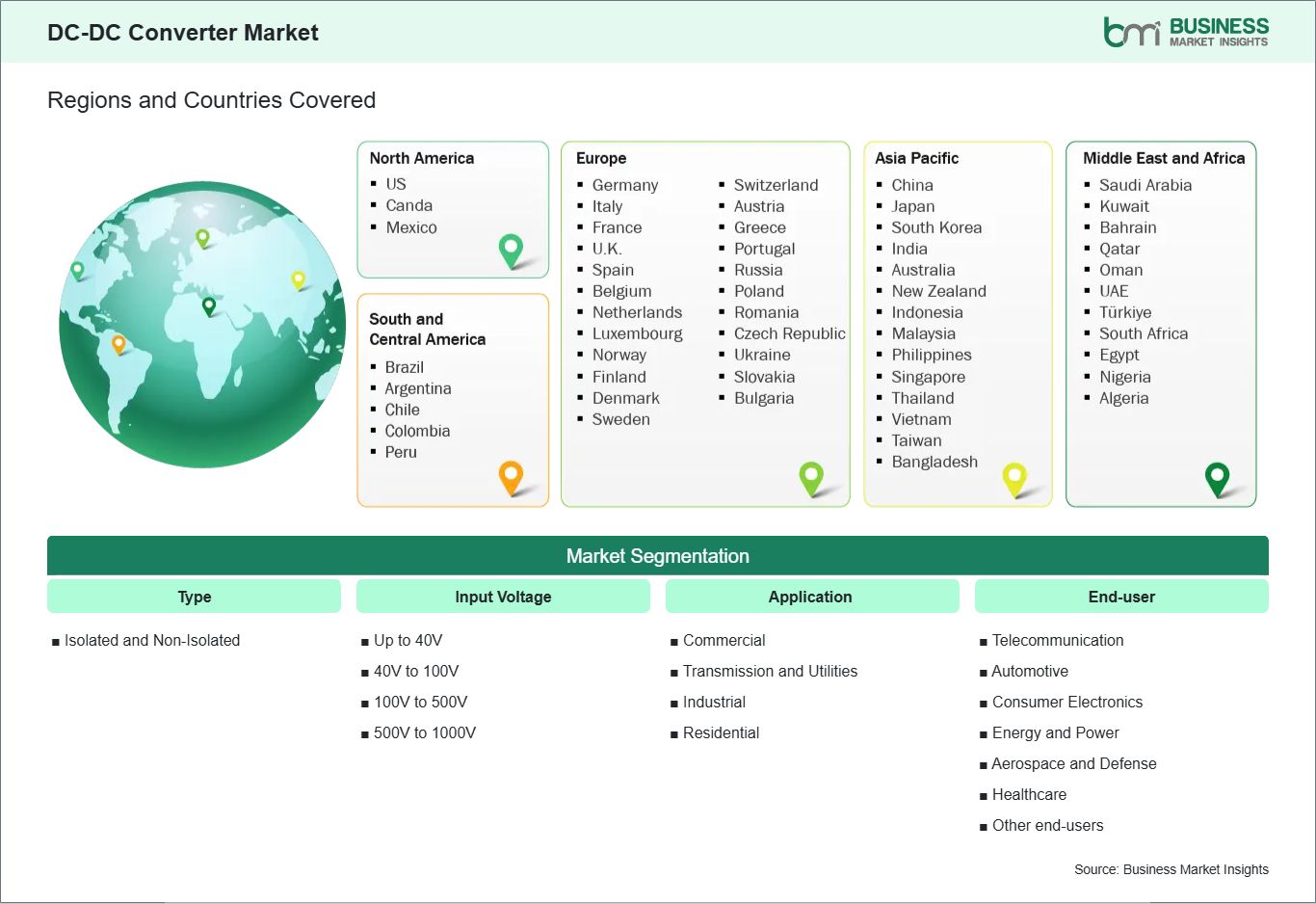
Key segments that contributed to the derivation of the DC-DC converter market analysis are type, input voltage, output voltage, and end-user.
- By type, the market is segmented into isolated and non-isolated converters. The isolated segment dominated the market in 2025, driven by its critical role in providing safety, noise isolation, and voltage level shifting in industrial, telecom, and automotive applications.
- By input voltage, the market is categorized into Up to 40V, 40V to 100V, 100V to 500V, and 500V to 1000V. The 40V to 100V segment held the largest share in 2025, largely due to its alignment with standard automotive and industrial bus voltages (e.g., 48V systems).
- By output voltage, the market is segmented into Up to 100V, 100V to 500V, and 500V to 1000V. The Up to 100V segment accounted for the dominant share, as it covers the vast majority of point-of-load (PoL) requirements for ICs, sensors, and logic boards across all industries.
- By end-user, the market is segmented into telecommunication, automotive, consumer electronics, energy & power, aerospace & defense, healthcare, and others. The telecommunication and automotive sectors collectively held the largest share in 2025, driven by massive infrastructure and vehicle production volumes.
Market Forces
DC-DC Converter Market Drivers and Opportunities
Electrification of Transportation and Growth of 5G/Data Centers
The twin engines of automotive electrification and digital infrastructure expansion are primary market drivers. Electric and hybrid vehicles require sophisticated DC-DC converters to manage energy between high-voltage traction batteries (400V/800V) and low-voltage (12V/48V) auxiliary systems for infotainment, lighting, and control units. Simultaneously, 5G base stations and hyperscale data centers demand converters with exceptional power density and efficiency to reduce energy losses and thermal load, directly impacting operational expenditure. This creates sustained, high-volume demand for advanced, reliable power conversion solutions.
Adoption of Wide-Bandgap Semiconductors and Digital Power Management
A transformative opportunity lies in the adoption of Gallium Nitride (GaN) and Silicon Carbide (SiC) semiconductors in DC-DC converters. These materials enable switching at much higher frequencies than traditional silicon, leading to dramatic reductions in the size of passive components (inductors, capacitors) and overall converter footprint, while improving efficiency. This is crucial for space-constrained applications in aerospace, telecom, and automotive. Furthermore, the integration of digital control loops and communication interfaces allows for real-time monitoring, fault diagnostics, and adaptive performance optimization, opening new revenue streams in intelligent power management and predictive maintenance services.
Size and Share Analysis
DC-DC Converter Market Size and Share Analysis
By type, isolated converters hold a larger revenue share due to their higher complexity, component count, and added value from safety isolation. They are essential in applications where electrical separation between input and output is mandatory for safety or noise immunity.
By input voltage, the 40V-100V range is a sweet spot, serving the growing 48V mild-hybrid automotive systems and many industrial equipment buses. The 100V-500V segment is the fastest-growing, fueled directly by the need to interface with 400V EV battery packs and solar panel arrays.
By output voltage, the low-voltage segment (Up to 100V) is the largest by volume, covering billions of point-of-load applications. The medium and high-voltage output segments are critical and high-value, serving motor drives, industrial equipment, and power transmission stages.
By end-user, telecommunications and automotive are the dominant sectors. The energy & power sector, particularly for renewable energy integration and energy storage systems, represents the highest growth potential. Aerospace & defense and healthcare are specialized, high-reliability segments with stringent requirements.
Report Coverage
DC-DC Converter Market Report Coverage and Deliverables
The "DC-DC Converter Market Size and Forecast (2022-2033)" report provides a detailed analysis of the market covering below areas:
- DC-DC Converter Market size and forecast at global, regional, and country levels for all the key market segments covered under the scope
- DC-DC Converter Market trends, as well as market dynamics such as drivers, restraints, and key opportunities
- DC-DC Converter Market analysis covering key market trends, global and regional framework, major players, regulations, and recent market developments
- Industry landscape and competition analysis covering market concentration, heat map analysis, prominent players, and recent developments for the DC-DC converter market
- Detailed company profiles, including SWOT analysis
Geographic Insights
DC-DC Converter Market Geographic Insights
The geographical scope of the DC-DC converter market report is divided into five regions: North America, Asia Pacific, Europe, Middle East & Africa, and South & Central America. The Asia Pacific region is both the largest market and the fastest-growing, while North America and Europe are key centers for innovation and high-value applications.
Asia Pacific, led by China, Japan, South Korea, and Taiwan, is the undisputed manufacturing and consumption hub. The region's dominance in consumer electronics production, automotive manufacturing, and telecommunications equipment assembly creates immense volume demand. China, in particular, is a massive market and a leading producer of DC-DC converter components and modules.
North America is a leader in R&D and early adoption of advanced technologies, particularly for data center, aerospace, defense, and electric vehicle applications. The presence of major technology firms, cloud service providers, and automotive OEMs drives demand for high-performance, cutting-edge converter solutions.
Europe maintains a strong market position driven by its leading automotive industry (especially in Germany), a robust industrial automation sector, and significant investments in renewable energy. European regulations emphasizing energy efficiency also spur innovation in high-efficiency power conversion technologies.
Industry Activity
Recent Developments
The DC-DC converter market is evaluated by gathering qualitative and quantitative data post primary and secondary research, which includes important corporate publications, association data, and databases. A few of the key developments in the DC-DC converter market are:
- In September 2025, Murata Manufacturing Co., Ltd. has expanded its lineup of isolated DC-DC converters for PoE with the launch of an IEEE802.3af-compliant isolated DC-DC converter for PD (hereinafter, ‘the product’). Murata has already started mass production of the product, and samples are available upon request.
- In February 2025, Calex, a leading innovator in power electronics, is excited to announce the launch of its new 3-kW HVC step-down DC-DC converter, specifically designed for the growing e-mobility sector. With an eye toward simplifying power management for Electric Vehicles (EVs) Hybrid Electric Vehicles (HEVs), and more, the 3-kW HVC delivers cutting-edge efficiency, reliability, and flexible integration options, making it ideal for engineers working on next-generation electric vehicles—no advanced power electronics expertise required.
- In May 2024, Intelligent power management company Eaton today announced it is now offering a higher power version of its low-voltage 48-volt DC/DC converter for commercial and off-highway vehicles that is designed to withstand the harsh environments in which those vehicles operate.
Trust & Transparency
Research Methodology
The market analysis combines proprietary research with secondary data from government agencies, company disclosures, regulatory filings, industry databases and expert interviews. Market estimates are validated through data triangulation, cross-market benchmarking and analyst
review.
View Full Research Methodology
Key Sources Referred:
World Bank - Global Trade Indicators World Trade Organization (WTO) International Monetary Fund (IMF) International Trade Administration (ITA) Company website Company annual reports Company investor presentations