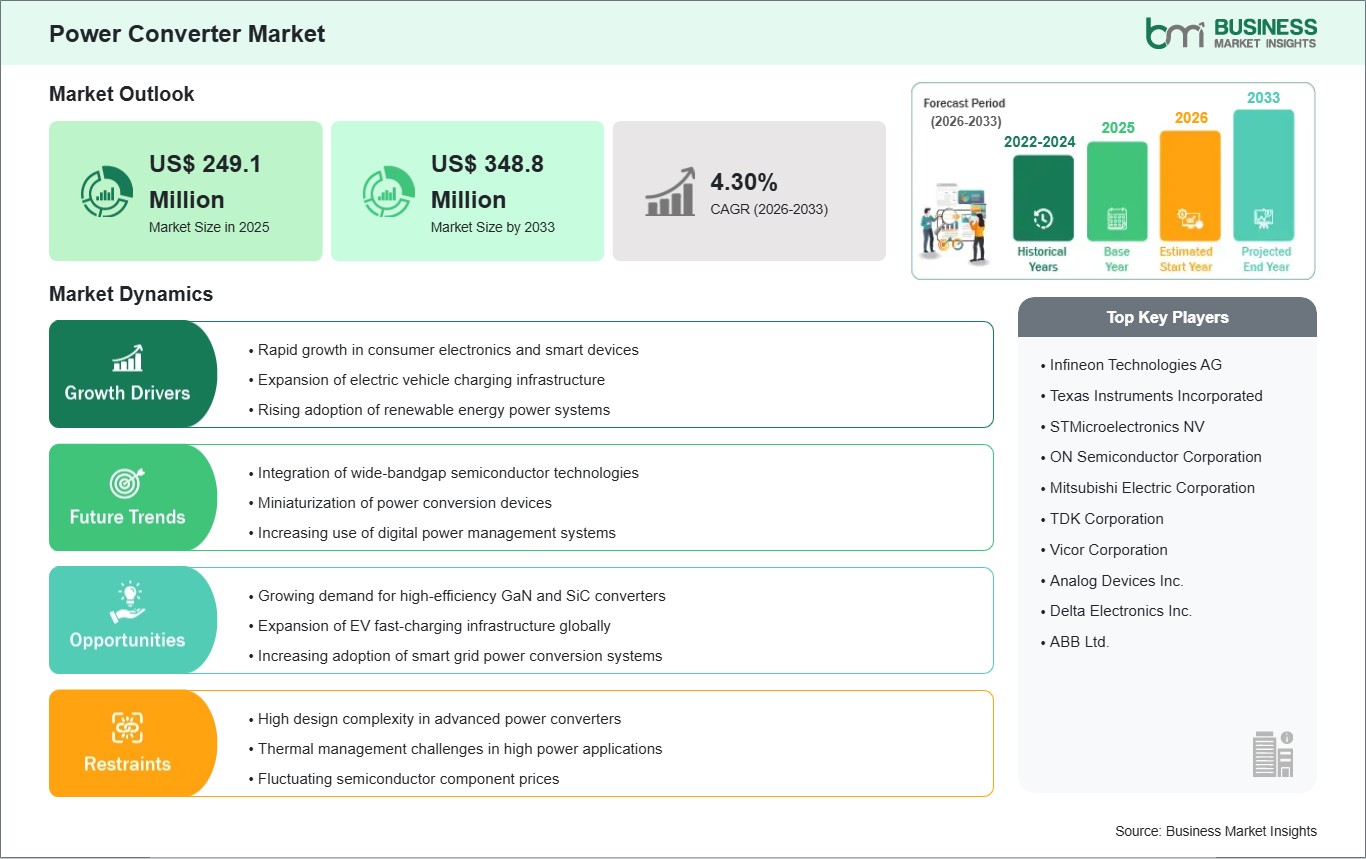
The Power Converter Market size is expected to reach US$ 348.8 million by 2033 from US$ 249.1 million in 2025. The market is estimated to record a CAGR of 4.30% from 2026 to 2033.
The power converter market has a crucial impact on today's electrical and electronic systems. It makes it possible to change electrical energy between different voltage, current, and frequency forms. Power converters are key parts in many areas like consumer electronics, green energy systems, electric cars, medical gear, and factory automation. As the world uses more energy and electronic devices become more common, people need more effective and dependable power conversion tech. The market is growing fast because of the quick spread of consumer electronics, more use of renewable energy, and the switch to electric transport systems.
New tech like digital power control, smaller parts, and wide-bandgap semiconductor materials are making power converters work better in different uses. Also, more money going into electric car charging stations and smart grid projects is creating new chances for growth. As industries continue to focus on energy efficiency and sustainable power management solutions, the power converter market is expected to witness significant expansion in the coming years.

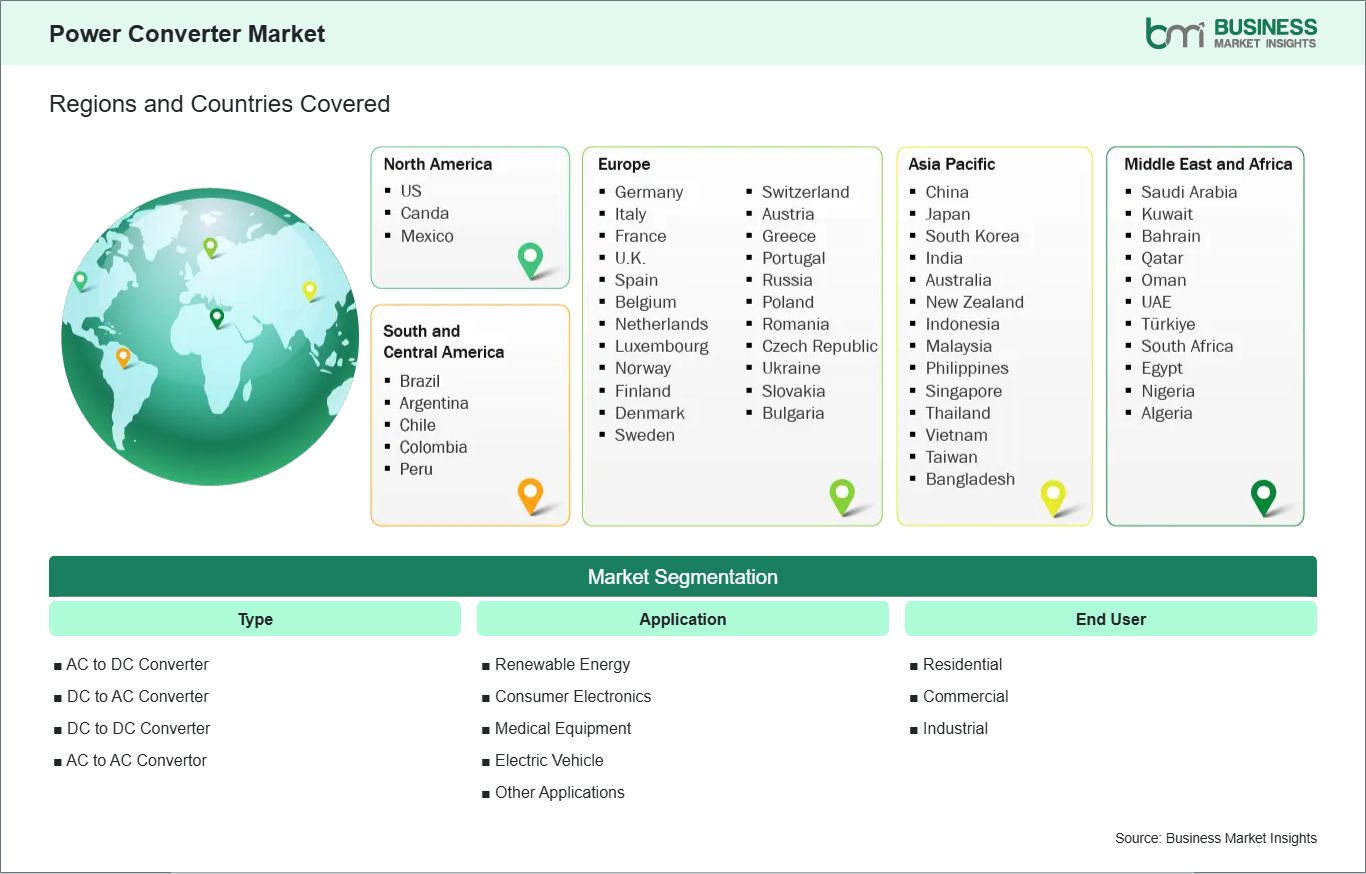
Key segments that contributed to the derivation of the Power Converter market analysis are type, application, and end user.
The quick growth of consumer electronics has become one of the biggest factors driving the power converter market. Gadgets like smartphones, tablets, laptops smart TVs, gaming systems, and wearable tech need effective power conversion answers to work and use energy. As electronic devices get smaller and do more things, the electronics industry has a greater need for top-notch power converters.
Modern consumer electronics operate with highly sensitive internal circuits that require regulated voltage levels. Power converters play a critical role in converting alternating current from power sources into stable direct current required by electronic components. Additionally, the widespread adoption of USB-C charging, fast charging technologies, and wireless charging systems has further accelerated the demand for advanced power conversion technologies.
The continuous evolution of smart homes and connected devices is also contributing to the expansion of this market. Devices such as smart speakers, home automation systems, IoT hubs, and security equipment rely on reliable power management systems. As the number of connected devices per household increases, manufacturers are integrating highly efficient converters to ensure performance, safety, and energy efficiency.
Wide-bandgap semiconductor technologies such as gallium nitride (GaN) and silicon carbide (SiC) are creating significant growth opportunities in the power converter market. These advanced materials enable higher efficiency, higher switching frequency, and lower energy losses compared to conventional silicon-based power electronics. As industries demand more compact and efficient power conversion systems, GaN and SiC technologies are gaining strong momentum.
Power converters based on GaN and SiC materials are increasingly being adopted in electric vehicles, renewable energy systems, data centers, and industrial equipment. These technologies allow converters to operate at higher temperatures and voltages while maintaining excellent energy efficiency. As a result, they support the development of smaller, lighter, and more efficient power electronic systems.
The adoption of these technologies is expected to accelerate as manufacturing costs decline and production scales increase. Semiconductor companies and power electronics manufacturers are investing heavily in research and development to improve device performance and reliability. This ongoing innovation is expected to unlock new applications across automotive, aerospace, renewable energy, and consumer electronics sectors.

The global Power Converter market is experiencing steady growth, with market size and share analysis reflecting evolving treatment preferences and competitive dynamics among key players. The report evaluates important subsegments categorized within type, application, and end user, highlighting their respective contributions to overall market performance.
By type, the AC to DC Converter subsegment dominated the market in 2025 due to its widespread use in power supplies for consumer electronics, EV charging systems, industrial equipment, and telecommunications infrastructure where stable direct current is required for reliable device operation.
By application, the Consumer Electronics subsegment dominated the market in 2025 due to the large-scale global production of smartphones, laptops, gaming consoles, and smart home devices that require efficient power conversion for charging, voltage regulation, and safe electronic component operation.
By end user, the Industrial subsegment dominated the market in 2025 due to increasing deployment of automation systems, robotics, heavy machinery, and industrial control equipment that require high-performance power converters to ensure efficient energy management and operational reliability.
| Report Attribute | Details |
|---|---|
| Market size in 2025 | US$ 249.1 Million |
| Market Size by 2033 | US$ 348.8 Million |
| Global CAGR (2026 - 2033) | 4.30% |
| Historical Data | 2022-2024 |
| Forecast period | 2026-2033 |
| Segments Covered | By Type
|
|
Regions and Countries Covered
| |
| North America | US, Canada, Mexico |
| Europe | Belgium, Austria, Finland, Denmark, Greece, Poland, Romania, Russia, Ukraine, Czech Republic, Slovakia, Bulgaria, Italy, Luxembourg, Germany, Switzerland, France, Netherlands, Norway, Portugal, Spain, Sweden, United Kingdom |
| Asia-Pacific | Australia, China, India, Japan, South Korea, Indonesia, Malaysia, Philippines, Singapore, Thailand, Vietnam, Bangladesh, New Zealand, Taiwan |
| South and Central America | Brazil, Argentina, Peru, Chile, Colombia |
| Middle East and Africa | Bahrain, Kuwait, Oman, Qatar, Saudi Arabia, United Arab Emirates, Turkiye, South Africa, Egypt, Algeria, Nigeria |
| Market leaders and key company profiles |
|
The "Power Converter Market Size and Forecast (2022 - 2033)" report provides a detailed analysis of the market covering below areas:
The geographical scope of the Power Converter market report is divided into: North America, Asia Pacific, Europe, Middle East & Africa, and South & Central America. North America held the largest share in 2025.
North America dominated the power converter market due to its strong technological infrastructure, extensive electronics manufacturing ecosystem, and early adoption of advanced power electronics technologies. The region hosts several leading semiconductor companies and power electronics manufacturers that continuously innovate and develop high-performance power conversion solutions.
Additionally, the presence of major electric vehicle manufacturers and large-scale renewable energy projects has significantly increased the demand for efficient power converters. The rapid expansion of data centers, smart grid projects, and electric vehicle charging infrastructure has further strengthened market growth in the region. Governments across North America are actively promoting renewable energy integration and electrification initiatives, which require sophisticated power conversion systems.
Furthermore, strong investments in research and development related to wide-bandgap semiconductors such as GaN and SiC are accelerating technological advancements. The combination of strong industrial infrastructure, advanced technology adoption, and increasing demand for energy-efficient electronic systems continues to position North America as the leading region in the global power converter market.

The Power Converter market is evaluated by gathering qualitative and quantitative data post primary and secondary research, which includes important corporate publications, association data, and databases. A few of the key developments in the Power Converter market are:
The Power Converter Market is valued at US$ 249.1 Million in 2025, it is projected to reach US$ 348.8 Million by 2033.
As per our report Power Converter Market, the market size is valued at US$ 249.1 Million in 2025, projecting it to reach US$ 348.8 Million by 2033. This translates to a CAGR of approximately 4.30% during the forecast period.
The Power Converter Market report typically cover these key segments-
The historic period, base year, and forecast period can vary slightly depending on the specific market research report. However, for the Power Converter Market report:
The Power Converter Market is populated by several key players, each contributing to its growth and innovation. Some of the major players include:
The Power Converter Market report is valuable for diverse stakeholders, including:
Essentially, anyone involved in or considering involvement in the Power Converter Market value chain can benefit from the information contained in a comprehensive market report.
Please tell us your area of interest
(Market Segments/ Regions and Countries/ Companies)