Market Summary
Executive Summary and Global Market Analysis
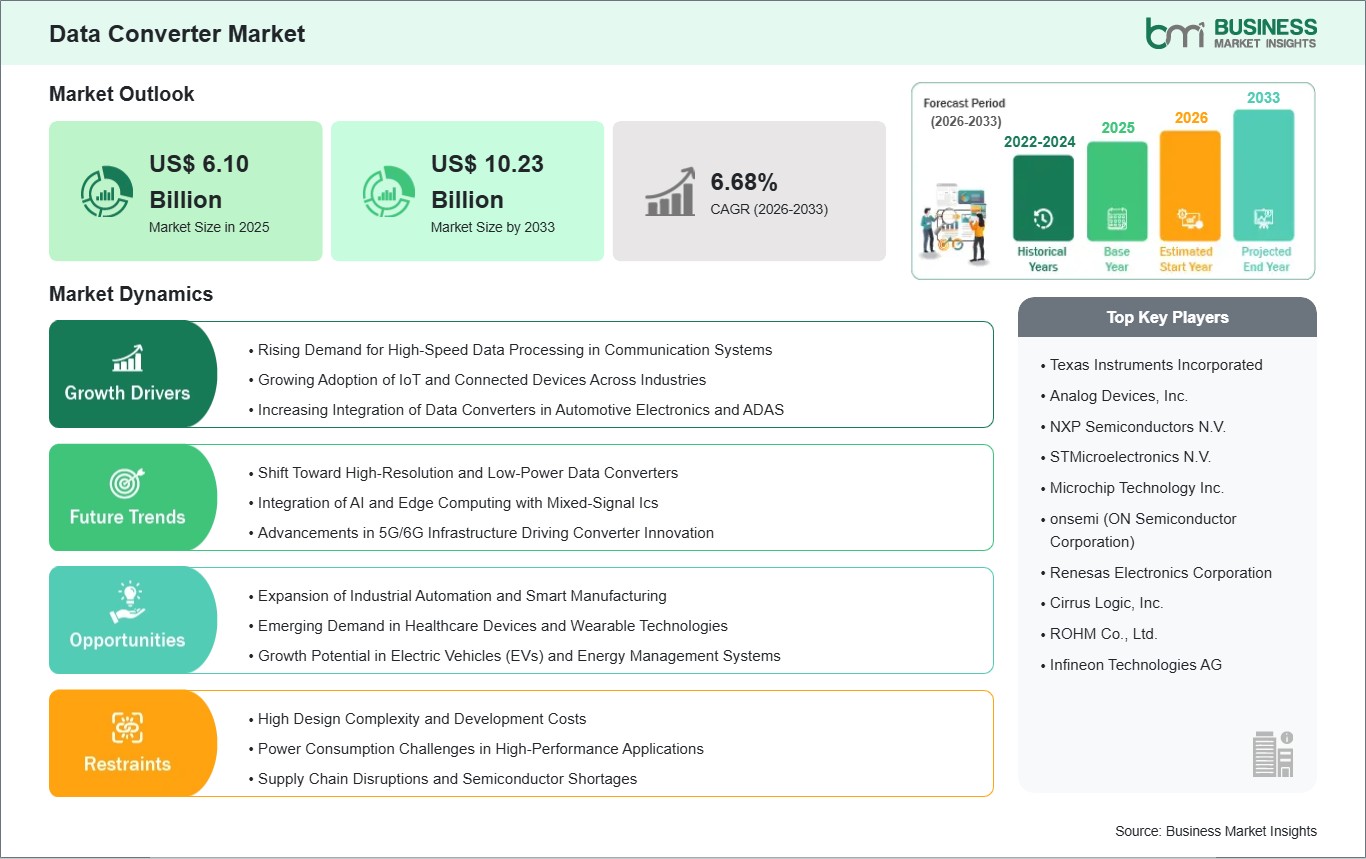
Data converters refer to the integrated electronic circuits, primarily Analog-to-Digital Converters (ADCs) and Digital-to-Analog Converters (DACs), engineered to bridge the gap between continuous real-world signals and discrete digital processing environments. By converting physical phenomena such as sound, light, and temperature into binary data, and vice versa, these components serve as the essential interface for all modern electronic systems. This technology is fundamental to the operation of high-speed telecommunications, precision medical imaging, and advanced automotive sensor suites. Market expansion is being propelled by the global rollout of 5G-Advanced and early 6G research, the rapid proliferation of IoT ecosystems, and the increasing institutional requirement for high-resolution, low-latency signal processing in smart industrial and healthcare applications.
However, several factors may restrain market progression. The high capital intensity associated with the research and development of advanced mixed-signal architectures, particularly those requiring Giga-samples per second (GSPS) sampling rates and high-fidelity signal integrity, remains a primary hurdle for semiconductor manufacturers. The industry also faces significant technical challenges regarding thermal-noise limitations and power-to-performance trade-offs, as increasing the resolution and speed often leads to excessive heat generation in miniaturized devices. Additionally, the trend toward system-on-chip (SoC) integration has intensified concerns regarding electromagnetic interference (EMI) and noise coupling between digital and analog domains on a single die. These hurdles, compounded by the strategic risks of specialty foundry supply chain volatility and the high costs of migrating to leading-edge process nodes, increase the total cost of ownership and may lengthen product qualification cycles for mission-critical aerospace and automotive applications.
Despite these hurdles, the market outlook remains highly favorable as the sector transitions toward intelligent and high-bandwidth architectures. Opportunities are emerging through the adoption of AI-integrated data acquisition; the market is witnessing the launch of converters with embedded neural processing capabilities that perform local data filtering and feature extraction, significantly reducing the bandwidth required for cloud transmission. The healthcare segment is gaining significant traction, with a rising requirement for high-resolution (above 16-bit) ADCs to support AI-driven medical imaging and zero-click diagnostic workflows. Furthermore, the growth of the automotive Software-Defined Vehicle (SDV) market aligns with global goals for advanced driver assistance and electrified mobility. Collectively, these innovations position the data converter industry for sustained long-term development as a cornerstone of the modern, digitized, and hyper-connected global electronic landscape.
Segment Analysis
Data Converter Market Segmentation
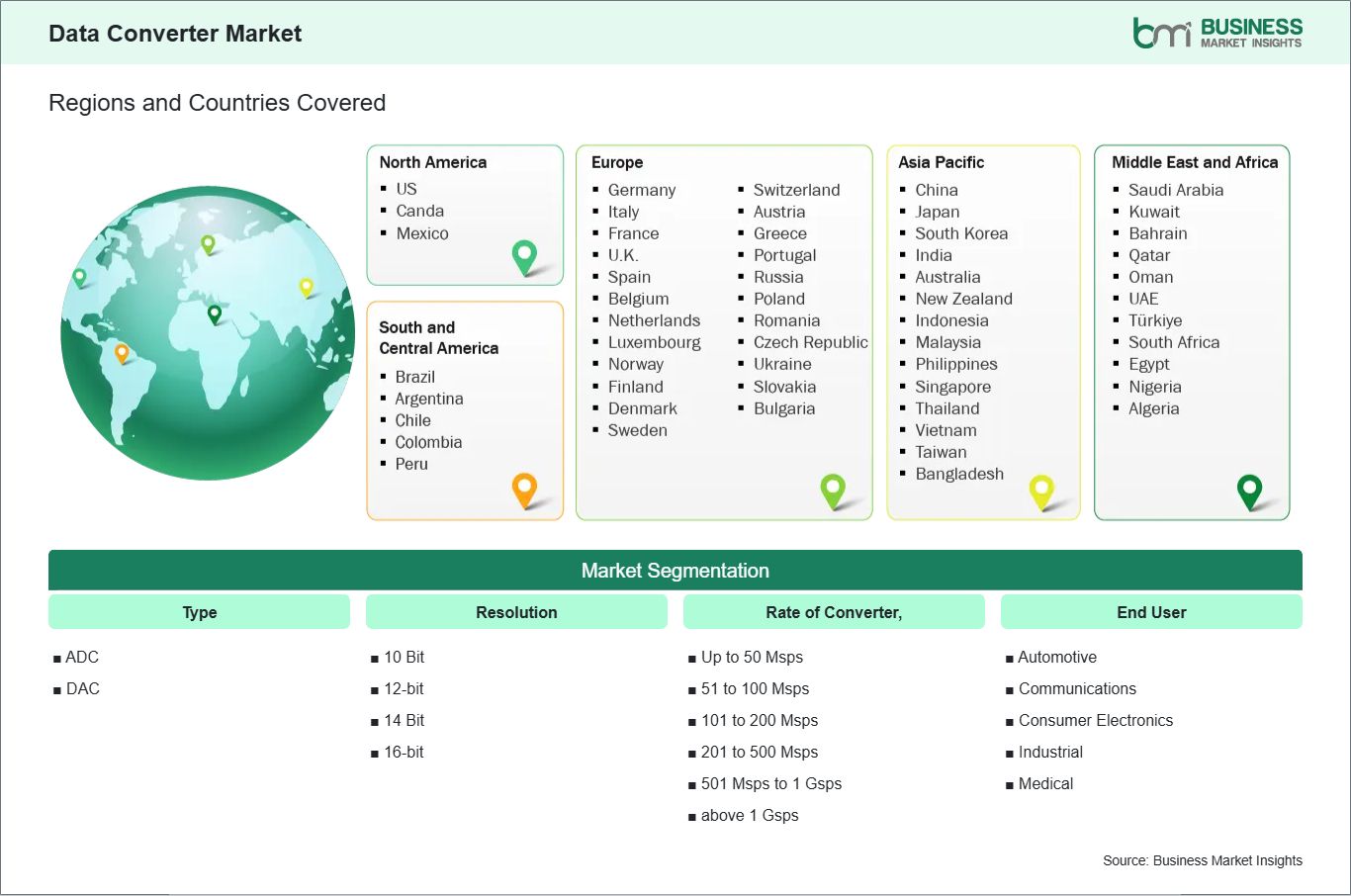
Key segments that contributed to the derivation of the Data Converter market analysis are type, resolution, rate of converter, and end user.
- By Type, the market is segmented into ADC and DAC.
- By Resolution, the market is divided into 10 Bit, 12-bit, 14 Bit, and 16-bit.
- By Rate of Converter, the market is categorized into Up to 50 Msps, 51 to 100 Msps, 101 to 200 Msps, 201 to 500 Msps, 501 Msps to 1 Gsps, and Above 1 Gsps.
- By End User, the market is segmented into Automotive, Communications, Consumer Electronics, Industrial, and Medical.
Market Forces
Data Converter Market Drivers and Opportunities
Rising Demand for Digitization, Connectivity, and Efficiency
The data converter market is being driven by the growing need for digitization, connectivity, and efficiency across industries such as telecommunications, consumer electronics, automotive, healthcare, and industrial automation. Data converters, including analog‑to‑digital converters (ADCs) and digital‑to‑analog converters (DACs), are essential for bridging the gap between real‑world analog signals and digital systems. The rapid expansion of 5G networks and IoT ecosystems is amplifying adoption, as converters enable high‑speed signal processing and seamless device communication. In automotive, advanced driver assistance systems (ADAS), infotainment, and electric vehicles rely heavily on precise data conversion for safety and performance. Healthcare applications such as medical imaging and patient monitoring are reinforcing demand, as converters ensure accurate signal capture and analysis. Additionally, industrial automation and robotics are leveraging data converters for real‑time monitoring, predictive maintenance, and process optimization. The rising popularity of smart devices and wearables is further propelling growth. Collectively, digitization, connectivity, and efficiency requirements are fueling sustained expansion in the global data converter market.
Rising Integration of AI, IoT, and Emerging Applications
Opportunities in the data converter market are expanding through the integration of artificial intelligence, IoT platforms, and emerging applications in smart infrastructure. AI‑enabled systems are opening lucrative opportunities by requiring high‑precision data converters for adaptive signal processing, machine learning, and real‑time analytics. The growing emphasis on IoT is fueling demand for interoperable converters that support connected devices in smart homes, smart cities, and industrial ecosystems. Emerging applications in renewable energy are driving innovation, as converters enable efficient monitoring and control of solar inverters, wind turbines, and energy storage systems. Additionally, sustainability trends are encouraging deployment of energy‑efficient, eco‑friendly converter technologies that align with global environmental goals. The expansion of AR/VR, autonomous vehicles, and advanced robotics is creating new pathways for adoption, where converters ensure seamless integration of sensors, actuators, and communication systems. Vendors who focus on high‑speed, low‑power, and AI‑optimized data converter solutions are well‑positioned to capture growth. The convergence of AI, IoT, and smart infrastructure underscores a transformative trajectory for the global data converter market.
Size and Share Analysis
Data Converter Market Size and Share Analysis
The Data Converter market demonstrates steady growth, with size and share analysis revealing evolving trends and competitive positioning among key players. The report examines subsegments categorized within type, resolution, rate of converter, and end user, offering insights into their contribution to overall market performance.
Based on Type, the ADC (Analog‑to‑Digital Converter) subsegment holds the primary market presence, as it is indispensable for converting analog signals into digital data for processing in communication systems, consumer electronics, and automotive applications. ADCs are widely used in smartphones, medical devices, and industrial automation, where precision and speed are critical. The DAC (Digital‑to‑Analog Converter) subsegment is essential for converting digital signals back into analog form, enabling audio playback, video rendering, and control systems. DACs anchor demand in entertainment, automotive infotainment, and industrial equipment. Together, ADCs dominate data acquisition, while DACs ensure seamless signal reproduction and usability.
Report Coverage
Data Converter Market Report Coverage and Deliverables
The "Data Converter Market Size and Forecast (2022 - 2033)" report provides a detailed analysis of the market covering below areas:
- Data Converter market size and forecast at global, regional, and country levels for all market segments covered under the scope
- Data Converter market trends, as well as drivers, restraints, and opportunities
- Data Converter market analysis covering key trends, global and regional framework, major players, regulations, and recent developments
- Industry landscape and competition analysis covering market concentration, heat map analysis, prominent players, and recent developments for the Data Converter market
- Detailed company profiles, including SWOT analysis
Geographic Insights
Data Converter Market Geographic Insights
The geographical scope of the Data Converter market report is divided into five regions: North America, Asia Pacific, Europe, Middle East & Africa, and South & Central America.
North America maintains a preeminent position within the global industry, a status reinforced by the region's sophisticated semiconductor ecosystem and the rapid deployment of high-capacity communication networks. The regional landscape is characterized by high-density investments in the United States and Canada. This dominance is supported by the presence of primary industry pioneers, including Analog Devices and Texas Instruments, who drive the commercialization of high-performance Analog-to-Digital Converters (ADCs) and Digital-to-Analog Converters (DACs) for mission-critical applications.
Technological progression in the region is largely driven by a decisive shift toward High-Speed Data Converters capable of handling gigasample-per-second (GSPS) rates. These advanced components are essential for the expansion of 5G-Advanced and satellite communication infrastructure, where low-latency and high-bandwidth signal processing are fundamental. Furthermore, the region is witnessing an increasing utilization of Edge AI hardware accelerators, which require high-resolution converters to bridge the gap between real-world analog sensors and digital machine learning models. This focus on Signal Integrity allows North American enterprises to maintain a competitive advantage in automated industrial processes and high-fidelity medical imaging.
Industry Activity
Recent Developments
The Data Converter market is evaluated by gathering qualitative and quantitative data post primary and secondary research, which includes important corporate publications, association data, and databases. A few of the key developments in the Data Converter market are:
- In February 2026, Broadcom Inc. launched the BroadPeak BCM85021, the industry’s first 6G digital front-end SoC with integrated ADC/DAC blocks. The device delivers breakthrough RF performance with sampling rates up to 19.6 GS/s and a 40% reduction in power consumption. It is designed to support massive MIMO and remote radio head applications for 5G Advanced and 6G networks. The SoC enables high-throughput, energy-efficient wireless infrastructure, accelerating AI-driven and next-generation connectivity solutions.
- In May 2025, Silanna Semiconductor launched the Plural Data Converter Series, offering 10-, 12-, 14-, and 16-bit ADCs with sample rates from 20 to 250 Msps. The factory-configurable platform enables over 150 distinct ADC configurations to meet diverse industrial and communications needs. The series provides a high-performance, affordable, and rapidly available alternative to legacy devices. Silanna’s roadmap will expand to include DACs and transceivers with sample rates up to 4 GS/s by 2026, further strengthening its presence in the data converter market.
Trust & Transparency
Research Methodology
The market analysis combines proprietary research with secondary data from government agencies, company disclosures, regulatory filings, industry databases and expert interviews. Market estimates are validated through data triangulation, cross-market benchmarking and analyst
review.
View Full Research Methodology
Key Sources Referred:
World Bank - Global Trade IndicatorsWorld Trade Organization (WTO)International Monetary Fund (IMF)International Trade Administration (ITA)Company WebsitesCompany Annual ReportsCompany Investor Presentations