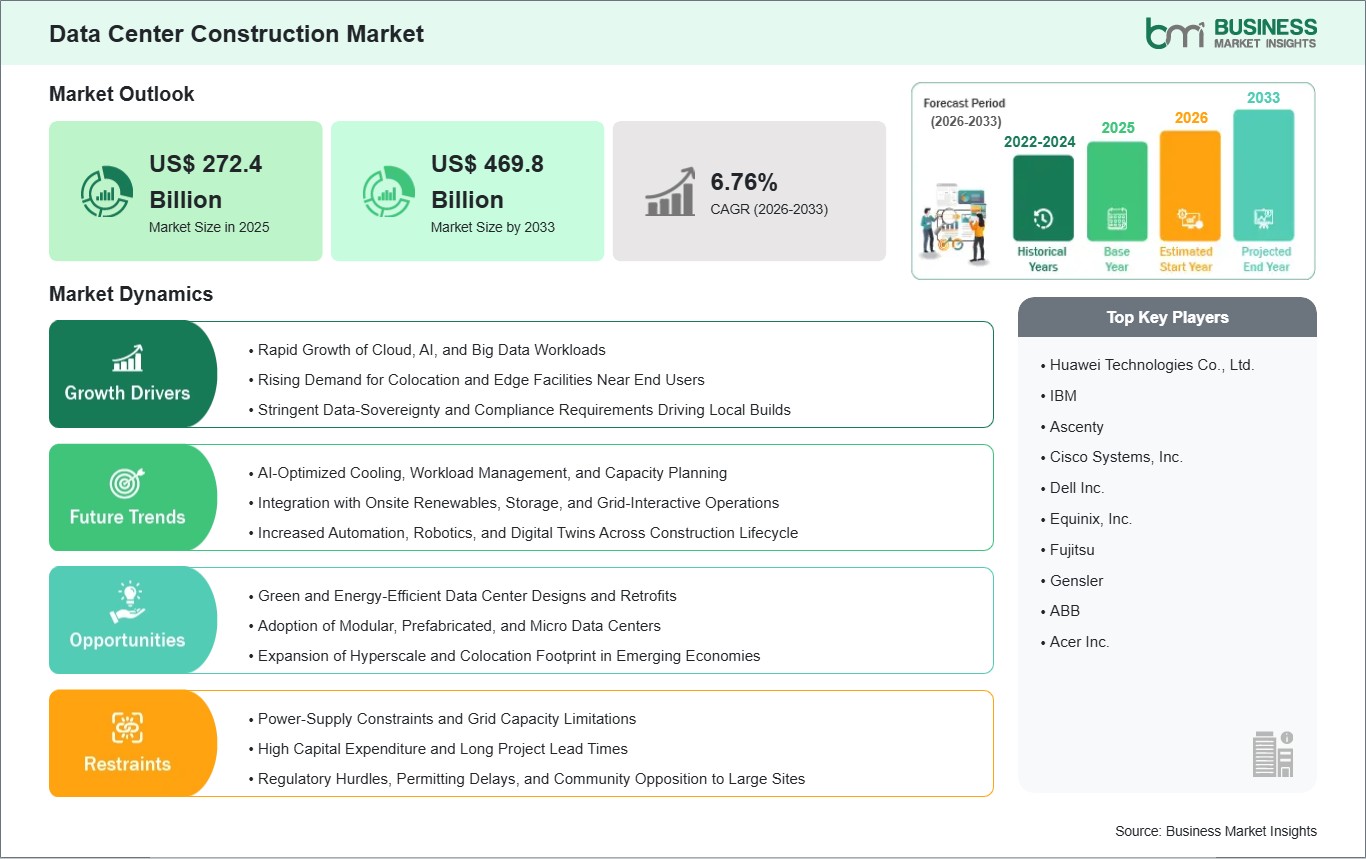
The Data Center Construction Market size is expected to reach US$ 469.80 billion by 2033 from US$ 272.40 billion in 2025. The market is estimated to record a CAGR of 6.77% from 2026 to 2033.
The data center construction market is the basis of the world's digital infrastructure, which includes physical facilities for cloud platforms, enterprise IT, content delivery, and AI workloads. These places are the integration of IT, power, and cooling systems that provide secure, always on processing capacity for industries, e.g. banking, telecommunications, ecommerce, manufacturing, and government services. Essentially, modern data centers can boast of being very reliable, having scalable compute, and the possibility of placing capacity close to users for low latency applications such as streaming, gaming, and industrial automation. The market expansion is a result of increasing cloud adoption, rapid data traffic growth, and the rise of hyperscale and colocation providers who are building larger campuses across regions. Edge computing, 5G rollout, and AI training clusters are the reasons why demand for new and upgraded facilities with higher rack densities and advanced cooling is growing so fast.
However, the industry is weighed down by high capital costs, grid power constraints, lack of land in key metros, and stricter environmental and permitting regulations. Despite that, there are still plenty of exciting opportunities in emerging markets, brownfield retrofits, modular and prefabricated builds, and the energy efficient designs, renewable integration, and innovative cooling technologies that lower carbon footprint while enabling capacity to grow.
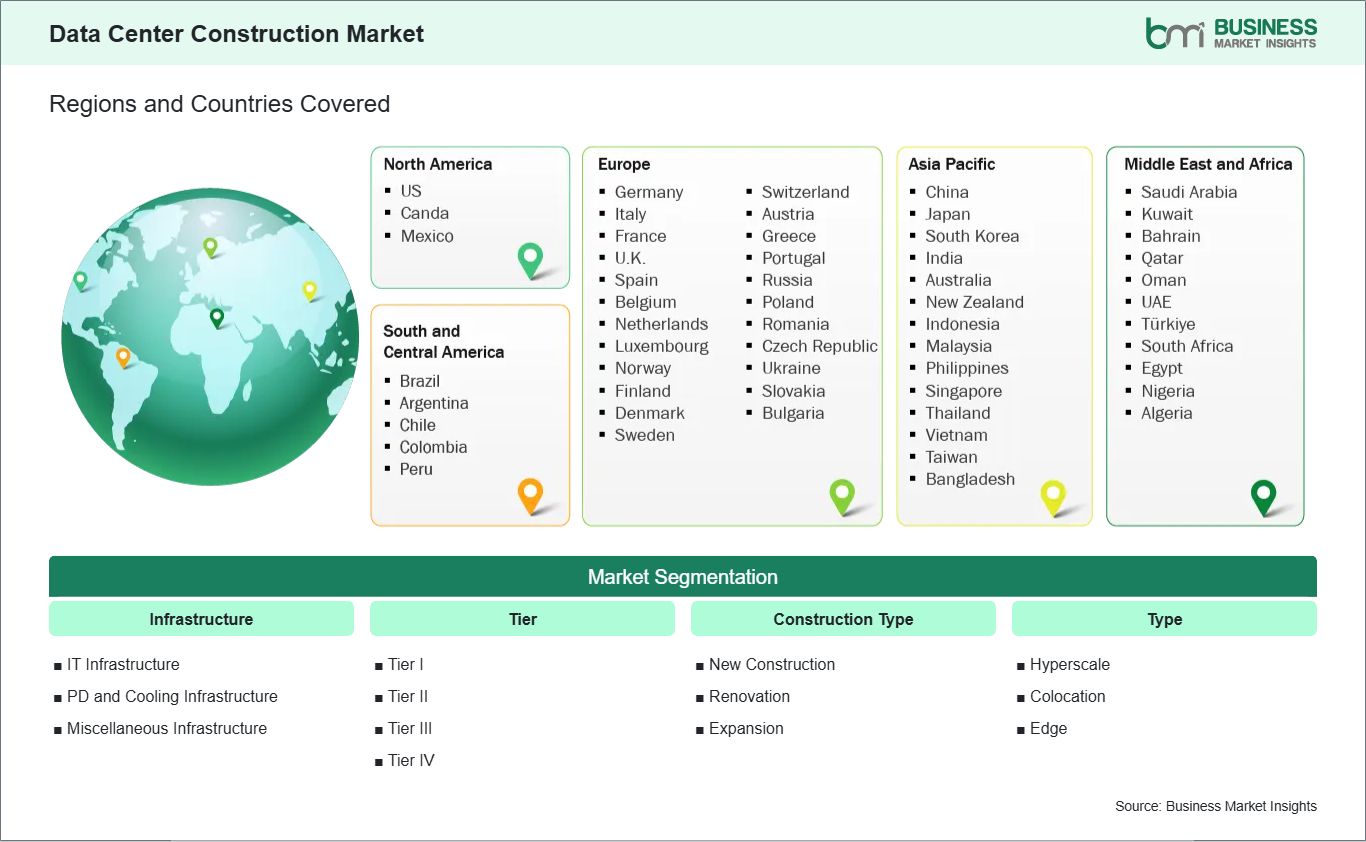
Key segments that contributed to the derivation of the Data Center Construction market analysis are infrastructure, tier, construction type, type, and end user.
The data center construction market is largely driven by the global surge in cloud computing, AI, and other data, intense digital services. Hyperscale cloud providers, OTT platforms, and big enterprises are expanding their infrastructures to support video streaming, SaaS, fintech, gaming, and generative AI workloads which require huge amounts of low, latency compute and storage capacity. Worldwide IP traffic and data creation keep increasing at an exponential rate which is forcing operators to build new campuses as well as expand their existing facilities in strategic hubs and emerging regions. Meanwhile, enterprises are also upgrading their old on, premises infrastructures and adopting hybrid, cloud models which need colocation and edge data centers close to industrial sites and areas with high population densities in order to meet latency and data, sovereignty requirements. The introduction of 5G and the increase in the number of connected devices are, therefore, putting more pressure on networks, thus, creating a need for more edge facilities that can process the data closer to end users. Data center location decisions are becoming increasingly influenced by government and regulatory incentives for digital economy initiatives, e, governance, and localization rules. The trends combine to form a continued pipeline of greenfield projects, brownfield expansions, and upgrades, thus, firmly positioning data center construction as a key enabler of the digital transformation and AI, driven innovation across the major industries.
A major opportunity in the data center construction market lies in changes made in the design of facilities and new energy, efficient, modular, and sustainable structures that can respond to the rapidly increasing environmental and operational challenges. Data centers still represent one of the largest consumers of electricity and, as such, they are getting a lot of attention from regulators, utilities, and communities, especially in power, constrained metros. Consequently, the demand for high, efficiency cooling (liquid, immersion, free, air), advanced power distribution, real, time energy management, and the installation of on, site renewables and battery storage to lower the PUE as well as the carbon footprint is rising. Construction firms and technology vendors that are able to deliver low, carbon, water, efficient campuses along with verifiable sustainability metrics are turning out to be the most favored by hyper scalers and colocation providers who have ambitious net, zero commitments. The requirement for prefabricated and modular data centers, which can shorten deployment timelines, standardize quality, and enable incremental capacity additions, is raising this being a perfect solution for emerging markets, remote industrial sites, and latency, sensitive edge locations. In such situations, the modular solutions provide the capability to react quickly to changes.

By infrastructure, the data center construction market is divided into IT infrastructure, PD and cooling infrastructure, and miscellaneous infrastructure. The IT infrastructure segment was the largest contributor to the market in 2024. IT infrastructure refers to the core computing hardware of data centers, which includes servers, storage, and networking equipment, and this is what undergoes continuous upgrades to support increased workloads and the virtualization process.
By tier, the market is divided into Tier I, Tier II, Tier III, and Tier IV. The Tier III segment had the largest share of the market in 2024. Tier III data centers provide high availability with several distribution paths and concurrent maintainability at a level lower than Tier IV, thus, most colocation and enterprise facilities choose them.
By construction type, the market is divided into new construction, renovation, and expansion. In 2024, the new construction segment was the major contributor to the market. Greenfield projects give operators the freedom to implement up, to, date, energy, saving designs and facilitate large hyperscale campuses in both new and mature hubs.
By type, the market division includes hyperscale, colocation, and edge. In 2024, the colocation segment accounted for the most significant share of the market. Colocation data centers are the preferred choice of companies implementing hybrid cloud strategies and of cloud providers looking for a local presence without the need to own all the physical assets.
By end user, the market division includes IT and telecommunications, BFSI, and government. The IT and telecommunications segment was the leading contributor to the market in 2024. The segment growth was mainly driven by cloud service providers, internet companies, and carriers, who expanded their capacity to support digital services and the increase of data traffic.
| Report Attribute | Details |
|---|---|
| Market size in 2025 | US$ 272.4 Billion |
| Market Size by 2033 | US$ 469.8 Billion |
| Global CAGR (2026 - 2033) | 6.76% |
| Historical Data | 2022-2024 |
| Forecast period | 2026-2033 |
| Segments Covered | By Infrastructure
|
| Regions and Countries Covered | North America
|
| Market leaders and key company profiles |
|
The Data Center Construction Market Size and Forecast (2022–2033) report provides a detailed analysis of the market covering below areas:
The geographical scope of the data center construction market report is divided into five regions: North America, Asia Pacific, Europe, Middle East & Africa, and South & Central America. The Data center construction market in Asia Pacific is expected to grow significantly during the forecast period.
The Asia-Pacific Data center construction market is segmented into China, Japan, South Korea, India, Australia, New Zealand, Indonesia, Malaysia, the Philippines, Singapore, Thailand, Vietnam, Taiwan, Bangladesh, and the Rest of Asia. China and India are at the top of the list when it comes to the amount of data consumed as more and more devices and applications are connected to the internet. Consequently, solid digital, economy policies, rapid cloud adoption, and expansion by hyperscale and colocation providers are some of the reasons that are leading to the formation of large campus developments and edge facilities in major hubs like Singapore, Mumbai, Sydney, Tokyo, and Seoul. Besides that, governments are investing in fiber backbones, renewable power, and industrial parks. However, data, localization, and cybersecurity regulations in countries like India and China make a favorable environment for local build, outs. The Markets of Southeast Asia, such as Indonesia, Malaysia, Thailand, and Vietnam, have become locations of interest for operators who want.
The Data center construction market is evaluated by gathering qualitative and quantitative data post primary and secondary research, which includes important corporate publications, association data, and databases. A few of the key developments in the data center construction market are:
The Data Center Construction Market is valued at US$ 272.4 Billion in 2025, it is projected to reach US$ 469.8 Billion by 2033.
As per our report Data Center Construction Market, the market size is valued at US$ 272.4 Billion in 2025, projecting it to reach US$ 469.8 Billion by 2033. This translates to a CAGR of approximately 6.76% during the forecast period.
The Data Center Construction Market report typically cover these key segments-
The historic period, base year, and forecast period can vary slightly depending on the specific market research report. However, for the Data Center Construction Market report:
The Data Center Construction Market is populated by several key players, each contributing to its growth and innovation. Some of the major players include:
The Data Center Construction Market report is valuable for diverse stakeholders, including:
Essentially, anyone involved in or considering involvement in the Data Center Construction Market value chain can benefit from the information contained in a comprehensive market report.
Please tell us your area of interest
(Market Segments/ Regions and Countries/ Companies)