Market Summary
Executive Summary and Global Market Analysis
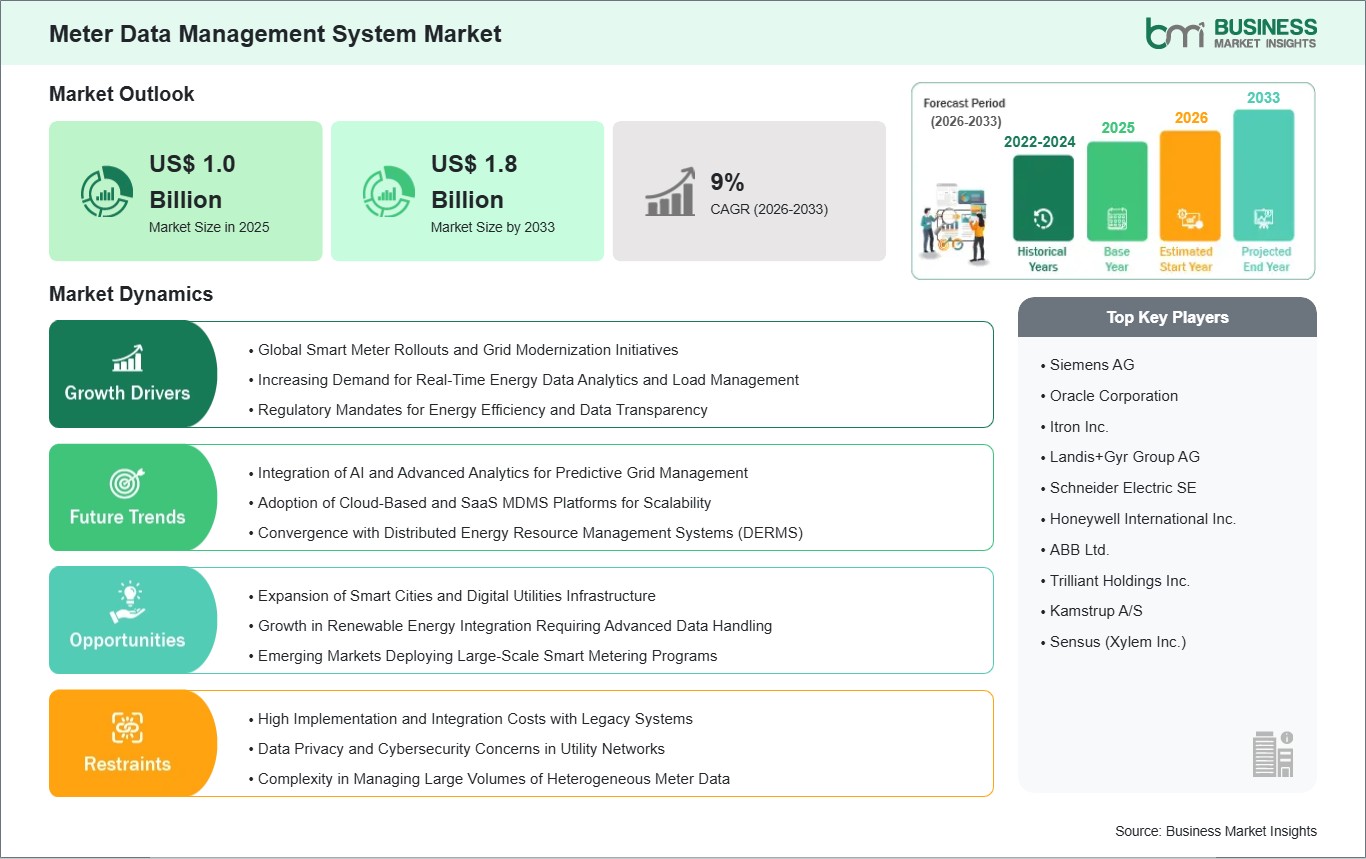
Meter Data Management Systems (MDMS) refer to centralized software platforms engineered to perform long-term storage and advanced processing of the massive volumes of data generated by smart metering infrastructures. Unlike simple data collection tools, an MDMS serves as the system of record that validates, cleanses, and processes raw interval data into billing-ready determinants. These systems provide the essential link between Advanced Metering Infrastructure (AMI) and enterprise applications, such as Billing and Customer Information Systems (CIS), Outage Management Systems (OMS), and Demand Response platforms, enabling utilities to transition from manual reading to automated, data-driven grid operations. Market expansion is fundamentally propelled by government-mandated smart meter rollouts and the urgent requirement for real-time grid balancing amidst the rising integration of variable renewable energy sources.
However, several factors may restrain market progression. Rising cybersecurity concerns remain a significant barrier, as the centralization of sensitive consumer consumption data creates attractive targets for sophisticated digital attacks. Technical challenges regarding the integration of MDMS with legacy utility systems, which often lack standardized communication protocols, can lead to prolonged implementation timelines and increased project risk. Additionally, the industry faces hurdles related to high initial capital expenditures for software licensing and infrastructure, which can be prohibitive for smaller municipal or cooperative utilities in developing economies.
Despite these hurdles, the market holds significant opportunities in the transition to cloud-native and SaaS (Software-as-a-Service) models, which offer the scalability required to handle petabytes of meter data without the need for extensive on-site hardware. The expansion into multi-utility data platforms, where electricity, water, and gas data are managed within a single unified interface, and the integration of Edge-computing-enabled MDMS for millisecond-level fault detection are expected to support long-term development.
Segment Analysis
Meter Data Management System Market Segmentation
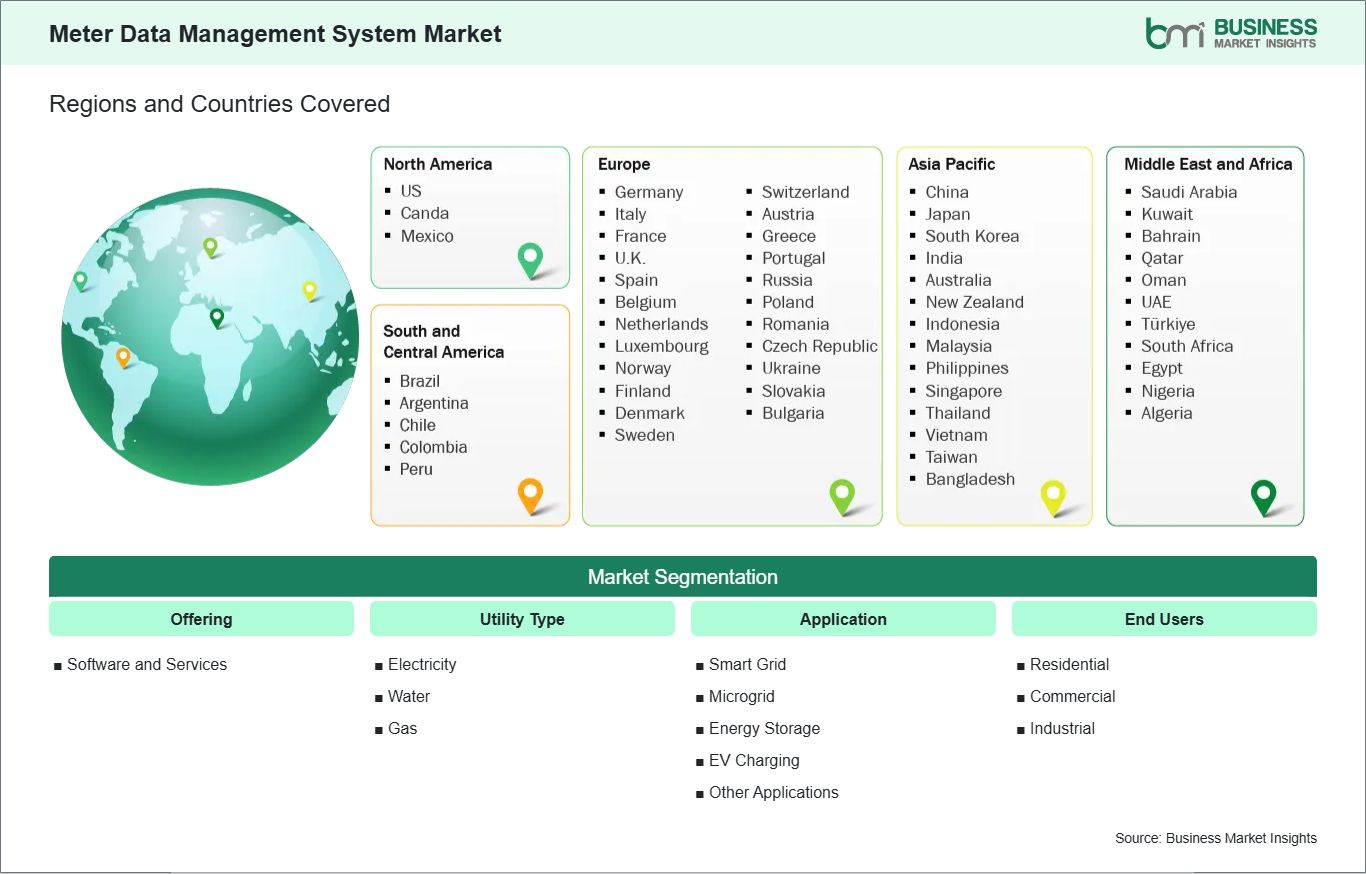
Key segments that contributed to the derivation of the Meter Data Management System market analysis are offering, utility type, application, and end user.
- By Offering, the market is segmented into Software and Services.
- By Utility Type, the market is divided into Electricity, Water, and Gas.
- By Application, the market is categorized into Smart Grid, Microgrid, Energy Storage, EV Charging, and Others.
- By End Users, the market is segmented into Residential, Commercial, and Industrial.
Market Forces
Meter Data Management System Market Drivers and Opportunities
Smart Grid Deployment, Regulatory Compliance, and Energy Efficiency
A primary driver for the meter data management system market is the rapid deployment of smart grids and the increasing installation of smart meters across electricity, water, and gas utilities. MDMS platforms are essential for collecting, validating, and analyzing meter data, enabling utilities to improve billing accuracy, detect anomalies, and optimize energy distribution. Governments and regulatory bodies worldwide are mandating advanced metering infrastructure (AMI) adoption to enhance transparency, reduce losses, and promote energy efficiency. The growing emphasis on sustainability and demand-side management is also fueling adoption, as MDMS solutions help utilities monitor consumption patterns and encourage efficient energy use. Additionally, the rise of distributed energy resources (DERs) such as rooftop solar and battery storage requires sophisticated data management to balance supply and demand, further reinforcing the role of MDMS in modern energy ecosystems. Collectively, smart grid expansion, regulatory compliance, and efficiency initiatives are propelling sustained growth in the MDMS market.
Advanced Analytics, EV Charging Integration, and Emerging Market Expansion
A significant opportunity in the meter data management system market lies in the integration of advanced analytics, support for electric vehicle (EV) charging infrastructure, and expansion into emerging economies. Utilities are increasingly leveraging MDMS platforms with AI and machine learning capabilities to enable predictive maintenance, detect fraud, and forecast demand more accurately. The rise of EV adoption is creating new challenges for grid management, and MDMS solutions are being adapted to monitor charging patterns, manage load balancing, and ensure reliable service. Beyond technological innovation, emerging markets in Asia-Pacific, Africa, and Latin America present lucrative prospects due to rapid electrification, urbanization, and government-led investments in smart infrastructure. Vendors who focus on developing scalable, cost-effective, and digitally enabled MDMS solutions tailored for these regions are well-positioned to capture new market segments. The convergence of advanced analytics, EV integration, and geographic expansion underscores a transformative growth pathway for the global MDMS market.
Size and Share Analysis
Meter Data Management System Market Size and Share Analysis
The Meter Data Management System market demonstrates steady growth, with size and share analysis revealing evolving trends and competitive positioning among key players. The report examines subsegments categorized within offering, utility type, application, and end user, offering insights into their contribution to overall market performance.
Based on application, the Smart Grid subsegment accounts for the highest consumption volume in the MDMS market. These systems are indispensable for Peak Load Management and Distribution Efficiency, ensuring that utilities can balance demand with variable renewable supply while maintaining operational reliability. By enabling real-time monitoring and intelligent distribution, Smart Grid applications anchor demand and continue to drive market stability. Alongside this, the EV Charging and Energy Storage subsegments are registering notable growth and are becoming essential for Decentralised Energy Governance. Here, the ability to track battery cycles and manage electric vehicle charging loads is critical for sustaining grid stability. As energy systems evolve toward distributed and renewable models, these applications are strengthening their influence, positioning themselves as key enablers of modern power infrastructure and long-term sustainability.
Report Coverage
Meter Data Management System Market Report Coverage and Deliverables
The "Meter Data Management System Market Size and Forecast (2022–2033)" report provides a detailed analysis of the market covering:
- Market size and forecast at global, regional, and country levels for all the key market segments covered under the scope
- Market trends, dynamics such as drivers, restraints, and key opportunities
- Market concentration, heat map analysis, prominent players, and recent developments
- Detailed company profiles, including SWOT analysis
Geographic Insights
Meter Data Management System Market Geographic Insights
The geographical scope of the Meter Data Management System market report is divided into five regions: North America, Asia Pacific, Europe, Middle East & Africa, and South & Central America.
North America represents a significant revenue corridor, characterized by early adoption of advanced metering infrastructure (AMI) and a high concentration of leading technology providers. Asia Pacific is identified as the most rapidly expanding region, propelled by large-scale government-mandated smart meter rollouts and extensive grid modernization programs in emerging economies. Europe maintains a strong market position through rigorous regulatory frameworks focused on energy efficiency and the integration of decentralized renewable energy sources. The Asia-Pacific Meter Data Management System Market serves as the primary engine for global industry growth, anchored by massive infrastructural investments in China and India. These nations are leading the transition toward Intelligent Grid Management, prioritizing the deployment of smart meters to reduce non-technical losses and improve billing accuracy. China remains a dominant force, characterized by a substantial volume of AMI shipments and a state-led focus on national power security. India is witnessing a notable transition, marked by visionary government programs and the adoption of time-of-day tariffs, which necessitate robust MDMS platforms for real-time data ingestion and validation.
Industry Activity
Recent Developments
The Meter Data Management System market is evaluated by gathering qualitative and quantitative data post primary and secondary research, which includes important corporate publications, association data, and databases. A few of the key developments in the Meter Data Management System market are:
- In August 2025, Honeywell acquired SparkMeter`s data platform and software technologies, expanding its Smart Energy portfolio. The acquisition strengthens Honeywell Forge Performance+ for Utilities by providing scalable, data-driven solutions for grid modernization and analytics. This move enhances Meter Data Management capabilities for utilities, supporting more efficient and informed operations.
- In February 2024, Itron introduced IEE Cloud for utilities, a cloud-based Meter Data Management platform designed to advance digitalization for energy and water utilities. The platform enables scalable and flexible management of utility data while offering automated processes and enhanced analytics. This development positions Itron to support utilities in integrating distributed energy resources and optimizing operational efficiency.
Trust & Transparency
Research Methodology
The market analysis combines proprietary research with secondary data from government agencies, company disclosures, regulatory filings, industry databases and expert interviews. Market estimates are validated through data triangulation, cross-market benchmarking and analyst
review.
View Full Research Methodology
Key Sources Referred:
World Bank – Global Trade IndicatorsWorld Trade Organization (WTO)International Monetary Fund (IMF)International Trade Administration (ITA)Company WebsitesCompany Annual ReportsCompany Investor Presentations