Market Summary
Executive Summary and Global Market Analysis
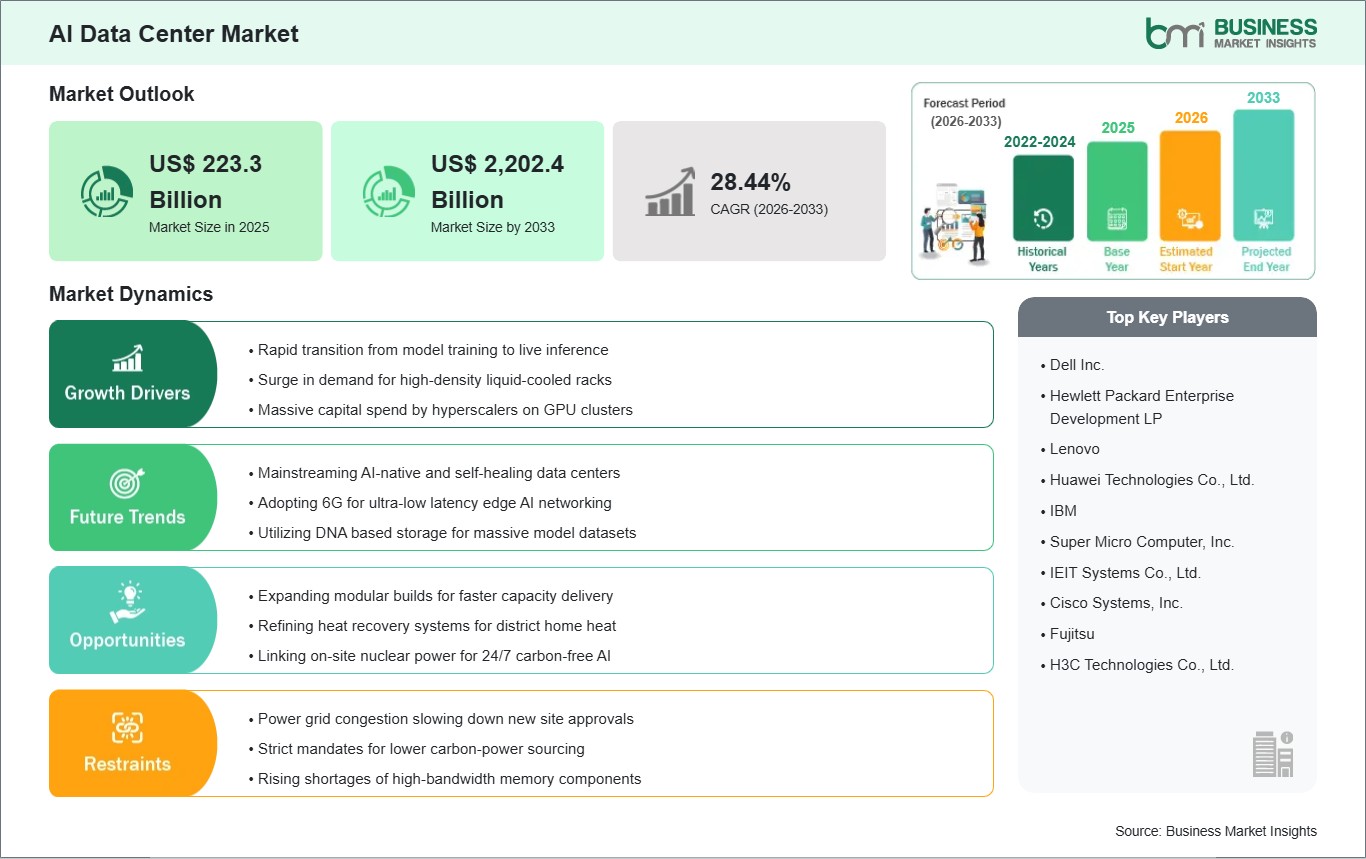
AI data centers are specialized computing facilities designed to meet the substantial computational and thermal requirements of artificial intelligence workloads, including large language model (LLM) training and high-speed inference. These centers serve as the core infrastructure of the global intelligence economy, encompassing hyperscale facilities, GPU-as-a-Service (GPUaaS) clouds, and liquid-cooled colocation centers. These technologies support the training of large neural networks, enable low-latency inference for real-time applications such as autonomous driving, and provide the high-density power delivery needed for generative AI. Market growth is driven by the rapid expansion of generative AI, significant infrastructure investments by technology hyperscalers, and the transition from experimental AI pilots to enterprise-scale production. Additionally, AI-driven Data Center Infrastructure Management (DCIM) uses machine learning to optimize power usage effectiveness (PUE) and predictive maintenance, improving operational efficiency.
However, several challenges can restrain market growth: high initial procurement and integration costs, particularly for advanced liquid cooling retrofits and high-density power distribution, can limit the expansion of smaller colocation providers and enterprise facilities. Stringent regulatory hurdles and evolving environmental standards regarding water usage and carbon emissions from massive energy consumption lengthen the time-to-market for new "mega-campuses" and increase development overhead. Additionally, the industry faces constraints due to technical complexity and a critical shortage of specialized engineering talent, where the lack of expertise in managing 100kW+ rack densities and complex AI-silicon clusters can result in the sub-optimal use of these high-performance environments.
Despite these hurdles, the market holds immense opportunities in the universal mandate for sustainable and power-independent infrastructure and the accelerating deployment of behind-the-meter energy solutions like small modular reactors (SMRs). The expansion of 5G-enabled edge AI data centers, which allow for instantaneous inference processing for autonomous robotics, and the development of sovereign AI clouds to ensure national data security are expected to create significant opportunities for market growth.
Segment Analysis
AI Data Center Market Segmentation
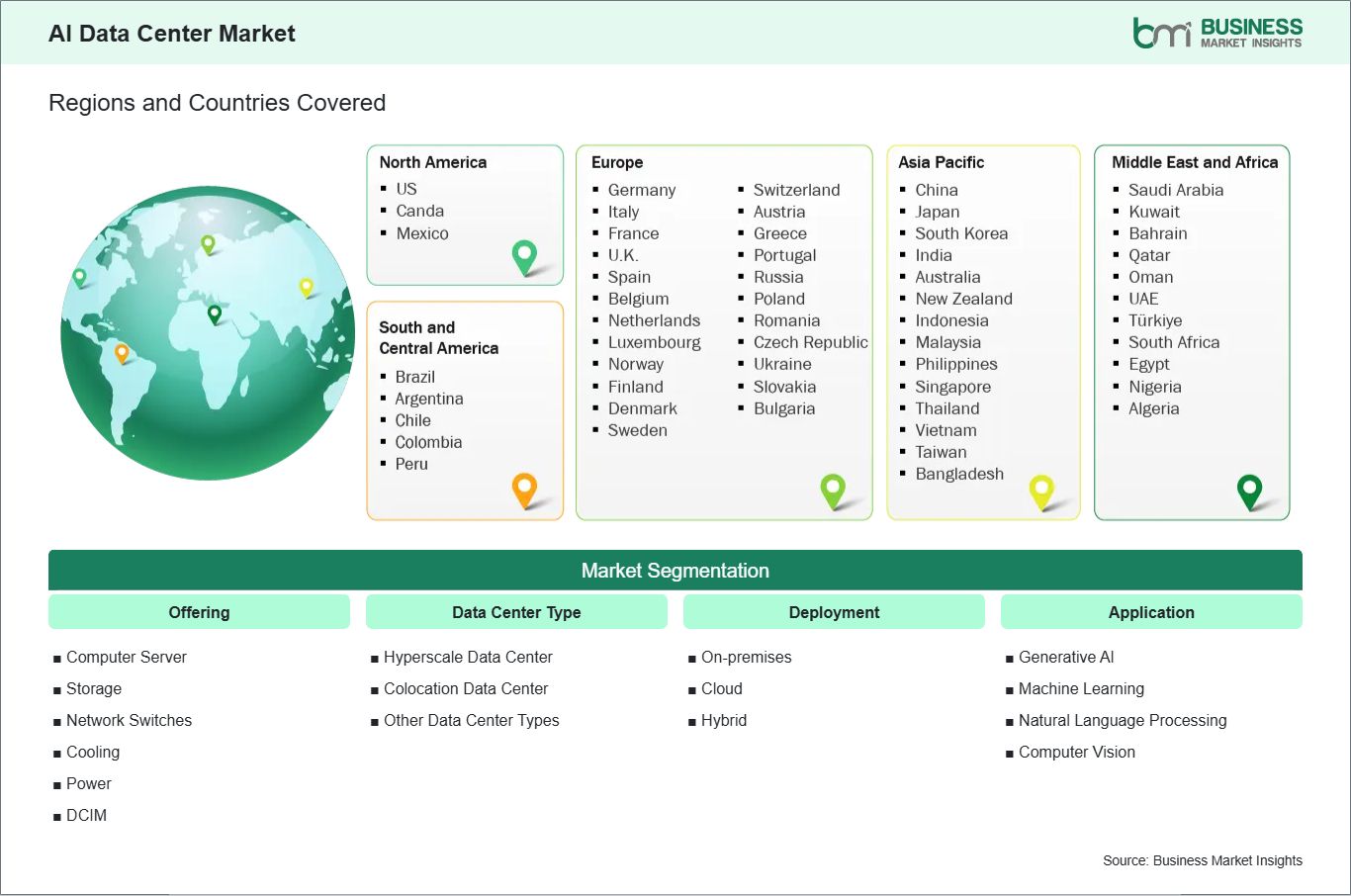
Key segments that contributed to the derivation of the AI Data Center market analysis are offering, data center type, deployment, application, and end user.
- By Offering, the market is segmented into Computer Server, Storage, Network Switches, Cooling, Power, and DCIM.
- By Data Center Type, the market is divided into Hyperscale Data Center, Colocation Data Center, and Others.
- By Deployment, the market is categorized into On-premises, Cloud, and Hybrid.
- By Application, the market is segmented into Generative AI, Machine Learning, Natural Language Processing, and Computer Vision.
- By End User, the market is divided into Cloud Service Providers, Enterprises, and Government Organizations.
Market Forces
AI Data Center Market Drivers and Opportunities
Scaling Generative AI Is Reshaping Data Center Power Systems
The primary driver for the AI Data Center Market is the massive transition of generative AI from experimental pilots to full-scale industrial production. As enterprises integrate large language models (LLMs) and agentic AI into their core workflows, the demand for high-density compute power has shifted from a specialized requirement to a foundational necessity. This "AI arms race" among hyperscalers and sovereign nations has forced a fundamental rethink of power infrastructure; by 2026, electricity availability will have become the defining constraint of the market.
Data centers are evolving from passive energy consumers into active grid stakeholders, investing in on-site power generation, such as natural gas turbines, small modular reactors (SMRs), and massive battery storage, to bypass grid congestion and ensure uptime. This relentless pursuit of compute capacity, backed by over a trillion dollars in planned ecosystem investment through the end of the decade, ensures a robust and high-velocity growth path as AI workloads move increasingly from model training to real-time inference.
Liquid Cooling Adoption and Edge AI Inference Growth
A significant high-value opportunity lies in the rapid adoption of advanced liquid cooling and thermal management systems. As next-generation GPUs and AI accelerators reach thermal design powers (TDP) that exceed the physical limits of traditional air cooling, technologies like direct-to-chip (DTC) and immersion cooling have moved from "niche" to "standard" for new builds. This transition not only enables higher rack densities but also offers a lucrative path for heat-reuse initiatives, where waste heat is redirected to local district heating or industrial processes.
Another major growth frontier is the expansion of Edge AI and Modular Data Centers. To reduce latency and data backhaul costs, AI inference is increasingly being offloaded from centralized hubs to localized nodes in factories, hospitals, and urban centers. This shift creates a massive market for prefabricated, "plug-and-play" modular units that can be deployed in months rather than years. Manufacturers who focus on AI-ready electrical architectures and "sovereign cloud" solutions, allowing nations to process sensitive data locally, are positioned to lead a market that is increasingly defined by speed, efficiency, and regional autonomy.
Size and Share Analysis
AI Data Center Market Size and Share Analysis
The AI Data Center market demonstrates steady growth, with size and share analysis revealing evolving trends and competitive positioning among key players. The report further examines subsegments categorized within offering, data center type, deployment, application, and end user, offering insights into their contribution to overall market performance.
For instance, the Computer Server subsegment holds a significant market share, driven by the insatiable demand for high-performance GPUs and specialized AI accelerators. These servers are indispensable for the Generative AI and Machine Learning subsegment of the application segment, where massive parallel processing is required to train models with trillions of parameters. A notable trend in 2026 is the rapid transition from air cooling to Liquid Cooling solutions, such as direct-to-chip and immersion cooling, which have become a technical necessity for racks exceeding 40 kW. These innovations are particularly vital in Hyperscale Data Centers, where they empower cloud providers to maintain hardware reliability while achieving Power Usage Effectiveness (PUE) ratings as low as 1.15.
Report Coverage
AI Data Center Market Report Coverage and Deliverables
The "AI Data Center Market Size and Forecast (2022 - 2033)" report provides a detailed analysis of the market covering below areas:
- AI Data Center market size and forecast at global, regional, and country levels for all the key market segments covered under the scope
- AI Data Center market trends, as well as market dynamics such as drivers, restraints, and key opportunities
- AI Data Center market analysis covering key market trends, global and regional framework, major players, regulations, and recent market developments
- Industry landscape and competition analysis covering market concentration, heat map analysis, prominent players, and recent developments for the AI Data Center market
- Detailed company profiles, including SWOT analysis
Geographic Insights
AI Data Center Market Geographic Insights
The geographical scope of the AI Data Center market report is divided into five regions: North America, Asia Pacific, Europe, Middle East &Africa, and South &Central America.
The Asia-Pacific AI Data Center Market is segmented into China, Japan, South Korea, India, Australia, New Zealand, Indonesia, Malaysia, the Philippines, Singapore, Thailand, Vietnam, Taiwan, Bangladesh, and the Rest of Asia. The market is primarily driven by the region's aggressive push into Generative AI and the rollout of 5G networks, which necessitate low-latency processing at the edge. China and Japan are leading the transition toward high-performance computing (HPC) facilities, while India and Southeast Asian hubs such as Malaysia are witnessing a surge in "mega-campus" developments. These projects are increasingly focused on overcoming grid constraints through localized power solutions and advanced liquid cooling technologies.
Industry Activity
Recent Developments
The AI Data Center market is evaluated by gathering qualitative and quantitative data post primary and secondary research, which includes important corporate publications, association data, and databases. A few of the key developments in the AI Data Center market are:
- In January 2026, LightHouse Data Centers and Wharton Digital announced the launch of a fully integrated platform to develop, own, and operate hyperscale data centers across North America. The partnership combines LightHouse's deep hyperscale development, leasing, and operational expertise with Wharton's institutional capital and four decades of real estate experience. Together, the platform is positioned to deliver in excess of 2 gigawatts (GW) of capacity to solve accelerating demand from hyperscale, AI, and cloud customers amid industry-wide supply constraints.
- In June 2025, Amazon announced plans to invest a new total of AU$20 billion from 2025 to 2029 to expand, operate, and maintain its data center infrastructure in Australia. The country's largest publicly-announced global technology investment will support the strong growth in customer demand for cloud computing and artificial intelligence (AI), accelerating AI adoption and capability, and the continued modernization of Australian organizations of all sizes.
Trust & Transparency
Research Methodology
The market analysis combines proprietary research with secondary data from government agencies, company disclosures, regulatory filings, industry databases and expert interviews. Market estimates are validated through data triangulation, cross-market benchmarking and analyst
review.
View Full Research Methodology
Key Sources Referred:
Institute of Electrical and Electronics Engineers (IEEE) International Energy Agency (IEA) Company website Company annual reports Company investor presentations