
Data Center Cooling Market Outlook: Size, Share, Trends, Growth Analysis, Competitive Landscape & Forecast, 2026–2033

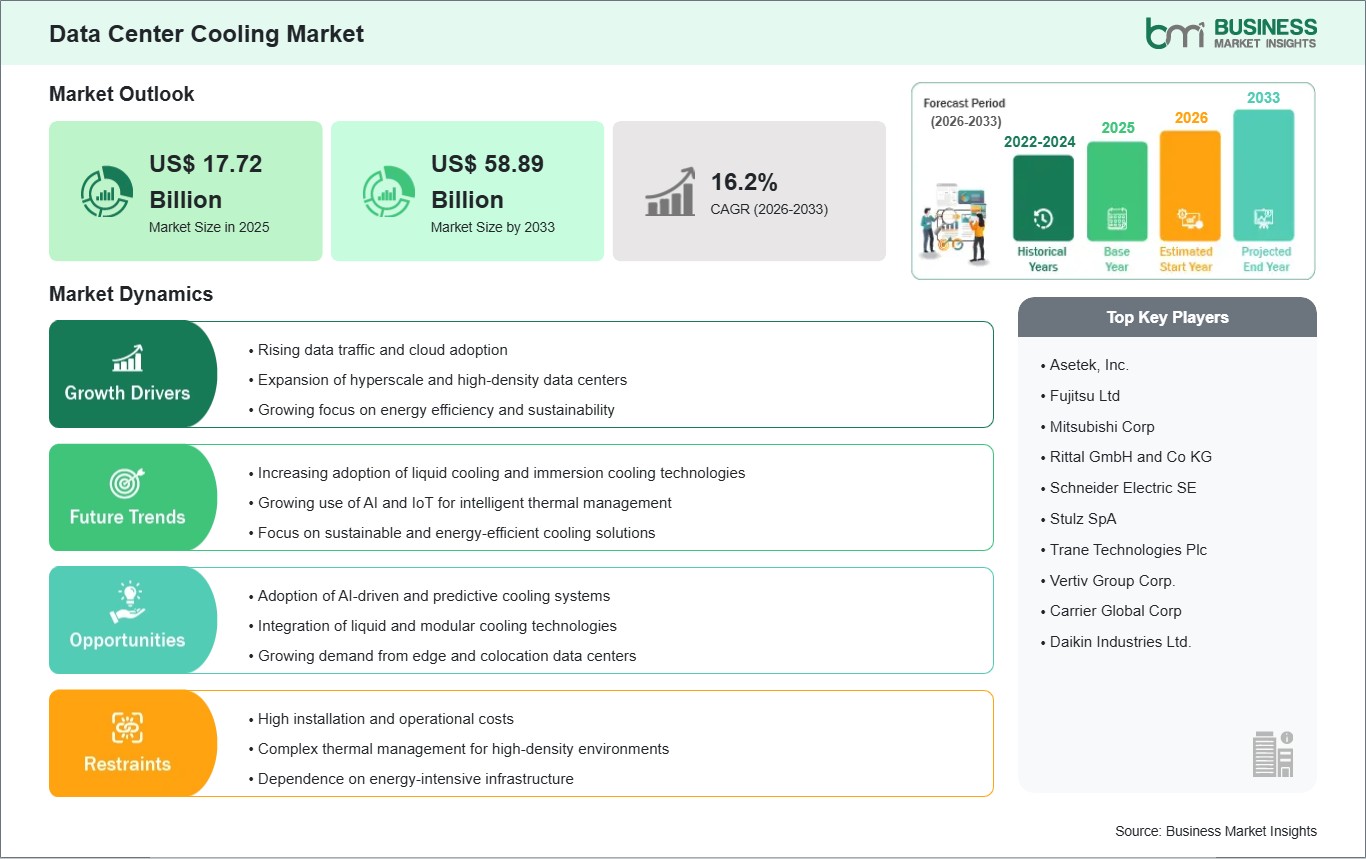
The Data Center Cooling Market size was valued at US$ 16.80 Billion in 2025 and is projected to reach US$ 50.70 Billion by 2033, growing at a CAGR of 15.1% during 2026–2033. Rising AI workloads, hyperscale data center expansion, increasing rack power densities, and growing sustainability mandates are accelerating demand for advanced cooling technologies, while liquid cooling adoption and edge infrastructure investments create significant long-term opportunities.

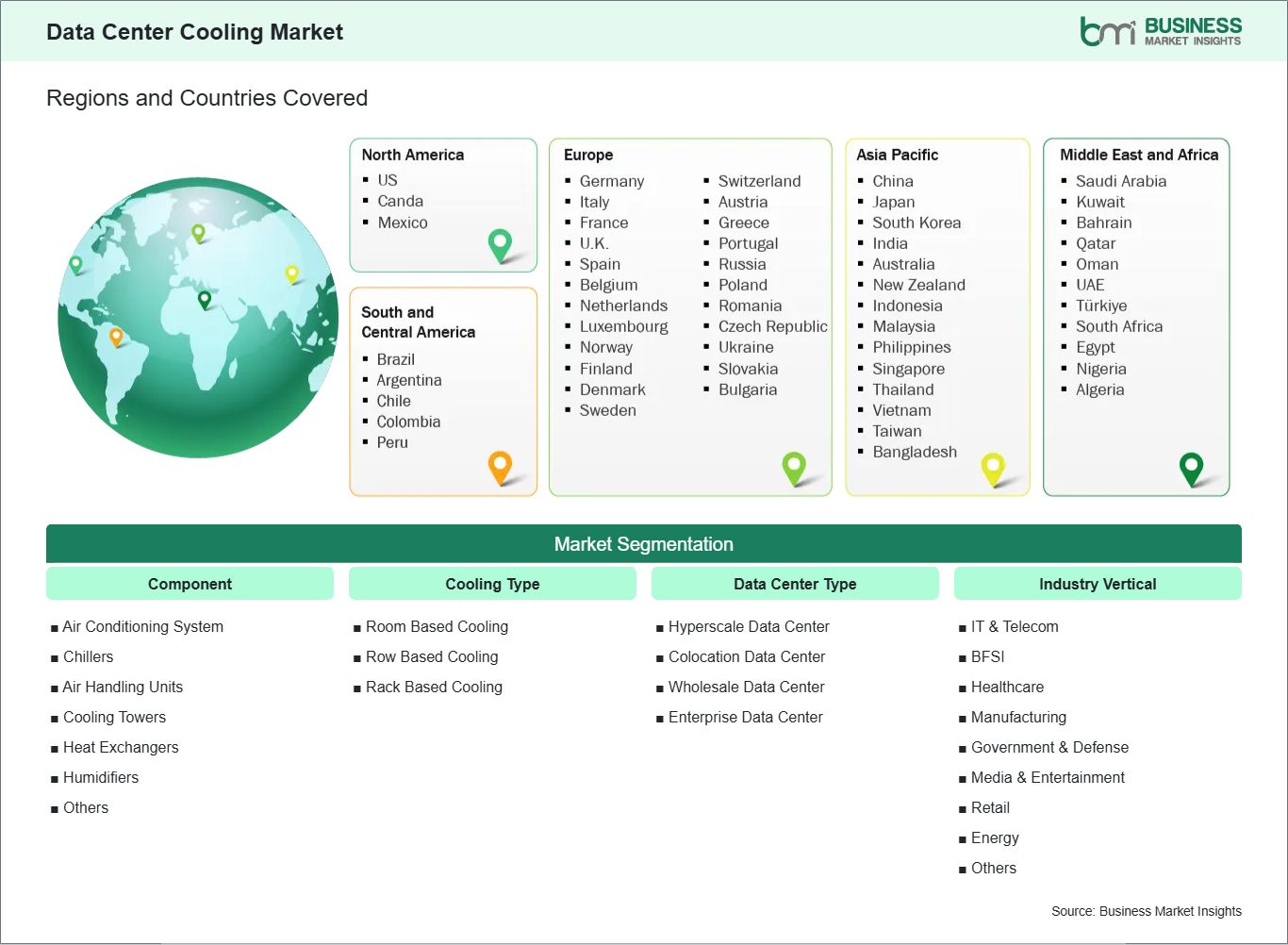
Report Coverage
  • Cooling Technology: Air-based Cooling, Liquid-based Cooling
  • Cooling Component: Air Conditioning , Chilling Units , Cooling Towers, Liquid Cooling Systems, Control Systems, Others
  • Data Center Type: Hyperscale, Enterprise, Colocation
  • Industry: IT and Telecom, Retail and Consumer Goods, Healthcare, Media and Entertainment, Federal and Institutional Agencies, Others
US$ 16.79 Bn Market size in 2025
US$ 50.69 Bn Market Size by 2033
15.1% CAGR, 2026 - 2033
2026-2033 Forecast Period

AI Overview

Data Center Cooling Market Summary

  • North America Region: North America held 32.9% share of the Global Data Center Cooling Market in 2025, growing with a CAGR of 13.3% during 2026–2033. Growth is driven by hyperscale capacity expansion, AI computing deployments, sustainability targets, advanced cooling upgrades, renewable-powered facilities, and increasing investments in high-density rack infrastructure across major colocation hubs globally. The U.S. market remains the regional growth engine, supported by AI facilities and hyperscale expansion, advancing at a CAGR of 12.6%.
  • Fastest Growing Region: Asia Pacific held 25.6% share of the Global Data Center Cooling Market in 2025, growing with a CAGR of 19.8% during 2026–2033. Accelerating digitalization, sovereign cloud initiatives, AI infrastructure investment, data localization regulations, expanding colocation development, smart city programs, and enterprise cloud migration continue creating substantial cooling equipment demand.
  • Leading Segment: Air-based Cooling hold 60.1% share of the Global Market in 2025, growing with a CAGR of 14.3% during 2026–2033. Established deployment practices, lower installation complexity, broad compatibility with existing facilities, optimized airflow management adoption, and retrofit opportunities continue supporting widespread implementation across global facilities.
  • High Growth Segment: Liquid-based Cooling hold 39.9% share of the Global Market in 2025, growing with a CAGR of 16.1% during 2026–2033. Increasing processor heat generation, AI server deployment, efficiency requirements, direct-to-chip innovations, sustainability goals, and reduced energy consumption advantages are accelerating adoption among operators.
  • Key Market Opportunity: Growing deployment of AI training clusters and high-performance computing facilities is generating demand for next-generation cooling architectures, enabling infrastructure operators to improve energy efficiency, server density, operational reliability, and sustainability outcomes.
  • Major Market Players: Rittal GmbH & Co. KG, STULZ GmbH, Johnson Controls International plc, Schneider Electric SE, Vertiv Group Corp., Alfa Laval AB, Dell Technologies Inc., Asetek A/S, ABB Ltd., Nortek Air Solutions, LLC.
Strategic Insights

Data Center Cooling Market: Strategic Insights

Data Center Cooling Market Strategic Framework
FREE PDF
Request your free sample
Request free sample
Stakeholder View

Key Takeaways

  • The market ecosystem is becoming increasingly integrated, with equipment manufacturers, data center operators, software providers, and energy specialists collaborating to optimize thermal performance.
  • Hyperscale facilities offer strong growth potential, driven by AI workloads, cloud expansion, and next-generation enterprise applications.
  • Innovation is shifting toward liquid cooling, direct-to-chip, immersion technologies, and AI-enabled monitoring to improve efficiency and reduce operating costs.
  • Asia Pacific remains an attractive investment market, supported by cloud expansion, digital transformation, and data localization requirements.
  • Investment is increasingly focused on energy-efficient infrastructure, while acquisitions and partnerships strengthen thermal management and data center capabilities.
  • Sustainability is driving adoption of heat recovery, intelligent controls, and low-energy cooling solutions to reduce environmental impact while maintaining performance.
Geographic Outlook

Data Center Cooling Market Regional Highlights

North America Data Center Cooling Market

North America held 32.9% share of the Global Market in 2025, growing with a CAGR of 13.3% during 2026–2033. The region benefits from extensive hyperscale infrastructure, significant AI server deployments, and strong colocation expansion. The Data Center Cooling Market share leadership stems from continuous investment by cloud service providers and enterprise operators upgrading facilities for high-density computing environments.

  • Increased hyperscale construction across various digital infrastructure zones continues to drive demand for highly efficient cooling solutions, intelligent thermal management systems, and energy-efficient facility enhancements to accommodate the growing density of server installations.
  • AI training clusters have driven the need to increase rack power density and, thus, the adoption of thermal management solutions to achieve energy efficiency and reliability.
  • Increased focus on carbon reduction targets has been leading to the adoption of energy-efficient devices, predictive monitoring systems, and thermal optimization techniques that could help reduce operational costs.
  • Utility upgrades and renewable energy sources are supporting next-generation data center construction, which requires highly scalable cooling solutions to meet future computational needs.

US Data Center Cooling Market

The United States held 74.93% share of the North America Data Center Cooling Market in 2025, growing with a CAGR of 12.6% during 2026–2033. Strong AI infrastructure investment, cloud expansion initiatives, and continuous enterprise digital transformation support robust demand for advanced thermal management systems. Large concentrations of hyperscale campuses and colocation facilities generate substantial opportunities for cooling technology suppliers and system integrators.

  • Northern Virginia, Texas, Arizona, and Oregon continue attracting large-scale data center campuses requiring advanced cooling architectures capable of supporting future computing capacity expansion.
  • Rapid deployment of generative AI infrastructure is increasing demand for liquid-assisted and direct-to-chip cooling solutions across high-density computing environments.
  • Enterprise modernization programs are creating retrofit opportunities for advanced airflow management technologies, precision air conditioning systems, and intelligent thermal control platforms.
  • Growth in edge computing deployments is generating incremental demand for compact and energy-efficient cooling systems tailored for distributed infrastructure environments.

Europe Data Center Cooling Market

Europe held 27.9% share of the Global Data Center Cooling Market in 2025, growing with a CAGR of 12.4% during 2026–2033. Sustainability regulations, renewable energy integration, and growing data sovereignty requirements are driving investments in efficient cooling technologies. Germany and the United Kingdom remain major deployment markets, while Spain and Poland are emerging as high-growth locations. The region increasingly prioritizes solutions that reduce power consumption and improve thermal performance across modern facilities.

  • Germany leads regional demand through a strong industrial digitalization ecosystem and expanding enterprise cloud infrastructure requiring high-performance thermal management solutions.
  • The United Kingdom remains a strategic colocation hub, supporting deployment of advanced cooling equipment across large-scale data center clusters serving international customers.
  • Poland continues attracting infrastructure investments due to favorable operating conditions and increasing demand for localized cloud and digital services.
  • Sustainability regulations encourage adoption of liquid cooling technologies, heat reuse systems, and intelligent controls designed to lower overall energy consumption.

Asia Pacific Data Center Cooling Market

Asia Pacific held 25.6% share of the Global Market in 2025, growing with a CAGR of 19.8% during 2026–2033. making it the fastest-growing region. Within the Data Center Cooling Market Scope, large-scale cloud investments, increasing internet penetration, and government-supported digital transformation programs are accelerating infrastructure deployment. China remains the largest regional market, while India demonstrates particularly rapid expansion. Continuous demand for colocation, hyperscale, and enterprise facilities is supporting substantial investment in advanced cooling technologies across the region.

  • China leads regional demand through hyperscale development, cloud expansion, and AI infrastructure deployment.
  • India is among the fastest-growing markets, driven by digitalization, data localization, and enterprise cloud adoption.
  • Southeast Asia is attracting significant colocation investment, creating demand for scalable, efficient cooling solutions.
  • Public and private digital infrastructure programs are driving adoption of next-generation cooling technologies.

Rest of World Data Center Cooling Market

Rest of World held 13.7% share of the Global Data Center Cooling Market in 2025, growing with a CAGR of 12.9% during 2026–2033. South and Central America continue benefiting from cloud infrastructure investment and increasing enterprise digitalization. Meanwhile, Middle East and Africa markets gain momentum through smart city initiatives, government-backed digital transformation programs, and expanding colocation capacity.

The United Arab Emirates and Saudi Arabia lead Middle Eastern investments, while Brazil remains the largest market across Latin America. Growing regional demand for cloud services and digital platforms continues supporting adoption of advanced cooling infrastructure.

  • Brazil remains a leading Latin American market due to rising cloud adoption, enterprise digitalization initiatives, and expanding colocation infrastructure developments.
  • Mexico continues witnessing investment activity from global technology providers seeking additional capacity to support regional digital transformation requirements.
  • Saudi Arabia is emerging as a high-growth destination supported by major smart infrastructure and digital economy investment programs.
  • The United Arab Emirates continues expanding advanced data center capacity, generating demand for efficient thermal management technologies optimized for hot climates.
Global Market Geography
FREE PDF
Request your free sample
Request free sample
Segment Analysis

Data Center Cooling Market Segmentation

Cooling Technology

Cooling Technology remains the foundation of thermal management infrastructure, with Air-based Cooling accounting for 60.1% market share in 2025 and growing at a CAGR of 14.3% during 2026–2033. Increasing deployment of AI servers is accelerating adoption of liquid alternatives. Liquid-based Cooling is the fastest-growing technology category, driven by increasing AI workloads, high-density computing environments, and demand for improved thermal efficiency.

  • Air-based Cooling: Remains the most widely deployed approach because of established infrastructure compatibility, easier installation, and strong suitability across enterprise, colocation, and legacy facilities undergoing thermal efficiency improvements.
  • Liquid-based Cooling: Experiences accelerated adoption as operators seek improved thermal management capabilities for AI workloads, high-performance computing environments, and increasingly dense server architectures demanding enhanced heat transfer efficiency.

Cooling Component

The Cooling Component segment is led by Air Conditioning systems, representing approximately 30.3% market share in 2025 and expanding at a CAGR of 11.6% during 2026–2033. Rising AI workloads and hyperscale facility expansion are increasing adoption of advanced component technologies. Liquid Cooling Systems are the fastest-growing component category, benefiting from high-density computing requirements and growing operator focus on energy-efficient thermal management infrastructure.

  • Air Conditioning: Widely utilized for precision climate control and airflow optimization, supporting stable operating conditions across enterprise, colocation, and hyperscale environments requiring dependable thermal performance.
  • Chilling Units: Critical for removing excess heat in large-scale facilities where centralized cooling architectures deliver operational efficiency and reliable temperature control under demanding workloads.
  • Cooling Towers: Support heat rejection processes in large facilities and remain important for improving overall cooling efficiency while managing operating costs across extensive infrastructure deployments.
  • Liquid Cooling Systems: Gain momentum due to increasing deployment of AI servers and high-density computing equipment requiring direct and highly efficient heat removal capabilities.
  • Control Systems: Enable predictive monitoring, thermal optimization, automated adjustments, and operational visibility, improving cooling performance and supporting energy management objectives throughout facilities.

Data Center Type

The Data Center Type segment is led by Hyperscale data centers, representing approximately 46.0% market share in 2025 and expanding at a CAGR of 14.4% during 2026–2033. Large investments by cloud vendors, AI infrastructure vendors, and digital platforms continue to support segment leadership. The colocation data center segment is becoming one of the fastest-growing categories due to rising outsourcing trends.

  • Hyperscale: Leads adoption of advanced cooling technologies because of massive computing requirements, energy-efficiency targets, and continuous investment in next-generation digital infrastructure.
  • Enterprise: Maintains stable demand through modernization projects focused on operational efficiency, business continuity, and support for evolving digital transformation initiatives.
  • Colocation: Expands steadily as organizations outsource infrastructure requirements, creating demand for flexible and scalable cooling systems capable of supporting diverse customer workloads.

Industry

The Industry segment is led by IT and Telecom, representing approximately 43.8% market share in 2025 and expanding at a CAGR of 15.9% during 2026–2033. Growth is fueled by cloud computing, 5G rollout, the rise of AI, and increased worldwide data usage. The healthcare industry is the leading industry category in terms of growth rates, driven by high investment in healthcare IT.

  • IT and Telecom: Represents the largest end-user base due to continuous cloud expansion, network modernization, and growing demand for computational capacity supporting digital services.
  • Retail and Consumer Goods: Increasingly adopts advanced data infrastructure to support e-commerce, customer analytics, inventory management, and omnichannel operational strategies.
  • Healthcare: Benefits from growing use of digital records, telemedicine platforms, diagnostic technologies, and data-intensive applications requiring secure infrastructure environments.
  • Media and Entertainment: Generates demand through streaming services, digital content production, and high-volume data processing requirements associated with modern media ecosystems.
  • Federal and Institutional Agencies: Continue investing in secure data infrastructure supporting governance, public services, digital transformation programs, and mission-critical operational requirements.
Market Forces

Data Center Cooling Market Dynamics

Key Market Drivers

Rising AI Workloads and High-Density Computing Requirements

The rapid integration of artificial intelligence, machine learning, and computing infrastructure is increasing thermal loads in the facilities that house them. High performance processors and computing systems produce more heat compared to traditional servers, necessitating that facility managers invest in cooling technologies. Facility managers need cooling solutions that can support rack densities higher than those in conventional enterprise environments. Data Center Cooling Market growth is closely linked to continued investments in AI-ready infrastructure, as hyperscale providers seek improved thermal management strategies.

Expansion of Hyperscale and Colocation Infrastructure

Global cloud adoption and digital transformation initiatives continue driving construction of hyperscale campuses and large colocation facilities. Such trends result in continuous demand for scalable systems capable of sustaining hundreds of servers operating non-stop. Operators are emphasizing the importance of energy efficiency, resilience, and operational sustainability, increasing capacity to accommodate the growing needs of enterprises and consumers in the digital world. The development of large-scale projects is associated with the implementation of cooling systems during the design of facilities. Geographic expansion into developing countries also helps meet demand.

Increasing Focus on Energy Efficiency and Sustainability

Energy use has become a key operational performance measure for facility managers seeking to minimize expenses and be environmentally friendly. Cooling systems are the major energy consumers in facilities; therefore, there is a need to implement more efficient cooling methods. The regulatory policies, carbon-reduction goals, and environmental commitments of corporations have facilitated this trend. Data Center Cooling Market trends indicate a growing preference for solutions that optimize power utilization effectiveness while maintaining reliable operating conditions. Operators increasingly evaluate cooling investments based on lifecycle efficiency improvements and emissions reduction potential.

Key Market Opportunities

Commercialization of Advanced Liquid Cooling Technologies

The increasing use of AI clusters and HPC computing infrastructure offers immense opportunities for providers of liquid cooling solutions. The traditional air-based system is constrained in its ability to scale with rising rack density, creating an ideal situation for the deployment of direct-to-chip, rear-door heat exchanger, and immersion cooling solutions. The operators of the infrastructure are looking to provide the thermal management solutions that will cater to their computing needs of the future with low energy usage. Long-term Data Center Cooling Market Forecasts indicate substantial opportunities for suppliers capable of delivering reliable, cost-effective liquid cooling solutions that meet evolving infrastructure requirements.

Growth of Edge Data Center Deployments

Edge computing is creating new avenues for market expansion as organizations process data closer to end users and connected devices. Distributed architecture demands a cooling system that is compact and energy efficient enough to function in limited space. Telecom operators, industrial organizations, and digital firms are continuously making investments in local infrastructure for the delivery of low latency services. This development offers opportunities to develop new thermal management products tailored for deployment at the edge.

Integration of AI-Based Cooling Management Platforms

Intelligent thermal management technologies represent a growing opportunity for market participants seeking differentiation through software-enabled optimization capabilities. AI and Predictive Analytics enable the operator to monitor performance, identify areas for improvement, and automatically adjust cooling systems based on the results. Such technology may be used to reduce energy consumption, enhance machine reliability, and minimize operating costs. It is projected that the usage of intelligent facility management systems will become more popular due to improved visibility provided by them.

Market Restraints and Challenges

High Capital Costs of Advanced Cooling Architectures

Factor: Advanced liquid cooling systems, immersion technologies, and integrated control platforms often require substantial upfront investment beyond conventional cooling approaches. Impact: High implementation costs may hinder the adoption of such operators with budget limitations. Most firms must analyze their ROI carefully before adopting well-established aerial systems. Other costs include facility changes, infrastructure improvements, and staff training.

Operational Complexity and Skills Availability

Factor: The deployment of sophisticated thermal management technologies frequently requires specialized technical expertise for design, operation, monitoring, and maintenance. Impact: A shortage of professionals can pose challenges for implementation and increase risks during operations. Most companies have trouble creating the internal capacity needed to handle such complex cooling systems. The integration with already existing facilities could necessitate tailored engineering solutions which will make implementation take longer.

Company Analysis

Competitive Landscape

The competitive environment remains characterized by technology innovation, energy-efficiency improvements, and strategic partnerships. The Data Center Cooling Market analysis indicates that vendors are increasingly focusing on liquid cooling, intelligent thermal management, and integrated infrastructure solutions to address high-density computing requirements.

Company Name

Overview

Products and Services relevant to this market

Rittal GmbH & Co. KG

Global industrial enclosure and infrastructure provider with strong presence in thermal management and data center solutions.

IT cooling systems, precision air conditioning, modular data center solutions, rack-based cooling technologies, and thermal management infrastructure.

STULZ GmbH

Specialized cooling technology company serving mission-critical environments worldwide.

Precision air conditioning systems, chilled water solutions, cyber cooling products, and thermal management solutions for data centers.

Johnson Controls International plc

Building technologies leader offering integrated energy and infrastructure solutions.

Chillers, air handling systems, building controls, thermal management platforms, and energy-efficient cooling technologies.

Schneider Electric SE

Global specialist in energy management and digital infrastructure solutions.

EcoStruxure platforms, cooling systems, monitoring software, thermal management solutions, and integrated data center infrastructure.

Vertiv Group Corp.

Major provider of critical digital infrastructure supporting enterprise and hyperscale facilities.

Precision cooling solutions, liquid cooling technologies, thermal management systems, and critical infrastructure support services.

Alfa Laval AB

Engineering company specializing in heat transfer and fluid handling technologies.

Heat exchangers, liquid cooling systems, thermal transfer equipment, and energy-efficient cooling components.

Dell Technologies Inc.

Leading technology provider supporting enterprise and AI infrastructure deployments.

AI-ready server infrastructure, liquid-cooled systems, integrated cooling-enabled computing solutions, and data center technologies.

Asetek A/S

Specialized developer of liquid cooling technologies for high-performance computing environments.

Direct liquid cooling systems, rack-level cooling technologies, thermal management components, and performance optimization solutions.

ABB Ltd.

Global electrification and automation company serving industrial and infrastructure markets.

Data center automation, cooling control systems, energy management technologies, and intelligent infrastructure solutions.

Nortek Air Solutions, LLC

Manufacturer of custom air handling and environmental control solutions.

Custom air handling units, ventilation technologies, precision airflow systems, and facility cooling equipment.

Trust & Transparency

Research Methodology

The market analysis combines proprietary research with secondary data from government agencies, company disclosures, regulatory filings, industry databases and expert interviews. Market estimates are validated through data triangulation, cross-market benchmarking and analyst review.

View Full Research Methodology

Questions Answered

Frequently Asked Questions

What does a Data Center Cooling Market Report typically evaluate?

A Market Report generally analyzes technology adoption, regional demand patterns, competitive positioning, growth opportunities, regulatory influences, investment trends, and evolving thermal management requirements.

Which end-use industry generates the highest demand?

IT and Telecom remains the largest end-user segment because cloud services, network modernization, and digital transformation initiatives require substantial computing and cooling infrastructure.

Why is Asia Pacific emerging as a key market?

Rapid digitalization, cloud adoption, government-backed infrastructure initiatives, and increasing investments in hyperscale and colocation facilities are accelerating demand throughout Asia Pacific.

Which cooling technology segment is growing fastest?

Liquid-based cooling is the fastest-growing technology segment due to its ability to efficiently manage heat generated by AI servers, high-performance computing systems, and dense rack environments.

What is driving demand for advanced cooling technologies in data centers?

Increasing AI workloads, higher rack densities, cloud infrastructure expansion, and sustainability initiatives are driving adoption of advanced cooling systems capable of delivering improved thermal efficiency and reliability.

Access the Full Data Center Cooling Market Report

Get segment-level forecasts, regional estimates, competitive benchmarking, company profiles and downloadable Excel datasets.

Access the full Data Center Cooling Market Report
400 pages PDF & Excel | 2026-10-15
Similar Research

Related Market Reports