Market Summary
Executive Summary and Global Market Analysis
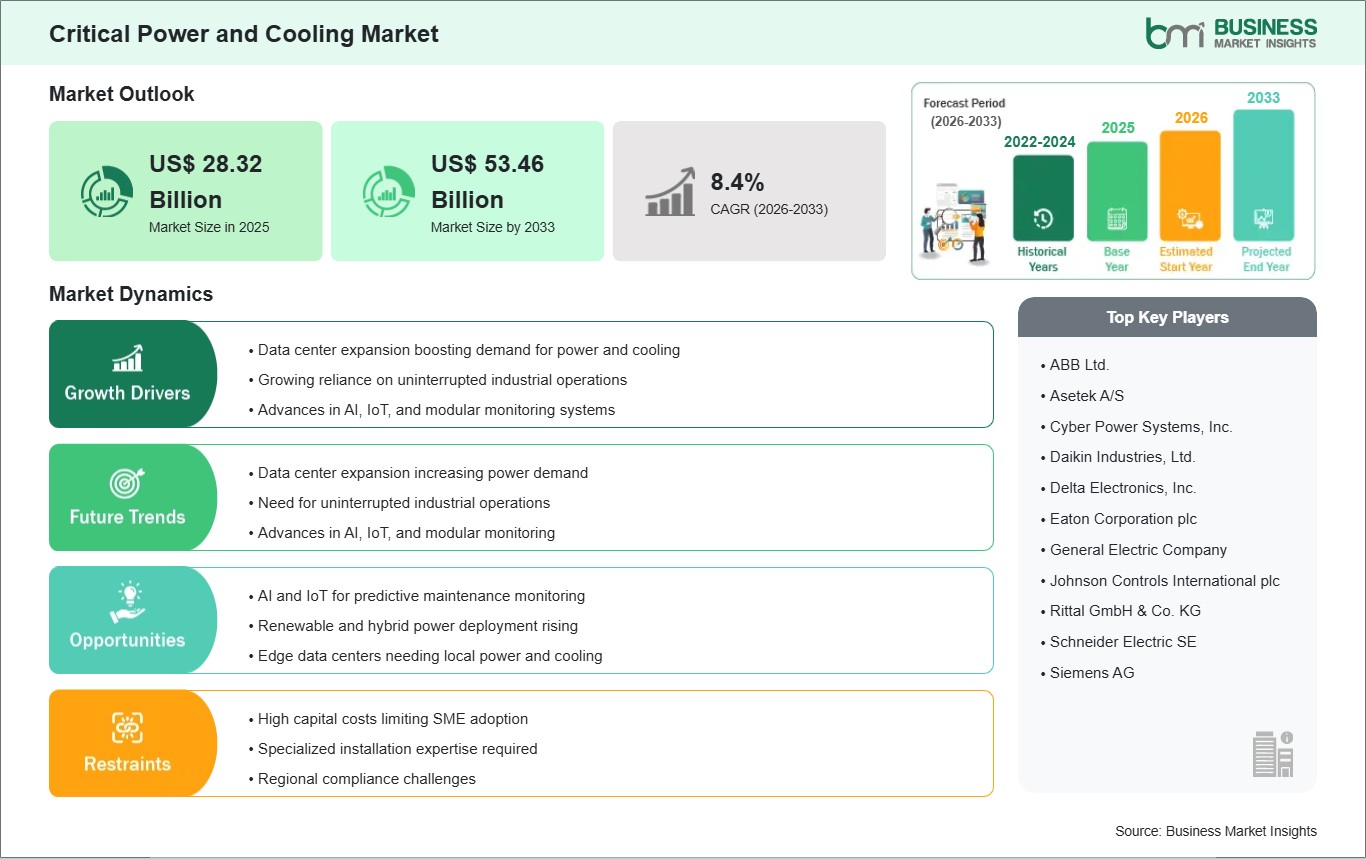
The Critical Power and Cooling Market is fundamentally driven by the growing reliance on digital infrastructure and uninterrupted operational continuity across industries. Data centers, healthcare facilities, telecom networks, and industrial plants require highly reliable power and cooling systems to prevent costly downtime, equipment failure, or data loss. Unlike conventional power solutions, critical power systems such as uninterruptible power supplies (UPS), generators, and precision cooling units are designed to provide redundancy, reliability, and precise environmental control. This focus on reliability is further amplified by the exponential growth of cloud computing, artificial intelligence workloads, and big data, which demand not only high energy capacity but also sophisticated thermal management solutions. Consequently, the market emphasizes technological innovation, modular system designs, and advanced monitoring for proactive management of energy and cooling efficiency.
Energy efficiency and sustainability are increasingly shaping market trends. Organizations are under pressure to reduce carbon footprints, optimize operational costs, and comply with stringent regulatory standards. As a result, vendors are integrating intelligent power management, AI-driven monitoring, and high-efficiency cooling technologies to ensure optimal performance with minimal energy consumption. This qualitative shift toward eco-conscious and automated solutions reflects broader global priorities for sustainability while meeting critical operational demands. Moreover, the adoption of modular and scalable systems allows businesses to tailor power and cooling infrastructure to evolving needs, improving flexibility and cost-effectiveness in dynamic industrial and IT environments.
Despite these growth drivers, the market faces notable challenges, including high capital expenditure, technical complexity, and diverse regional regulatory frameworks. Smaller enterprises or emerging markets may find the initial investment prohibitive, limiting penetration. Additionally, integrating advanced systems requires specialized expertise for installation, maintenance, and system optimization. Nevertheless, the long-term strategic value of uninterrupted power and precise thermal management—mitigating downtime, safeguarding sensitive equipment, and supporting digital transformation—ensures that the critical power and cooling market remains a resilient and high-priority segment in the global infrastructure landscape.
Segment Analysis
Critical Power and Cooling Market Segmentation
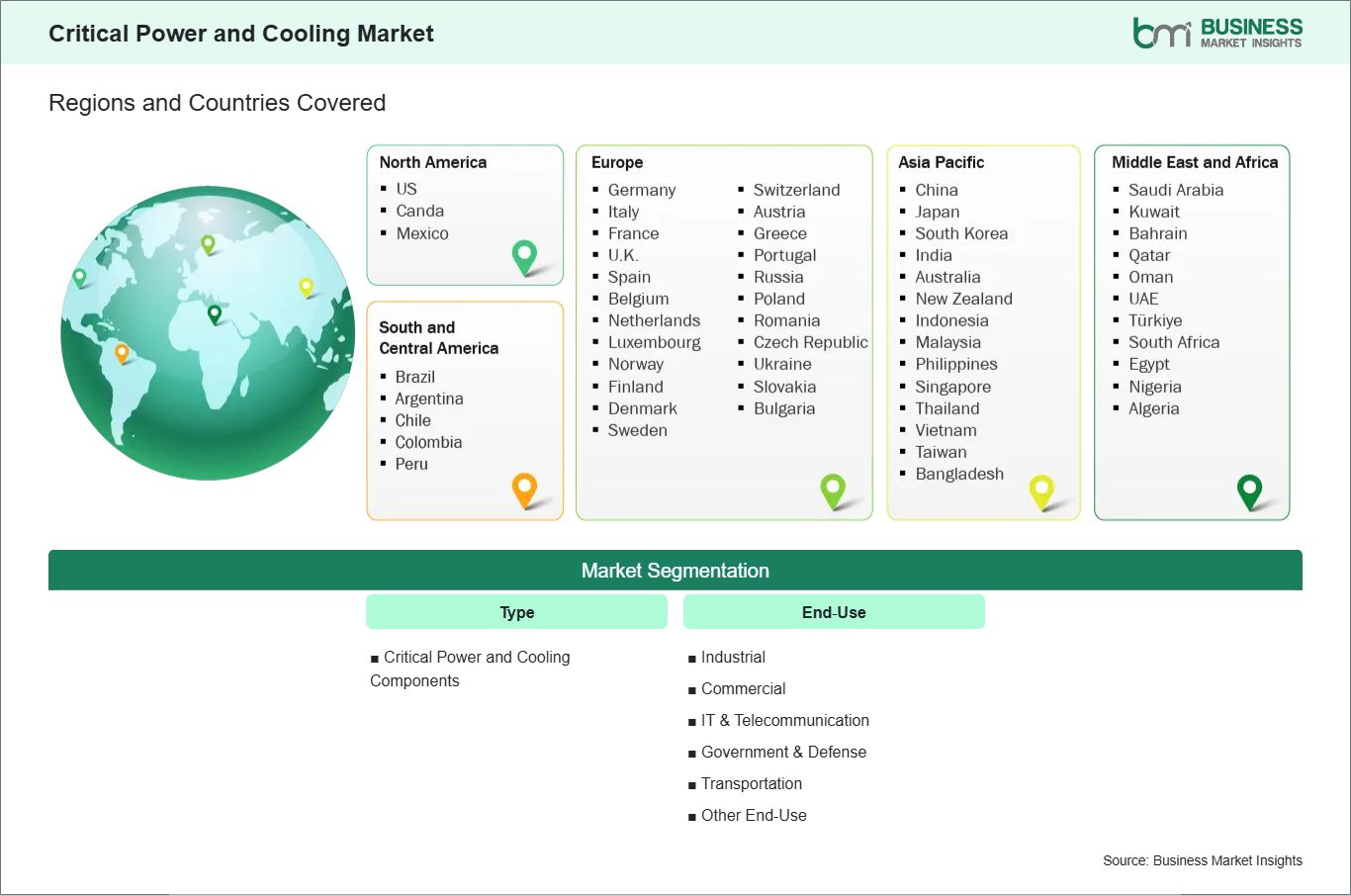
Key segments that contributed to the derivation of the Critical Power and Cooling market analysis are critical power type, cooling component, end-use.
- Critical power type segment is divided into UPS, Generators, and Others. The UPS segment accounted for the largest share of the Critical Power market in 2025.
- Cooling component segment is divided into Air Conditioning, Chilling Units, Cooling Towers, Liquid Cooling Systems, and Others. The Air Conditioning segment accounted for the largest share of the Critical Cooling market in 2025.
- The market is segmented into Industrial, Commercial, IT & Telecommunication, Government & Defense, and Transportation. The IT & Telecommunication segment accounted for the largest share in 2025.
Market Forces
Critical Power and Cooling Market Drivers and Opportunities
Rapid Expansion of Data Centers and Digital Infrastructure
The surge in cloud computing, AI workloads, big data, and IoT services is driving unprecedented demand for reliable power and cooling solutions. Data centers and digital facilities require uninterrupted power and precise thermal management to prevent downtime, equipment damage, or data loss. This trend is fueling investment in advanced UPS systems, generators, precision cooling, and intelligent monitoring solutions, positioning critical power and cooling as a core requirement for modern IT infrastructure.
Industrial and Commercial Reliance on Operational Continuity
Industries such as healthcare, telecom, manufacturing, and banking increasingly depend on continuous operations. Any disruption in power or cooling can lead to financial losses, safety hazards, and reputational damage. As a result, businesses are adopting advanced power backup and precision cooling systems to ensure reliability and compliance with operational and regulatory standards.
Energy-Efficient and Sustainable Solutions
Growing environmental regulations and cost pressures create opportunities for energy-optimized power and cooling solutions. Companies can leverage AI-enabled monitoring, modular systems, and eco-friendly technologies to improve efficiency while reducing carbon footprints.
Emerging Markets and Regional Expansion
Developing regions in Asia-Pacific, Africa, and South & Central America present significant growth potential due to increasing digitalization, industrialization, and urbanization. Vendors can expand operations, introduce scalable solutions, and capture first-mover advantages in these high-growth markets.
Size and Share Analysis
Critical Power and Cooling Market Size and Share Analysis
Critical power type segment is divided into UPS, Generators, and Others. The UPS segment accounted for the largest share of the Critical Power market in 2025, due to its widespread adoption in data centers and critical infrastructure for uninterrupted power supply.
Critical cooling type segment is divided into Air Conditioning, Chilling Units, Cooling Towers, Liquid Cooling Systems, and Others. The Air Conditioning segment accounted for the largest share of the Critical Cooling market in 2025, as it is essential for maintaining optimal operating conditions in IT and telecommunication facilities.
The market is segmented into Industrial, Commercial, IT & Telecommunication, Government & Defense, and Transportation. The IT & Telecommunication segment accounted for the largest share in 2025, driven by the growing demand for reliable power and cooling solutions to support expanding data centers and network infrastructure.
Report Coverage
Critical Power and Cooling Market Report Coverage and Deliverables
The "Critical Power and Cooling Market Size and Forecast (2022-2033)" report provides a detailed analysis of the market covering below areas:
- Critical Power and Cooling market size and forecast at global, regional, and country levels for all the key market segments covered under the scope
- Critical Power and Cooling market trends, as well as market dynamics such as drivers, restraints, and key opportunities
- Critical Power and Cooling market analysis covering key market trends, global and regional framework, major players, regulations, and recent market developments
- Industry landscape and competition analysis covering market concentration, heat map analysis, prominent players, and recent developments for the Critical Power and Cooling market
- Detailed company profiles, including SWOT analysis
Geographic Insights
Critical Power and Cooling Market Geographic Insights
The geographical scope of the Critical Power and Cooling market report is divided into five regions: North America, Asia Pacific, Europe, Middle East & Africa, and South & Central America. The Critical Power and Cooling market in Asia Pacific is expected to grow significantly during the forecast period.
The Critical Power and Cooling Market demonstrates significant regional diversity in adoption and growth. North America is the largest market, led by the United States, due to its mature data center ecosystem, cloud infrastructure expansion, and strong demand for energy-efficient, reliable power and cooling solutions. Europe is also a major player, driven by stringent energy regulations, sustainability mandates, and modernization of IT and industrial infrastructure, with Germany, the United Kingdom, and France leading adoption.
The Asia Pacific region is the fastest-growing market, fueled by rapid digitalization, cloud adoption, and government initiatives in China, India, Japan, and Southeast Asia, with emerging hubs in Singapore and Malaysia. South and Central America are experiencing steady growth, supported by expanding telecom networks and digital infrastructure in countries like Brazil and Argentina. Meanwhile, the Middle East and Africa show rising potential, particularly in GCC countries, where investment in data centers and energy-efficient cooling systems is increasing to support digital transformation.
Industry Activity
Recent Developments
The Critical Power and Cooling market is evaluated by gathering qualitative and quantitative data post primary and secondary research, which includes important corporate publications, association data, and databases. A few of the key developments in the Critical Power and Cooling market are:
- In October 2024, Schneider Electric has opened a new Critical Power and Cooling Hub in Leeds, UK to tackle the growing data centre skills shortage. The facility provides hands-on training on UPS, cooling systems, energy management, and safety standards for customers, partners, and engineers. It complements existing UK hubs and aims to build a skilled workforce to support expanding digital infrastructure and future technologies.
- In July 2025, Vertiv announced the launch of its Liebert XDU1350 coolant distribution unit, engineered to support high-density, liquid-cooled data center environments. The system is designed to enhance thermal management efficiency for AI and high-performance computing (HPC) workloads by enabling precise temperature control and scalable deployment. Featuring advanced monitoring capabilities and compact integration, the XDU1350 helps data center operators improve energy efficiency and reliability while addressing increasing rack power densities.
Trust & Transparency
Research Methodology
The market analysis combines proprietary research with secondary data from government agencies, company disclosures, regulatory filings, industry databases and expert interviews. Market estimates are validated through data triangulation, cross-market benchmarking and analyst
review.
View Full Research Methodology
Key Sources Referred:
World Bank - Global Trade IndicatorsWorld Trade Organization (WTO)International Monetary Fund (IMF)International Trade Administration (ITA)Company websiteCompany annual reportsCompany investor presentations