
Data Center Accelerator Market Outlook: Size, Share, Trends, Growth Analysis, Competitive Landscape & Forecast, 2026-2033

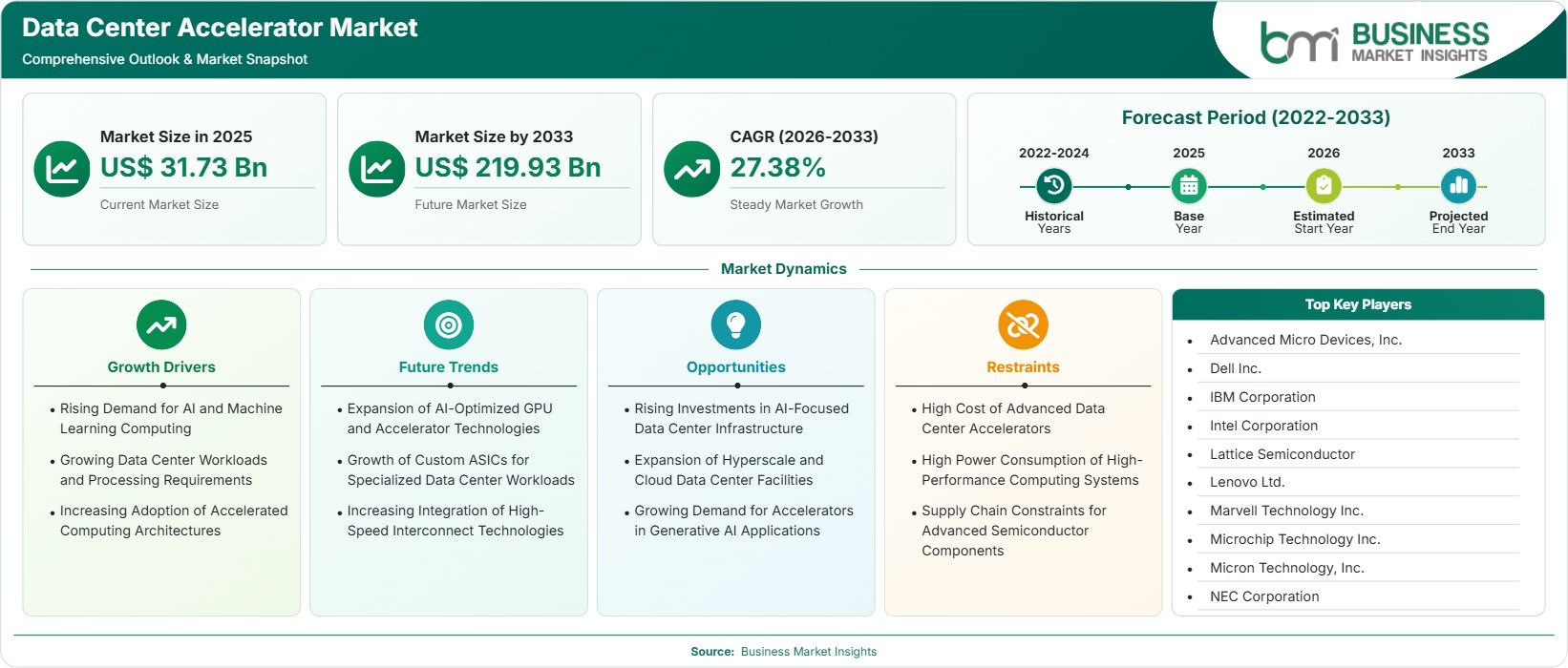
The Data Center Accelerator Market size was valued at US$ 31.73 Billion in 2025 and is projected to reach US$ 219.93 Billion by 2033, growing at a CAGR of 27.38% during 2026–2033. Rising adoption of artificial intelligence workloads, increasing deployment of hyperscale data centers, growing demand for high-performance computing, expansion of cloud infrastructure, and growing investments in advanced semiconductor technologies are creating substantial growth opportunities across the market.

Report Coverage
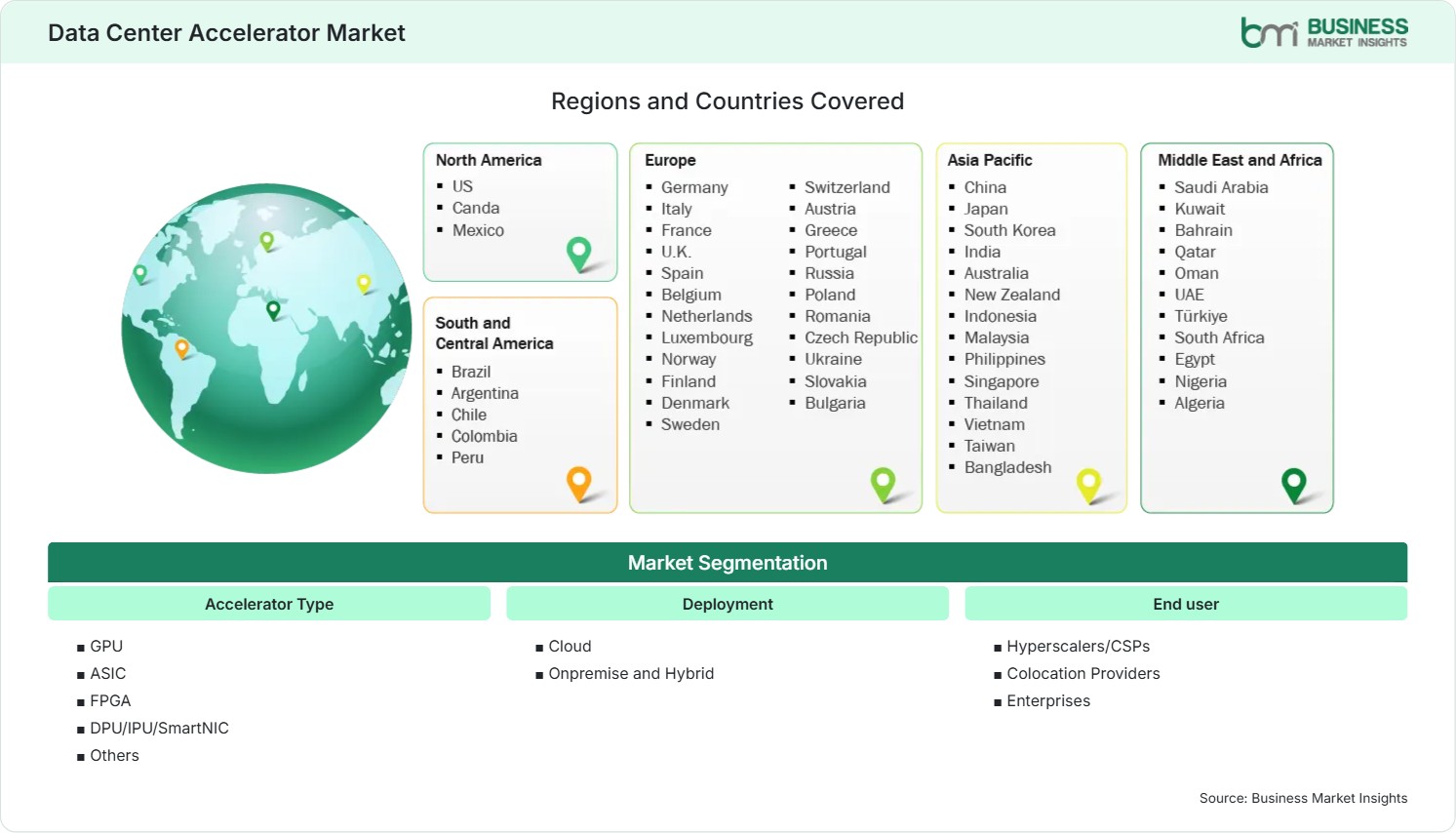
  • Accelerator Type: GPU, ASIC, FPGA, DPU/IPU/SmartNIC, Others
  • Deployment: Cloud, Onpremise and Hybrid
  • End user: Hyperscalers/CSPs, Colocation Providers, Enterprises
US$ 31.73 Bn Market size in 2025
US$ 219.93 Bn Market Size by 2033
27.38% CAGR, 2026 - 2033
2026-2033 Forecast Period

01 AI Overview

Data Center Accelerator Market Summary

  • North America Region: North America holds a data center accelerator market share of 41%–45% in 2025 and is projected to grow at a CAGR of 26.0%–27.0% during 2026–2033. Growth is supported by hyperscale data center expansion, AI infrastructure investments, cloud computing adoption, semiconductor innovation, enterprise digital transformation, machine learning deployments, edge computing initiatives, advanced networking technologies, high-performance computing requirements, and strong technology spending. The U.S. remains the dominant market owing to the presence of major cloud service providers and technology companies, advancing at a CAGR of 26.3%–27.3%.
  • Fastest Growing Region: Asia Pacific accounts for 26%–30% share in 2025 and is expected to register a CAGR of 30.5%–32.0% through 2033. Growth is fueled by expanding cloud infrastructure, increasing AI adoption, rising data generation, digital transformation programs, government technology initiatives, semiconductor investments, enterprise data center expansion, growing demand for high-performance computing, increasing internet penetration, and hyperscale facility development.
  • Leading Segment: GPU represents 46%–50% share in 2025 and is anticipated to grow at a CAGR of 28.5%–29.5% through 2033. Demand is supported by AI model training, machine learning applications, high-performance computing workloads, large-scale data analytics, cloud infrastructure expansion, parallel processing capabilities, enterprise AI adoption, scientific computing requirements, and accelerated computing architectures.
  • High Growth Segment: Cloud captures 48%–52% share in 2025 and is forecast to expand at a CAGR of 29.0%–30.0% during 2026–2033. Expansion is driven by increasing cloud workload migration, AI-as-a-service adoption, hyperscaler investments, scalable infrastructure requirements, digital transformation initiatives, enterprise cloud deployment, operational flexibility benefits, data-intensive applications, and growing demand for accelerated computing resources.
  • Key Market Opportunity: Rapid deployment of generative AI, large language models, advanced analytics, and enterprise AI platforms is creating opportunities for next-generation accelerator architectures, specialized processors, and optimized data center infrastructure.
  • Major Market Players: Advanced Micro Devices, Inc., Dell Inc., IBM Corporation, Intel Corporation, Lattice Semiconductor, Lenovo Ltd., Marvell Technology Inc., Microchip Technology Inc., Micron Technology, Inc., and NEC Corporation.
02 Strategic Insights

Data Center Accelerator Market: Strategic Insights

Data Center Accelerator Market Strategic Framework
FREE PDF
Request your free sample
Request free sample
03 Stakeholder View

Key Takeaways

  • The data center accelerator market is increasingly driven by artificial intelligence, machine learning, high-performance computing, and cloud-native workloads that require specialized accelerator architectures capable of delivering superior computational performance.
  • Cloud deployments continue to present the strongest growth opportunity as hyperscale cloud providers expand infrastructure capacity to support data-intensive applications and AI-driven services.
  • GPU, FPGA, ASIC, and DPU technologies are becoming essential for handling increasingly complex workloads while improving energy efficiency and reducing computational bottlenecks.
  • Asia Pacific represents a major growth opportunity owing to rapid digital transformation, increasing cloud adoption, expanding data center construction, and government support for advanced technology development.
  • Strategic collaborations among semiconductor companies, cloud service providers, data center operators, and enterprise technology vendors are accelerating innovation and infrastructure deployment.
  • Demand for low-latency processing, real-time analytics, generative AI, and large language models is encouraging continuous investment in next-generation accelerator technologies.
04 Geographic Outlook

Data Center Accelerator Market Regional Highlights

North America Data Center Accelerator Market

North America accounted for 41%–45% of global revenue in 2025 and is expected to grow at a CAGR of 26.0%–27.0% through 2033. The region benefits from significant investments in hyperscale data centers, artificial intelligence infrastructure, and cloud computing platforms. The Data Center Accelerator Market share remains highest in North America due to the presence of major technology companies, cloud service providers, and semiconductor innovators. Growing deployment of accelerated computing infrastructure is supporting long-term market expansion.

  • Hyperscale operators continue investing heavily in AI-ready infrastructure and advanced accelerator technologies.
  • Enterprise demand for AI, analytics, and machine learning workloads is accelerating deployment of specialized processors.
  • Strong semiconductor innovation supports rapid adoption of next-generation accelerator architectures.
  • Cloud service providers continue expanding accelerated computing offerings.
  • Data-intensive applications are increasing demand for high-performance processing platforms.

US Data Center Accelerator Market

The United States represents 84%–88% of North American demand and is projected to grow at a CAGR of 26.3%–27.3% through 2033. Investments in cloud computing, AI development, and advanced data center infrastructure continue supporting market expansion. Growing demand for high-performance computing and enterprise AI applications is creating opportunities for accelerator vendors and infrastructure providers.

  • Increasing AI model development requires greater deployment of accelerator-based computing infrastructure.
  • Cloud providers continue expanding data center footprints and processing capacity.
  • Enterprise digital transformation supports growing demand for accelerated computing solutions.
  • Semiconductor innovation strengthens long-term market competitiveness.

Europe Data Center Accelerator Market

Europe held 22%–26% of global revenue in 2025 and is anticipated to grow at a CAGR of 27.0%–28.0% through 2033. Market growth is supported by cloud adoption, digital sovereignty initiatives, and increasing investments in high-performance computing capabilities. Germany remains the leading market, while Ireland is among the fastest-growing countries with a CAGR of 29.0%–30.0%. Rising enterprise adoption of AI and analytics platforms continues supporting demand.

  • Government-supported digital infrastructure initiatives are strengthening accelerator adoption.
  • Germany benefits from strong industrial digitalization and enterprise computing investments.
  • AI-driven workloads are increasing demand for specialized processing technologies.
  • Cloud and colocation providers are expanding accelerator-enabled services.
  • Demand for energy-efficient computing infrastructure continues rising.

Asia Pacific Data Center Accelerator Market

Asia Pacific accounted for 26%–30% of global revenue in 2025 and is expected to register the fastest CAGR of 30.5%–32.0% through 2033. Growth is driven by expanding cloud infrastructure, rising AI adoption, increasing internet usage, and rapid digital transformation activities. China and India remain major markets, while Singapore demonstrates strong growth with a CAGR of 31.5%–33.0%. Large-scale investments in advanced data center infrastructure continue creating favorable market conditions.

  • AI investments continue driving demand for accelerator-equipped computing facilities.
  • Hyperscale cloud providers are expanding infrastructure capacity throughout the region.
  • Government digitalization initiatives support long-term technology adoption.
  • Enterprise workload migration to cloud environments strengthens market growth.
  • Rapid growth in data generation increases demand for high-performance processing capabilities.

Rest of World Data Center Accelerator Market

Rest of World accounted for 8%–12% of global revenue in 2025 and is expected to grow at a CAGR of 27.5%–28.5% through 2033. Expansion is supported by increasing cloud adoption, digital transformation initiatives, and investment in modern data center infrastructure. The Middle East is witnessing strong data center activity, while Brazil leads growth in South America through expanding enterprise computing requirements.

  • Digital transformation initiatives continue accelerating demand for advanced computing infrastructure.
  • Cloud adoption is increasing across enterprise and government sectors.
  • Data center development projects support growing deployment of accelerator technologies.
  • AI and analytics applications are creating new infrastructure requirements.
  • Regional technology investments continue strengthening market potential.
Global Market Geography
FREE PDF
Request your free sample
Request free sample
05 Segment Analysis

Data Center Accelerator Market Segmentation

Accelerator Type

GPU accounts for 46%–50% share in 2025 and is expected to grow at a CAGR of 28.5%–29.5% through 2033. The segment dominates due to its exceptional parallel processing capabilities, widespread deployment in artificial intelligence workloads, and increasing use in large-scale data analytics. The Data Center Accelerator Market scope continues to expand as enterprises and cloud providers invest in advanced accelerator infrastructure to support next-generation computing applications.

  • GPU: Widely adopted for AI model training, machine learning, high-performance computing, generative AI, and advanced analytics workloads requiring massive parallel processing capabilities.
  • ASIC: Utilized for application-specific processing tasks, delivering optimized performance, energy efficiency, and accelerated execution for targeted workloads.
  • FPGA: Supports customizable computing environments where flexibility, low latency, and workload-specific optimization are critical requirements.
  • DPU/IPU/SmartNIC: Increasingly deployed to offload networking, storage, and infrastructure management functions while improving data center efficiency.
  • Others: Include emerging accelerator architectures designed for specialized AI, scientific computing, and enterprise processing applications.

Deployment

Cloud holds 48%–52% share in 2025 and is projected to grow at a CAGR of 29.0%–30.0% through 2033. Growth is supported by expanding hyperscale infrastructure, increasing AI-as-a-service offerings, and enterprise migration toward cloud-based computing environments. Current Data Center Accelerator Market trends indicate significant demand for accelerator-enabled cloud platforms capable of supporting intensive workloads.

  • Cloud: Benefits from scalability, operational flexibility, accelerated infrastructure deployment, and growing demand for AI and machine learning services.
  • On-premise: Maintains importance among organizations requiring direct control over infrastructure, security, compliance, and workload optimization.
  • Hybrid: Gains adoption by combining cloud scalability with on-premise performance requirements and data sovereignty considerations.

End-user

Hyperscalers/CSPs account for 54%–58% share in 2025 and are expected to register a CAGR of 29.5%–30.5% through 2033. Demand is driven by large-scale AI workloads, cloud service expansion, and continuous data center investments. Accelerator deployments continue increasing as hyperscale operators seek higher computing performance and operational efficiency.

  • Hyperscalers/CSPs: Invest heavily in accelerator technologies to support cloud computing, AI model training, analytics, and large-scale enterprise applications.
  • Colocation Providers: Expand accelerator-enabled infrastructure to serve enterprise customers seeking flexible access to advanced computing capabilities.
  • Enterprises: Leverage accelerators for AI applications, analytics platforms, simulation environments, and data-intensive business operations.
06 Market Forces

Data Center Accelerator Market Dynamics

Key Market Drivers

Rising Demand for AI and Machine Learning Computing

Artificial intelligence and machine learning workloads are growing rapidly across industries including healthcare, finance, manufacturing, retail, and telecommunications. These workloads require enormous computing resources capable of processing large datasets and complex algorithms. Data center accelerators provide the computational performance necessary to train and deploy advanced AI models efficiently. Organizations increasingly rely on AI to improve decision-making, automation, customer engagement, and operational productivity. As enterprises expand AI initiatives, demand for high-performance accelerator technologies continues increasing, making AI adoption one of the strongest drivers supporting long-term market growth.

Growing Data Center Workloads and Processing Requirements

The volume of data generated globally continues growing due to cloud computing, connected devices, digital transformation initiatives, and enterprise analytics requirements. Data centers must process increasingly complex workloads while maintaining performance, scalability, and reliability. Traditional CPU-based architectures often struggle to meet these intensive processing demands efficiently. Accelerators such as GPUs, FPGAs, and ASICs help optimize workload execution and enhance system performance. Growing demand for real-time analytics, video processing, cloud services, and high-performance applications continues driving adoption of advanced accelerator solutions across modern data center environments.

Increasing Adoption of Accelerated Computing Architectures

Organizations increasingly recognize the benefits of accelerated computing architectures in improving workload efficiency and reducing processing time. These architectures combine specialized accelerators with traditional computing resources to deliver optimal performance for targeted applications. Accelerated platforms enable faster execution of AI, analytics, simulation, and scientific computing tasks while improving resource utilization. Cloud providers, enterprises, and research institutions are expanding investments in accelerator-enabled infrastructure to remain competitive and support evolving workload requirements. This ongoing transition toward heterogeneous computing environments continues strengthening demand for advanced data center accelerator technologies.

Key Market Opportunities

Rising Investments in AI-Focused Data Center Infrastructure

Technology companies, cloud providers, and enterprises are investing heavily in AI-focused infrastructure to support increasingly sophisticated applications. Deployment of large language models, predictive analytics platforms, and intelligent automation systems requires massive computational resources. Data Center Accelerator Market Forecasts indicate significant investment activity directed toward AI-ready facilities equipped with specialized processing technologies. Demand for optimized infrastructure capable of supporting AI training and inference workloads continues growing across industries. Vendors delivering accelerator solutions designed specifically for AI environments are positioned to benefit from these substantial investment opportunities.

Expansion of Hyperscale and Cloud Data Center Facilities

Rapid growth in cloud computing continues driving expansion of hyperscale facilities worldwide. Cloud service providers are increasing infrastructure investments to support enterprise digital transformation, data storage growth, and AI workloads. Accelerator technologies play a critical role in enabling high-performance cloud services while optimizing operational efficiency. Increasing deployment of next-generation cloud platforms is generating substantial demand for advanced processing capabilities. As hyperscale and cloud operators continue expanding global capacity, manufacturers of accelerator technologies are expected to benefit from sustained infrastructure investment cycles.

Growing Demand for Accelerators in Generative AI Applications

Generative AI applications require extraordinary computational power for model training, inference processing, and continuous optimization. Large language models, intelligent assistants, content generation systems, and enterprise AI platforms are increasing demand for specialized accelerator technologies. Organizations are deploying advanced hardware solutions to reduce training times and improve operational efficiency. The rapid expansion of generative AI use cases is creating strong opportunities for vendors offering high-performance accelerator products. As adoption accelerates across commercial and industrial sectors, demand for accelerator-enabled infrastructure is expected to increase significantly.

Market Restraints and Challenges

High Cost of Advanced Data Center Accelerators

Factor: Advanced accelerators require sophisticated semiconductor manufacturing processes, high-performance architectures, specialized memory technologies, and significant research and development investments. Impact: Elevated acquisition costs can create budget constraints for enterprises and smaller data center operators. Large-scale deployment often requires substantial capital expenditure, affecting investment decisions and infrastructure planning. Organizations must carefully evaluate performance benefits against total ownership costs. These financial considerations may slow adoption rates among cost-sensitive users despite the substantial performance advantages offered by accelerator technologies.

High Power Consumption of High-Performance Computing Systems

Factor: Accelerator-intensive computing environments consume significant electrical power and often require advanced cooling infrastructure to maintain operational performance. Impact: Rising energy consumption increases operating costs and places pressure on sustainability objectives. Data center operators face challenges balancing computational performance with energy efficiency requirements. Power availability and thermal management constraints may limit deployment scalability in certain regions. Addressing energy efficiency concerns remains a critical challenge as accelerator adoption continues expanding across AI and high-performance computing environments.

07 Company Analysis

Competitive Landscape

The Data Center Accelerator Market analysis reveals strong competition among semiconductor manufacturers, enterprise technology companies, data center infrastructure providers, and computing platform vendors focused on AI acceleration, cloud computing, and high-performance processing technologies.

Company Name

Overview

Products and Services Relevant to this Market

Advanced Micro Devices, Inc.

Semiconductor company providing high-performance computing and accelerator technologies.

GPUs, AI accelerators, data center processors, and high-performance computing solutions.

Dell Inc.

Enterprise infrastructure provider serving cloud, AI, and data center markets.

Accelerator-enabled servers, AI infrastructure, storage solutions, and integrated platforms.

IBM Corporation

Technology company focused on AI, cloud computing, and enterprise infrastructure solutions.

AI computing platforms, accelerator-integrated systems, hybrid cloud solutions, and analytics technologies.

Intel Corporation

Global semiconductor leader supporting enterprise and hyperscale computing markets.

Data center processors, AI accelerators, FPGAs, networking technologies, and cloud infrastructure solutions.

Lattice Semiconductor

Semiconductor company specializing in programmable logic and low-power computing technologies.

FPGAs, programmable devices, edge computing accelerators, and infrastructure processing solutions.

Lenovo Ltd.

Technology provider delivering enterprise infrastructure and data center computing solutions.

Accelerator-ready servers, AI infrastructure, storage systems, and enterprise computing platforms.

Marvell Technology Inc.

Semiconductor company focused on data infrastructure and accelerated computing applications.

Data processing units, networking accelerators, storage controllers, and cloud infrastructure technologies.

Microchip Technology Inc.

Semiconductor solutions provider serving enterprise computing and networking markets.

FPGA solutions, embedded processors, infrastructure controllers, and accelerator-related technologies.

Micron Technology, Inc.

Memory and storage technology company supporting high-performance computing environments.

Advanced memory solutions, storage technologies, AI infrastructure support, and accelerator ecosystem components.

NEC Corporation

Technology company delivering enterprise computing, networking, and digital infrastructure solutions.

AI platforms, data center solutions, computing infrastructure, and enterprise accelerator technologies.

10 Trust & Transparency

Research Methodology

The market analysis combines proprietary research with secondary data from government agencies, company disclosures, regulatory filings, industry databases and expert interviews. Market estimates are validated through data triangulation, cross-market benchmarking and analyst review.

View Full Research Methodology

11 Questions Answered

Frequently Asked Questions

What does this Data Center Accelerator Market Report evaluate?

The market report evaluates market trends, deployment strategies, accelerator technologies, competitive positioning, regional opportunities, growth drivers, investment prospects, and industry challenges through 2033.

How is generative AI influencing accelerator demand?

Generative AI applications require substantial computing power for model training and inference, significantly increasing demand for advanced GPUs, ASICs, and other specialized accelerator architectures.

Why is Asia Pacific the fastest-growing region?

Asia Pacific benefits from rapid cloud infrastructure expansion, increasing AI investments, growing data generation, strong digital transformation initiatives, and ongoing hyperscale data center development.

Which accelerator type leads the market?

GPU leads the market due to its superior parallel processing performance and widespread use in AI training, machine learning, analytics, scientific computing, and generative AI workloads.

What is driving growth in the data center accelerator market?

Growth is primarily driven by increasing adoption of artificial intelligence, machine learning, cloud computing, high-performance computing, and data-intensive enterprise applications requiring accelerated processing capabilities.

Access the Full Data Center Accelerator Market Report

Get segment-level forecasts, regional estimates, competitive benchmarking, company profiles and downloadable Excel datasets.

Access the full Data Center Accelerator Market Report
350 pages PDF & Excel | 2026-08-20