
AI Accelerator Market Outlook: Size, Share, Trends, Growth Analysis, Competitive Landscape & Forecast, 2026-2033

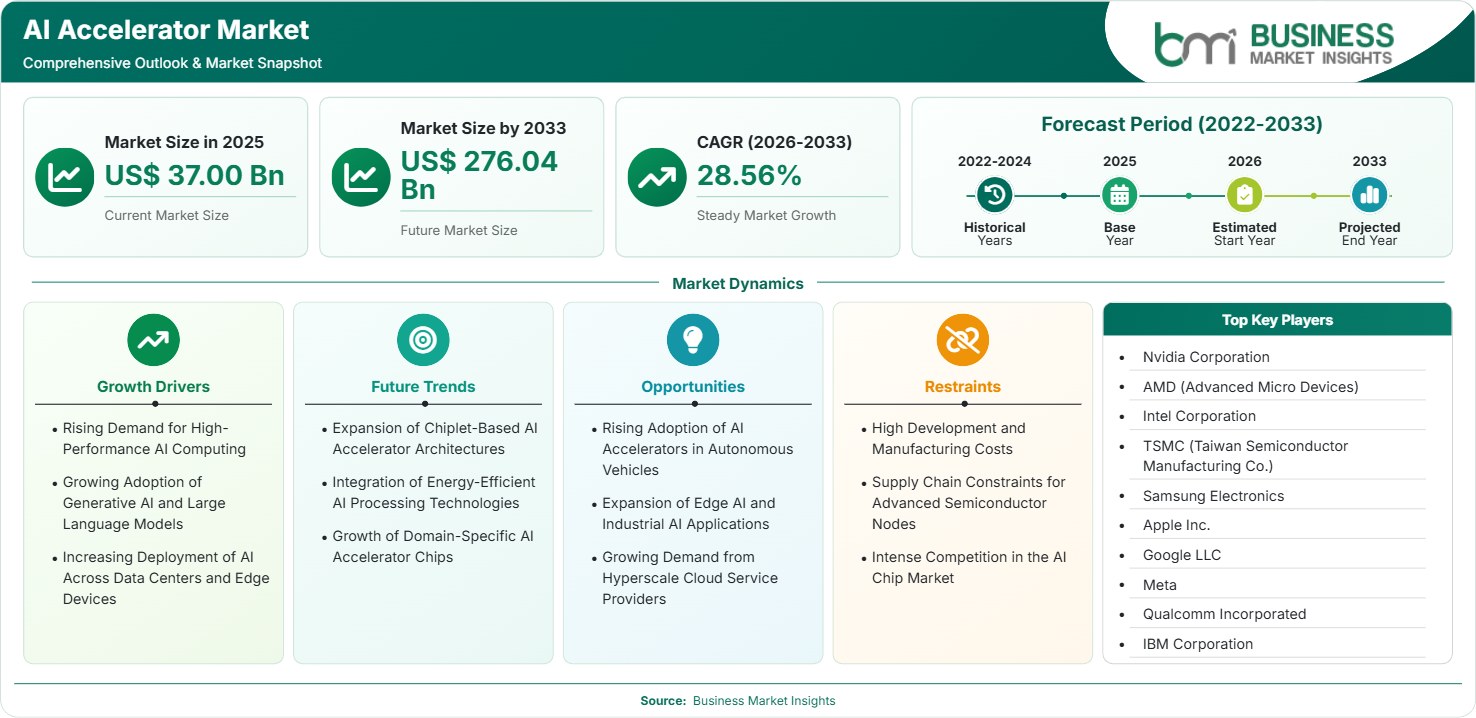
The AI Accelerator Market size was valued at US$ 37.00 Billion in 2025 and is projected to reach US$ 276.04 Billion by 2033, growing at a CAGR of 28.56% during 2026–2033. Rising adoption of artificial intelligence workloads, increasing deployment of generative AI models, growing investments in cloud computing infrastructure, and expanding demand for high-performance computing solutions are supporting market growth globally.

Report Coverage
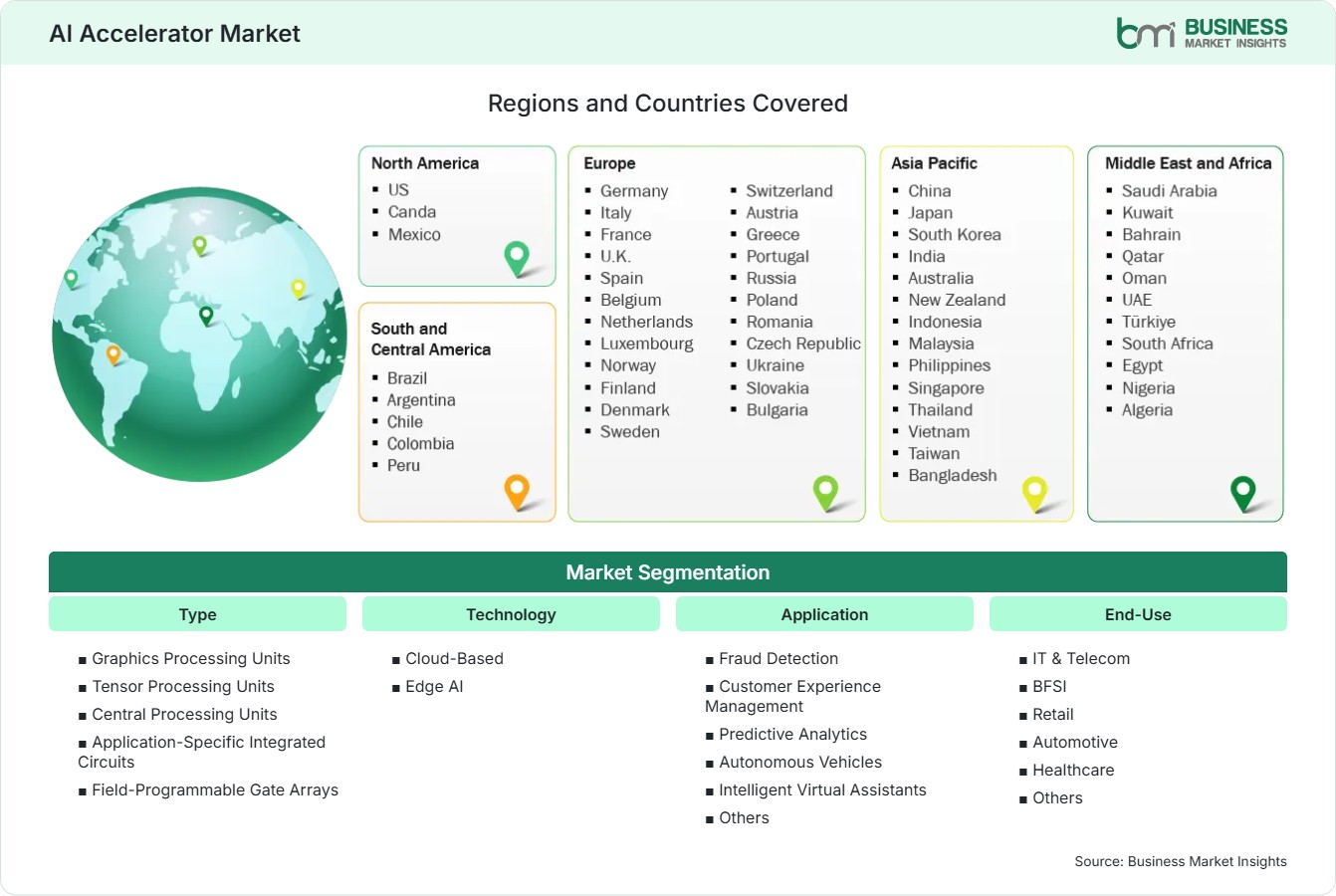
  • Type: Graphics Processing Units , Tensor Processing Units , Central Processing Units , Application-Specific Integrated Circuits , Field-Programmable Gate Arrays
  • Technology: Cloud-Based, Edge AI
  • Application: Fraud Detection, Customer Experience Management, Predictive Analytics, Autonomous Vehicles, Intelligent Virtual Assistants, Others
  • End-Use: IT & Telecom, BFSI, Retail, Automotive, Healthcare, Others
US$ 37.00 Bn Market size in 2025
US$ 276.04 Bn Market Size by 2033
28.56% CAGR, 2026 - 2033
2026-2033 Forecast Period

AI Overview

AI Accelerator Market Summary

  • North America Region: North America holds a AI accelerator market share of 40%–43% in 2025, growing with a CAGR of 27.5%–28.8% during 2026–2033. Strong investments in AI infrastructure, growing hyperscale data center deployments, and increasing enterprise adoption of generative AI technologies continue supporting regional leadership. The U.S. market is expected to register a CAGR of 27.8%–29.1%.
  • Fastest Growing Region: Asia Pacific accounts for 24%–27% share in 2025 and is projected to grow at a CAGR of 30.0%–31.5% through 2033. Rising semiconductor investments, increasing AI adoption across industries, expanding cloud infrastructure, and growing demand for intelligent automation continue driving regional growth.
  • Leading Segment: Graphics Processing Units (GPUs) represent 44%–47% share in 2025 and are expected to grow at a CAGR of 29.0%–30.3% through 2033. Their superior parallel processing capability and widespread utilization in AI training and inference applications continue supporting segment dominance.
  • High Growth Segment: Cloud-Based AI accounts for 58%–61% share in 2025 and is forecast to grow at a CAGR of 29.5%–30.8% during 2026–2033. Rapid cloud adoption and increasing deployment of AI workloads through scalable cloud platforms continue accelerating segment growth.
  • Key Market Opportunity: Expansion of generative AI, edge intelligence, autonomous systems, and AI-powered enterprise applications is creating substantial growth opportunities.
  • Major Market Players: Nvidia Corporation, AMD (Advanced Micro Devices), Intel Corporation, TSMC (Taiwan Semiconductor Manufacturing Co.), Samsung Electronics, Apple Inc., Google LLC, Meta, Qualcomm Incorporated, and IBM Corporation.
Strategic Insights

AI Accelerator Market: Strategic Insights

AI Accelerator Market Strategic Framework
FREE PDF
Request your free sample
Request free sample
Stakeholder View

Key Takeaways

  • AI accelerators are becoming essential infrastructure components for machine learning, deep learning, and generative AI applications.
  • GPUs remain the leading technology segment due to their ability to efficiently process large-scale AI workloads.
  • Cloud-based AI deployment continues driving strong demand for accelerator hardware across hyperscale data centers.
  • Enterprises are increasingly investing in AI infrastructure to improve productivity and decision-making capabilities.
  • Edge AI adoption is expanding across automotive, healthcare, industrial automation, and smart device applications.
  • North America maintains AI accelerator market leadership through strong technology innovation and AI investment activity.
  • Asia Pacific is expected to witness the fastest growth owing to semiconductor expansion and increasing AI adoption.
Geographic Outlook

AI Accelerator Market Regional Highlights

North America AI Accelerator Market

North America accounts for 40%–43% AI Accelerator Market share in 2025 and is projected to grow at a CAGR of 27.5%–28.8% through 2033. Strong AI infrastructure investments, growing deployment of large language models, and expanding hyperscale data center networks continue supporting regional leadership. The region also benefits from a highly developed technology ecosystem and significant enterprise AI spending.

  • Major technology companies are aggressively investing in AI accelerator infrastructure to support generative AI platforms, large-scale model training, and increasingly computationally intensive enterprise workloads.
  • Growing demand for AI-enabled cloud services is encouraging hyperscale providers to deploy large volumes of accelerator hardware across data center environments.
  • Financial institutions are expanding adoption of AI accelerators to improve fraud detection, risk assessment, and predictive analytics capabilities across digital banking operations.
  • Healthcare organizations are increasingly utilizing AI-powered computing infrastructure to support diagnostics, medical imaging analysis, and precision medicine initiatives.
  • The rapid advancement of autonomous systems and intelligent transportation technologies continues creating additional demand for high-performance AI processing solutions.

US AI Accelerator Market

The United States contributes approximately 86%–90% of North American revenue and is expected to register a CAGR of 27.8%–29.1% through 2033. Strong investments in artificial intelligence, extensive cloud infrastructure, and leadership in semiconductor innovation continue supporting AI accelerator market dominance.

  • Technology companies are deploying advanced accelerator architectures to support generative AI applications, machine learning development, and enterprise automation initiatives.
  • Cloud service providers continue expanding AI infrastructure capacity to meet rapidly growing demand for training and inference workloads.
  • Enterprises are increasingly integrating AI solutions into customer service, analytics, cybersecurity, and operational optimization functions.
  • Strong venture capital funding and research activity continue accelerating innovation throughout the AI hardware ecosystem.

Europe AI Accelerator Market

Europe represents 24%–27% of global revenue in 2025 and is anticipated to expand at a CAGR of 28.2%–29.5% through 2033. Increasing adoption of AI technologies, growing investments in digital transformation, and rising demand for advanced computing infrastructure continue supporting regional growth. Germany remains the leading AI accelerator market while Poland demonstrates stronger growth momentum.

  • Germany continues leading regional demand through strong industrial automation, manufacturing innovation, and enterprise AI deployment activities.
  • Poland is among the fastest-growing markets and is estimated to register a CAGR of 31.0%–32.3% during the forecast period, supported by increasing digitalization investments.
  • Organizations are utilizing AI accelerators to improve predictive maintenance, process optimization, and intelligent manufacturing capabilities.
  • Financial institutions continue investing in AI-powered analytics platforms to strengthen compliance management and operational performance.
  • Rising deployment of cloud-based AI services is supporting demand for specialized accelerator technologies across industries.

Asia Pacific AI Accelerator Market

Asia Pacific accounts for 24%–27% of global revenue in 2025 and is expected to achieve the fastest CAGR of 30.0%–31.5% through 2033. Expanding semiconductor manufacturing, growing enterprise AI adoption, and increasing investments in cloud and edge computing infrastructure continue supporting strong regional growth.

  • China remains the largest regional AI accelerator market due to substantial investments in AI development, semiconductor manufacturing, and intelligent infrastructure initiatives.
  • India is projected to achieve approximately 31.8%–33.1% CAGR, supported by rapid digital transformation, cloud adoption, and enterprise AI deployment activities.
  • Technology companies are increasingly implementing AI accelerators to support generative AI applications, analytics platforms, and automation solutions.
  • Expansion of telecommunications infrastructure and edge computing deployments is creating significant opportunities for AI accelerator providers.
  • Government support for digital innovation and domestic semiconductor ecosystems continues enhancing regional growth prospects.

Rest of World AI Accelerator Market

Rest of World accounts for 7%–10% of global revenue in 2025 and is projected to expand at a CAGR of 27.8%–29.0% through 2033. Increasing cloud adoption, growing digital transformation activities, and expanding deployment of intelligent technologies continue supporting market growth.

  • Brazil continues generating demand through increasing enterprise technology investments and broader adoption of AI-enabled analytics solutions.
  • The UAE is witnessing significant implementation of AI-driven smart city projects, creating demand for advanced computing and accelerator infrastructure.
  • Saudi Arabia is expected to achieve approximately 29.5%–30.8% CAGR through 2033, supported by investments in digital economy initiatives and artificial intelligence development.
  • Enterprises across diverse sectors are implementing AI solutions to improve customer engagement, productivity, and operational effectiveness.
  • Expanding regional cloud infrastructure investments are expected to support long-term growth opportunities for accelerator manufacturers.
Global Market Geography
FREE PDF
Request your free sample
Request free sample
Segment Analysis

AI Accelerator Market Segmentation

Type

The type segment represents the technological backbone of the AI accelerator industry, encompassing specialized processors designed to enhance artificial intelligence, machine learning, and deep learning workloads. The segment accounts for approximately 44%–47% share in 2025 and is projected to grow at a CAGR of 29.0%–30.3% through 2033. The expanding AI Accelerator Market scope is supported by increasing deployment of generative AI models, rising demand for high-performance computing infrastructure, growing investments in hyperscale data centers, and rapid adoption of AI-enabled business applications across industries.

  • Graphics Processing Units (GPUs): GPUs remain the dominant segment due to their exceptional parallel computing capabilities, which make them highly effective for training and inference of complex AI models. Enterprises, cloud providers, and research organizations continue adopting GPUs to support large language models, computer vision, and generative AI applications.
  • Tensor Processing Units (TPUs): TPUs are increasingly utilized for AI-specific workloads because they offer optimized performance for neural network processing and machine learning operations. Growing adoption of cloud-based AI services continues supporting demand.
  • Central Processing Units (CPUs): CPUs continue playing a critical role in AI ecosystems by managing general-purpose computing tasks, orchestration functions, and workload coordination across heterogeneous computing environments.
  • Application-Specific Integrated Circuits (ASICs): ASICs are gaining popularity due to their ability to deliver highly efficient performance for specific AI tasks while reducing energy consumption and operational costs.
  • Field-Programmable Gate Arrays (FPGAs): FPGAs remain valuable for applications requiring flexibility, reconfigurability, and low-latency processing, particularly within edge computing and industrial AI environments.

Technology

Technology adoption patterns continue shaping AI accelerator deployment strategies as organizations seek scalable and efficient computing environments. This segment accounts for approximately 58%–61% share in 2025 and is expected to register a CAGR of 29.5%–30.8% through 2033. Current AI Accelerator Market trends indicate increasing utilization of cloud and edge-based AI processing architectures.

  • Cloud-Based: Cloud-based AI remains the leading segment due to widespread enterprise adoption of cloud infrastructure for AI training, model deployment, data analytics, and generative AI applications. Cloud providers continue expanding accelerator-rich infrastructure to support escalating demand.
  • Edge AI: Edge AI is witnessing rapid growth as organizations increasingly require real-time intelligence, low-latency processing, and localized decision-making capabilities. The segment is gaining momentum across autonomous vehicles, industrial automation, healthcare devices, and smart city applications.

Application

Application diversity continues expanding as AI technologies become increasingly embedded within enterprise operations, consumer services, and industrial environments. This segment accounts for approximately 33%–36% share in 2025 and is projected to grow at a CAGR of 28.8%–30.1% through 2033.

  • Fraud Detection: Financial institutions increasingly utilize AI accelerators to process large datasets, identify anomalies, and improve real-time fraud detection capabilities.
  • Customer Experience Management: Organizations deploy AI acceleration technologies to support recommendation engines, personalized interactions, chatbot systems, and intelligent customer engagement platforms.
  • Predictive Analytics: Growing utilization of predictive modeling is driving demand for high-performance AI infrastructure capable of supporting complex analytical workloads.
  • Autonomous Vehicles: Autonomous driving systems rely heavily on AI accelerators for sensor fusion, object recognition, navigation, and decision-making processes.
  • Intelligent Virtual Assistants: Virtual assistants increasingly require advanced AI hardware to improve speech recognition, language understanding, and conversational experiences.
  • Others: Additional applications include cybersecurity, industrial automation, healthcare diagnostics, smart manufacturing, content generation, and scientific research.

End-Use

End-use adoption continues accelerating as organizations across industries increasingly integrate artificial intelligence into core operations and strategic initiatives. This segment accounts for approximately 30%–33% share in 2025 and is forecast to grow at a CAGR of 29.0%–30.2% through 2033.

  • IT & Telecom: IT and telecom organizations remain among the largest users of AI accelerators due to growing cloud services, network optimization requirements, and intelligent infrastructure deployments.
  • BFSI: Banking and financial institutions are increasingly adopting accelerator-enabled AI platforms for risk management, fraud prevention, compliance, and customer service optimization.
  • Retail: Retail companies leverage AI acceleration technologies to support demand forecasting, recommendation systems, inventory optimization, and consumer analytics.
  • Automotive: Automotive manufacturers continue investing heavily in AI infrastructure to enable autonomous driving, advanced driver assistance systems, and intelligent mobility solutions.
  • Healthcare: Healthcare providers increasingly utilize AI accelerators for diagnostics, medical imaging, drug discovery, and precision medicine initiatives.
  • Others: Additional industries include manufacturing, education, energy, government, transportation, and media sectors.
Market Forces

AI Accelerator Market Dynamics

Key Market Drivers

Rising Demand for High-Performance AI Computing

The rapid evolution of artificial intelligence is significantly increasing demand for specialized computing infrastructure capable of processing highly complex workloads. Modern AI applications involve massive datasets, advanced neural networks, and increasingly sophisticated machine learning models that require substantial computational resources. Traditional computing architectures often struggle to efficiently handle these requirements, encouraging organizations to adopt specialized AI accelerators. Accelerators help reduce training times, improve inference performance, and enable more efficient utilization of computational resources. As organizations continue expanding AI deployments across business functions, high-performance computing demand is expected to remain one of the strongest drivers of AI accelerator market growth throughout the forecast period.

Growing Adoption of Generative AI and Large Language Models

The technologies such as generative AI and large language models are being considered as revolutionary in many different industrial sectors. There are various types of applications including content generation, software creation, customer support, and enterprise productivity that utilize AI models which comprise of billions of parameters. It becomes essential to use specific types of processors that can do heavy-duty parallel calculations efficiently. Companies, enterprises, and clouds are making significant investments in accelerators for fulfilling training and inference requirements of AI models. Additionally, there is growing interest in generative AI apps, which is resulting in the formation of new AI-specific data centers and growth in existing computing infrastructures.

Increasing Deployment of AI Across Data Centers and Edge Devices

AI deployment is rapidly expanding beyond centralized cloud environments into distributed edge ecosystems. Data centers continue investing in accelerator-rich infrastructure to support large-scale AI workloads, while edge devices increasingly require localized intelligence for real-time decision-making. Applications such as industrial automation, connected healthcare, autonomous systems, and smart cities depend on low-latency AI processing capabilities. AI accelerators enable efficient workload execution in both centralized and decentralized computing environments. The growing convergence of cloud computing, edge computing, and AI technologies is creating sustained demand for accelerator hardware across multiple deployment scenarios. This trend is expected to remain a major contributor to AI accelerator market expansion over the forecast period.

Key Market Opportunities

Rising Adoption of AI Accelerators in Autonomous Vehicles

The creation of autonomous and semi-autonomous vehicles has created numerous openings for accelerator manufacturers targeting AI acceleration. This technology needs extremely high processing capacity to analyze the data collected by cameras, radar technology, Lidar technology, and vehicle-to-vehicle communication. Accelerators can provide fast and efficient performance in perception, navigation, object detection, and decision making. The car industry keeps on investing heavily in transportation intelligence to enhance their assistance and autonomous driving technologies. With the growing adoption of autonomous mobility worldwide, the need for accelerators in the automobile industry is anticipated to rise significantly.

Expansion of Edge AI and Industrial AI Applications

Industrial organizations increasingly seek AI solutions capable of delivering real-time insights close to data sources. Edge AI deployments help reduce latency, improve reliability, enhance data privacy, and optimize operational efficiency. Manufacturing facilities, industrial automation systems, robotics platforms, and smart infrastructure projects are generating substantial demand for compact and energy-efficient AI accelerators. Vendors continue developing specialized processors tailored to edge deployment requirements. The expanding use of intelligent automation technologies across industrial sectors is expected to create long-term growth opportunities.

Growing Demand from Hyperscale Cloud Service Providers

Hyperscale cloud providers remain among the largest consumers of AI accelerator technologies. The rapid growth of AI-as-a-Service offerings, generative AI platforms, advanced analytics solutions, and enterprise AI adoption is driving unprecedented infrastructure investment. Cloud providers continue expanding data center footprints and deploying accelerator-rich environments to meet customer demand. Long-term AI Accelerator Market Forecasts remain highly favorable as hyperscale operators increase spending on next-generation AI computing infrastructure.

Market Restraints and Challenges

High Development and Manufacturing Costs

Factor: AI accelerators require highly sophisticated semiconductor design processes, advanced fabrication technologies, substantial research and development investment, and specialized manufacturing capabilities. The complexity associated with creating high-performance AI chips contributes significantly to development and production costs.

Impact: Elevated costs can create barriers for new entrants, increase product pricing, and limit accessibility for smaller organizations. Manufacturers must continuously invest in innovation while balancing cost efficiency and technological competitiveness.

Supply Chain Constraints for Advanced Semiconductor Nodes

Factor: AI accelerator production depends heavily on advanced semiconductor fabrication processes and specialized manufacturing capacity. Limited availability of leading-edge semiconductor nodes, geopolitical uncertainties, and supply chain disruptions can affect production timelines and hardware availability.

Impact: Supply constraints may delay deployments, increase procurement costs, and create challenges for organizations seeking to rapidly scale AI infrastructure. These issues can influence market growth rates and investment planning across the broader AI ecosystem.

Company Analysis

Competitive Landscape

The AI Accelerator Market analysis is characterized by intense competition among semiconductor manufacturers, AI infrastructure providers, hyperscale cloud companies, processor designers, and advanced computing technology developers. Companies are investing heavily in next-generation AI processors, advanced packaging technologies, semiconductor manufacturing capacity, and software ecosystems to address rapidly expanding computing requirements.

Company Name

Overview

Products and Services relevant to this market

Nvidia Corporation

AI computing and graphics technology company recognized for leadership in accelerated computing platforms.

AI GPUs, data center accelerators, AI software platforms, generative AI infrastructure, and high-performance computing solutions.

AMD (Advanced Micro Devices)

Semiconductor company specializing in high-performance processors and accelerated computing technologies.

AI accelerators, GPUs, CPUs, data center processors, adaptive computing solutions, and AI computing platforms.

Intel Corporation

Semiconductor manufacturer serving enterprise, cloud, telecommunications, and AI markets.

AI processors, CPUs, AI acceleration technologies, FPGA solutions, data center hardware, and edge AI platforms.

TSMC (Taiwan Semiconductor Manufacturing Co.)

Semiconductor foundry company providing advanced manufacturing capabilities for AI chip developers.

Advanced semiconductor manufacturing, AI chip fabrication, process technologies, packaging solutions, and foundry services.

Samsung Electronics

Technology company engaged in semiconductor manufacturing, memory solutions, and AI hardware development.

AI processors, memory technologies, semiconductor fabrication services, edge AI chips, and advanced computing components.

Apple Inc.

Consumer technology company integrating AI acceleration into device and computing ecosystems.

Neural processing technologies, AI-enabled processors, edge AI hardware, intelligent device platforms, and custom silicon solutions.

Google LLC

Technology company developing AI infrastructure, cloud services, and specialized AI processors.

Tensor Processing Units (TPUs), cloud AI infrastructure, machine learning platforms, AI development tools, and generative AI computing solutions.

Meta

Technology company focused on AI infrastructure and large-scale computing environments.

AI training infrastructure, custom accelerator development, generative AI platforms, machine learning systems, and data center technologies.

Qualcomm Incorporated

Semiconductor company specializing in mobile, automotive, and edge AI processing technologies.

AI processors, edge AI platforms, automotive AI solutions, intelligent computing systems, and wireless AI technologies.

IBM Corporation

Enterprise technology company focusing on hybrid cloud, AI solutions, and advanced computing infrastructure.

AI accelerators, enterprise AI platforms, hybrid cloud computing solutions, AI software ecosystems, and high-performance processing technologies.

Trust & Transparency

Research Methodology

The market analysis combines proprietary research with secondary data from government agencies, company disclosures, regulatory filings, industry databases and expert interviews. Market estimates are validated through data triangulation, cross-market benchmarking and analyst review.

View Full Research Methodology

Questions Answered

Frequently Asked Questions

How are generative AI applications influencing AI accelerator demand?

Generative AI applications require significant computational resources for training and inference processes. As enterprises increasingly adopt large language models, AI copilots, content generation platforms, and intelligent automation tools, demand for specialized AI accelerators continues to rise significantly.

What does this AI Accelerator Market Report cover?

This report covers type analysis, technology segmentation, application assessment, end-use industry evaluation, regional trends, competitive landscape analysis, market dynamics, opportunities, restraints, and future growth prospects through 2033.

Why is Cloud-Based AI the largest technology segment?

Cloud-Based AI dominates the market because organizations increasingly rely on cloud infrastructure to access scalable computing resources, support AI training workloads, deploy machine learning models, and accelerate enterprise digital transformation initiatives.

Which type segment dominates the market?

Graphics Processing Units (GPUs) represent the leading segment due to their superior parallel processing capabilities, high performance in AI model training, and widespread adoption across data centers, cloud environments, and enterprise AI applications.

What is driving growth in the market?

Rising demand for high-performance AI computing, growing adoption of generative AI and large language models, increasing deployment of artificial intelligence across cloud platforms and edge devices, and expanding investments in AI infrastructure are the primary factors driving market growth.

Access the Full AI Accelerator Market Report

Get segment-level forecasts, regional estimates, competitive benchmarking, company profiles and downloadable Excel datasets.

Access the full AI Accelerator Market Report
350 pages PDF & Excel | 2026-08-31