
Modular Data Center Market Outlook: Size, Share, Trends, Growth Analysis, Competitive Landscape & Forecast, 2026–2033

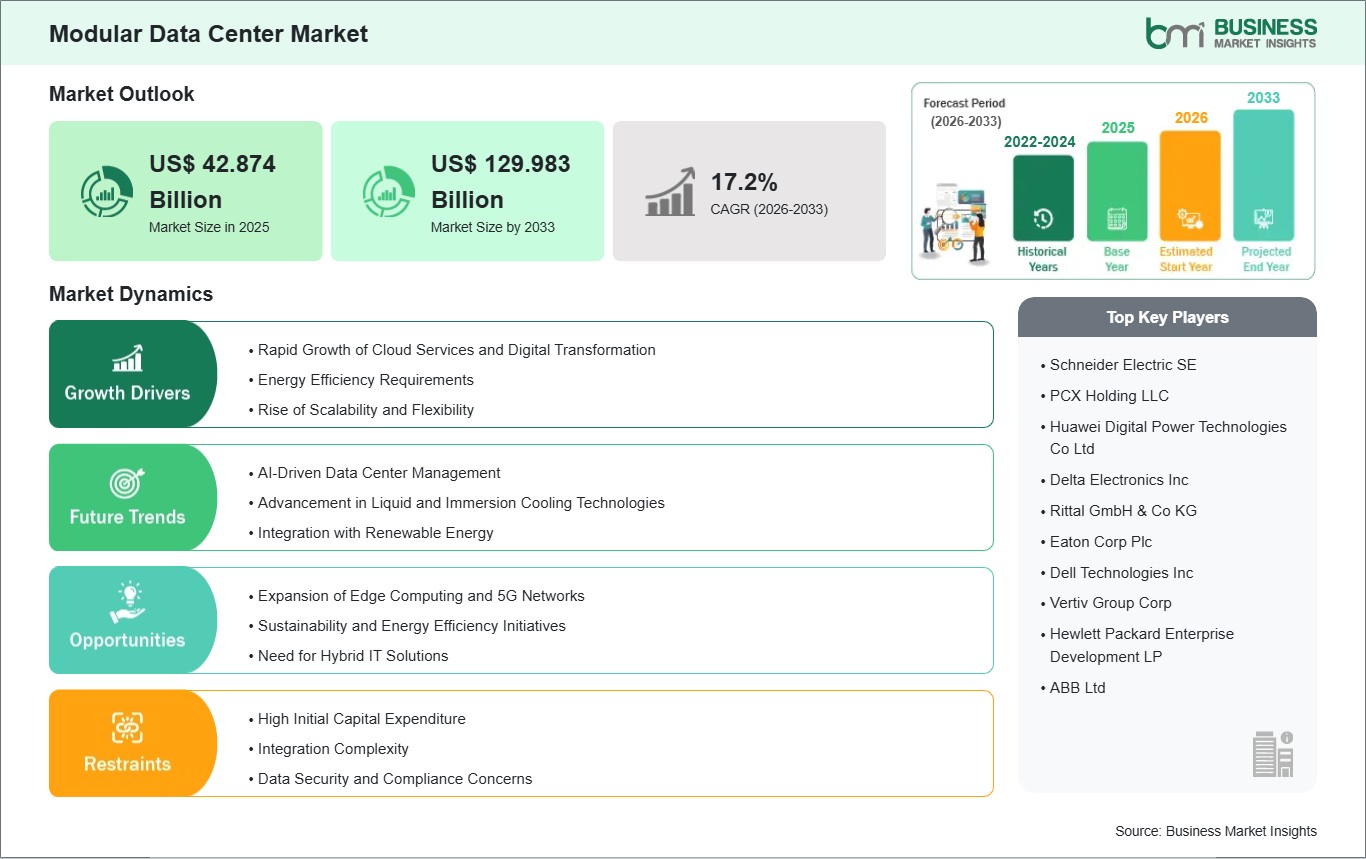
The Modular Data Center Market size was valued at US$ 31.66 billion in 2025 and is projected to reach US$ 105.84 billion by 2033, growing at a CAGR of 16.3% during 2026–2033. Rising cloud adoption, accelerating AI workloads, increasing edge computing deployment, and growing requirements for scalable digital infrastructure are driving market expansion. Significant opportunities are emerging from AI-ready facilities, 5G-enabled edge ecosystems, and rapid digital infrastructure investments across emerging economies.

Report Coverage
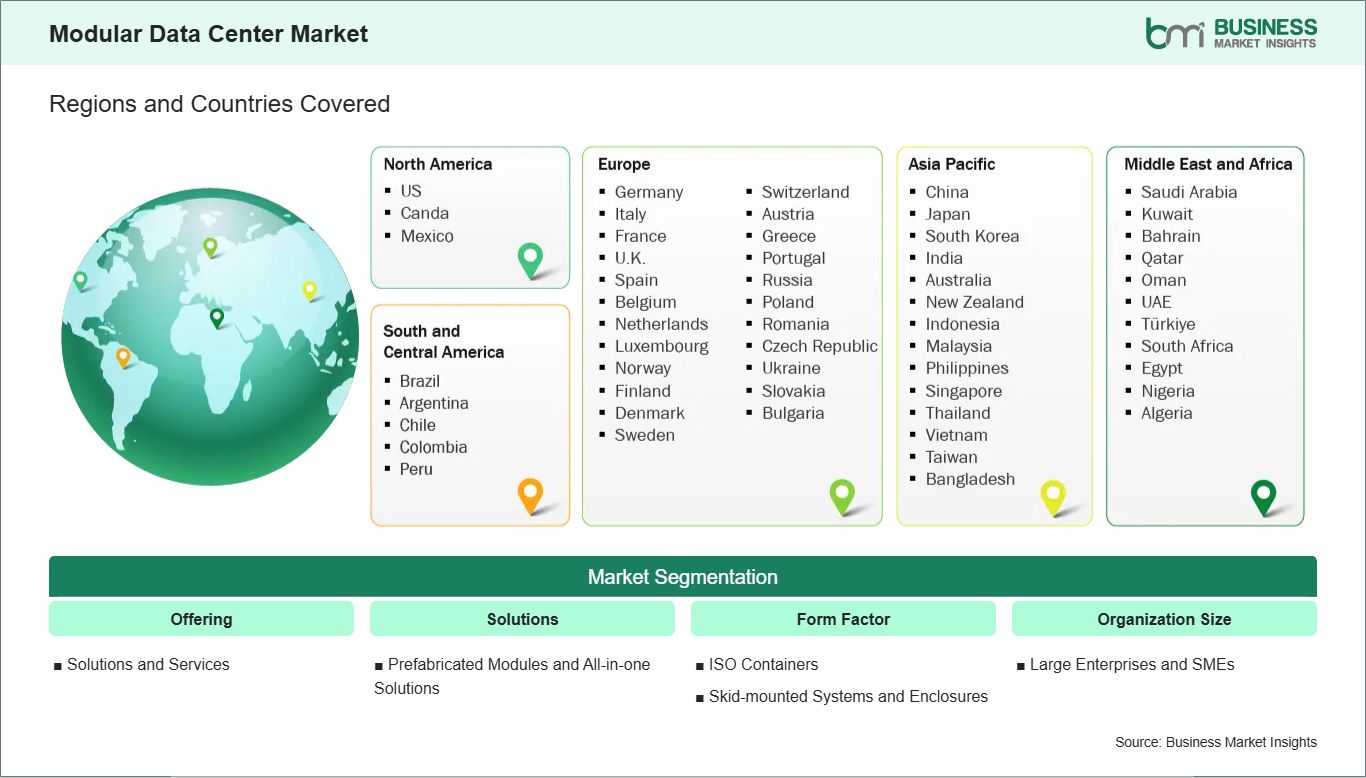
  • Component: Solution, Services
  • Deployment: Containerized, Enclosures, Skid-mounted
  • End User: Cloud Service Providers, Telecom Service Provider, Enterprise
US$ 31.66 Bn Market size in 2025
US$ 105.84 Bn Market Size by 2033
16.8% CAGR, 2026 - 2033
2026-2033 Forecast Period

AI Overview

Modular Data Center Market Summary

  • Europe Region: Europe holds 32.8% share in 2025, growing with a CAGR of 13.5% during 2026–2033. Increasing hyperscale investments, AI infrastructure deployments, edge computing expansion, and enterprise digital transformation initiatives continue creating demand for rapidly deployable modular facilities. Germany dominate the region due to strong AI infrastructure investments, hyperscale expansion.
  • Fastest Growing Region: Asia Pacific holds 27.4% share in 2025, growing with a CAGR of 21.5% during 2026–2033. Rapid cloud adoption, growing data localization requirements, expanding digital economies, and increasing investments in telecommunications infrastructure continue accelerating market adoption.
  • Leading Component Segment: Solution accounts for 72.0% share in 2025, expanding at a CAGR of 15.4%. Demand for integrated power, cooling, racks, physical infrastructure, and turnkey deployments continues supporting segment leadership across global markets.
  • Leading Deployment Segment: Containerized deployment represents 38.3% share in 2025, advancing at a CAGR of 14.0%. Rapid deployment capability, mobility advantages, support for remote computing locations, and edge infrastructure expansion continue driving adoption.
  • High Growth End User Segment: Cloud Service Providers deployment represents 61.9% share in 2025, advancing at a CAGR of 18.0%. The segment's growth is driven by continued expansion of hyperscale cloud infrastructure, rising enterprise migration to cloud platforms, and increasing demand for AI, analytics, and high-performance computing workloads.
  • Key Market Opportunity: Growing requirements for AI-ready digital infrastructure, distributed computing environments, and rapidly deployable facilities are creating significant opportunities for integrated infrastructure providers and modular solution developers.
  • Major Market Players: Vertiv Holdings Co., Schneider Electric SE, Huawei Digital Power Technologies Co., Ltd., Eaton Corporation plc, ABB Ltd., Delta Electronics, Inc., Rittal GmbH & Co. KG, Johnson Controls International plc, ZTE Corporation, Flex Ltd.
Strategic Insights

Modular Data Center Market: Strategic Insights

Modular Data Center Market Strategic Framework
FREE PDF
Request your free sample
Request free sample
Stakeholder View

Key Takeaways

  • The value chain increasingly integrates infrastructure vendors, power-system providers, cooling technology suppliers, prefabrication specialists, and digital monitoring platform developers to deliver turnkey facilities.
  • Edge computing deployments and AI-driven infrastructure expansion present the strongest growth opportunities, particularly in locations requiring rapid scalability and low-latency processing capabilities.
  • Innovation remains focused on high-density cooling, intelligent energy management, prefabricated construction techniques, and integrated monitoring platforms that improve operational efficiency.
  • Asia Pacific offers compelling opportunities due to accelerating cloud adoption, telecom modernization programs, and expanding digital infrastructure investments across major economies.
  • Strategic collaborations between infrastructure providers and cloud operators are increasing as organizations seek standardized deployment models and reduced implementation timelines.
  • Sustainability considerations are influencing purchasing decisions, encouraging adoption of energy-efficient cooling systems, renewable power integration, and optimized infrastructure designs.
Geographic Outlook

Modular Data Center Market Regional Highlights

North America Modular Data Center Market

North America accounting for 30.3% Modular Data Center Market share in 2025 and expected to expand at a CAGR of 12.4% through 2033. A high rate of adoption of AI infrastructure, hyperscale deployment, and edge computing systems provides a solid base for future growth. The area enjoys advanced cloud ecosystems and enterprise digital transformation spending. Continued growth in distributed computing infrastructure and deployment requirements adds further momentum.

  • Hyperscale cloud providers continue adopting modular infrastructure to accelerate capacity additions while reducing data center deployment timelines.
  • AI-driven infrastructure investments are increasing demand for high-density modular facilities capable of supporting advanced computing workloads efficiently.
  • Edge computing deployments across sectors including healthcare, manufacturing, and retail continue supporting distributed infrastructure implementation.
  • Enterprise modernization strategies are encouraging adoption of scalable infrastructure platforms designed to support evolving workload requirements.
  • Advanced digital ecosystems and technology investments continue strengthening regional market leadership.

US Modular Data Center Market

The United States accounts for 83.9% of North American demand and is projected to register a CAGR of 11.9% in Modular Data Center Market during the forecast period. Growing AI infrastructure investments, cloud computing expansion, and enterprise digital transformation initiatives continue supporting deployment activity. Demand remains particularly strong among hyperscale operators and telecommunications providers seeking scalable infrastructure solutions for rapidly growing data requirements.

  • AI infrastructure projects continue driving investments in modular facilities designed for accelerated deployment and flexible capacity scaling.
  • Telecommunications network expansion and edge computing growth are increasing adoption across distributed computing environments.
  • Cloud providers continue utilizing modular deployment approaches to shorten construction cycles and improve infrastructure responsiveness.
  • Increasing demand for resilient and scalable infrastructure supports ongoing adoption across enterprise segments.

Europe Modular Data Center Market

Europe captures 32.8% share in 2025 and is forecast to grow at a CAGR of 13.5% through 2033. Demand is supported by sustainability goals, data localization requirements, and increasing investments in regional digital infrastructure. Germany remains the leading market, while the Nordic countries demonstrate faster expansion. Growth is further supported by edge computing deployments and modernization of existing facilities in Modular Data Center Market forecasts.

  • Sustainability objectives encourage adoption of energy-efficient modular infrastructure across commercial and enterprise environments.
  • Data sovereignty regulations continue stimulating investments in locally deployed computing infrastructure.
  • Germany maintains leadership due to strong industrial digitalization and enterprise technology adoption.
  • Nordic countries benefit from favorable operating environments and growing investments in digital infrastructure.
  • Expansion of cloud and colocation facilities continues supporting regional demand.

Asia Pacific Modular Data Center Market

Asia Pacific accounts for 27.4% share in 2025 and represents the fastest-growing region with a CAGR of 21.5%. Rapid cloud adoption, growing telecommunications investments, and increasing digital service penetration are supporting infrastructure expansion. China leads regional demand while India records the strongest momentum with a CAGR of 30.6%. Rising investments in edge computing and localized data processing capabilities continue strengthening Modular Data Center Market growth.

  • Cloud service providers continue deploying modular facilities to support expanding digital ecosystems and customer demand.
  • Telecommunications operators are increasingly implementing modular infrastructure alongside 5G network expansion projects.
  • India demonstrates strong growth due to digital transformation initiatives and growing enterprise cloud adoption.
  • Rising data localization requirements support deployment of regional infrastructure assets.
  • Smart-city and digital infrastructure programs continue driving long-term deployment opportunities.

Rest of World Modular Data Center Market

The Rest of World region represents 9.5% share in 2025 and is expected to grow at a CAGR of 18.2%. Middle Eastern markets are investing heavily in digital infrastructure diversification, while Latin America is witnessing growing cloud and colocation development activity. Saudi Arabia and the UAE lead growth in the Middle East, while Brazil remains the largest Latin American opportunity in Modular Data Center Market. Increasing adoption of digital services continues creating favorable conditions for deployment.

  • Gulf countries are accelerating investments in digital transformation and smart infrastructure projects.
  • Brazil continues attracting infrastructure developers seeking to capitalize on growing cloud service demand.
  • Edge computing requirements are increasing as organizations expand digital service delivery capabilities.
  • Enterprises are adopting modular facilities to improve deployment flexibility and support expanding workloads.
  • Growing connectivity and digitalization initiatives are expected to drive future market expansion.
Global Market Geography
FREE PDF
Request your free sample
Request free sample
Segment Analysis

Modular Data Center Market Segmentation

Component

The Component segment remains dominated by integrated infrastructure offerings. The Solution segment accounted for approximately 72.0% share in 2025 and is anticipated to grow at a CAGR of 15.4%. Demand is driven by turnkey deployments integrating power, cooling, racks, security, and monitoring systems. The Modular Data Center Market scope continues expanding as organizations seek standardized and scalable infrastructure solutions capable of supporting accelerating digital workloads.

  • Solution: Integrated infrastructure platforms provide power, cooling, enclosure, monitoring, and security systems that simplify deployment while reducing implementation complexity.
  • Services: Consulting, installation, maintenance, monitoring, and lifecycle management services support operational efficiency and long-term infrastructure performance.

Deployment

Deployment trends increasingly favor rapid implementation models that support flexible infrastructure expansion. Containerized systems represented approximately 38.3% share in 2025 and are projected to achieve a CAGR of 14.0%. Organizations prioritize deployment approaches capable of reducing construction timelines, simplifying relocation, and supporting remote infrastructure requirements.

  • Containerized: Preferred for mobility, rapid deployment, standardized configurations, and support for edge computing locations requiring efficient infrastructure implementation.
  • Enclosures: Provide secure and scalable modular environments suitable for enterprise facilities, telecommunications sites, and distributed computing deployments.
  • Skid-mounted: Deliver compact infrastructure solutions that simplify transportation and installation across industrial and remote operating environments.

End User

The End User segment reflects growing adoption across cloud, telecommunications, and enterprise environments. Cloud Service Providers accounted for approximately 61.9% share in 2025 and are projected to expand at a CAGR of 18.0%. Current Modular Data Center Market trends indicate strong utilization among cloud operators requiring scalable infrastructure capable of supporting growing digital-service demand and AI workloads.

  • Cloud Service Providers: Continue driving market demand through large-scale capacity expansion and growing requirements for rapidly deployable digital infrastructure.
  • Telecom Service Provider: Increasingly deploy modular facilities to support 5G infrastructure, edge computing, and distributed network operations.
  • Enterprise: Organizations adopt modular environments to enhance flexibility, improve deployment efficiency, and support evolving digital transformation initiatives.
Market Forces

Modular Data Center Market Dynamics

Key Market Drivers

Rising Adoption of Cloud Computing and AI Workloads

The rapid proliferation of cloud computing infrastructure and AI-driven applications is driving increased demand for modular infrastructure. Hyperscalers, cloud companies, and large organizations are building up their computing capabilities to cater to AI training, inference, big data analysis, and digital services. Conventional methods of construction tend to falter at such rapid pace of construction, thereby creating scope for prefabrication and modularity. Modular data centers ensure quick deployment, guaranteed performance, and scalable infrastructure expansion. As companies scale up their AI clusters and clouds, the need for unified power, cooling, network, and rack infrastructure becomes ever more important. The Modular Data Center Market trends remains a major catalyst supporting long-term market expansion across developed and emerging regions.

Increasing Deployment of Edge Computing Infrastructure for Low-Latency Data Processing

The growing need for low-latency digital services is encouraging edge computing deployments across telecommunications, healthcare, manufacturing, retail, and transportation sectors. The trend of processing data closer to the consumer has grown, with the aim of improving responsiveness and avoiding network congestion. Modular facilities are an effective means of building infrastructure in distributed locations where conventional construction methods could be expensive or cumbersome. Telecommunication service providers are using modular solutions to accommodate increasing data traffic driven by connected devices and new digital services.

Rising Demand for Scalable and Flexible Data Center Capacity Expansion

There is an increasing need for infrastructure that can adapt to the constantly changing demands of workloads. Modular buildings make it possible to scale up computing capability incrementally, and hence decrease the risks involved in making a large initial investment. Enterprises, cloud service providers, and collocation providers are employing modular designs to be able to quickly react to the market conditions while remaining flexible at the same time. Systems incorporating power distribution, cooling techniques, and monitoring capabilities make implementation easier and standardization more likely. These advantages position modular deployments as critical infrastructure solutions supporting future digital Modular Data Center Market growth.

Key Market Opportunities

Growing Demand for AI-Ready and High-Density Computing Infrastructure

Artificial intelligence applications are increasing demand for facilities capable of supporting high-density computing environments. The installation of AI training clusters and advanced computing requires an intricate power and cooling solution that can be installed with ease and efficiency. With modular data centers, the operator can incorporate advanced technology while reducing installation time. Solution providers specializing in advanced computing technology can leverage the growing demand for these technologies. As AI adoption expands across industries, requirements for scalable and standardized infrastructure will continue creating significant revenue opportunities for Modular Data Center Market participants.

Expansion of 5G Networks Creating New Edge Data Center Deployments

The continued rollout of 5G networks is creating new opportunities for edge infrastructure deployment across urban and remote locations. Telecommunications operators require distributed computing environments capable of processing increasing volumes of traffic generated by connected devices and digital applications. The deployment of modular facilities provides a convenient solution for the placement of infrastructure at the edge of the network with the capacity to remain scalable and consistent in operation. It is anticipated that the integration of 5G technology, IoT, industrial automation, and smart cities will drive growth in the need for edge computing environments.

Increasing Demand for Modular Data Centers in Emerging Markets

Emerging countries are pouring resources into building digital infrastructure to facilitate economic modernization and related processes, such as cloud adoption and data localization. Most regions face difficulties with conventional infrastructure construction, creating an opportunity to adopt modular solutions. Increasingly, the government and private investments are being provided for the projects aimed at increasing digital connectivity and boosting computing power in a particular region. The benefits of the modular solution include quick deployment, less complex construction process, and scalability.

Market Restraints and Challenges

High Upfront Costs Hinder Adoption among Budget-Conscious Organizations

Factor: Modular facilities require substantial initial investments in prefabricated infrastructure, integrated power systems, cooling technologies, transportation, and deployment activities. Organizations with limited capital budgets may find implementation costs challenging despite long-term operational benefits. Impact: Financial limitations may result in delays in making purchase decisions, downsizing of projects or the tendency to continue relying on traditional methods of infrastructure. Small businesses are highly affected by this due to a lack of financial flexibility and the alternative technology investments they would prefer. Lifecycle savings, though they may offset costs, are insufficient.

Supply Chain Disruptions Delay Delivery of Critical Components

Factor: Modular solutions rely on the availability of electrical systems, cooling systems, semiconductors, power transmission systems, steel frameworks, and other specialized infrastructure elements. The disruption of global supply chains can affect procurement and production timelines. Impact: Delay in projects could lead to higher implementation costs, delay in generating revenue, and disruption of infrastructure planning cycles. Longer lead time could also have an impact on customers' confidence and implementation timeline for the large projects. It is imperative that supply chain resilience and diversified supplier base be maintained.

Company Analysis

Competitive Landscape

The competitive environment is characterized by product innovation, integrated infrastructure development, edge computing solutions, and strategic partnerships with cloud and telecommunications providers. Current Modular Data Center Market analysis indicates that vendors are increasingly focused on AI-ready infrastructure, energy efficiency, and rapid deployment capabilities.

Company Name

Overview

Products and Services Relevant to This Market

Vertiv Holdings Co.

Global provider of critical digital infrastructure solutions supporting data centers, communication networks, and enterprise facilities.

Modular data centers, power systems, cooling infrastructure, monitoring software, integrated deployment solutions.

Schneider Electric SE

Leading energy management and automation provider with extensive modular infrastructure capabilities.

Prefabricated modular data centers, power distribution, cooling systems, energy management platforms.

Huawei Digital Power Technologies Co., Ltd.

Major supplier of digital power and intelligent infrastructure solutions serving telecommunications and enterprise customers.

Modular facilities, smart power systems, cooling technologies, integrated digital infrastructure.

Eaton Corporation plc

Power management specialist providing infrastructure solutions for mission-critical environments.

Modular infrastructure, UPS systems, power distribution equipment, electrical management solutions.

ABB Ltd.

Technology company supporting industrial automation, energy management, and digital infrastructure projects.

Power solutions, electrical infrastructure, digital monitoring systems, modular facility technologies.

Delta Electronics, Inc.

Provider of energy-efficient infrastructure technologies and data center solutions.

Modular systems, cooling equipment, power electronics, infrastructure optimization solutions.

Rittal GmbH & Co. KG

Specialist in enclosure systems, IT infrastructure, and modular deployment environments.

IT enclosures, modular infrastructure, power distribution systems, edge deployment solutions.

Johnson Controls International plc

Global provider of building technologies and intelligent infrastructure solutions.

Cooling technologies, facility management systems, integrated infrastructure support services.

ZTE Corporation

Telecommunications technology provider supporting digital infrastructure and network deployments.

Modular facilities, telecommunications infrastructure, edge computing solutions, integrated systems.

Flex Ltd.

Manufacturing and technology solutions company serving infrastructure, communications, and enterprise markets.

Prefabricated infrastructure, modular integration services, manufacturing and deployment solutions.

Trust & Transparency

Research Methodology

The market analysis combines proprietary research with secondary data from government agencies, company disclosures, regulatory filings, industry databases and expert interviews. Market estimates are validated through data triangulation, cross-market benchmarking and analyst review.

View Full Research Methodology

Questions Answered

Frequently Asked Questions

What are the key challenges affecting Modular Data Center Market growth?

High capital requirements, supply-chain disruptions, component shortages, and project-delivery delays remain important challenges influencing adoption and deployment schedules.

Which region is growing the fastest?

Asia Pacific is the fastest-growing region due to increasing cloud adoption, telecommunications investments, digital transformation initiatives, and growing demand for localized computing infrastructure.

Why are modular data centers important for AI workloads?

They provide scalable power, cooling, and rack infrastructure capable of supporting high-density AI computing environments while significantly reducing deployment timelines.

Which deployment type leads the Modular Data Center Market report?

Containerized systems lead deployment demand because they offer mobility, standardized configurations, rapid installation, and suitability for edge computing environments.

What is driving adoption of modular data centers?

Growing cloud computing demand, AI infrastructure expansion, edge computing deployments, and requirements for rapid infrastructure scalability are the primary factors accelerating adoption.

Access the Full Modular Data Center Market Report

Get segment-level forecasts, regional estimates, competitive benchmarking, company profiles and downloadable Excel datasets.

Access the full Modular Data Center Market Report
400 pages PDF & Excel | 2026-11-20
Similar Research

Related Market Reports