Market Summary
Executive Summary and Global Market Analysis
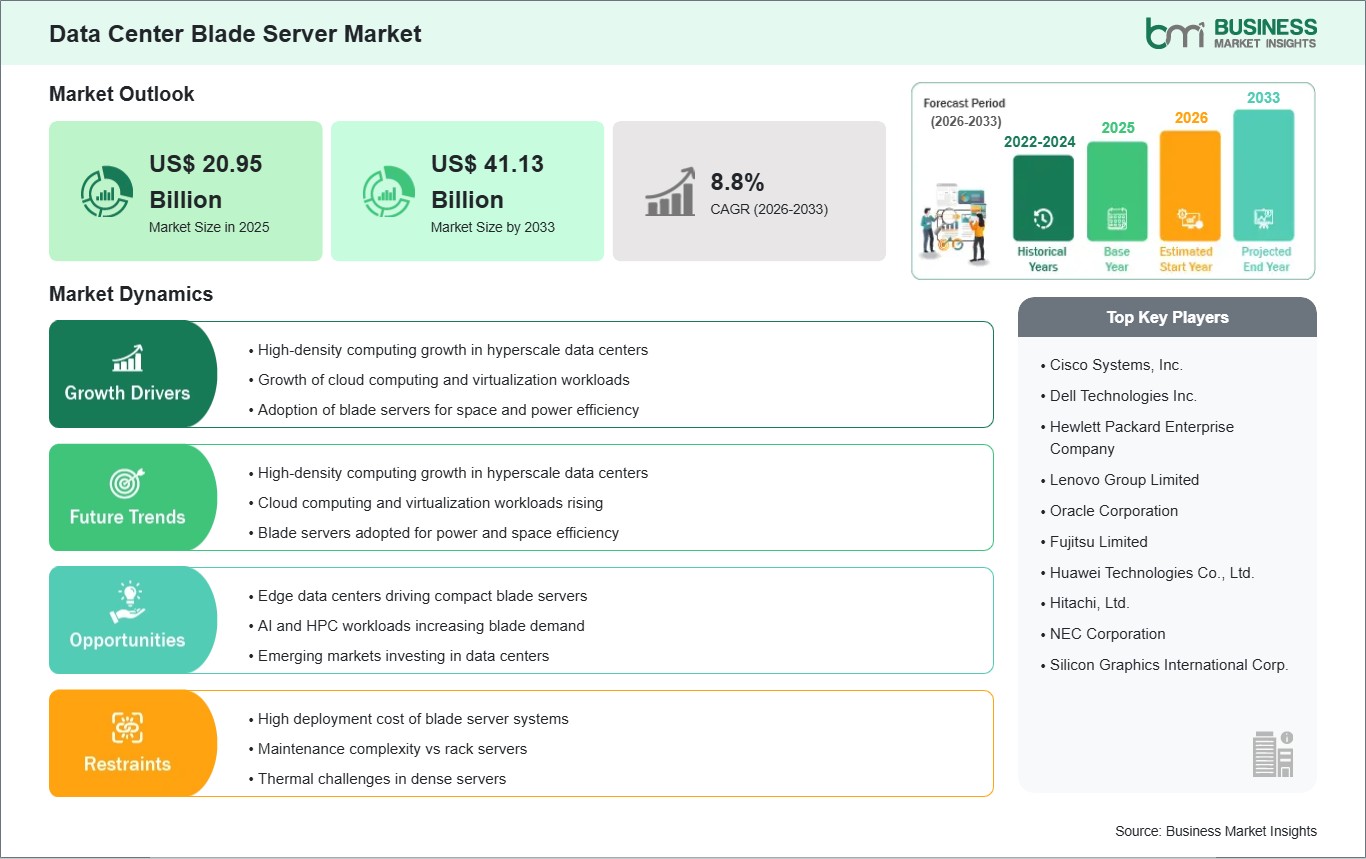
A datacenter blade server is a compact, modular server designed to save space and improve efficiency in large-scale computing environments. Unlike traditional rack servers, blade servers consolidate multiple server modules—called “blades”—into a single chassis, sharing power, cooling, and networking resources. This design allows datacenters to optimize space, reduce energy consumption, and simplify management, making them ideal for cloud computing, virtualization, and high-performance workloads. The usage of blade servers spans enterprises, cloud service providers, and research institutions that require scalable and efficient computing infrastructure. The demand factors driving the blade server market include the growing adoption of cloud services, increasing data center deployments, the need for energy-efficient and high-density solutions, and rising trends in big data analytics and AI workloads. Additionally, businesses seeking reduced operational costs and simplified server maintenance further accelerate the market growth of datacenter blade servers.
Segment Analysis
Data Center Blade Server Market Segmentation
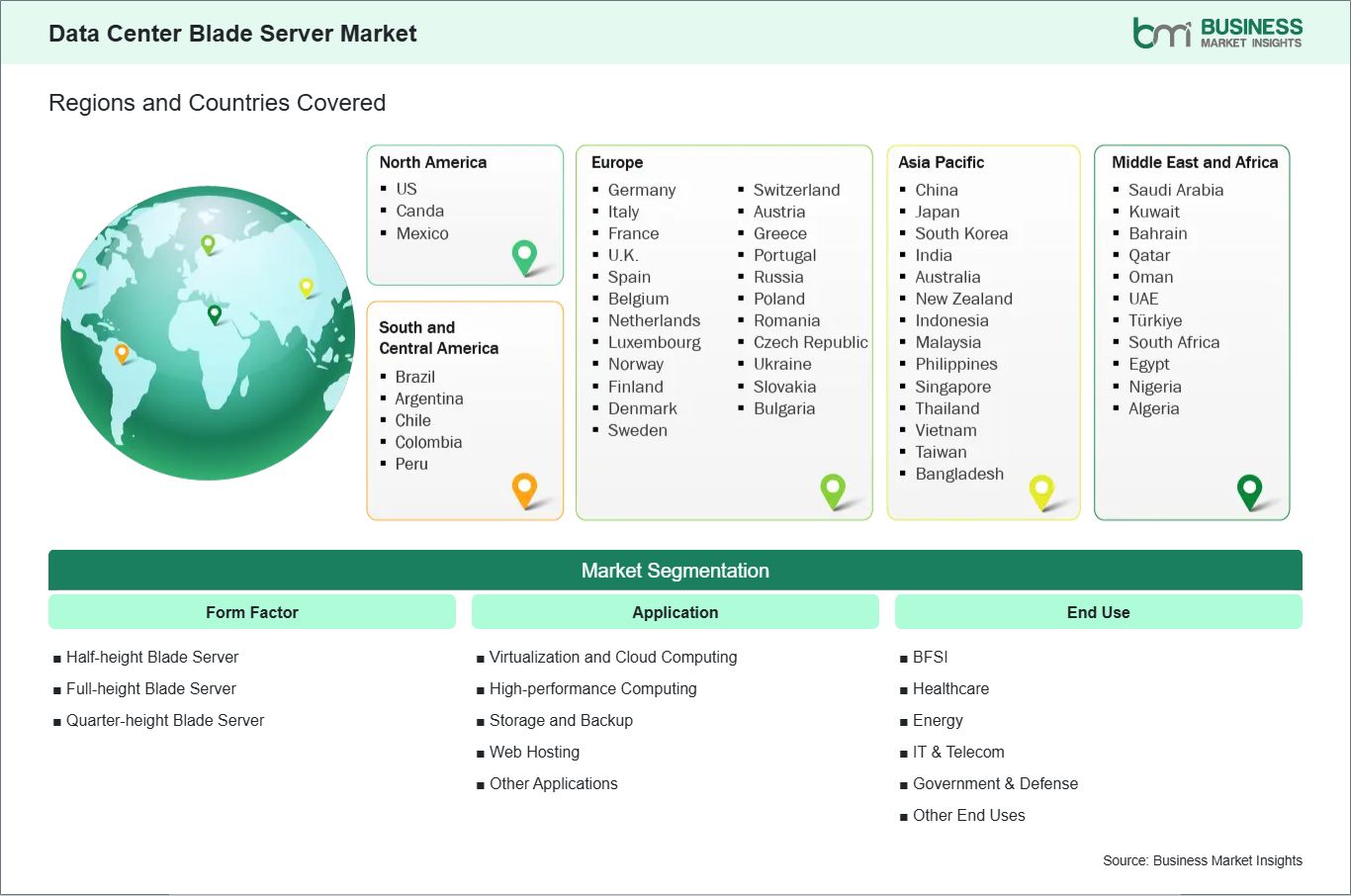
Key segments that contributed to the derivation of the data center blade server market analysis are form factor, application, and end use.
- By form factor, the market is segmented into half-height blade server, full-height blade server, and quarter-height blade server. The half‑height blade server segment held the largest share of the market in 2025.
- By application, the market is segmented into virtualization and cloud computing, high-performance computing (HPC), storage and backup, web hosting, and others. The virtualization and cloud computing segment held the largest share of the market in 2025.
- By end use, the market is segmented into BFSI, healthcare, energy, IT & telecom, government & defense, and others. The BFSI segment held the largest share of the market in 2025.
Market Forces
Data Center Blade Server Market Drivers and Opportunities
Increasing Adoption of Cloud Computing
The rapid adoption of cloud computing is a significant driver fueling the growth of the data center blade server market. Organizations across industries are migrating from traditional on-premises infrastructure to cloud-based solutions to improve scalability, flexibility, and cost efficiency. Blade servers, with their high-density design and modular architecture, offer an ideal solution for cloud service providers who require efficient utilization of space, power, and cooling within data centers. Their ability to handle high workloads, virtualization, and distributed computing makes them crucial for supporting cloud platforms and software-as-a-service (SaaS) applications. Moreover, as businesses increasingly rely on real-time data analytics and AI-driven applications, the demand for high-performance computing resources grows, further driving the adoption of blade servers. This trend ensures continuous investment in blade server infrastructure to meet evolving cloud computing requirements, solidifying their role as a backbone for modern data centers.
Growth in Edge Computing Deployments
The rise of edge computing presents a significant opportunity for the data center blade server market. Edge computing involves processing data closer to the source, such as IoT devices, autonomous vehicles, and smart city applications, to reduce latency and improve real-time decision-making. Blade servers, due to their compact form factor, energy efficiency, and modularity, are well-suited for deployment in edge data centers where space and power constraints are critical. As enterprises seek to deliver faster and more reliable services, deploying blade servers at edge locations allows for efficient handling of localized workloads while maintaining seamless connectivity with central data centers. Additionally, the increasing proliferation of connected devices generates massive volumes of data, creating the need for scalable, high-performance edge infrastructure. Capitalizing on edge computing expansion not only boosts demand for blade servers but also encourages innovation in server design tailored for distributed, high-performance environments.
Size and Share Analysis
Data Center Blade Server Market Size and Share Analysis
By form factor, the market is segmented into half-height blade server, full-height blade server, and quarter-height blade server. The half-height blade server segment held the largest share of the market in 2025. This form factor leads primarily because it offers an optimal blend of space efficiency, performance, and energy utilization, which aligns with the needs of hyperscale data centers and enterprise IT environments that prioritize compact yet powerful compute infrastructure.
By application, the market is segmented in virtualization and cloud computing, high-performance computing (HPC), storage and backup, web hosting, and others. The virtualization and cloud computing segment held the largest share of the market in 2025, owing to the shift toward virtualized infrastructures and hybrid cloud strategies. Blade servers are inherently optimized for such environments because they support efficient workload consolidation, high availability, and seamless scalability — key requisites for modern cloud‑centric operations.
By end use, the market is segmented BFSI, healthcare, energy, IT & telecom, government & defense, and others. The BFSI segment held the largest share of the market in 2025. Financial institutions’ reliance on low‑latency computing and robust data handling capabilities sustains their dominant share in blade server consumption, although IT & telecom sectors are poised for rapid growth given increasing 5G, edge computing, and cloud service rollouts.
Report Coverage
Data Center Blade Server Market Report Coverage and Deliverables
The "Data Center Blade Server Market Size and Forecast (2022 - 2033)" report provides a detailed analysis of the market covering below areas:
- Data center blade server market size and forecast at global, regional, and country levels for all the key market segments covered under the scope
- Data center blade server market trends, as well as market dynamics such as drivers, restraints, and key opportunities
- Data center blade server market analysis covering key market trends, global and regional framework, major players, regulations, and recent market developments
- Industry landscape and competition analysis covering market concentration, heat map analysis, prominent players, and recent developments for the air circuit breaker market
- Detailed company profiles, including SWOT analysis
Geographic Insights
Data Center Blade Server Market Geographic Insights
The geographical scope of the data center blade server market report is divided into five regions: North America, Asia Pacific, Europe, Middle East & Africa, and South & Central America. The data center blade server market in North America is expected to grow significantly during the forecast period.
The Asia Pacific data center blade server market is segmented into China, Japan, South Korea, India, Australia, New Zealand, Indonesia, Malaysia, the Philippines, Singapore, Thailand, Vietnam, Taiwan, Bangladesh, and the Rest of Asia Pacific. As enterprises seek scalable, high-performance computing solutions, blade servers offer compact design, energy efficiency, and easier management, making them ideal for dense datacenter environments. The rise of big data analytics, artificial intelligence (AI), and Internet of Things (IoT) applications is fueling demand for servers capable of handling large-scale, compute-intensive workloads. Additionally, government initiatives supporting smart cities and digital infrastructure development in countries such as China, India, and Singapore are accelerating datacenter expansion. The need for cost-effective, energy-efficient solutions to reduce operational expenses is further propelling the market. Moreover, growing e-commerce, financial services, and telecommunication sectors in the region are investing heavily in robust IT infrastructure, contributing significantly to the increasing deployment of blade servers across Asia Pacific.
Industry Activity
Recent Developments
The data center blade server market is evaluated by gathering qualitative and quantitative data post primary and secondary research, which includes important corporate publications, association data, and databases. A few of the key developments in the data center blade server market are:
- In December 2025, Supermicro, Inc. announcing the latest addition to its SuperBlade family with the SBI-622BA-1NE12-LCC, a high-density, direct liquid-cooled blade server powered by dual Intel Xeon 6900 series processors with up to 256 P-cores. This new SuperBlade solution delivers outstanding compute density, power efficiency, and performance. This new SuperBlade solution delivers outstanding compute density, power efficiency, and performance. Both air cooling and direct liquid cooling (CPU-only and CPU/DIMM/VRM cold plates) can be supported.
- In August 2025, Giga Computing, a subsidiary of GIGABYTE and an industry leader in accelerated computing servers and advanced cooling technologies, today announced the launch of its first 3U 10-node blade servers: the GIGABYTE B343-C40, supporting AMD EPYC 4005 or Ryzen 9000 Series processors, and the GIGABYTE B343-X40, supporting Intel® Xeon® 6300-series processors. This new GIGABYTE B-series marks Giga Computing’s entry into blade server solutions, optimized for enterprise, edge, and cloud workloads that demand scalable, power-efficient systems with centralized management.
Trust & Transparency
Research Methodology
The market analysis combines proprietary research with secondary data from government agencies, company disclosures, regulatory filings, industry databases and expert interviews. Market estimates are validated through data triangulation, cross-market benchmarking and analyst
review.
View Full Research Methodology
Key Sources Referred:
World Bank - Global Trade IndicatorsWorld Trade Organization (WTO)International Monetary Fund (IMF)International Trade Administration (ITA)Company websiteCompany annual reportsCompany investor presentations