Aircraft DC-DC Converter Market Outlook (2022-2033)

Historic Data: 2022-2024   |   Base Year: 2025   |   Forecast Period: 2026-2033
Report Content: Market Scope, Market Segmentation, Market Dynamics, and Competitive Analysis

Report Coverage:
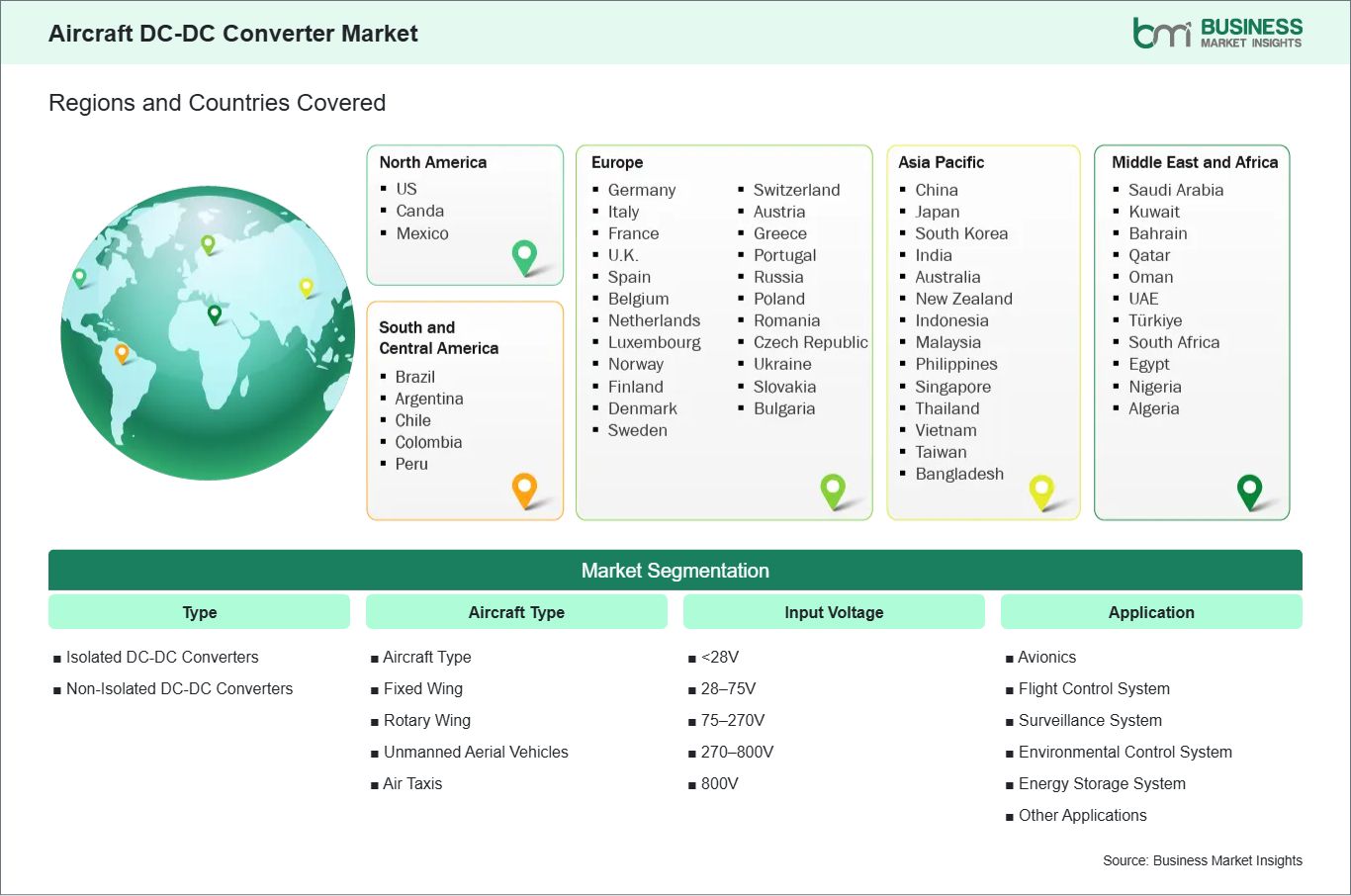
  • Type (Isolated DC-DC Converters, Non-Isolated DC-DC Converters)
  • Aircraft Type (Aircraft Type, Fixed Wing, Rotary Wing, Unmanned Aerial Vehicles, Air Taxis))
  • Input Voltage (<28V, 28-75V, 75-270V, 270-800V, 800V)
  • Application (Avionics, Flight Control System, Surveillance System, Environmental Control System, Energy Storage System, Other Applications)

No. of Pages: 400
Report Code: BMIPUB00033275
Category: Electronics and Semiconductor
Aircraft DC-DC Converter Market

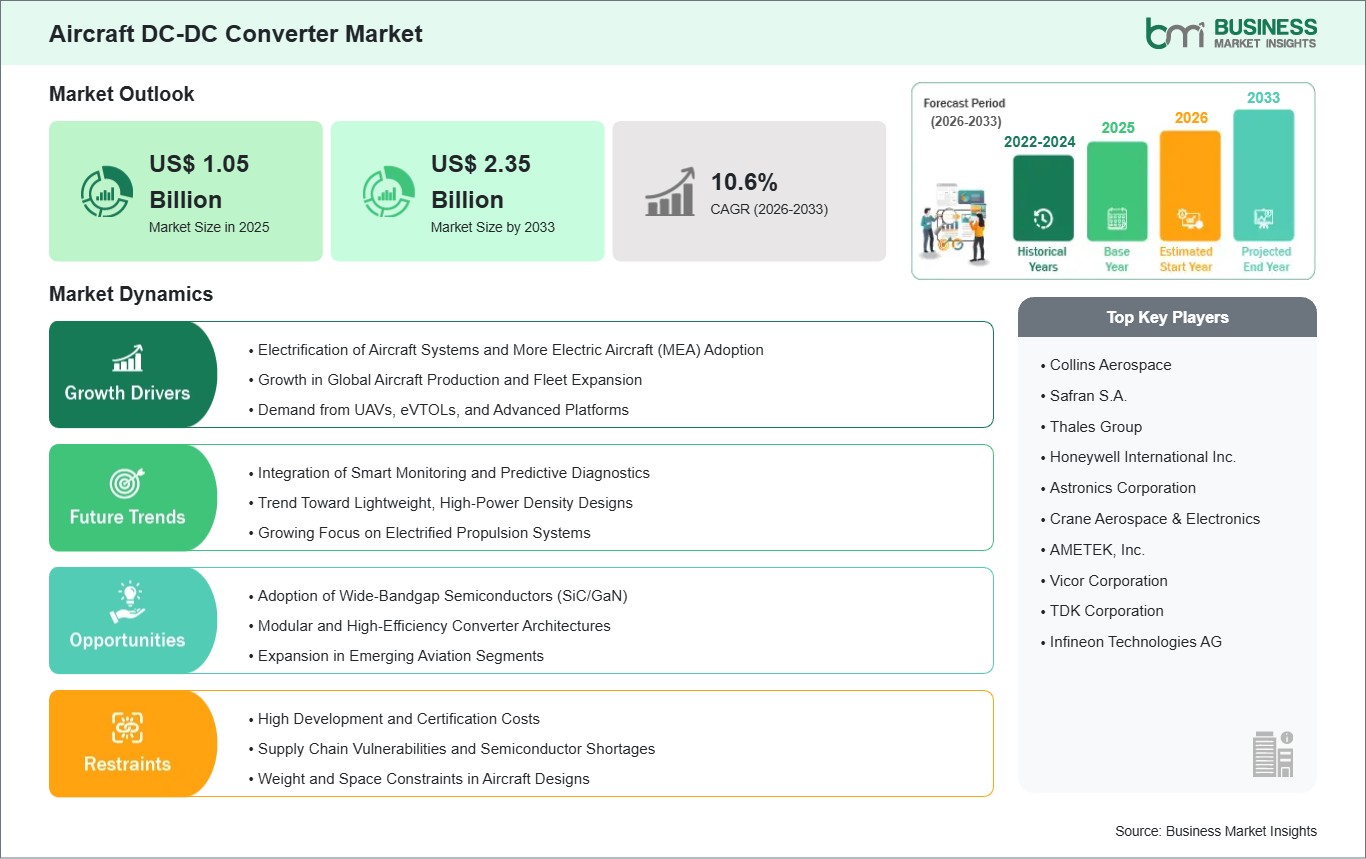
The aircraft DC-DC converter market size is expected to reach US$ 2.35 billion by 2033 from US$ 1.05 billion in 2025. The market is estimated to record a CAGR of 10.6% from 2026 to 2033.

Executive Summary and Global Market Analysis:

An aircraft DC-DC converter is a critical power electronics component used to convert and regulate direct current (DC) voltage levels within aircraft electrical systems. These converters ensure stable and efficient power delivery to avionics, flight control systems, communication equipment, sensors, and cabin electronics. Aircraft DC-DC converters are designed to meet stringent aerospace standards for reliability, efficiency, electromagnetic compatibility, and environmental resilience. They are deployed across various aircraft platforms, including fixed wing, rotary wing, and unmanned aerial vehicles (UAVs), and are available in isolated and non-isolated configurations to support diverse voltage and load requirements.

The global aircraft DC-DC converter market is witnessing steady growth, driven by the increasing electrification of aircraft systems, rising aircraft production and deliveries, and the growing adoption of advanced avionics and power management architectures. The shift toward more-electric and all-electric aircraft has significantly increased demand for efficient, lightweight, and high-power-density DC-DC converters capable of supporting complex onboard electrical loads. Additionally, the rapid expansion of UAV operations in defense and commercial applications is creating new opportunities for compact and high-efficiency power conversion solutions.

Aircraft DC-DC Converter Market - Strategic Insights:

global-market-strategic-framework
Get more information on this report

Aircraft DC-DC Converter Market Segmentation Analysis:

Key segments that contributed to the derivation of the aircraft DC-DC converter market analysis are type, aircraft type, input voltage and application.

  • By type, the market is segmented into isolated DC-DC converters and non-isolated DC-DC converters. The isolated DC-DC converters segment held the largest share of the market in 2025.
  • By aircraft type, the market is segmented into fixed wing, rotary wing, unmanned aerial vehicles, and air taxis. The fixed wing segment held the largest share of the market in 2025.
  • By input voltage, the market is segmented into <28V, 28–75V, 75–270V, 270–800V, and 800V. The 28–75V segment held the largest share of the market in 2025.
  • By application, the market is segmented into avionics, flight control system, surveillance system, environmental control system, energy storage system, and others. The avionics segment held the largest share of the market in 2025.

Aircraft DC-DC Converter Market Drivers and Opportunities:

Electrification of Aircraft Systems and Advanced Avionics Integration

The increasing electrification of aircraft systems is a major driver of growth in the aircraft DC-DC converter market. Modern aircraft rely heavily on electrically powered avionics, flight control systems, surveillance equipment, and environmental control systems, all of which require stable and efficient DC power conversion. In commercial and military aviation, DC-DC converters are being tightly integrated with advanced avionics architectures and power distribution units to support higher electrical loads and multiple voltage levels. UAV platforms, in particular, depend on compact, lightweight, and high-efficiency DC-DC converters to power sensors, communication modules, and autonomous control systems. As aircraft manufacturers continue to adopt more-electric and all-electric designs, the demand for high-performance, reliable DC-DC converters is expected to increase significantly, driving sustained market growth.

High-Voltage Architectures and Next-Generation Aircraft Platforms

The transition toward high-voltage electrical architectures in next-generation aircraft presents significant growth opportunities for the aircraft DC-DC converter market. Emerging platforms such as electric aircraft, hybrid-electric propulsion systems, and urban air mobility vehicles require DC-DC converters capable of handling higher input voltage ranges while maintaining efficiency, thermal stability, and safety. Advances in wide-bandgap semiconductor technologies, such as silicon carbide (SiC) and gallium nitride (GaN), are enabling the development of compact, high-power-density converters suitable for these applications. Additionally, the growing adoption of energy storage systems onboard aircraft is creating opportunities for bidirectional DC-DC converters that support efficient power flow between batteries and onboard systems. As the aviation industry continues to invest in sustainable and electric aviation concepts, demand for advanced DC-DC converter solutions is expected to create new growth avenues across commercial, military, and UAV segments.

Aircraft DC-DC Converter Market Size and Share Analysis:

By Type, the market is segmented into isolated DC-DC converters and non-isolated DC-DC converters. The isolated DC-DC converters segment held the largest share of the market in 2025. Isolated DC-DC converters are widely used in aircraft electrical systems due to their ability to provide electrical isolation between input and output, enhancing safety, reducing noise, and protecting sensitive avionics from voltage transients. These converters are extensively deployed in critical applications such as avionics, flight control systems, and surveillance systems, where reliability and fault protection are essential. The growing adoption of advanced avionics and safety-critical electronic systems across commercial, military, and UAV platforms continues to drive demand for isolated DC-DC converters in the aircraft DC-DC converter market.

By Aircraft Type, the market is segmented into fixed wing, rotary wing, unmanned aerial vehicles, and air taxis. The fixed wing segment held the largest share of the market in 2025. Fixed wing aircraft, including commercial airliners, regional jets, and business aircraft, require multiple voltage conversion stages to support complex onboard electrical architectures. The high number of aircraft deliveries, fleet expansions, and modernization programs in commercial aviation are key factors driving the adoption of DC-DC converters in this segment. Additionally, the increasing electrification of systems in rotary wing aircraft, UAVs, and emerging air taxi platforms is contributing to steady growth across all aircraft types, particularly for lightweight and high-efficiency power conversion solutions.

By Input Voltage, the market is segmented into <28V, 28–75V, 75–270V, 270–800V, and 800V. The 28–75V segment held the largest share of the market in 2025. This voltage range is commonly used in traditional aircraft power distribution systems and supports a wide range of avionics and auxiliary systems. DC-DC converters operating in this range offer an optimal balance between efficiency, reliability, and compatibility with existing aircraft electrical architectures. However, higher voltage segments, such as 270–800V and 800V, are gaining traction due to the growing adoption of more-electric and hybrid-electric aircraft, which require high-voltage power conversion for propulsion systems and energy storage applications.

By Application, the market is segmented into avionics, flight control system, surveillance system, environmental control system, energy storage system, and others. The avionics segment held the largest share of the market in 2025. Avionics systems rely heavily on DC-DC converters to deliver stable and regulated power to navigation, communication, flight management, and cockpit display systems. The increasing integration of advanced digital avionics, real-time data processing, and connected aircraft technologies is driving demand for high-performance DC-DC converters in this segment. Growth in energy storage and environmental control system applications is also creating new opportunities, particularly as aircraft platforms transition toward electrified and sustainable power architectures.

Aircraft DC-DC Converter Market Report Highlights:

Report Attribute Details
Market size in 2025 US$ 1.05 Billion
Market Size by 2033 US$ 2.35 Billion
Global CAGR (2026 - 2033)10.6%
Historical Data 2022-2024
Forecast period 2026-2033
Segments Covered By Type
  • Isolated DC-DC Converters
  • Non-Isolated DC-DC Converters
By Aircraft Type
  • Aircraft Type
  • Fixed Wing
  • Rotary Wing
  • Unmanned Aerial Vehicles
  • Air Taxis
By Input Voltage
  • <28V
  • 28-75V
  • 75-270V
  • 270-800V
  • 800V
By Application
  • Avionics
  • Flight Control System
  • Surveillance System
  • Environmental Control System
  • Energy Storage System
  • Other Applications
Regions and Countries Covered
North America US, Canada, Mexico
Europe Belgium, Austria, Finland, Denmark, Greece, Poland, Romania, Russia, Ukraine, Czech Republic, Slovakia, Bulgaria, Italy, Luxembourg, Germany, Switzerland, France, Netherlands, Norway, Portugal, Spain, Sweden, United Kingdom
Asia-Pacific Australia, China, India, Japan, South Korea, Indonesia, Malaysia, Philippines, Singapore, Thailand, Vietnam, Bangladesh, New Zealand, Taiwan
South and Central America Brazil, Argentina, Peru, Chile, Colombia
Middle East and Africa Bahrain, Kuwait, Oman, Qatar, Saudi Arabia, United Arab Emirates, Turkiye, South Africa, Egypt, Algeria, Nigeria
Market leaders and key company profiles
  • Collins Aerospace
  • Safran S.A.
  • Thales Group
  • Honeywell International Inc.
  • Astronics Corporation
  • Crane Aerospace & Electronics
  • AMETEK, Inc.
  • Vicor Corporation
  • TDK Corporation
  • Infineon Technologies AG
Get more information on this report

Aircraft DC-DC Converter Market Report Coverage and Deliverables:

The "Aircraft DC-DC Converter Market Size and Forecast (2022–2033)" report provides a detailed analysis of the market covering below areas:

  • Aircraft DC-DC converter market size and forecast at global, regional, and country levels for all the key market segments covered under the scope
  • Aircraft DC-DC converter market trends, as well as market dynamics such as drivers, restraints, and key opportunities
  • Aircraft DC-DC converter market analysis covering key market trends, global and regional framework, major players, regulations, and recent market developments
  • Industry landscape and competition analysis covering market concentration, heat map analysis, prominent players, and recent developments for the aircraft DC-DC converter market
  • Detailed company profiles, including SWOT analysis

Aircraft DC-DC Converter Market Geographic Insights:

The geographical scope of the aircraft DC-DC converter market report is divided into five regions: North America, Asia Pacific, Europe, Middle East & Africa, and South & Central America. The aircraft DC-DC converter market in Asia Pacific is expected to grow significantly during the forecast period.

Asia Pacific has emerged as one of the fastest-growing regions for aircraft DC-DC converters, driven by the rapid expansion of commercial aviation, increasing production and deployment of UAVs, and rising investments in advanced aircraft electrical systems. Countries such as China, Japan, South Korea, and India are at the forefront of this growth, supported by increasing air passenger traffic, expanding aircraft fleets, and growing domestic aircraft manufacturing programs. The rising adoption of advanced avionics, flight control systems, and electrified subsystems in both commercial and military aircraft is fueling strong demand for reliable and efficient DC-DC converters across the region.

In addition, Asia Pacific benefits from a large base of aircraft operators, increasing defense modernization programs, and growing investments in electric and hybrid-electric aircraft technologies. Government initiatives focused on aviation infrastructure development, airspace modernization, UAV integration, and indigenous aerospace manufacturing are further supporting the adoption of DC-DC converters in fixed wing, rotary wing, and unmanned aircraft platforms. The continued emphasis on energy efficiency, lightweight power electronics, and next-generation aircraft architectures is expected to sustain strong market growth across commercial, defense, and UAV segments in the region.

global-market-geography
Get more information on this report

Aircraft DC-DC Converter Market Research Report Guidance:

  • The report includes qualitative and quantitative data in the aircraft DC-DC converter market across type, aircraft type, input voltage, application and geography.
  • The report starts with the key takeaways (chapter 2), highlighting the key trends and outlook of the aircraft DC-DC converter market.
  • Chapter 3 includes the research methodology of the study.
  • Chapter 4 further includes ecosystem analysis.
  • Chapter 5 highlights the major industry dynamics in the aircraft DC-DC converter market, including factors that are driving the market, prevailing deterrents, potential opportunities, as well as future trends. Impact analysis of these drivers and restraints is also covered in this section.
  • Chapter 6 discusses the aircraft DC-DC converter market scenario, in terms of historical market revenues, and forecast till the year 2031.
  • Chapters 7 to 10 cover aircraft DC-DC converter market segments by component, type, technology, end-user industry, and geography across North America, Europe, Asia Pacific, Middle East and Africa, and South and Central America. They cover the market volume revenue forecast and factors driving the market.
  • Chapter 11 describes the competitive analysis along with the heat map analysis for the key players operating in the market.
  • Chapter 12 describes the industry landscape analysis. It provides detailed descriptions of business activities such as market initiatives, new developments, mergers, and joint ventures globally, along with a competitive landscape.
  • Chapter 13 provides detailed profiles of the major companies operating in the aircraft DC-DC converter market. Companies have been profiled on the basis of their key facts, business descriptions, products and services, financial overview, SWOT analysis, and key developments.
  • Chapter 14, i.e., the appendix is inclusive of a brief overview of the company, list of abbreviations, and disclaimer.

Aircraft DC-DC Converter Market News and Key Development:

The aircraft DC-DC converter market is evaluated by gathering qualitative and quantitative data post primary and secondary research, which includes important corporate publications, association data, and databases. A few of the key developments in the aircraft DC-DC converter market are:

  • In February 2025, True Blue Power today introduced the company’s new high voltage TC6500 DC-to-DC Converter. The TC6500 converts 270 VDC to 28 VDC to power avionics and other related systems onboard business, commercial, defense, and Advanced Air Mobility (AAM) aircraft. Weighing just 10.4 pounds (4.7 kg), the TC6500 high voltage converter is compact, lightweight and easy to install anywhere in the aircraft, including inside or outside of the pressure vessel. It can be easily installed in parallel for increased power output and redundancy, without the need for additional wiring. Remote On/Off capability, military-grade connectors, and a rugged aluminum chassis ensure the TC6500 delivers superior performance and reliability in demanding 270-volt applications.
  • In September 2025, VPT, Inc., a HEICO company announced the release of the VXR125-27000S, the first 270 V input model in its VXR Series of high-reliability COTS DC-DC converters, introduced in parallel with the VXRF2-270 EMI filter. The converter delivers 125 W of output power and operates over a 160 V to 400 V input range. The VXR125-27000S incorporates VPT's patented epoxy-encapsulated V-SHIELD packaging, designed for high chemical and environmental resistance, and features dual-sided conduction cooling to simplify thermal management.

Key Sources Referred:

  • World Bank – Global Trade Indicators
  • World Trade Organization (WTO)
  • International Monetary Fund (IMF)
  • International Trade Administration (ITA)
  • Company website
  • Company annual reports
  • Company investor presentations
The List of Companies - Aircraft DC-DC Converter Market
  • Collins Aerospace
  • Safran S.A.
  • Thales Group
  • Honeywell International Inc.
  • Astronics Corporation
  • Crane Aerospace & Electronics
  • AMETEK, Inc.
  • Vicor Corporation
  • TDK Corporation
  • Infineon Technologies AG
Frequently Asked Questions
How big is the Aircraft DC-DC Converter Market?

The Aircraft DC-DC Converter Market is valued at US$ 1.05 Billion in 2025, it is projected to reach US$ 2.35 Billion by 2033.

What is the CAGR for Aircraft DC-DC Converter Market by (2026 - 2033)?

As per our report Aircraft DC-DC Converter Market, the market size is valued at US$ 1.05 Billion in 2025, projecting it to reach US$ 2.35 Billion by 2033. This translates to a CAGR of approximately 10.6% during the forecast period.

What segments are covered in this report?

The Aircraft DC-DC Converter Market report typically cover these key segments-

  • Type (Isolated DC-DC Converters, Non-Isolated DC-DC Converters)
  • Aircraft Type (Aircraft Type, Fixed Wing, Rotary Wing, Unmanned Aerial Vehicles, Air Taxis))
  • Input Voltage (<28V, 28-75V, 75-270V, 270-800V, 800V)
  • Application (Avionics, Flight Control System, Surveillance System, Environmental Control System, Energy Storage System, Other Applications)

What is the historic period, base year, and forecast period taken for Aircraft DC-DC Converter Market?

The historic period, base year, and forecast period can vary slightly depending on the specific market research report. However, for the Aircraft DC-DC Converter Market report:

  • Historic Period : 2022-2024
  • Base Year : 2025
  • Forecast Period : 2026-2033
  • Who are the major players in Aircraft DC-DC Converter Market?

    The Aircraft DC-DC Converter Market is populated by several key players, each contributing to its growth and innovation. Some of the major players include:

  • Collins Aerospace
  • Safran S.A.
  • Thales Group
  • Honeywell International Inc.
  • Astronics Corporation
  • Crane Aerospace & Electronics
  • AMETEK, Inc.
  • Vicor Corporation
  • TDK Corporation
  • Infineon Technologies AG
  • Who should buy this report?

    The Aircraft DC-DC Converter Market report is valuable for diverse stakeholders, including:

    • Investors: Provides insights for investment decisions pertaining to market growth, companies, or industry insights. Helps assess market attractiveness and potential returns.
    • Industry Players: Offers competitive intelligence, market sizing, and trend analysis to inform strategic planning, product development, and sales strategies.
    • Suppliers and Manufacturers: Helps understand market demand for components, materials, and services related to concerned industry.
    • Researchers and Consultants: Provides data and analysis for academic research, consulting projects, and market studies.
    • Financial Institutions: Helps assess risks and opportunities associated with financing or investing in the concerned market.

    Essentially, anyone involved in or considering involvement in the Aircraft DC-DC Converter Market value chain can benefit from the information contained in a comprehensive market report.

    Available Report Formats

    pdf-format excel-format pptx-format
    Buy Now
    Sales Assistance
    +1 646 791 7070 (US & UK)
    Customization Form

    Please tell us your area of interest
    (Market Segments/ Regions and Countries/ Companies)