Market Summary
Executive Summary and Global Market Analysis
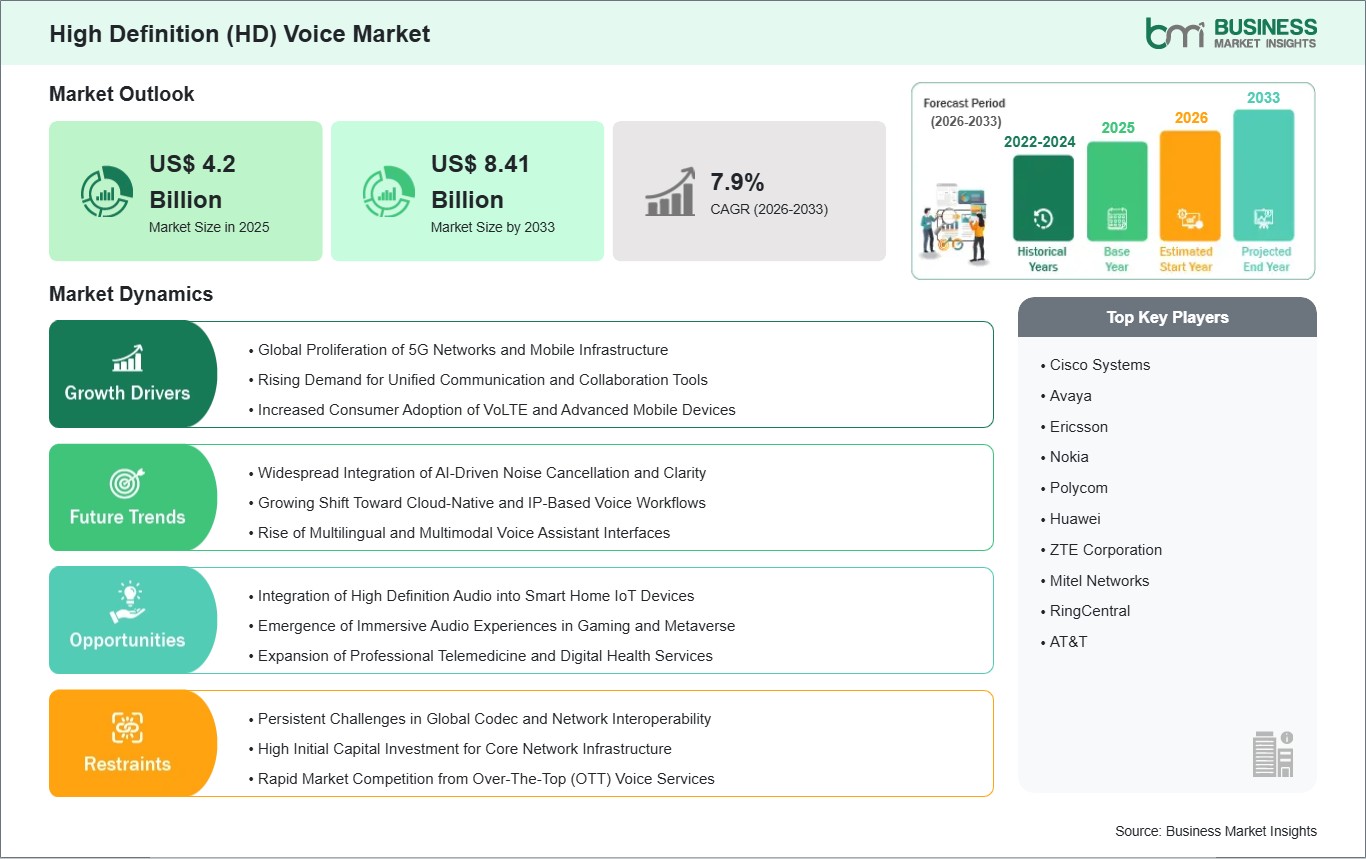
High Definition (HD) Voice, also known as wideband audio, plays a critical role in the telecommunications industry by providing significantly higher audio quality compared to traditional standard telephony. By doubling the frequency range of voice signals, HD Voice offers clearer, more natural-sounding speech and reduces background noise, making it essential for sectors such as IT and telecom, BFSI, healthcare, and customer service. HD Voice has several advantages, including improved speech recognition, reduced listener fatigue, and enhanced clarity for multi-party conference calls. The proliferation of 5G networks, the rapid adoption of Voice over LTE (VoLTE), and the increasing demand for unified communication-as-a-service (UCaaS) solutions are fueling the market. Additionally, innovations in artificial intelligence-based noise cancellation, advanced audio codecs such as EVS (Enhanced Voice Services), and HD audio integration into IoT devices will enhance efficiency in communications.
However, several challenges can restrain market growth, such as codec incompatibility between various service providers, the expensive initial investments for upgrading the network infrastructure of the networks, and the inability to route the process of the voice call through the traditional public switched telephone networks. The industry is also sensitive to the rapid rise of Over-The-Top (OTT) applications, which may bypass traditional telecom carrier services. Despite these hurdles, the market holds significant opportunities driven by the expansion of remote work and virtual collaboration, the growth of broadband subscriptions in developing countries, and the integration of HD voice in AR/VR and telepresence applications. Investment in Web-based Real-Time Communication (WebRTC) and cloud-based telephony is also expected to open new avenues for market expansion.
Segment Analysis
High Definition (HD) Voice Market Segmentation
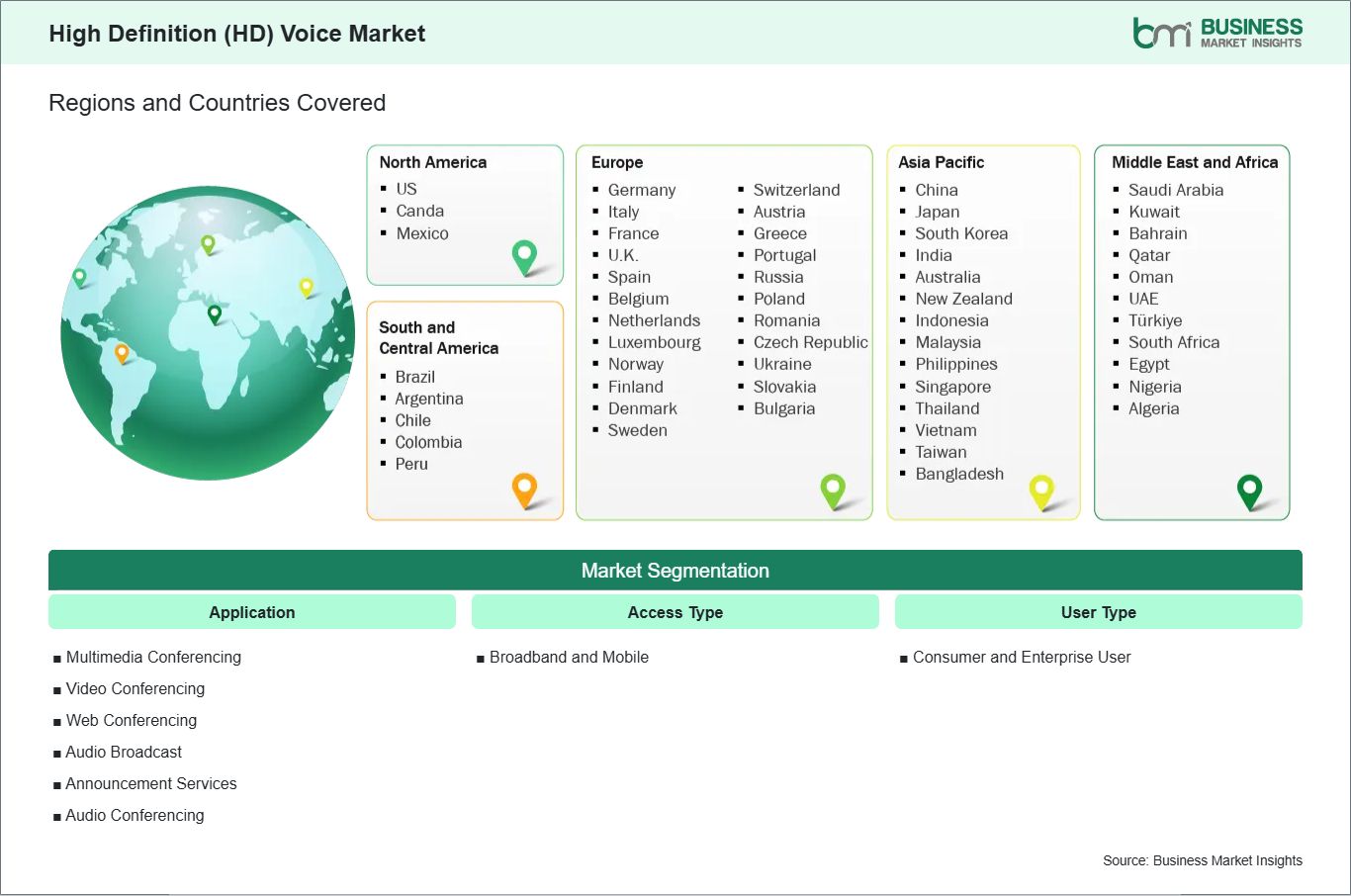
Key segments that contributed to the derivation of the High Definition (HD) Voice market analysis are application, access type, and user type.
- By Application, the market is segmented into Multimedia Conferencing, Video Conferencing, Web Conferencing, Audio Broadcast, Announcement Services, and Audio Conferencing.
- By Access Type, the market is divided into Broadband and Mobile.
- By User Type, the market is categorized into Consumer and Enterprise User.
Market Forces
High Definition (HD) Voice Market Drivers and Opportunities
Rapid Expansion of Global E-commerce and Remote Work Models
The rapid growth of global digitalization and remote work models has emerged as a pivotal factor positively driving the high definition (HD) voice market. With the transition to hybrid work environments and the increasing preference for virtual meetings, businesses now expect crystal-clear audio quality and real-time collaboration, making HD voice a critical component of the corporate communication ecosystem.
The demand for the HD-enabled audio is expected to grow significantly. This growth is associated with the increasing demand and sales of VoIP subscriptions, 5G-enabled smartphones, and conferencing hardware. The robust expansion of the digital economy supports the growth of the HD voice market, as the need for fast, efficient, and clear global communication solutions continues to increase to meet consumer expectations and professional supply chain demands worldwide. Major technology giants such as Cisco, Microsoft, and Zoom have not only expanded their reach globally but have also significantly influenced communication models by demanding high-fidelity audio capabilities.
Globalization of Trade and Interconnected Economic Networks
The ongoing globalization of trade has become a powerful driver of growth in the HD voice market. As international trade agreements expand and global supply chains become increasingly interconnected, businesses are more reliant than ever on high-quality communication to coordinate across time zones. HD voice services, with their ability to reduce listener fatigue and eliminate language misunderstandings due to audio clarity, have emerged as a crucial enabler of this global exchange.
Recently, the emergence of 5G networks has paved the way for the development of newer markets, facilitating cross-border trade as well as the exchange of information among the developed and emerging markets. Time-critical coordination, particularly with high value in the pharmaceutical industry, auto industry, or financial markets, uses HD voice with high precision. As companies adapt to just-in-time inventory practices and real-time remote monitoring, the demand for rapid, high-quality audio delivery via broadband and mobile networks is expected to grow steadily. As companies adapt to just-in-time inventory practices and real-time remote monitoring, the demand for rapid, high-quality audio delivery via broadband and mobile networks is expected to grow steadily.
Size and Share Analysis
High Definition (HD) Voice Market Size and Share Analysis
The high definition (HD) voice market demonstrates steady growth, with size and share analysis revealing evolving trends and competitive positioning among key players. The report further examines subsegments categorized within application, access type, and user type, offering insights into their contribution to overall market performance.
Based on applications, the audio Conferencing services are typically used for large-scale enterprise meetings where clear vocal clarity is essential to maintain productivity and reduce background interference. This application segment is widely utilized across various industries due to its cost-efficiency and high user capacity.
In terms of access type, mobile access involves the movement of voice data across cellular networks and plays a vital role in supporting the consumer market. This segment benefits from increasing 5G penetration, trade agreements for mobile hardware, and the rising demand for mobile-first communication apps.
On the basis of user type, the enterprise users utilize HD voice for critical operations such as customer support, remote consultation in healthcare, and internal team coordination, requiring strict audio standards and 99.9% uptime reliability.
Report Coverage
High Definition (HD) Voice Market Report Coverage and Deliverables
The "High Definition (HD) Voice Market Size and Forecast (2022 - 2033)" report provides a detailed analysis of the market covering below areas:
- High Definition (HD) Voice market size and forecast at global, regional, and country levels for all the key market segments covered under the scope.
- High Definition (HD) Voice market trends, as well as market dynamics such as drivers, restraints, and key opportunities.
- High Definition (HD) Voice market analysis covering key market trends, global and regional framework, major players, regulations, and recent market developments.
- Industry landscape and competition analysis covering market concentration, heat map analysis, prominent players, and recent developments for the High Definition (HD) Voice market
- Detailed company profiles, including SWOT analysis.
Geographic Insights
High Definition (HD) Voice Market Geographic Insights
The geographical scope of the High Definition (HD) Voice market report is divided into five regions: North America, Asia Pacific, Europe, Middle East &Africa, and South &Central America.
The Asia-Pacific High Definition (HD) Voice market is segmented into China, Japan, South Korea, India, Australia, and the Rest of Asia. The Asia-Pacific market is experiencing robust growth, driven by the rapid expansion of 5G infrastructure, growing international business trade, and the rising demand for time-sensitive customer support services. Major economies like China and India are leading the way, fueled by massive telecommunications investments and the development of high-speed fiber-optic networks.
The region is also witnessing increased adoption of advanced communication technologies, including AI-based voice enhancement and digital voice assistants, particularly relevant for sectors like BFSI and IT services. Network capacity expansion, alongside the modernization of communication hubs by regional telcos, is enhancing operational efficiency and reducing latency. Additionally, the surge in manufacturing and services exports, coupled with the growth of unified communication networks, is positioning Asia-Pacific as a key hub in the global voice technology ecosystem.
Industry Activity
Recent Developments
The High Definition (HD) Voice market is evaluated by gathering qualitative and quantitative data post primary and secondary research, which includes important corporate publications, association data, and databases. A few of the key developments in the High Definition (HD) Voice market are:
- In January 2026, Iridium Communications Inc. announced successful on-air testing of Iridium NTN Direct℠, including two-way message transmission over its low-Earth orbit (LEO) satellite network. This milestone marks a significant step forward as Iridium prepares for beta testing and commercial service of Iridium NTN Direct in 2026. Iridium NTN Direct is being developed as the world's first truly global, standards-based NB-IoT and direct-to-device (D2D) non-terrestrial network (NTN) service.
- In January 2026, Cadence announced the Cadence® Tensilica® HiFi iQ DSP IP, the sixth generation of its highly successful HiFi DSP family, based on a new architecture purpose-built for next-generation voice AI and emerging immersive audio. As these applications proliferate in the home entertainment, automotive infotainment, and smartphone markets, the HiFi iQ DSP delivers the performance and energy efficiency required to meet growing SoC computational demands. Compared to the industry-leading Tensilica HiFi 5s DSP, the HiFi iQ DSP offers 2X greater compute performance, 8X higher AI performance, and more than 25% energy savings for most
Trust & Transparency
Research Methodology
The market analysis combines proprietary research with secondary data from government agencies, company disclosures, regulatory filings, industry databases and expert interviews. Market estimates are validated through data triangulation, cross-market benchmarking and analyst
review.
View Full Research Methodology
Key Sources Referred:
World Bank - Global Trade Indicators World Trade Organization (WTO) International Monetary Fund (IMF) International Trade Administration (ITA) Company website Company annual reports Company investor presentations