Market Summary
Executive Summary and Global Market Analysis
High Speed Camera Market refers to imaging systems capable of capturing thousands of frames per second. These cameras enable precise motion analysis across scientific, industrial, and creative applications. Their ability to reveal transient phenomena makes them essential for investigating high-speed events invisible to conventional imaging.
Expanding demand from industries requiring advanced visualization is encouraging wider deployment. Automotive testing, media production, and scientific research rely on detailed frame-by-frame analysis. Manufacturers continue refining sensor performance and image clarity, supporting broader applicability across varied operating environments.
From a segmentation perspective, frame rate categories define performance tiers suited for different operational requirements. Lower frame ranges cater to general testing and media usage, while higher frame capabilities address advanced aerospace and research scenarios. Applications further diversify the market through domain-specific imaging demands.
Technological progress has improved resolution, storage efficiency, and real-time processing capabilities. Integration with analytical software enhances usability across industrial and laboratory settings. Evolving workflows in digital content creation also support increased utilization of high-speed imaging solutions.
Competition within the industry remains structured around innovation in sensor technology and product reliability. Market participants emphasize differentiation through performance consistency and adaptability to specialized use cases. Strategic positioning continues to revolve around product advancement rather than pricing competition.
Segment Analysis
High Speed Camera Market Segmentation
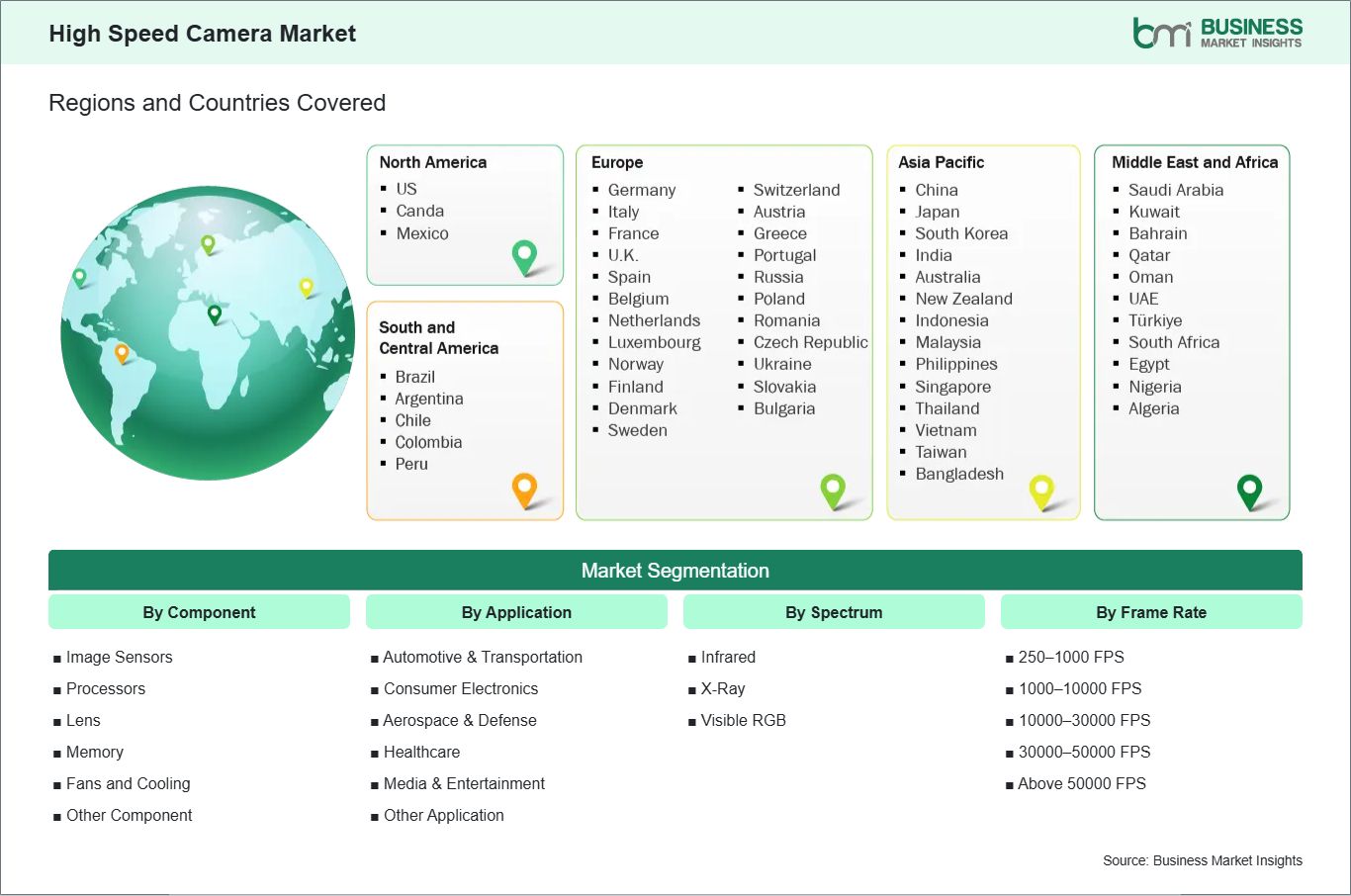
The market demonstrates diversified adoption across component, application, spectrum, and frame rate.
By Component
- Image Sensors: Capture high-speed light data and convert it into digital signals for motion analysis and imaging applications
- Processors: Handle real-time image processing and data computation for high-frame-rate output
- Lens: Focus and optimize light capture for accurate high-speed imaging across different environments
- Memory: Enables rapid data storage and transfer during high-frame-rate recording
- Fans and Cooling: Maintain thermal stability of high-speed cameras during continuous operation
- Others: Includes housings, interfaces, and supporting electronic components
By Application
- Automotive & Transportation: Used for crash testing, ADAS development, and vehicle performance analysis
- Consumer Electronics: Applied in device testing, motion capture, and product development
- Aerospace & Defense: Used for high-speed aerodynamics testing, weapon systems analysis, and flight research
- Healthcare: Applied in medical imaging, biomechanics, and surgical research
- Media & Entertainment: Used for slow-motion filming, sports broadcasting, and visual effects
- Others: Includes industrial testing, scientific research, and specialized engineering applications
By Spectrum
- Infrared: Used for thermal imaging, night vision, and heat-based motion analysis
- X-Ray: Used for internal structure analysis and high-penetration imaging in research and medical applications
- Visible RGB: Most widely used spectrum for standard high-speed imaging and motion capture
By Frame Rate
- 250–1000 FPS: Suitable for basic motion analysis and standard industrial applications
- 1000–10000 FPS: Used for detailed slow-motion analysis in automotive and industrial testing
- 10000–30000 FPS: Applied in advanced research, aerospace testing, and high-speed industrial inspection
- 30000–50000 FPS: Used for ultra-high-speed events such as combustion studies and ballistic testing
- Above 50000 FPS: Highest performance segment, used in advanced scientific research and extreme motion capture applications.
Market Forces
High Speed Camera Market Drivers and Opportunities
Rising Demand for Precision Monitoring in Industrial Applications
Increasing emphasis on quality assurance and operational accuracy has influenced adoption across industrial sectors. High speed imaging supports fault detection, material testing, and production monitoring. Industries pursue advanced visualization tools to reduce inefficiencies and improve process reliability. This shift toward precision-driven manufacturing strengthens reliance on high-speed cameras in routine operations.
Enhanced regulatory expectations in safety and performance testing reinforce this demand. Industries must comply with strict validation procedures, particularly in automotive and aerospace domains. High speed cameras enable detailed assessment under controlled conditions. Their relevance grows as companies align operational practices with compliance frameworks and technological advancements.
Integration of High Speed Imaging in Advanced Research Environments
Emerging scientific disciplines increasingly require detailed capture of dynamic processes. High speed cameras support experiments involving fluid dynamics, material deformation, and biological motion. Continuous improvements in image resolution and processing capabilities enhance their role in experimental workflows. Research institutions adopt these systems to support complex investigations.
Opportunities extend toward expanded use in interdisciplinary innovation. Integration with artificial intelligence and simulation models enhances analytical depth. Future applications may include advanced diagnostics and real-time decision systems. Long-term growth is supported by continuous collaboration between research institutions and technology developers.
Size and Share Analysis
High Speed Camera Market Size and Share Analysis
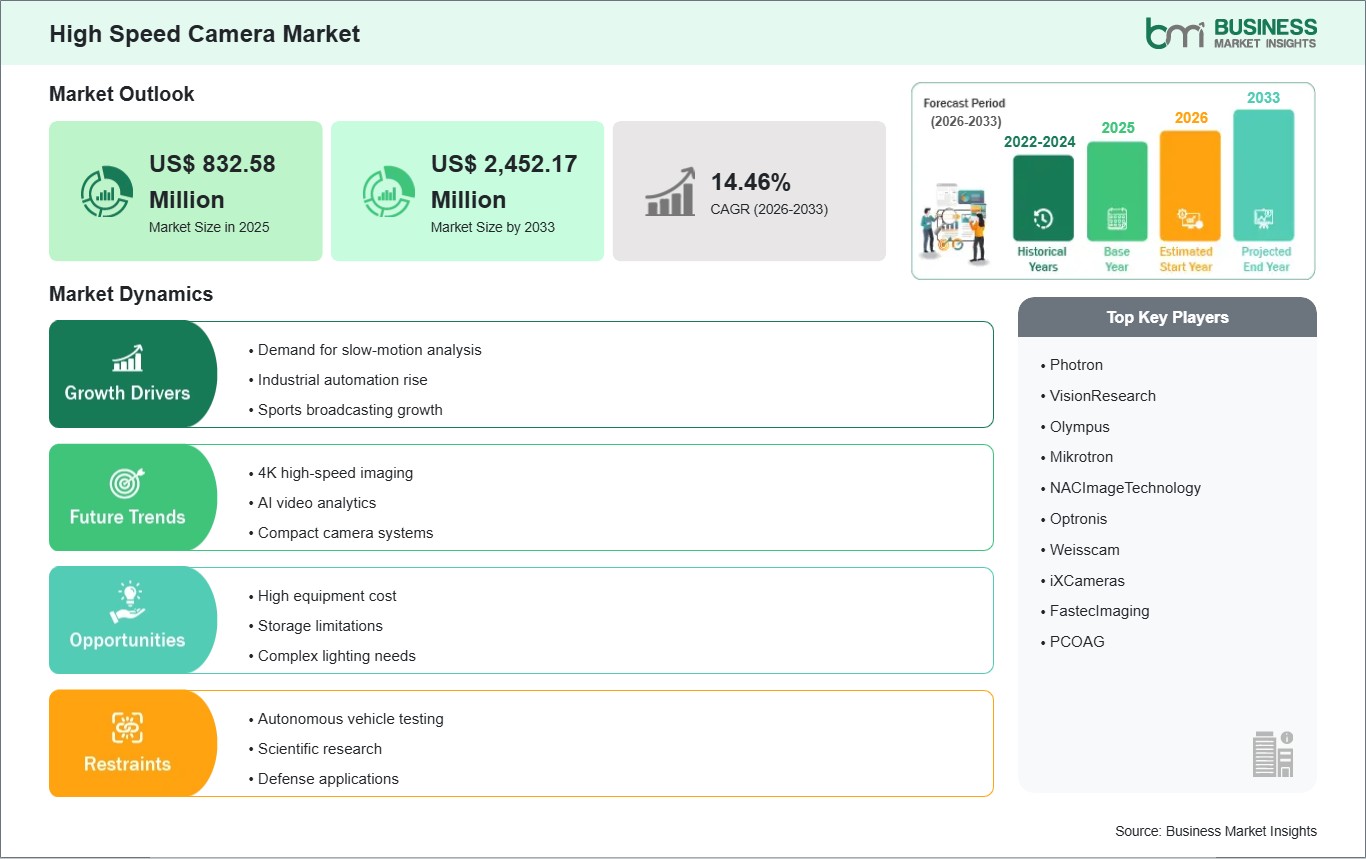
The High Speed Camera Market is projected to grow from US$ 832.58 Million in 2025 to US$ 2,452.17 Million by 2033 , registering a CAGR of 14.46% from 2026 to 2033.
Frame rate segmentation indicates stronger positioning of mid-range performance cameras. These systems address a wider spectrum of applications without requiring complex setups. Higher frame rate systems remain essential in specialized environments, particularly where extreme precision is critical.
Application-wise, industrial use leads due to continuous integration into production environments. Automotive and aerospace applications contribute through testing requirements, while media usage expands with evolving content production standards. Demand remains closely aligned with visual accuracy and operational efficiency needs.
Report Coverage
High Speed Camera Market Report Coverage and Deliverables
The "High Speed Camera Market Size and Forecast (2022–2033)" report provides a detailed analysis of the market covering below areas:
- High Speed Camera market size and forecast at global, regional, and country levels for all the key market segments covered under the scope
- High Speed Camera market trends, as well as market dynamics such as drivers, restraints, and key opportunities
- High Speed Camera market analysis covering key market trends, global and regional framework, major players, regulations, and recent market developments
- Industry landscape and competition analysis covering market concentration, heat map analysis, prominent players, and recent developments for the High Speed Camera market
- Detailed company profiles, including SWOT analysis
Geographic Insights
High Speed Camera Market Geographic Insights
The High Speed Camera market shows diverse regional adoption patterns influenced by industrial maturity, research infrastructure, and sector-specific requirements. Developed economies demonstrate strong uptake due to established testing facilities and technological readiness. Emerging markets exhibit gradual expansion supported by industrial development initiatives.
North America maintains a strong presence driven by innovation in automotive and aerospace sectors. The United States leads with extensive research funding and advanced testing facilities. Canada supports adoption through academic research and industrial collaborations, contributing to steady utilization across multiple applications.
Asia Pacific demonstrates significant expansion as manufacturing capabilities continue to evolve. Countries such as China, Japan, and South Korea invest in industrial automation and research infrastructure. High speed imaging adoption aligns with advancements in production technologies and increasing emphasis on quality standards.
Europe remains an important contributor with established automotive and aerospace industries. Germany and France lead in industrial applications, while the United Kingdom emphasizes research-driven utilization. Emerging regions, including parts of Latin America and the Middle East, show gradual progress through infrastructure development and industrial investments.
Industry Activity
Recent Developments
The High Speed Camera market is evaluated by gathering qualitative and quantitative data post primary and secondary research, which includes important corporate publications, association data, and databases. A few of the key developments in the High Speed Camera market are:
- 2024: Vision Research introduced enhancements to its Phantom series, focusing on improved frame rates and image processing capabilities
- 2023: Photron launched an advanced high-speed camera model designed for industrial testing and precision measurement applications.
Trust & Transparency
Research Methodology
The market analysis combines proprietary research with secondary data from government agencies, company disclosures, regulatory filings, industry databases and expert interviews. Market estimates are validated through data triangulation, cross-market benchmarking and analyst
review.
View Full Research Methodology
Key Sources Referred:
Industry reports on sustainable tire manufacturing and automotive mobility Government transportation and environmental policy publications Automotive trade journals and tire technology periodicals Company annual reports and sustainability disclosures Academic studies on bio-based polymers and recycled materials International automotive production and mobility assessments Research publications covering tire material innovation and efficiency trends Company website Company annual reports Company investor presentations