
Miniature Camera Market Outlook: Size, Share, Trends, Growth Analysis, Competitive Landscape & Forecast, 2026-2033

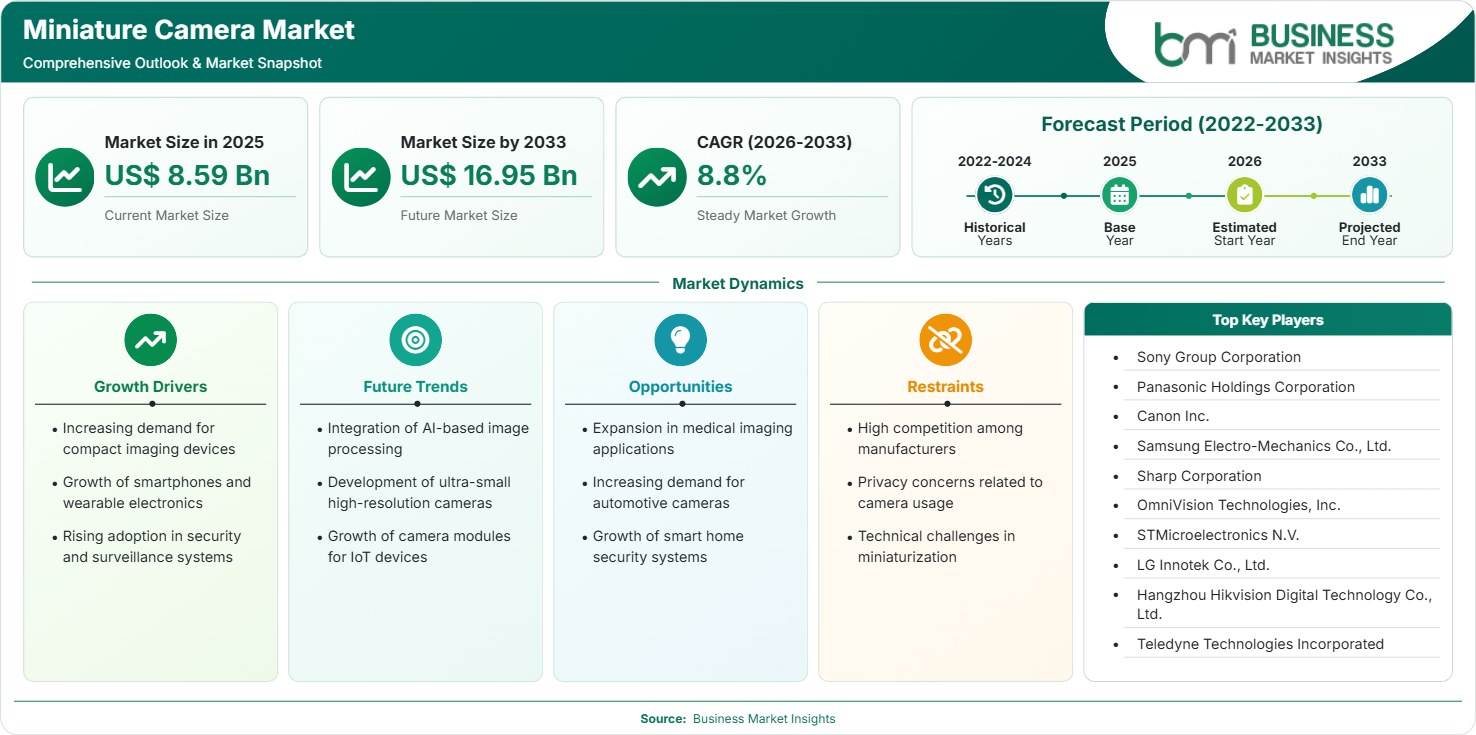
The Miniature Camera Market size was valued at US$ 8.59 Billion in 2025 and is projected to reach US$ 16.95 Billion by 2033, exhibiting a CAGR of 8.8% from 2026 to 2033, on account of surging demand for miniature cameras, rise in the usage of smartphones and wearable devices, and increased use in security and surveillance solutions.

Report Coverage
  • Type: CMOS, CCD
  • Application: Medical, Industrial, Others
US$ 8.59 Bn Market size in 2025
US$ 16.95 Bn Market Size by 2033
8.8% CAGR, 2026 - 2033
2026-2033 Forecast Period

01 AI Overview

Miniature Camera Market Summary

  • North America Region: North America holds market share 29%–32% in 2025, with a CAGR of 8.3% to 8.8%. This can be attributed to the high use of imaging systems, security factors, and medical devices. In the US, the market growth rate stands at 8.5% to 9.0%.
  • Fastest Growing Region: Asia Pacific holds market share 39%–42% in 2025, expanding at a CAGR of 9.5%–10.1%, supported by consumer electronics manufacturing, smartphone production, automotive electronics, and expanding industrial automation.
  • Leading Segment: CMOS accounts for 73%–76% market share in 2025, growing at a CAGR of 9.0%–9.5%, driven by low power consumption, superior image quality, compact design, and broad integration across consumer and industrial devices.
  • High Growth Segment: Medical applications hold 31%–34% share in 2025, growing at a CAGR of 9.8%–10.4%, driven by increasing adoption of minimally invasive procedures, endoscopy, and advanced diagnostic imaging technologies.
  • Key Market Opportunity: Expansion in medical imaging applications, increasing automotive camera deployment, and growing adoption of smart home security systems continue creating long-term opportunities for miniature camera manufacturers.
  • Major Market Players: Sony Group Corporation, Panasonic Holdings Corporation, Canon Inc., Samsung Electro-Mechanics Co., Ltd., Sharp Corporation, OmniVision Technologies, Inc., STMicroelectronics N.V., LG Innotek Co., Ltd., Hangzhou Hikvision Digital Technology Co., Ltd., Teledyne Technologies Incorporated.
02 Strategic Insights

Miniature Camera Market: Strategic Insights

Miniature Camera Market Strategic Framework
FREE PDF
Request your free sample
Request free sample
03 Stakeholder View

Key Takeaways

  • The miniature camera value chain is becoming increasingly integrated as image sensor manufacturers, optics suppliers, semiconductor companies, module assemblers, and device manufacturers collaborate to improve imaging performance and production efficiency.
  • Growth opportunities remain strongest across medical imaging, automotive vision systems, industrial automation, and smart security applications requiring compact, high-resolution imaging solutions.
  • Innovation is focused on AI-enabled image processing, ultra-miniaturized camera modules, high-resolution CMOS sensors, low-light imaging technologies, and energy-efficient designs for next-generation connected devices.
  • Asia Pacific remains the most attractive investment destination due to its dominant consumer electronics manufacturing ecosystem, expanding semiconductor production, and increasing adoption of automotive and industrial imaging technologies.
  • Strategic partnerships, acquisitions, and investments in semiconductor fabrication and camera module manufacturing continue strengthening competitive positioning among global imaging technology providers.
  • Growing deployment of AI, machine vision, robotics, and Internet of Things devices is encouraging manufacturers to develop intelligent miniature cameras with enhanced processing, connectivity, and real-time imaging capabilities.
04 Geographic Outlook

Miniature Camera Market Regional Highlights

North America Miniature Camera Market

North America accounts for 29%–32% share in 2025, expanding at a CAGR of 8.3%–8.8%. The market share remains strong due to advanced healthcare infrastructure, increasing adoption of AI-powered surveillance, expanding autonomous vehicle development, and strong investments in industrial automation. Continuous technological innovation supports regional demand across multiple end-use industries.

  • Growing investments in medical imaging equipment continue increasing demand for miniature cameras used in endoscopy, diagnostics, and minimally invasive surgical procedures.
  • Expanding deployment of AI-powered surveillance systems strengthens adoption of advanced miniature imaging technologies across commercial and public security applications.
  • Automotive manufacturers continue integrating compact cameras into advanced driver assistance systems and autonomous vehicle development programs.
  • Industrial automation and robotics applications continue driving demand for high-performance miniature imaging systems supporting quality inspection and machine vision.

US Miniature Camera Market

The US holds 24%–27% share in 2025, growing at a CAGR of 8.5%–9.0%. The market growth is driven by expanding medical technology innovation, increasing deployment of security systems, autonomous vehicle development, and rising investments in artificial intelligence-enabled imaging solutions.

  • Healthcare providers continue adopting miniature imaging systems for minimally invasive procedures and advanced diagnostic technologies.
  • Growing investments in autonomous mobility and intelligent transportation systems support increasing deployment of automotive camera modules.
  • Defense, aerospace, and industrial sectors continue expanding use of compact imaging technologies for surveillance and inspection applications.
  • Strong research and development investments continue accelerating innovation in image sensors, optics, and intelligent vision technologies.

Europe Miniature Camera Market

Europe captures 24%–27% share in 2025, expanding at a CAGR of 8.1%–8.6%. The Miniature Camera Market share is supported by increasing demand for automotive vision systems, industrial automation, medical imaging technologies, and advanced security infrastructure. Germany, the UK, and France remain leading regional markets, while Eastern Europe records the fastest growth with a CAGR of 9.0%–9.5% owing to expanding electronics manufacturing and industrial modernization.

  • Germany continues leading automotive camera innovation through growing investments in advanced driver assistance systems and autonomous vehicle technologies.
  • Increasing healthcare investments across Europe continue strengthening adoption of miniature cameras used in endoscopy and diagnostic imaging systems.
  • Industrial automation and smart manufacturing initiatives continue supporting deployment of machine vision and inspection cameras.
  • Eastern European countries continue attracting electronics manufacturing investments supported by expanding industrial infrastructure and competitive production costs.

Asia Pacific Miniature Camera Market

Asia Pacific accounts for 39%–42% share in 2025 and is projected to grow at a CAGR of 9.5%–10.1%. The market growth is driven by large-scale consumer electronics manufacturing, smartphone production, automotive electronics expansion, and increasing investments in semiconductor fabrication across China, Japan, South Korea, Taiwan, and India.

  • China remains the largest regional manufacturing hub for smartphones, surveillance equipment, and compact camera modules supporting global electronics demand.
  • India records the fastest regional growth with a CAGR of 10.2%–10.8%, supported by expanding electronics manufacturing, digitalization initiatives, and increasing investments in automotive and medical technologies.
  • Japan and South Korea continue leading innovation in CMOS image sensors, optics, and advanced camera module technologies.
  • Growing demand for wearable devices, industrial automation, and AI-powered surveillance systems continues strengthening regional market expansion.

Rest of World Miniature Camera Market

Rest of World represents 7%–9% share in 2025, growing at a CAGR of 8.4%–8.9%. South & Central America and the Middle East & Africa continue expanding through increasing security infrastructure investments, healthcare modernization, and industrial digitalization initiatives.

Brazil remains the leading South American market, while the United Arab Emirates and Saudi Arabia continue investing in smart city projects, surveillance systems, and healthcare infrastructure.

  • Smart city development initiatives continue increasing deployment of surveillance cameras and intelligent monitoring systems across the Middle East.
  • Brazil leads regional demand through expanding consumer electronics adoption and healthcare technology investments.
  • Industrial automation and infrastructure modernization continue creating opportunities for compact imaging technologies across emerging economies.
  • Growing adoption of connected security systems and intelligent monitoring solutions supports steady demand for miniature camera technologies.
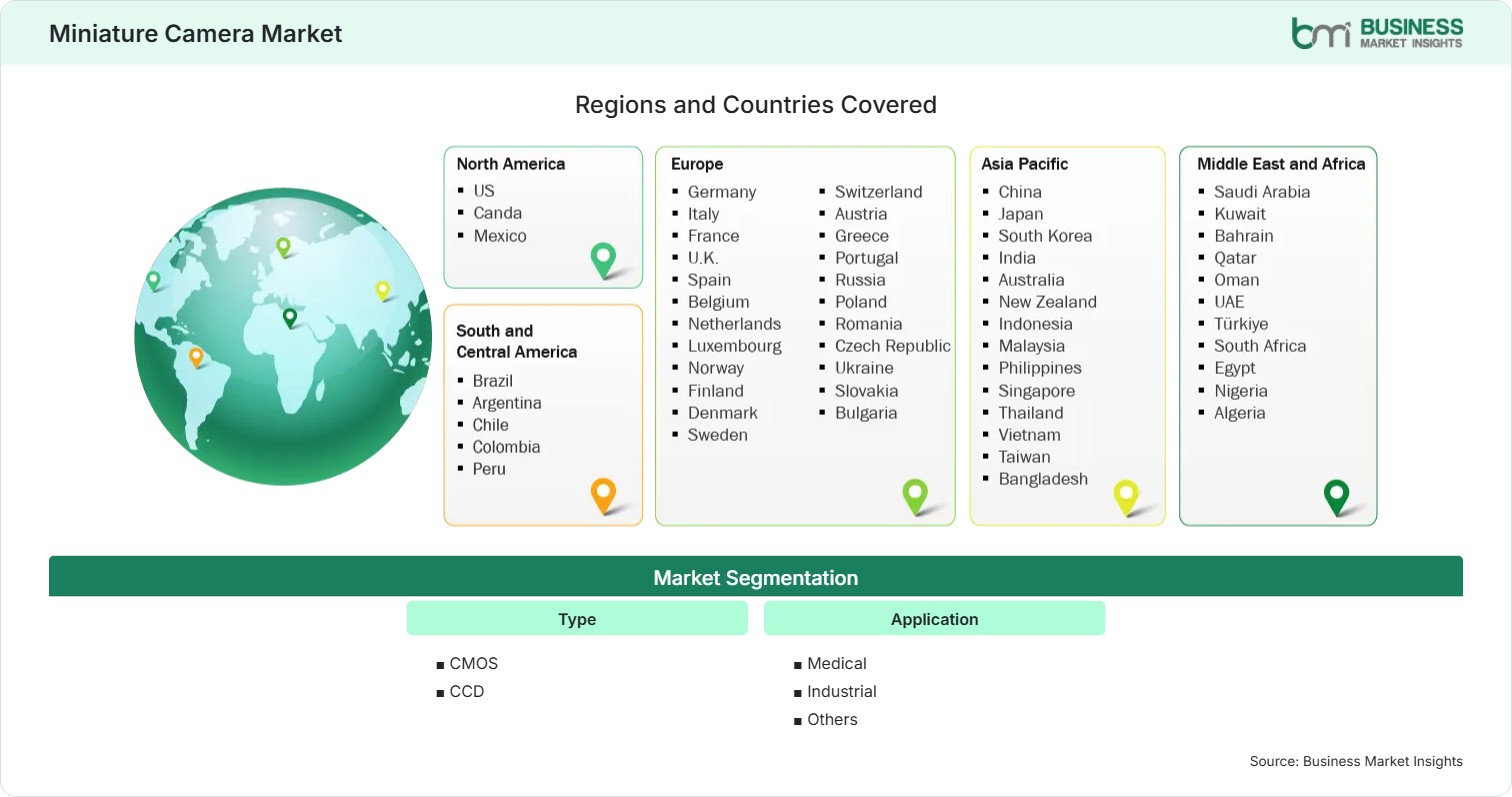
Global Market Geography
FREE PDF
Request your free sample
Request free sample
05 Segment Analysis

Miniature Camera Market Segmentation

Type

The type segment is led by CMOS, accounting for 73%–76% market share in 2025 and projected to grow at a CAGR of 9.0%–9.5% during the forecast period. CMOS image sensors dominate owing to their low power consumption, compact size, faster processing capability, and superior image quality. The Miniature Camera Market scope continues expanding with growing deployment across smartphones, medical devices, automotive systems, and industrial applications.

  • CMOS: CMOS sensors remain the preferred technology because of high integration capability, low manufacturing cost, excellent energy efficiency, and compatibility with advanced image processing technologies.
  • CCD: CCD sensors continue serving specialized applications requiring superior image sensitivity, low noise performance, and exceptional image quality across scientific, industrial, and medical imaging environments.

Application

The application segment is led by Medical, accounting for 31%–34% market share in 2025 and projected to grow at a CAGR of 9.8%–10.4% during the forecast period. Growing adoption of minimally invasive procedures, endoscopy, capsule endoscopy, and advanced diagnostic imaging continues strengthening demand for highly compact camera modules.

  • Medical: Medical applications continue expanding through increasing use of miniature cameras in endoscopy, surgical visualization, diagnostic equipment, and minimally invasive healthcare procedures.
  • Industrial: Industrial applications continue witnessing strong adoption across robotics, machine vision, automated inspection systems, quality control, and intelligent manufacturing environments requiring compact imaging technologies.
06 Market Forces

Miniature Camera Market Dynamics

Key Market Drivers

Increasing Demand for Compact Imaging Devices

Growing demand for compact and high-performance imaging devices across consumer electronics, healthcare, industrial automation, and automotive sectors continues driving market expansion. Miniaturization of electronic products and continuous innovation in semiconductor imaging technologies are encouraging wider adoption of miniature camera modules. Miniature Camera Market growth is further supported by increasing deployment of compact cameras in drones, wearable devices, robotics, and smart consumer products requiring high-resolution imaging with minimal space requirements.

Growth of Smartphones and Wearable Electronics

Rapid expansion of smartphones, smartwatches, augmented reality devices, and wearable electronics continues increasing demand for miniature camera technologies. Manufacturers are developing thinner, higher-resolution camera modules with advanced autofocus, image stabilization, and artificial intelligence capabilities to improve user experience. Continuous product innovation and growing consumer demand for premium imaging performance continue accelerating adoption of miniature camera modules across mobile and wearable electronics.

Rising Adoption in Security and Surveillance Systems

Increasing investments in intelligent surveillance infrastructure, smart cities, commercial security, and residential monitoring systems continue strengthening demand for miniature cameras. AI-enabled video analytics, facial recognition technologies, and connected security platforms require compact imaging modules capable of delivering high-quality real-time video. Growing deployment across transportation, retail, industrial facilities, and public safety applications further supports sustained market expansion.

Key Market Opportunities

Expansion in Medical Imaging Applications

Growing adoption of minimally invasive surgical procedures and advanced diagnostic technologies presents significant opportunities for miniature camera manufacturers. Miniature Camera Market Forecasts indicate increasing demand for compact imaging solutions supporting endoscopy, capsule endoscopy, robotic-assisted surgery, and precision diagnostics. Continuous innovation in medical imaging technologies is expected to create long-term growth opportunities across hospitals and specialized healthcare facilities.

Increasing Demand for Automotive Cameras

Rapid deployment of advanced driver assistance systems, autonomous driving technologies, parking assistance, and in-cabin monitoring solutions continues driving demand for miniature automotive cameras. Vehicle manufacturers are integrating multiple compact cameras to improve safety, navigation, and driver awareness. Expanding electric vehicle production further strengthens opportunities for advanced imaging technologies across automotive applications.

Growth of Smart Home Security Systems

Increasing adoption of connected home technologies is driving strong demand for intelligent security cameras equipped with compact imaging modules. Smart doorbells, indoor monitoring systems, outdoor surveillance devices, and AI-powered security platforms continue expanding globally. Manufacturers are developing high-resolution miniature cameras featuring low-light performance, motion detection, and cloud connectivity to meet growing residential and commercial security requirements.

Market Restraints and Challenges

High Competition Among Manufacturers

Factor: The miniature camera industry is highly competitive, with numerous global manufacturers continuously introducing new imaging technologies, advanced sensors, and compact camera modules. Impact: Intense competition places pressure on pricing, reduces profit margins, and requires continuous investment in research, product innovation, and manufacturing efficiency. Companies must consistently differentiate through performance, reliability, and technological advancements to maintain market competitiveness.

Privacy Concerns Related to Camera Usage

Factor: Increasing deployment of miniature cameras across surveillance systems, wearable electronics, and connected devices has raised growing concerns regarding user privacy, data security, and unauthorized monitoring. Impact: Strict regulatory requirements and evolving privacy legislation may limit adoption in certain applications while increasing compliance costs for manufacturers. Companies must strengthen cybersecurity features, data protection measures, and transparent privacy practices to maintain consumer confidence and regulatory compliance.

07 Company Analysis

Competitive Landscape

The miniature camera market analysis reflects a highly competitive environment driven by continuous innovation in image sensors, optics, AI-enabled imaging, and miniaturized camera modules. Leading companies are strengthening their market positions through investments in semiconductor technologies, strategic partnerships, product innovation, and expansion into medical, automotive, industrial, and security applications.

Company Name

Overview

Products and Services Relevant to this Market

Sony Group Corporation

Global leader in image sensor technology and consumer electronics with strong expertise in CMOS imaging solutions.

CMOS image sensors, miniature camera modules, automotive image sensors, industrial imaging, and medical imaging solutions.

Panasonic Holdings Corporation

Global electronics manufacturer offering advanced imaging technologies for industrial, medical, and consumer applications.

Miniature cameras, imaging sensors, industrial vision systems, security cameras, and medical imaging devices.

Canon Inc.

Leading imaging technology company specializing in optical systems and digital imaging products.

Compact camera modules, imaging systems, medical cameras, industrial inspection cameras, and optical technologies.

Samsung Electro-Mechanics Co., Ltd.

Major supplier of camera modules and electronic components for smartphones and automotive applications.

Smartphone camera modules, automotive cameras, optical modules, miniature imaging systems, and semiconductor components.

Sharp Corporation

Japanese electronics company with expertise in display and imaging technologies.

Compact camera modules, imaging sensors, consumer electronics cameras, and industrial imaging solutions.

OmniVision Technologies, Inc.

Global developer of advanced CMOS image sensors serving automotive, medical, security, and consumer electronics industries.

CMOS image sensors, miniature camera modules, automotive imaging, medical imaging sensors, and security camera solutions.

STMicroelectronics N.V.

International semiconductor manufacturer focused on advanced imaging and sensing technologies.

Image sensors, embedded vision technologies, camera components, industrial imaging, and IoT sensor solutions.

LG Innotek Co., Ltd.

Leading manufacturer of camera modules and electronic components for global electronics brands.

Smartphone camera modules, automotive camera systems, optical components, and compact imaging technologies.

Hangzhou Hikvision Digital Technology Co., Ltd.

Global provider of video surveillance equipment and AI-powered imaging solutions.

Security cameras, miniature surveillance cameras, AI vision systems, and intelligent monitoring technologies.

Teledyne Technologies Incorporated

Global technology company specializing in digital imaging and scientific instrumentation.

Industrial cameras, scientific imaging systems, medical imaging technologies, and high-performance miniature cameras.

08 Industry Activity

Recent Developments

January 2026

Sony introduced the VENICE Extension System Mini (CBK-3621XS), a smartphone-sized camera extension system featuring the VENICE 2 8.6K full-frame CMOS sensor. The compact module is approximately 70% smaller than its predecessor and is designed for applications requiring ultra-compact, high-performance camera systems.

September 2025

Sony Semiconductor Solutions announced the IMX828 automotive CMOS image sensor with a built-in MIPI A-PHY interface, enabling the development of more compact and simplified automotive camera modules for advanced driver assistance systems (ADAS).

March 2024

ams-OSRAM expanded its NanEye CMOS micro camera module portfolio for medical imaging applications, offering ultra-miniature camera modules for endoscopy and other minimally invasive medical devices.

April, 2024: Sony Electronics launched the ILX-LR1, an ultra-lightweight interchangeable-lens camera designed for industrial applications such as drones, inspection, mapping, and surveying, expanding its compact camera portfolio for industrial imaging.

10 Trust & Transparency

Research Methodology

The market analysis combines proprietary research with secondary data from government agencies, company disclosures, regulatory filings, industry databases and expert interviews. Market estimates are validated through data triangulation, cross-market benchmarking and analyst review.

View Full Research Methodology

11 Questions Answered

Frequently Asked Questions

What does the Miniature Camera Market Report cover?

The market report provides detailed analysis of market size, segmentation, regional Miniature Camera Market trends, competitive landscape, technological developments, growth opportunities, and future market forecasts.

What are the major challenges affecting the market?

High competition among manufacturers and increasing privacy concerns related to camera usage remain the key challenges influencing market growth.

Which type segment holds the largest market share?

CMOS image sensors hold the largest market share owing to their low power consumption, compact size, cost efficiency, and superior imaging performance across multiple applications.

Which region dominates the market?

Asia Pacific dominates the market due to its strong consumer electronics manufacturing base, semiconductor production capabilities, and expanding automotive and industrial sectors.

What is driving the Miniature Camera Market?

Increasing demand for compact imaging devices, growth of smartphones and wearable electronics, and rising adoption in security and surveillance systems are the primary drivers of market growth.

Access the Full Miniature Camera Market Report

Get segment-level forecasts, regional estimates, competitive benchmarking, company profiles and downloadable Excel datasets.

Access the full Miniature Camera Market Report
350 pages PDF & Excel | 2026-07-27