Market Summary
Executive Summary and Global Market Analysis
The High Altitude Pseudo Satellite (HAPS) market represents a specialized segment within aerospace systems designed for sustained operations in the stratosphere. These platforms function between traditional satellites and unmanned aerial vehicles, offering persistent regional coverage. Their ability to remain airborne for extended durations supports continuous monitoring and data transmission without reliance on orbital infrastructure.
Expansion of network coverage requirements and security monitoring needs has influenced the deployment of such systems. Operators seek solutions capable of delivering communication services in remote zones while maintaining adaptable positioning. The shift toward resilient surveillance frameworks has further reinforced interest in these platforms as they address operational gaps left by existing aerial and space-based systems.
Segmentation across platform categories highlights a diverse technological landscape shaped by mission objectives. Airships provide higher payload capacity for extended missions, while UAV-based systems emphasize maneuverability and endurance. Balloon systems continue to be explored for targeted connectivity services in geographically challenging environments. Application diversity spans intelligence, communication, and environmental observation use cases, reflecting broad functional scope.
Technological improvements in solar energy utilization, lightweight materials, and onboard autonomy have redefined system capabilities. Platforms increasingly support multi-role operations that combine imaging, sensing, and communication relay in single deployments. Such advancements are enabling integration into both civilian and strategic applications where persistent visibility and connectivity are required.
The competitive environment demonstrates a mix of aerospace innovators, defense contractors, and emerging service providers. Industry participants are focusing on platform efficiency, endurance optimization, and payload versatility. Partnerships and pilot programs are shaping development pathways as stakeholders move toward scalable operational models within the stratospheric domain.
Segment Analysis
High Altitude Pseudo Satellite (HAPS) Market Segmentation
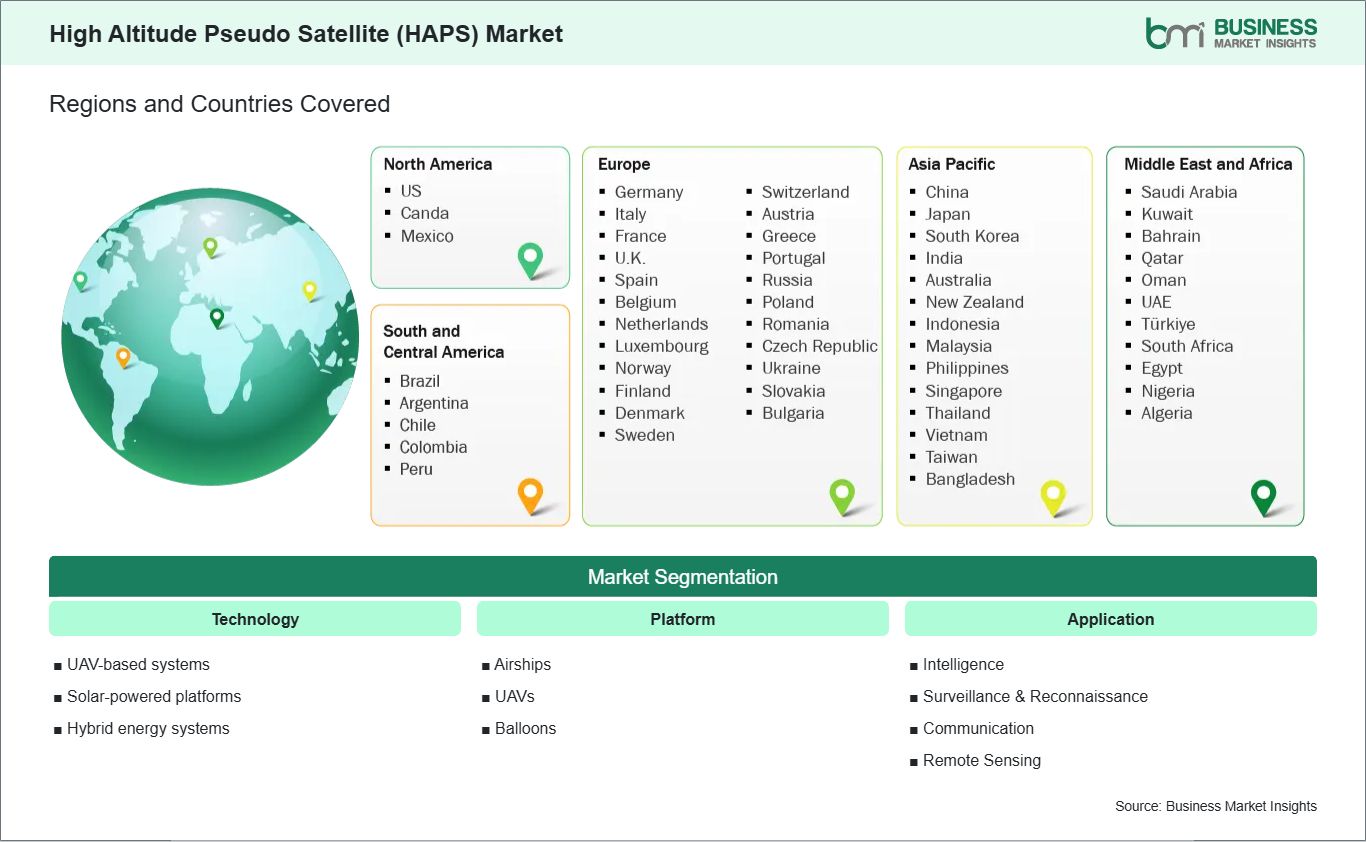
The market demonstrates diversified adoption across platform, technology, and application.
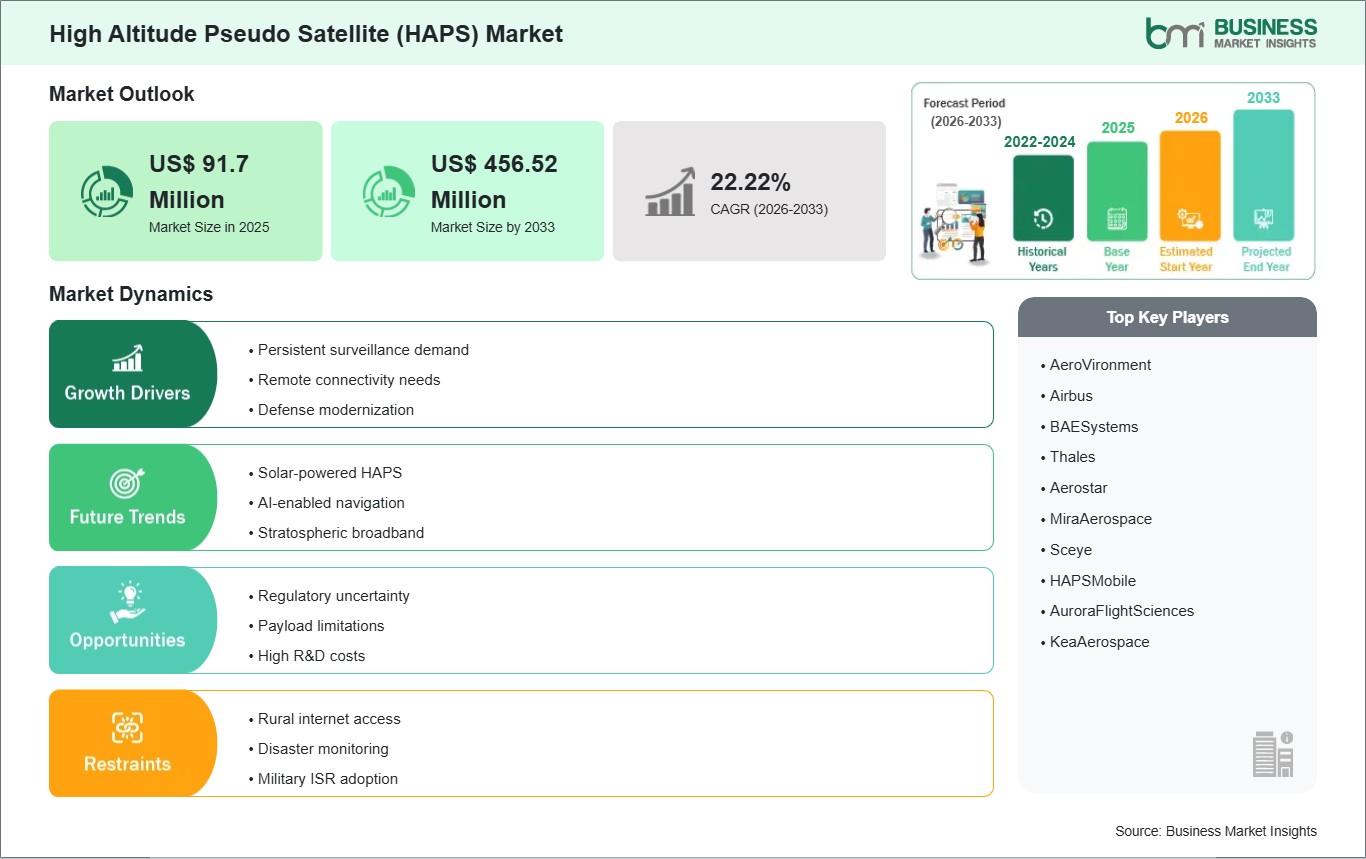
- By technology, the High Altitude Pseudo Satellite (HAPS) market is divided into UAV-based systems, solar-powered platforms, and hybrid energy systems. The solar-powered platforms segment dominated the market in 2025, supported by the industry shift toward long-endurance, energy-efficient stratospheric operations.
- By platform, the High Altitude Pseudo Satellite (HAPS) market is divided into Airships, UAVs, and Balloons. The UAVs segment dominated the market in 2025, supported by the industry shift toward flexible deployment and extended endurance capabilities.
- By application, the High Altitude Pseudo Satellite (HAPS) market is divided into ISR, Communication, and Remote Sensing. The Communication segment dominated the market in 2025, supported by the industry focus on expanding connectivity coverage in remote and under served regions.
Market Forces
High Altitude Pseudo Satellite (HAPS) Market Drivers and Opportunities
Infrastructure Gaps in Remote Connectivity
Limited terrestrial infrastructure in remote areas has created a need for alternative connectivity solutions. High altitude platforms address this challenge by delivering communication services without fixed ground installations. Their ability to remain positioned over specific regions supports consistent network access. This aligns with efforts to extend digital services across underserved locations where traditional deployment models remain impractical.
The operational flexibility of these systems aligns with regulatory frameworks encouraging expanded connectivity coverage. Governments are evaluating non-terrestrial networks to complement existing infrastructure. Technological readiness, combined with improved energy efficiency, supports the deployment of long-endurance platforms that integrate with communication ecosystems while maintaining operational adaptability.
Expansion of Stratospheric Surveillance Capabilities
Advancements in sensing technology are opening new avenues for persistent surveillance applications. High altitude platforms enable continuous monitoring across large geographic regions, supporting environmental tracking and security operations. Integration of imaging and communication payloads enhances mission versatility and supports multi-domain operations across civil and defense applications.
Future development pathways indicate wider use of these systems in coordinated aerial networks. Emerging concepts include interconnected platforms forming distributed observation systems. This approach could extend coverage capabilities while reducing reliance on single-node operations, creating opportunities for broader adoption across commercial and institutional sectors.
Size and Share Analysis
High Altitude Pseudo Satellite (HAPS) Market Size and Share Analysis
The High Altitude Pseudo Satellite (HAPS) Market is projected to grow from US$ 91.7 Million in 2025 to US$ 456.52 Million by 2033 , registering a CAGR of 22.22% from 2026 to 2033.
Within the platform segment, UAV-based systems hold a strong position due to their adaptability and ease of deployment. Airships maintain relevance in missions requiring extended station-keeping and higher payload capacity. Balloon-based solutions continue to serve niche applications, particularly in experimental and temporary connectivity scenarios.
Application trends indicate communication services as a significant contributor to market activity, driven by remote coverage requirements. ISR applications maintain steady demand from defense sectors seeking persistent observation capabilities. Remote sensing functions also support environmental monitoring programs, reinforcing their role in both commercial and institutional use cases.
Report Coverage
High Altitude Pseudo Satellite (HAPS) Market Report Coverage and Deliverables
The "High Altitude Pseudo Satellite (HAPS) Market Size and Forecast (2022–2033)" report provides a detailed analysis of the market covering below areas:
- Market size and forecast at global, regional, and country levels for all the key market segments covered under the scope
- Market trends, as well as market dynamics such as drivers, restraints, and key opportunities
- Market analysis covering key market trends, global and regional framework, major players, regulations, and recent market developments
- Industry landscape and competition analysis covering market concentration, heat map analysis, prominent players, and recent developments for the market
- Detailed company profiles, including SWOT analysis
Geographic Insights
High Altitude Pseudo Satellite (HAPS) Market Geographic Insights
The High Altitude Pseudo Satellite (HAPS) market shows diverse regional adoption patterns influenced by technological maturity, defense priorities, and connectivity requirements. Global interest continues to expand as countries evaluate alternatives to conventional satellite infrastructure. Both commercial and government entities are exploring these platforms for communication resilience and surveillance flexibility.
In North America, the United States leads development efforts through aerospace innovation and strong defense investments. Programs emphasize advanced UAV-based platforms and integrated communication systems. Canada is also exploring applications in remote connectivity, particularly for northern regions where terrestrial networks face geographical limitations.
Asia Pacific demonstrates significant momentum, driven by national security initiatives and expanding telecom needs. India is actively advancing domestic HAPS programs focused on surveillance and border monitoring. Japan is developing stratospheric connectivity solutions to enhance communication networks in disaster-prone areas and rural landscapes.
Europe is characterized by collaborative research and regulatory alignment supporting platform development. Countries such as France and Germany are participating in joint projects to explore multi-platform systems. Emerging markets in the Middle East and Latin America are evaluating these technologies for infrastructure extension and environmental observation initiatives.
Industry Activity
Recent Developments
The High Altitude Pseudo Satellite (HAPS) market is evaluated by gathering qualitative and quantitative data post primary and secondary research, which includes important corporate publications, association data, and databases. A few of the key developments in the High Altitude Pseudo Satellite (HAPS) market are:
- In 2025, UAVOS and Mira Aerospace completed a successful HAPS test flight, demonstrating advanced imaging payload performance and multi-application capabilities.
- In 2024, Airbus subsidiary AALTO received regulatory design approval for its Zephyr HAPS platform, supporting future commercial deployment plans.
Trust & Transparency
Research Methodology
The market analysis combines proprietary research with secondary data from government agencies, company disclosures, regulatory filings, industry databases and expert interviews. Market estimates are validated through data triangulation, cross-market benchmarking and analyst
review.
View Full Research Methodology
Key Sources Referred:
Industry reports on sustainable tire manufacturing and automotive mobility Government transportation and environmental policy publications Automotive trade journals and tire technology periodicals Company annual reports and sustainability disclosures Academic studies on bio-based polymers and recycled materials International automotive production and mobility assessments Research publications covering tire material innovation and efficiency trends Company website Company annual reports Company investor presentations