
Hemostats Market Outlook: Size, Share, Trends, Growth Analysis, Competitive Landscape & Forecast, 2026-2033

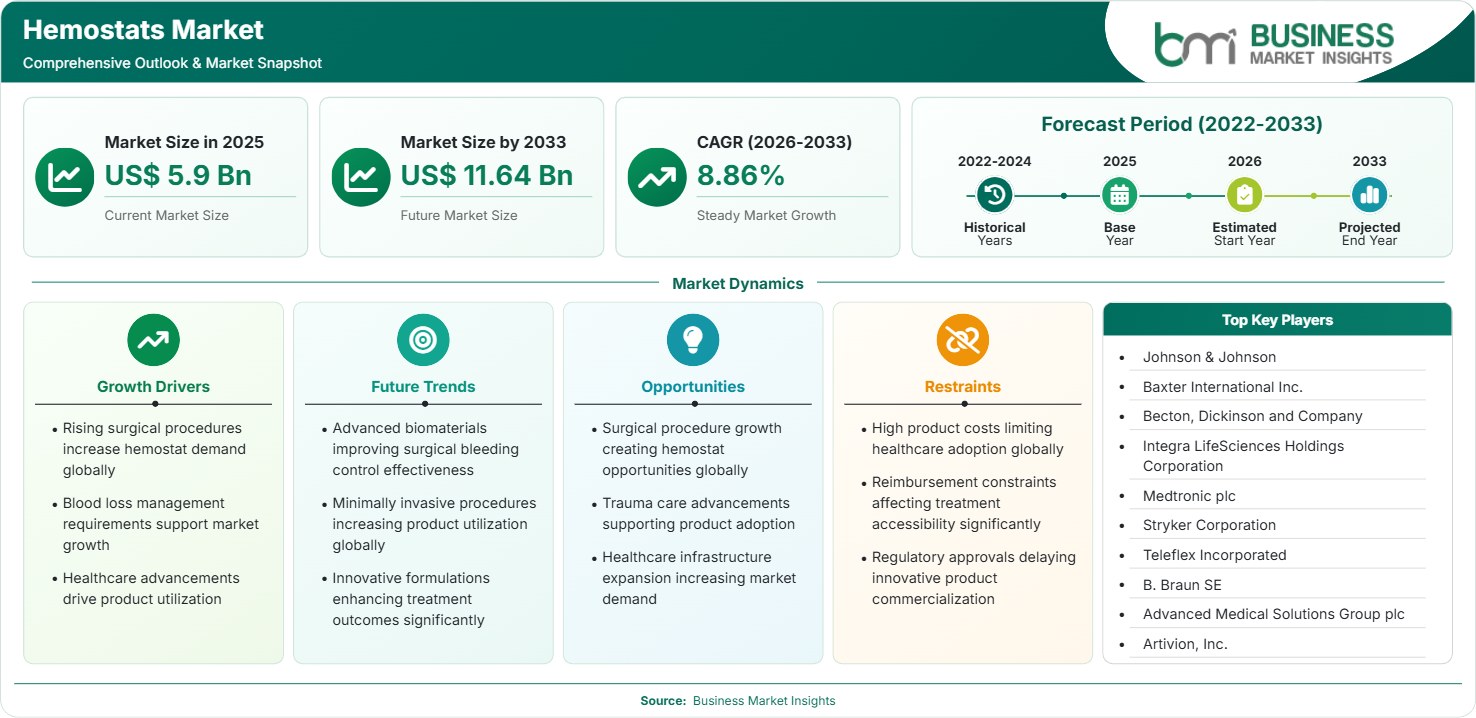
The Hemostats Market size was valued at US$ 5.9 Billion in 2025 and is projected to reach US$ 11.64 Billion by 2033, growing at a CAGR of 8.86% during 2026–2033. Surgical procedure volumes, trauma care demand, minimally invasive interventions, faster bleeding control, advanced biomaterials, ambulatory surgery expansion, and product-storage innovations are creating opportunities across hospitals, trauma centers, and tactical care.

Report Coverage
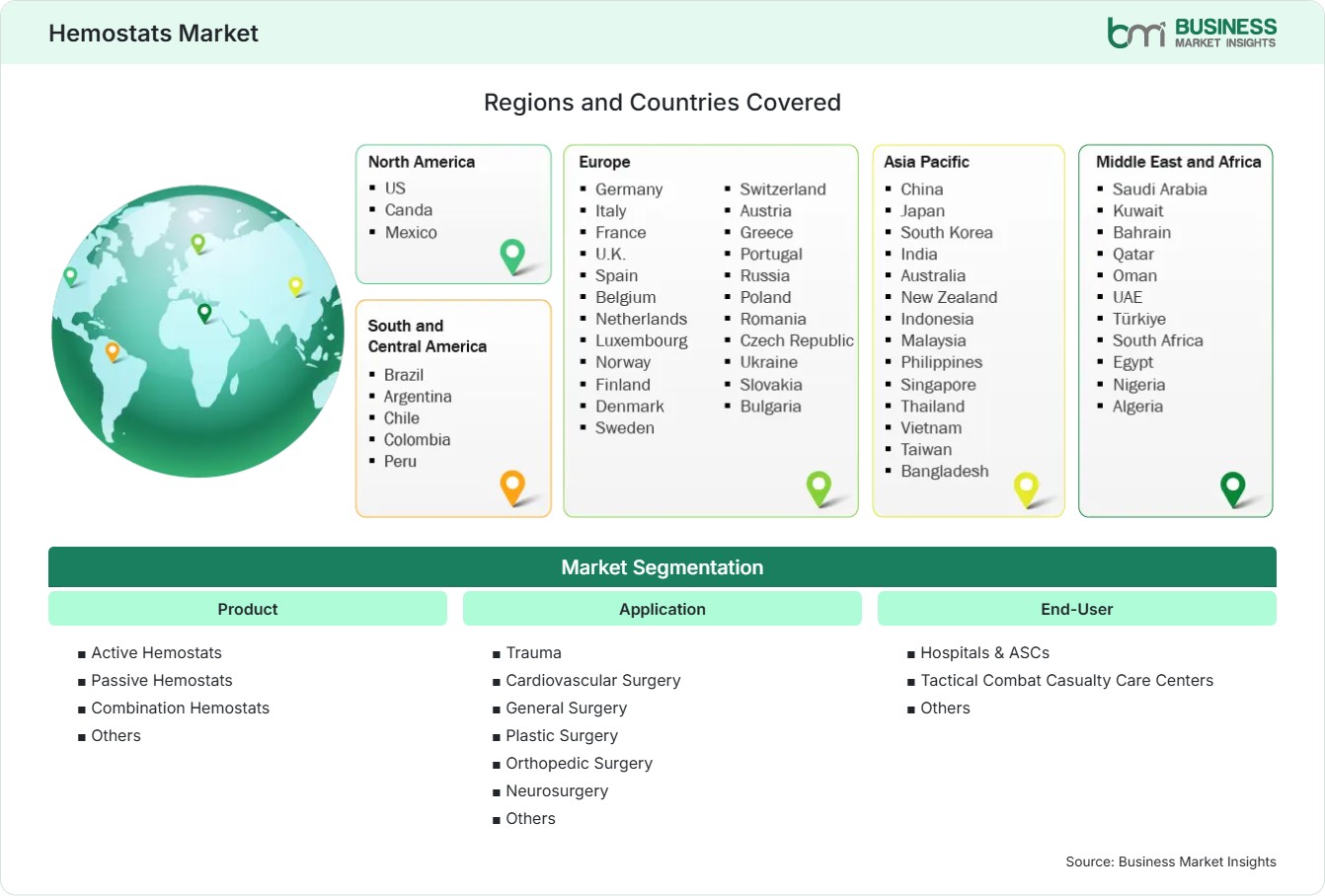
  • Product: Active Hemostats, Passive Hemostats, Combination Hemostats, Others
  • Application: Trauma, Cardiovascular Surgery, General Surgery, Plastic Surgery, Orthopedic Surgery, Neurosurgery, Others
  • End-User: Hospitals & ASCs, Tactical Combat Casualty Care Centers, Others
US$ 5.9 Bn Market size in 2025
US$ 11.64 Bn Market Size by 2033
8.86% CAGR, 2026 - 2033
2026-2033 Forecast Period

AI Overview

Hemostats Market Summary

  • North America Region: North America holds a 38%–42% share in 2025, growing at a CAGR of 8.1%–8.8%, influenced by high surgical volumes, advanced hospitals, trauma systems, premium product adoption, and strong clinical evidence. The US represents the region's principal demand center, supported by advanced surgery and trauma infrastructure, with a CAGR of 8.0%–8.7% through 2033.
  • Fastest Growing Region: Asia Pacific holds a 20%–24% Hemostats Market share in 2025, growing at a CAGR of 10.0%–10.8%, supported by expanding surgical capacity, healthcare investment, rising trauma treatment demand, improving reimbursement, and increasing adoption of advanced bleeding-control technologies.
  • Leading Segment: Passive Hemostats holds a 43%–47% share in 2025, growing at a CAGR of 8.2%–9.0%, supported by broad surgical compatibility, established clinical familiarity, absorbable materials, straightforward handling, and demand for dependable topical bleeding control.
  • High Growth Segment: Active Hemostats holds a 25%–29% share in 2025, growing at a CAGR of 9.4%–10.2%, driven by thrombin-enabled clot formation, complex bleeding management, minimally invasive surgery, rapid application, and demand for improved procedural efficiency.
  • Key Market Opportunity: Demand is shifting toward ready-to-use, room-temperature-stable, absorbable, multifunctional products that reduce preparation time and logistical complexity while supporting rapid hemostasis across increasingly decentralized surgical environments.
  • Major Market Players: Johnson & Johnson, Baxter International Inc., Becton, Dickinson and Company, Integra LifeSciences Holdings Corporation, Medtronic plc, Stryker Corporation, Teleflex Incorporated, B. Braun SE, Advanced Medical Solutions Group plc, and Artivion, Inc.
Strategic Insights

Hemostats Market: Strategic Insights

Hemostats Market Strategic Framework
FREE PDF
Request your free sample
Request free sample
Stakeholder View

Key Takeaways

  • The value chain includes biomaterial suppliers, manufacturers of active agents, developers of medical devices, contract sterilization providers, distributors, hospitals, ambulatory surgical centers, trauma systems, and military procurement channels, and product differentiation is now taking place at the point where material science meets procedural workflow.
  • In cases where ordinary mechanical pressure is not adequate, active and combination technologies offer solutions, especially in cardiovascular, neurosurgical, orthopedic, and other complex abdominal operations that require controlled management of bleeding.
  • Development of products is heading in the direction of using absorbable matrices, advanced patches, flowable formulations, synthetic polymers, ready-to-use forms, and products that are stable during storage, to reduce the need for preparation and, at the same time, ensure a predictable application.
  • The Asia Pacific region provides a favorable environment for expansion since the development of surgical infrastructure, the rise in healthcare spending, the growth of urban trauma networks, and the increasing capacity of private hospitals all contribute to the uptake of advanced bleeding-control products.
  • Strategic activity is now combining procedural platforms, vascular technologies, surgical visualization, and capabilities relating to hemostasis. Recent transactions show how manufacturers make use of related technologies to strengthen their relationships with surgeons and increase their relevance to hospital purchases.
Geographic Outlook

Hemostats Market Regional Highlights

North America Hemostats Market

North America accounts for a 38%–42% Hemostats Market share in 2025 and is projected to expand at a CAGR of 8.1%–8.8% through 2033. The region benefits from sophisticated surgical infrastructure, high procedural intensity, trauma networks, established reimbursement mechanisms, and extensive surgeon familiarity with advanced hemostatic technologies.

  • There is a continued demand for absorbable and active products in relation to high-acuity cardiovascular, orthopedic, and neurosurgical procedures in tertiary hospitals and specialized surgical centers.
  • When selecting hemostatic technologies, hospital value-analysis committees are increasingly taking into account not only the acquisition cost but also the preparation time, storage requirements, wastage, and application efficiency.
  • There is a demand from trauma systems and military medicine for portable bleeding-control technologies that can be quickly deployed in emergency and prehospital situations.
  • The introduction of products that have room-temperature stability and are easy to prepare deals with the operational difficulties linked to those that need to be kept refrigerated or require multiple steps.

US Hemostats Market

The US represents approximately 72%–76% of the North American Hemostats Market demand in 2025 and is projected to grow at a CAGR of 8.0%–8.7% through 2033. Demand is supported by extensive hospital infrastructure, high procedural complexity, trauma-center networks, ambulatory surgery, and established adoption of advanced surgical products.

  • The clearance granted by the FDA and the expansion of its indications can greatly increase the number of procedures that can be addressed, particularly when manufacturers show that their product is both safe and effective in a range of other bleeding situations.
  • Ambulatory surgical centers require products that are compact and easy to store, as these products reduce the number of preparation steps and help to achieve efficient turnover of the operating room.
  • Specialized opportunities arise in the field of trauma and in military procurement for hemostatic technologies, which are designed to deal with severe bleeding and are suitable for treatment conditions that are highly constrained.

Europe Hemostats Market

Europe holds a 27%–30% Hemostats Market share in 2025 and is expected to expand at a CAGR of 8.4%–9.1%. Germany, the United Kingdom, France, Italy, and Spain provide major demand centers, while Poland and selected Central European markets offer comparatively faster expansion as hospital modernization continues.

  • As hospitals are aiming at improved operational efficiency as well as clinical performance, European manufacturers are focusing on shelf stability, absorbability, and easier preparation.
  • Germany and France are still important reference markets since specialist hospitals carry out a high volume of cardiovascular, orthopedic, abdominal, and neurosurgical operations.
  • The environment for procurement in the UK places a strong emphasis on evidence, economic value, and the use of standardized methods of purchasing by hospitals, thereby influencing the adoption of premium hemostatic products.
  • The modernization of healthcare in central and eastern Europe is providing greater opportunities for advanced surgical technologies since hospitals are improving their operating-room facilities and trauma services.

Asia Pacific Hemostats Market

Asia Pacific represents a 20%–24% Hemostats Market share in 2025 and is forecast to grow at a CAGR of 10.0%–10.8%, making it the fastest-expanding major region. China, Japan, South Korea, India, and Australia form the principal demand markets, while Southeast Asia provides additional growth potential. Japan remains a leading mature market with sophisticated surgical capabilities.

  • By combining its high volume of surgical procedures with hospital modernization, China is creating opportunities for domestic manufacturing, a range of multinational companies, and the production of advanced biomaterials on a local scale.
  • India is extending its network of tertiary hospitals, private surgical networks, trauma facilities, and its distribution of medical devices to promote greater use of advanced bleeding-control products.
  • Japan places a strong emphasis on high-quality surgical technologies, on the reliability of product performance, and on the adoption of these products in a manner supported by evidence within specialized hospital departments.
  • The healthcare systems in Southeast Asia are increasing their investment in surgical infrastructure, which is opening up opportunities for distributors who are able to offer training, clinical support, and a reliable supply.

Rest of World Hemostats Market

South and Central America collectively represent a 7%–9% Hemostats Market share in 2025 and are projected to grow at a CAGR of 7.8%–8.6%. Brazil leads regional demand through its large hospital network, surgical volumes, and private healthcare capacity, while Mexico provides a significant secondary market.

  • Brazil offers the greatest opportunity in South America, due to the presence of private hospitals, the availability of specialist surgical services, and the growing access to the distribution of advanced medical devices.
  • Investment by Gulf healthcare companies is increasing the capacity for tertiary surgical procedures and thus generating a demand for advanced products used in cardiovascular, orthopedic, general, and trauma surgeries.
  • South Africa acts as a significant medical center for the region, since it has specialist hospitals and private healthcare networks that help promote the use of more valuable surgical technologies.
  • In Latin America, procurement continues to be concerned with affordability, which provides chances for manufacturers who offer products backed by clinical evidence and who have efficient methods of packaging, distribution, and inventory management.
Global Market Geography
FREE PDF
Request your free sample
Request free sample
Segment Analysis

Hemostats Market Segmentation

Product

Passive Hemostats represent a 43%–47% Hemostats Market share in 2025 and are projected to grow at a CAGR of 8.2%–9.0%, supported by broad procedural applicability, established surgeon familiarity, absorbable materials, and straightforward topical application across routine and complex surgeries.

  • Active Hemostats: Thrombin-based and biologically active formulations accelerate clot formation at bleeding sites, supporting cardiovascular, general, trauma, and complex surgical procedures requiring rapid hemostatic response.
  • Passive Hemostats: Collagen, oxidized cellulose, gelatin, and mineral-based products provide mechanical matrices that support clot formation, benefiting broad surgical use, predictable handling, and established clinical protocols.
  • Combination Hemostats: Products combining mechanical matrices with active coagulation components address difficult bleeding by integrating physical coverage and biochemical clot formation within one procedural solution.

Application

General Surgery represents a 28%–32% share in 2025 and is projected to grow at a CAGR of 8.0%–8.7%, supported by procedure breadth, bleeding-control requirements, minimally invasive techniques, and routine use across abdominal and soft-tissue operations.

  • Trauma: Emergency bleeding management requires rapidly deployable products capable of controlling significant hemorrhage when conventional pressure, suturing, or vessel management is difficult.
  • Cardiovascular Surgery: High-risk vascular procedures require dependable hemostasis around anastomoses, grafts, and tissue surfaces where uncontrolled bleeding can increase procedural complexity and resource utilization.
  • General Surgery: Broad procedural volume supports consistent demand for topical matrices, flowable formulations, and patches across abdominal, gastrointestinal, hepatobiliary, and soft-tissue operations.
  • Plastic Surgery: Reconstructive and aesthetic procedures increasingly use advanced hemostatic products where tissue preservation, controlled bleeding, and clean surgical fields influence procedural efficiency.
  • Orthopedic Surgery: Joint replacement, spine, trauma, and bone procedures create demand for products that support bleeding management around highly vascular tissues and difficult-to-compress surfaces.
  • Neurosurgery: Intracranial and spinal procedures require precise bleeding control where visualization, tissue protection, absorbability, and limited residual material are particularly important.

End-User

Hospitals and ASCs represent a 78%–82% share in 2025 and are projected to grow at a CAGR of 8.5%–9.2%, supported by procedural concentration, specialist adoption, centralized purchasing, and increasing ambulatory surgery volumes.

  • Hospitals & ASCs: Hospitals and ambulatory centers purchase hemostatic technologies across multiple specialties, emphasizing clinical evidence, product consistency, storage efficiency, and total procedural economics.
  • Tactical Combat Casualty Care Centers: Tactical care environments prioritize lightweight, rapidly deployable bleeding-control solutions that can function under constrained conditions before definitive surgical treatment becomes available.
Market Forces

Hemostats Market Dynamics

Key Market Drivers

Rising Surgical Complexity and Procedural Volume

Increasing surgical complexity is a principal demand catalyst because bleeding management becomes more difficult as procedures involve vascular structures, adhesions, minimally invasive access, and multiple operative sites. The World Health Organization estimates that hundreds of millions of surgical procedures occur globally each year, establishing a broad clinical base for bleeding-control technologies. Cardiovascular, orthopedic, oncology, and trauma procedures often require products that complement suturing, electrosurgery, clips, and compression. The Hemostats Market growth profile, therefore, reflects not simply procedure counts but the increasing intensity of bleeding-management requirements within individual operations.

Shift Toward Advanced Absorbable and Active Technologies

Technology development is moving beyond basic mechanical matrices toward products combining biomaterials, thrombin, synthetic polymers, and tissue-adherent structures. The Hemostats Market trends increasingly emphasize rapid preparation, controlled application, improved conformability, and compatibility with minimally invasive instruments. Baxter introduced a room-temperature-stable HEMOPATCH product in Europe in 2025, illustrating how storage requirements are becoming part of product innovation and hospital workflow design. Ready-to-use formats can reduce preparation requirements and simplify inventory management, while active formulations can support faster clot formation in challenging bleeding conditions.

Expansion of Trauma and Emergency Bleeding Management

Trauma care is now extending its range of applicable settings beyond operating rooms to include emergency departments, military medicine, ambulances, and field treatment sites. Teleflex has developed vascular-access products that are geared towards military use and are suitable for difficult emergency scenarios, showing how there is a greater focus on quick interventions in difficult conditions. In the case of trauma-related hemostatic products, the criteria for competition include speed, portability, ease of use, shelf stability, and effectiveness in field conditions. These same features are beginning to affect purchases in civilian emergency care. As a result of increasing population density, the growth of road transport, industrial activity, and improved emergency preparedness, hospitals are enhancing their trauma capabilities to meet the demand for rapid control of bleeding. Suppliers who are able to prove operational reliability, have simple training requirements, and are compatible with emergency procedures can move beyond the traditional channels for elective surgery.

Key Market Opportunities

Room-Temperature and Ready-to-Use Product Platforms

Storage and preparation requirements represent a practical opportunity for product developers. Room-temperature-stable formats can reduce dependence on refrigerated inventory, simplify operating-room preparation, and improve product availability across hospitals and ASCs. Baxter's 2025 European launch of room-temperature HEMOPATCH demonstrates commercial interest in addressing this logistical requirement. Manufacturers can extend the opportunity by developing packaging that integrates applicators, minimizes preparation steps, and reduces unused product after opening. Such improvements are particularly relevant for facilities with variable surgical schedules or constrained storage capacity. The Hemostats Market opportunity extends to emerging markets where cold-chain infrastructure may be less consistent.

Expansion of Advanced Hemostasis in Emerging Surgical Systems

Healthcare infrastructure investment across Asia Pacific, Latin America, and the Gulf is creating opportunities for advanced bleeding-control products beyond mature Western markets. Hospitals developing cardiovascular, oncology, orthopedic, and trauma capabilities increasingly require products that complement modern surgical equipment. China and India offer particularly broad addressable populations because large patient volumes coexist with expanding tertiary-care capacity. Hemostats Market Forecasts are therefore increasingly influenced by healthcare-capacity expansion rather than only replacement demand in established hospitals. Companies that localize procurement, packaging, education, and regulatory strategies can capture demand as advanced surgery becomes available to a wider patient population.

Combination Technologies and Specialty-Specific Solutions

Combination products provide an opportunity to address bleeding scenarios where a single mechanism may be insufficient. Integrating physical matrices with active coagulation agents can provide coverage, adherence, and clot formation within one application. Specialty-specific formulations can further address the different requirements of cardiovascular, neurosurgical, orthopedic, and minimally invasive procedures. Ethicon's ETHIZIA Hemostatic Patch received a US regulatory supplement in June 2026, expanding indications to minimally invasive liver procedures, demonstrating how regulatory expansion can enlarge the clinical addressable market for established technologies. Future Hemostats Market development can focus on conformability, reduced residual material, controlled degradation, and compatibility with robotic or laparoscopic workflows.

Market Restraints and Challenges

High Product Costs and Hospital Procurement Pressure

The cost of advanced hemostats can be considerably greater than that of ordinary mechanical methods for controlling bleeding, especially when active ingredients, specialized biomaterials, or combined technologies are used. As a result, hospitals that are required to control costs may limit the use of such high-priced products to situations in which clear clinical or workflow advantages are shown. Nowadays, procurement teams take into account not only the unit price but also waste, packaging, preparation time, shelf life, and reimbursement.

Regulatory Complexity and Clinical Evidence Requirements

The need for extensive regulatory documentation, strict manufacturing controls, and a great deal of clinical evidence applies to products that contain biological materials, thrombin, novel polymers, or combine different mechanisms, meaning that broader indications will only be approved after such requirements have been met. As a result, the development process takes longer, which in turn raises commercialization costs and can postpone geographic expansion. This is especially true of smaller manufacturers who have limited regulatory resources. At the same time, product claims must stay in line with the approved indications and ongoing compliance obligations that arise from post-market surveillance.

Company Analysis

Competitive Landscape

The competitive landscape is characterized by diversified medical-device companies, surgical technology specialists, and focused hemostasis developers. Hemostats Market analysis indicates that competitive positioning depends on portfolio breadth, clinical evidence, surgeon familiarity, distribution reach, regulatory approvals, product handling, and ability to serve multiple surgical specialties.

Company Name

Overview

Products and Services relevant to this market

Johnson & Johnson

Global healthcare company with a major surgical franchise and extensive hospital relationships across developed and emerging markets.

Ethicon hemostatic products, surgical technologies, absorbable matrices, patches, sealants, and related bleeding-management solutions.

Baxter International Inc.

Diversified healthcare company with established surgical and advanced hemostasis capabilities serving hospitals globally.

FLOSEAL, HEMOPATCH, surgical hemostatic products, tissue-sealing technologies, and procedural support solutions.

Becton, Dickinson and Company

Global medical technology company supplying products across medication delivery, diagnostics, and surgical care environments.

Hemostatic and surgical-care technologies, procedural products, and hospital workflow solutions supporting bleeding management.

Integra LifeSciences Holdings Corporation

Specialty medical technology company focused on tissue technologies, neurosurgery, and reconstructive procedures.

SurgiFlo and related hemostatic products serve neurosurgical, orthopedic, reconstructive, and general surgical applications.

Medtronic plc

Global medical technology company with broad surgical, cardiovascular, and neurovascular procedure portfolios.

Surgical hemostasis products and technologies are used alongside cardiovascular, general, minimally invasive, and specialty procedures.

Stryker Corporation

Medical technology company serving orthopedic, surgical, neurotechnology, and hospital markets worldwide.

Surgical products and technologies supporting bleeding management across orthopedic and other operative environments.

Teleflex Incorporated

Medical technology company with strong positions in vascular access, emergency medicine, and interventional care.

QuikClot bleeding-control products and emergency-care technologies serving trauma and surgical bleeding-management requirements.

B. Braun SE

Global medical technology company supplying surgical, infusion, vascular, and hospital-care technologies.

Surgical hemostatic products, sealants, tissue-management solutions, and related operating-room technologies.

Advanced Medical Solutions Group plc

Specialist medical technology company focused on advanced wound closure, tissue adhesives, and surgical solutions.

Tissue adhesives, surgical sealants, wound-care products, and technologies supporting closure and bleeding-control workflows.

Artivion, Inc.

Cardiovascular medical technology company specializing in aortic, cardiac, vascular, and surgical technologies.

Surgical sealants, cardiovascular repair products, and tissue-management technologies relevant to complex bleeding-control procedures.

Trust & Transparency

Research Methodology

The market analysis combines proprietary research with secondary data from government agencies, company disclosures, regulatory filings, industry databases and expert interviews. Market estimates are validated through data triangulation, cross-market benchmarking and analyst review.

View Full Research Methodology

Questions Answered

Frequently Asked Questions

How does regulatory approval affect commercial expansion?

Regulatory approval determines the indications, patient populations, and procedures for which a product can be marketed. Additional indications can expand addressable demand, but manufacturers must provide appropriate evidence, maintain quality systems, and satisfy market-specific regulatory requirements before commercialization.

What role does military medicine play in bleeding-control innovation?

Military medicine emphasizes rapid bleeding control under limited-resource conditions, encouraging the development of lightweight, portable, shelf-stable products. Technologies proven in tactical environments can also influence civilian trauma protocols, emergency departments, ambulances, and disaster-response systems.

Why are absorbable materials important in surgical hemostasis?

Absorbable materials can provide temporary bleeding control while reducing the need for subsequent removal. Their value is particularly relevant in difficult-to-access anatomical locations, minimally invasive procedures, and surgeries where retained foreign material could complicate postoperative management.

How are ambulatory surgery centers affecting product development?

ASCs favor products requiring minimal preparation, compact storage, predictable application, and limited inventory complexity. These requirements encourage manufacturers to develop ready-to-use formats, longer shelf-life products, room-temperature storage, and packaging designed for rapid procedural turnover.

What factors determine the choice between passive and active hemostats?

The Hemostats Market Report highlights that Passive products primarily provide a physical matrix that supports clot formation, while active products incorporate agents such as thrombin to accelerate coagulation. Selection depends on bleeding severity, tissue characteristics, surgical access, surgeon preference, product handling, contraindications, and hospital protocols.

Access the Full Hemostats Market Report

Get segment-level forecasts, regional estimates, competitive benchmarking, company profiles and downloadable Excel datasets.

Access the full Hemostats Market Report
350 pages PDF & Excel | 2026-11-02
Similar Research

Related Market Reports