Hazmat Suits Market Regional Highlights
North America Hazmat Suits Market
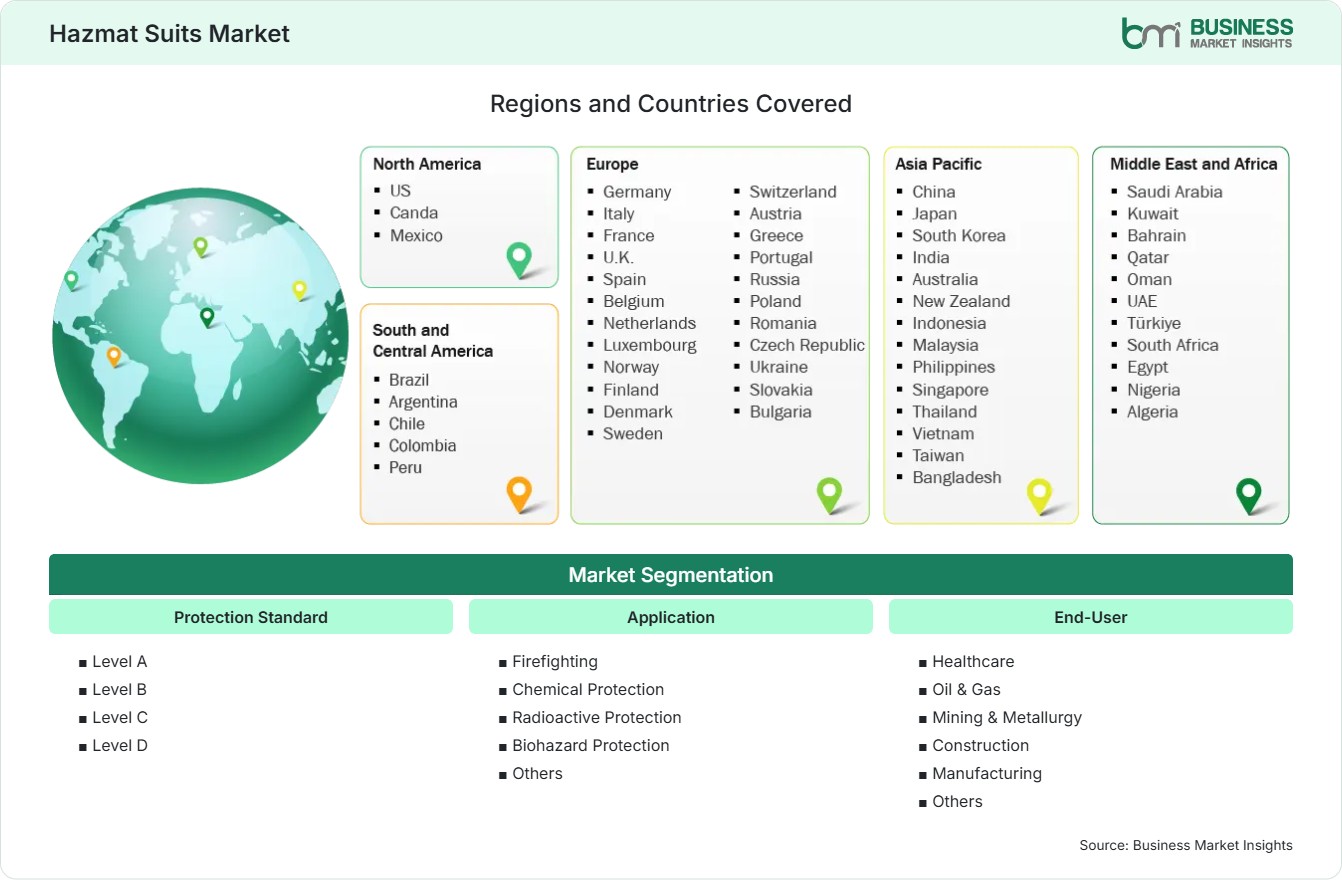
In North America, the Hazmat Suits Market share was 35%-38% in 2025 and is anticipated to grow at a CAGR of 7.0%-7.4% through 2033. The demand mainly focuses on chemical processing, emergency response, oil and gas, health care, and industrial maintenance. The Occupational Safety and Health Administration’s guidelines for different levels of protection make it possible to differentiate when purchasing. The region is known for its existing certification framework, replacement cycles, distribution channels, and the high demand for reusable gas-tight suits.
- Chemical processing and emergency-response organizations prioritize certified barrier performance, respiratory compatibility, seam integrity, and rapid deployment, sustaining replacement demand for specialized protective garments across high-consequence operating environments.
- Fire-service procurement increasingly incorporates garment inspection, cleaning, repair, and rental capabilities, creating recurring service revenue alongside equipment sales and encouraging suppliers to develop integrated lifecycle offerings.
- Healthcare preparedness maintains demand for biological protection systems, particularly where facilities require defined donning, doffing, waste handling, and contamination-control procedures for high-consequence infectious diseases.
- Industrial customers increasingly evaluate comfort, mobility, and heat management alongside barrier performance, encouraging manufacturers to develop lighter materials that reduce physiological burden during prolonged hazardous-duty operations.
US Hazmat Suits Market
The US accounted for 68%-72% of the total demand in North America in 2025 and is expected to grow at a CAGR of 6.9%-7.3%. Purchasing includes fire departments, chemical plants, laboratories, hospitals, utility companies, and government agencies. According to OSHA, Level A denotes the highest level of protection against exposure to the skin, lungs, and eyes, while lower levels address progressively more well-defined and controlled exposure situations.
- Federal, state, municipal, and industrial emergency-response programs support demand for high-specification garments, while inspection and decontamination requirements increase recurring spending after field deployment.
- Chemical manufacturing and refining facilities require protection against diverse liquids, vapors, gases, and particulates, supporting demand for encapsulating suits, splash protection, and compatible respiratory systems.
- Healthcare organizations increasingly emphasize PPE usability, training, and safe removal procedures, consistent with WHO guidance addressing biological hazards and contamination-control practices.
Europe Hazmat Suits Market
The Europe Hazmat Suits Market had a market share between 27% - 30% in 2025 and is expected to register a compound annual growth rate between 7.2% - 7.7%. Germany, France, the United Kingdom, Italy, and Nordic nations serve as mature demand hubs, while Poland and Spain offer a more rapid industrial development. The European procurement criteria include chemical resistance, compliance, ergonomic design, and environmental aspects. Reusable hazmat suits are becoming more significant as their use becomes economically justified through recycling and reuse.
- Germany remains a major industrial and emergency-response market, with chemical manufacturing, pharmaceuticals, process industries, and specialist fire services sustaining demand for advanced protective clothing.
- The United Kingdom and France maintain diversified requirements across healthcare, chemical handling, utilities, emergency response, and civil protection, supporting multiple suit configurations and replacement cycles.
- Poland and Spain are developing higher-growth opportunities as manufacturing investment, logistics infrastructure, construction activity, and industrial safety requirements expand across regional production networks.
- European product development increasingly balances certified barrier performance with comfort and sustainability, encouraging materials that improve breathability, durability, recyclability, and resource efficiency.
Asia Pacific Hazmat Suits Market
Asia Pacific region stood at 23% - 26% share in 2025 and is expected to grow at a CAGR of 8.3% - 8.8%. It is the leading regional market for growth, with China, Japan, South Korea, India, and Australia as key regions, and India, Indonesia, and Vietnam having excellent growth prospects. The chemical industry, manufacturing, mining, the pharmaceutical industry, electronics, the energy sector, construction, and healthcare infrastructure have led to widening applications. Regional manufacturing will enable shorter delivery times and greater availability, while accounting for sizing and climatic considerations.
- China remains a major industrial consumer because chemical production, refining, electronics, pharmaceuticals, and manufacturing operations require differentiated protection against liquid, particulate, and gaseous hazards.
- India is developing rapidly through pharmaceutical production, chemicals, infrastructure, mining, healthcare expansion, and formalization of occupational-safety practices, supporting demand for both disposable and reusable protective systems.
- Japan and South Korea emphasize advanced manufacturing, electronics, chemicals, and emergency preparedness, supporting premium protective garments with high material performance, ergonomic construction, and controlled quality specifications.
- Australia provides specialized demand from mining, energy, emergency response, and industrial maintenance, where exposure risks and remote operating conditions increase requirements for durable protective equipment.
Rest of World Hazmat Suits Market
Rest of World represented 10%–13% Hazmat Suits Market share in 2025 and is projected to grow at a CAGR of 6.8%–7.3%. South America and Central America are supported by mining, chemicals, agriculture, oil and gas, and industrial processing. Brazil and Mexico represent leading demand centers, while Chile and Colombia offer specialized mining and industrial opportunities. Regulatory modernization, industrial expansion, and emergency preparedness are supporting replacement demand across protective-equipment categories.
Demand from the Middle East and Africa is limited to petroleum products and gas, petrochemicals, mining and metallurgy, healthcare, and civil defense applications. Some prominent regions include Saudi Arabia, the United Arab Emirates, and South Africa, which is a major mining and industrial hub. Growth in industry and emergency response capability is creating a need for high-end products.
- Brazil and Mexico benefit from diversified industrial activity, including chemicals, manufacturing, healthcare, energy, and construction, supporting recurring procurement of protective garments and related accessories.
- Chile and Colombia offer specialized opportunities through mining and energy operations where chemical exposure, particulate hazards, confined spaces, and emergency response require application-specific protection.
- Saudi Arabia and the United Arab Emirates are supported by petrochemical investment, energy infrastructure, industrial diversification, and emergency-response modernization, creating demand for high-performance chemical protection.
- South Africa's mining and industrial base sustains demand for protective clothing, while healthcare preparedness and emergency services create additional opportunities for biological and chemical hazard applications.