
Edge AI Semiconductor Market Outlook: Size, Share, Trends, Growth Analysis, Competitive Landscape & Forecast, 2026-2033

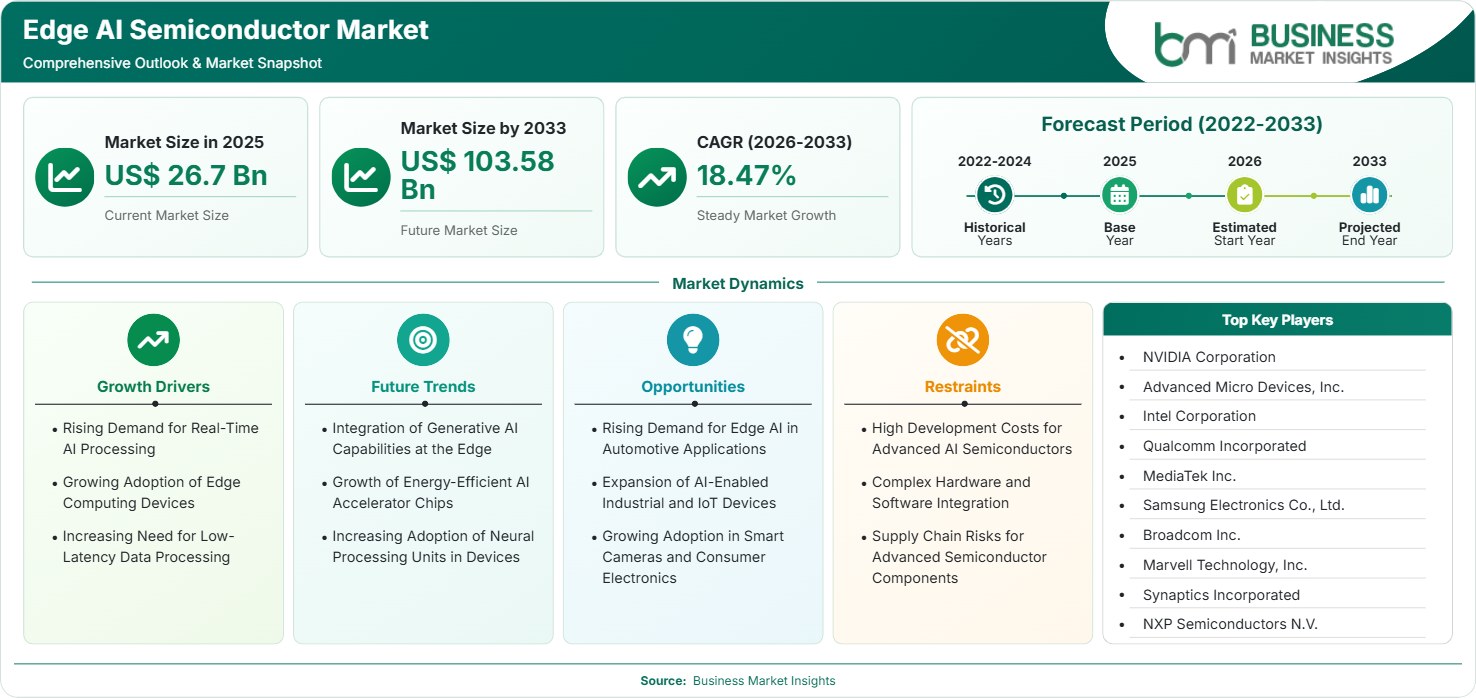
The Edge AI Semiconductor Market size was valued at US$ 26.70 Billion in 2025 and is projected to reach US$ 103.58 Billion by 2033, growing at a CAGR of 18.47% during 2026–2033. Rising adoption of artificial intelligence at the edge, growing demand for real-time data processing, increasing deployment of autonomous systems, expansion of IoT ecosystems, and growing investments in energy-efficient AI hardware are driving substantial market growth worldwide.

Report Coverage
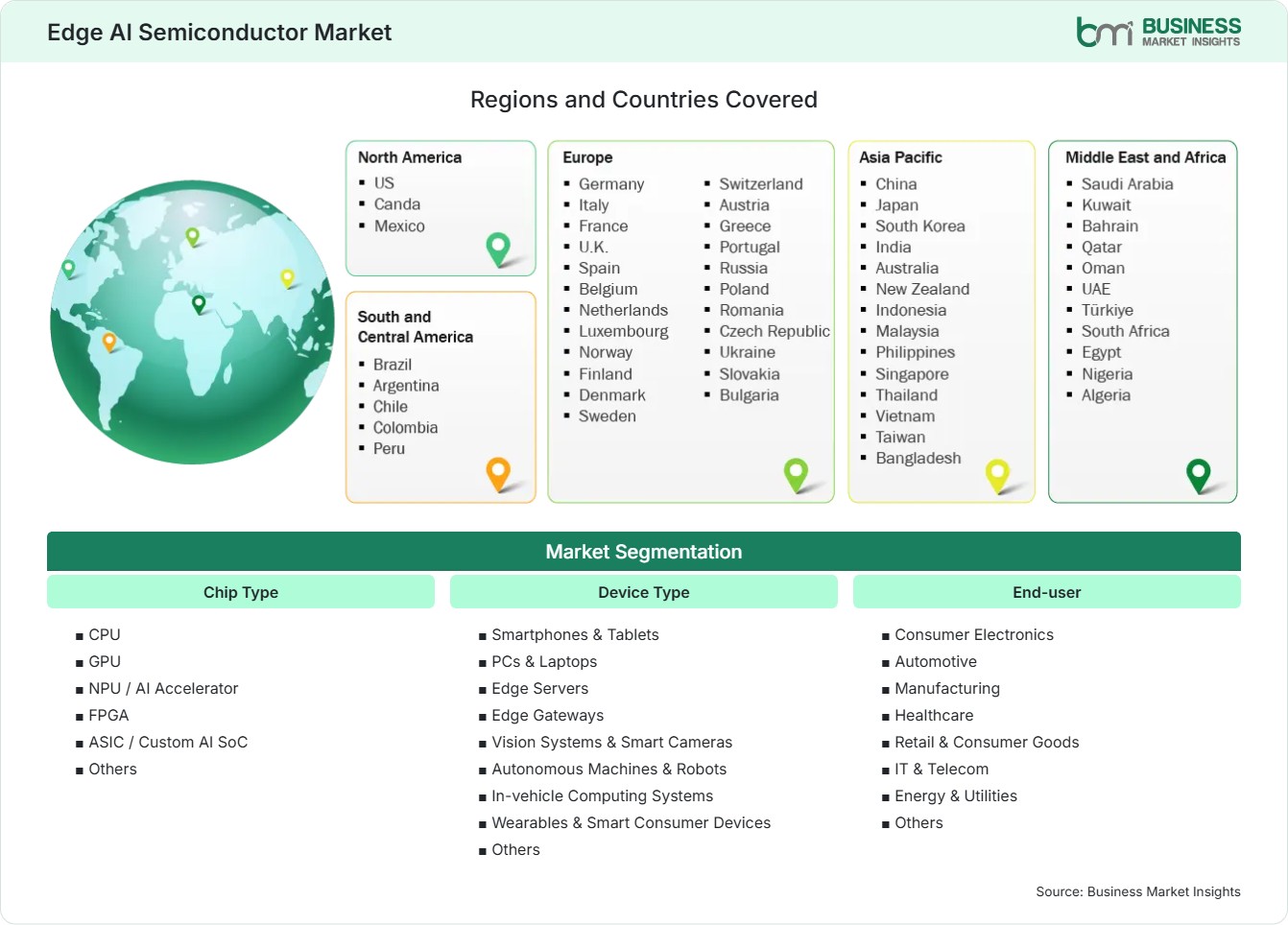
  • Chip Type: CPU, GPU, NPU / AI Accelerator, FPGA, ASIC / Custom AI SoC, Others
  • Device Type: Smartphones & Tablets, PCs & Laptops, Edge Servers, Edge Gateways, Vision Systems & Smart Cameras, Autonomous Machines & Robots, In-vehicle Computing Systems, Wearables & Smart Consumer Devices, Others
  • End-user: Consumer Electronics, Automotive, Manufacturing, Healthcare, Retail & Consumer Goods, IT & Telecom, Energy & Utilities, Others
US$ 26.7 Bn Market size in 2025
US$ 103.58 Bn Market Size by 2033
18.47% CAGR, 2026 - 2033
2026-2033 Forecast Period

AI Overview

Edge AI Semiconductor Market Summary

  • North America Region: North America holds a Edge AI Semiconductor Market share of 37%–41% in 2025 and is projected to grow at a CAGR of 17.2%–18.0% during 2026–2033. Growth is supported by strong AI infrastructure investments, advanced semiconductor ecosystems, widespread adoption of autonomous technologies, increasing deployment of edge computing systems, robust cloud-edge integration, growing demand for AI-powered consumer devices, and substantial research and development spending. The U.S. remains the dominant market, advancing at a CAGR of 17.4%–18.2%.
  • Fastest Growing Region: Asia Pacific accounts for 29%–33% share in 2025 and is expected to register a CAGR of 20.0%–21.0% through 2033. Growth is fueled by expanding electronics manufacturing, increasing deployment of AI-enabled devices, growing industrial automation, rising automotive electronics production, government support for semiconductor development, and increasing adoption of smart technologies.
  • Leading Segment: NPU / AI Accelerator represents 26%–30% share in 2025 and is anticipated to grow at a CAGR of 19.2%–20.0% through 2033. Demand is supported by increasing AI inference workloads, low-power processing requirements, growing deployment in edge devices, real-time analytics applications, and demand for optimized machine learning performance.
  • High Growth Segment: Consumer Electronics captures 30%–34% share in 2025 and is forecast to expand at a CAGR of 20.2%–21.2% during 2026–2033. Expansion is driven by AI-enabled smartphones, smart wearables, intelligent home devices, voice assistants, image processing applications, and growing consumer demand for on-device AI capabilities.
  • Key Market Opportunity: Growing deployment of generative AI at the edge, autonomous systems, smart manufacturing solutions, and AI-powered consumer electronics is creating significant opportunities for advanced semiconductor innovation.
  • Major Market Players: NVIDIA Corporation, Advanced Micro Devices, Inc., Intel Corporation, Qualcomm Incorporated, MediaTek Inc., Samsung Electronics Co., Ltd., Broadcom Inc., Marvell Technology, Inc., Synaptics Incorporated, and NXP Semiconductors N.V.
Strategic Insights

Edge AI Semiconductor Market: Strategic Insights

Edge AI Semiconductor Market Strategic Framework
FREE PDF
Request your free sample
Request free sample
Stakeholder View

Key Takeaways

  • The market is witnessing rapid growth as enterprises increasingly deploy artificial intelligence processing capabilities directly on edge devices to reduce latency and enhance real-time decision-making.
  • Consumer electronics remain the largest growth contributor owing to rising adoption of AI-enabled smartphones, wearables, smart home products, and intelligent personal devices.
  • NPU and AI accelerator technologies are becoming increasingly important as device manufacturers seek optimized inference performance with low power consumption.
  • Edge AI Semiconductor Market forecast suggest that the Asia Pacific represents the fastest-growing regional opportunity due to its strong electronics manufacturing ecosystem, semiconductor investments, and growing adoption of AI-powered solutions.
  • Automotive, industrial automation, healthcare, and smart city applications are creating substantial opportunities for advanced edge AI semiconductor providers.
  • Increasing demand for privacy-preserving AI processing and reduced cloud dependency is accelerating adoption of edge-based machine learning architectures.
Geographic Outlook

Edge AI Semiconductor Market Regional Highlights

North America Edge AI Semiconductor Market

North America accounted for 37%–41% of global revenue in 2025 and is projected to grow at a CAGR of 17.2%–18.0% through 2033. The region benefits from strong semiconductor innovation, widespread AI deployment, advanced cloud infrastructure, and significant investments in next-generation computing technologies. The Edge AI Semiconductor Market share remains the largest globally due to the presence of leading semiconductor companies, AI developers, and hyperscale technology providers.

  • Major technology companies continue investing heavily in edge AI platforms, enabling deployment of intelligent processing capabilities across consumer, industrial, and enterprise environments.
  • Increasing adoption of autonomous systems, smart cameras, robotics, and connected devices is creating substantial demand for high-performance edge AI processors and accelerators.
  • Strong research and development capabilities support continuous innovation in low-power AI chips, heterogeneous architectures, and specialized inference accelerators.
  • Rising enterprise adoption of edge computing helps improve response times, strengthen data security, and reduce dependence on centralized cloud resources.
  • Expansion of smart infrastructure and industrial automation applications continues driving deployment of AI-enabled semiconductor technologies across multiple industries.

US Edge AI Semiconductor Market

The United States represents 84%–88% of North American Edge AI Semiconductor Market demand and is expected to grow at a CAGR of 17.4%–18.2% through 2033. Growth is supported by strong AI investments, semiconductor innovation, advanced manufacturing capabilities, and early technology adoption across key industries.

  • Technology leaders continue investing in AI-focused semiconductor development programs designed to improve inference performance and energy efficiency.
  • Growing deployment of AI-enabled consumer devices is strengthening demand for edge processors capable of handling complex workloads locally.
  • Expanding use of AI across healthcare, automotive, retail, and industrial sectors is supporting long-term semiconductor demand.
  • Significant investments in domestic semiconductor production and advanced computing technologies continue enhancing market competitiveness.

Europe Edge AI Semiconductor Market

Europe held 22%–26% of global revenue in 2025 and is expected to register a CAGR of 18.0%–18.8% through 2033. Increasing industrial automation, expanding adoption of intelligent manufacturing systems, and growing AI investments are supporting regional growth. Germany remains the leading Edge AI Semiconductor Market, while France represents a strong growth market with a CAGR of 18.8%–19.6%.

  • Industrial digitalization initiatives continue increasing demand for AI-enabled semiconductors supporting smart factories and automated production systems.
  • Automotive manufacturers are integrating edge AI technologies into advanced driver assistance systems, intelligent mobility platforms, and connected vehicles.
  • Strong emphasis on data privacy and local processing encourages deployment of on-device AI capabilities across multiple applications.
  • Government initiatives supporting semiconductor development and AI adoption continue creating favorable market conditions.
  • Growing investments in robotics and machine vision technologies are driving adoption of specialized AI accelerators.

Asia Pacific Edge AI Semiconductor Market

Asia Pacific accounted for 29%–33% of global revenue in 2025 and is expected to record the fastest CAGR of 20.0%–21.0% through 2033. Edge AI Semiconductor Market growth is driven by expanding electronics manufacturing, increasing AI integration in consumer devices, growing industrial automation, and rising semiconductor investments. China, Japan, South Korea, and India remain key markets.

  • Strong electronics manufacturing ecosystems continue supporting large-scale deployment of edge AI capabilities across consumer and industrial products.
  • Governments are investing heavily in semiconductor development, artificial intelligence technologies, and advanced manufacturing infrastructure.
  • Increasing demand for AI-powered smartphones, smart appliances, wearables, and connected devices continues fueling semiconductor consumption.
  • Industrial automation and smart manufacturing initiatives are accelerating implementation of AI-enabled edge processing solutions.
  • Automotive technology advancements and growing adoption of intelligent mobility systems are creating additional opportunities for edge AI chip providers.

Rest of World Edge AI Semiconductor Market

Rest of World accounted for 7%–11% of global revenue in 2025 and is forecast to grow at a CAGR of 18.2%–19.0% through 2033. Market growth is supported by digital transformation initiatives, increasing AI adoption, expanding telecommunications infrastructure, and growing smart city investments.

  • Organizations increasingly deploy edge AI technologies to improve operational efficiency and support data-driven decision-making.
  • Governments continue investing in smart infrastructure and digital modernization projects that require intelligent processing capabilities.
  • Telecommunications operators are integrating AI-powered edge computing platforms to improve network performance and service delivery.
  • Smart city initiatives are expanding demand for AI-enabled surveillance, traffic management, and public service applications.
  • Growing cloud-edge convergence is creating new opportunities for semiconductor manufacturers across emerging markets.
Global Market Geography
FREE PDF
Request your free sample
Request free sample
Segment Analysis

Edge AI Semiconductor Market Segmentation

Chip Type

NPU / AI Accelerator accounts for 26%–30% share in 2025 and is expected to grow at a CAGR of 19.2%–20.0% through 2033. The segment leads the market due to growing demand for dedicated AI inference processing, low-power performance optimization, real-time analytics capabilities, and increasing deployment in smartphones, autonomous systems, smart cameras, and industrial devices. The Edge AI Semiconductor Market scope continues to expand as enterprises and device manufacturers increasingly integrate specialized AI processing hardware into edge computing environments to improve efficiency, responsiveness, and intelligence.

  • CPU: Continues to play a fundamental role in edge computing architectures by managing system operations and supporting general-purpose processing tasks.
  • GPU: Benefits from strong demand for parallel processing workloads, machine vision applications, and advanced AI inference functions requiring high computational performance.
  • NPU / AI Accelerator: Optimized specifically for AI and machine learning tasks, offering superior efficiency and lower power consumption compared to conventional processors.
  • FPGA: Increasingly utilized for customizable AI workloads where flexibility, reconfigurability, and low-latency processing are critical requirements.
  • ASIC / Custom AI SoC: Supports application-specific optimization for autonomous systems, industrial equipment, and advanced consumer electronics.
  • Others: Include emerging AI processing architectures designed to enhance edge intelligence and computational efficiency.

Device Type

Smartphones & Tablets account for 32%–36% share in 2025 and are projected to grow at a CAGR of 18.5%–19.3% through 2033. Edge AI Semiconductor Market demand is supported by increasing adoption of on-device AI, image processing, voice assistants, computational photography, and personalized user experiences.

  • Smartphones & Tablets: Drive substantial demand for integrated AI accelerators capable of enhancing performance while minimizing energy consumption.
  • PCs & Laptops: Utilize edge AI semiconductors for intelligent productivity features, security applications, and enhanced user experiences.
  • Edge Servers: Support localized AI workloads requiring low latency and high-performance processing capabilities.
  • Edge Gateways: Enable intelligent data processing and analytics across connected IoT ecosystems.
  • Vision Systems & Smart Cameras: Benefit from AI-powered image recognition, object detection, and surveillance analytics capabilities.
  • Autonomous Machines & Robots: Utilize edge AI chips to support navigation, predictive actions, and real-time decision-making functions.
  • In-vehicle Computing Systems: Leverage edge AI for autonomous driving, advanced driver assistance systems, and intelligent mobility solutions.
  • Wearables & Smart Consumer Devices: Increasingly integrate AI functions for health monitoring, voice interaction, and personalized experiences.
  • Others: Include specialized devices supporting industry-specific edge AI applications.

End-user

Consumer Electronics accounts for 30%–34% share in 2025 and is forecast to register the highest CAGR of 20.2%–21.2% through 2033. Growth is driven by rapid adoption of AI-enabled smartphones, smart speakers, wearable devices, intelligent cameras, and personal digital assistants. Current Edge AI Semiconductor Market trends indicate accelerating deployment of AI-enabled consumer devices capable of delivering real-time intelligence while minimizing reliance on cloud connectivity.

  • Consumer Electronics: Benefits from growing consumer demand for intelligent and responsive devices equipped with advanced AI functions.
  • Automotive: Increasingly adopts edge AI semiconductors for ADAS, autonomous driving platforms, and in-vehicle intelligence systems.
  • Manufacturing: Utilizes AI-enabled edge processing for predictive maintenance, process optimization, and quality control applications.
  • Healthcare: Supports medical imaging, patient monitoring, diagnostics, and intelligent healthcare systems.
  • Retail & Consumer Goods: Leverages edge AI for smart checkout systems, customer analytics, and inventory optimization.
  • IT & Telecom: Benefits from edge AI-driven network optimization, cybersecurity, and intelligent infrastructure management.
  • Energy & Utilities: Deploys AI-enabled solutions for grid monitoring, predictive maintenance, and energy management systems.
  • Others: Include public sector, agriculture, logistics, and transportation applications.
Market Forces

Edge AI Semiconductor Market Dynamics

Key Market Drivers

Growing Demand for Real-Time Artificial Intelligence Processing

Organizations across industries increasingly require real-time decision-making capabilities that cannot rely solely on remote cloud infrastructure. Edge AI semiconductors enable data processing directly at the source, significantly reducing latency and improving responsiveness. Applications such as autonomous vehicles, industrial automation, robotics, surveillance systems, and smart consumer devices depend on immediate analysis and action. As businesses continue prioritizing operational efficiency and intelligent automation, demand for semiconductors capable of delivering low-latency AI inference is expected to rise substantially. This trend is becoming a major catalyst for market expansion across both enterprise and consumer environments.

Expansion of IoT and Connected Device Ecosystems

The rapid growth of connected devices is creating enormous volumes of data that require intelligent processing at the edge. Smart homes, industrial IoT systems, healthcare monitoring equipment, wearable devices, and connected vehicles increasingly rely on localized AI capabilities. Edge AI semiconductors help reduce bandwidth usage, improve privacy, and enable autonomous system functionality without constant cloud dependence. As billions of connected devices continue entering the global ecosystem, manufacturers are investing in advanced semiconductor solutions that can efficiently support AI workloads while maintaining energy efficiency and operational reliability.

Increasing Adoption of Autonomous and Intelligent Systems

Autonomous machines, intelligent robots, advanced driver assistance systems, and smart industrial equipment require highly efficient AI processing capabilities. Edge AI semiconductors provide the computational power necessary to support machine vision, object recognition, predictive decision-making, and autonomous operation. Businesses increasingly utilize automation technologies to improve productivity, reduce operational costs, and enhance safety. These developments are accelerating demand for specialized processors designed specifically for AI workloads. Continued innovation in autonomous technologies is expected to support strong long-term semiconductor demand across multiple industries.

Key Market Opportunities

Rising Deployment of Generative AI at the Edge

The emergence of generative AI applications is creating important opportunities for edge semiconductor providers. Consumers and enterprises increasingly seek AI-powered devices capable of performing language processing, image generation, voice assistance, and predictive tasks locally. Processing generative AI workloads at the edge reduces latency, improves privacy, and decreases cloud infrastructure costs. Semiconductor manufacturers are actively developing next-generation accelerators optimized for these demanding workloads. As generative AI capabilities become integrated into smartphones, PCs, industrial devices, and consumer electronics, demand for advanced edge AI hardware is projected to increase significantly.

Expansion of Smart Manufacturing and Industry 4.0 Initiatives

Manufacturers worldwide continue investing in Industry 4.0 technologies focused on intelligent automation, predictive maintenance, machine vision, and digital transformation. Edge AI semiconductors serve as critical components in these systems by enabling local processing and real-time industrial intelligence. Factories increasingly deploy AI-enabled sensors, robotics, and monitoring platforms to optimize productivity and reduce downtime. As smart manufacturing adoption accelerates across developed and emerging markets, substantial opportunities are emerging for semiconductor suppliers capable of delivering efficient and scalable edge AI processing solutions.

Growing Adoption of Edge AI in Healthcare Applications

Healthcare providers increasingly utilize edge AI technologies for diagnostics, patient monitoring, medical imaging analysis, and wearable health devices. Processing data locally enables faster clinical decisions while enhancing privacy and reducing data transmission requirements. Hospitals and healthcare organizations continue investing in intelligent systems capable of improving patient outcomes and operational efficiency. Semiconductor manufacturers have significant opportunities to develop specialized processors optimized for healthcare workloads requiring reliability, accuracy, and low power consumption. Growing healthcare digitalization is expected to drive further adoption of edge AI solutions.

Market Restraints and Challenges

High Development Costs for Advanced AI Semiconductors

Factor: Designing and manufacturing advanced edge AI semiconductors requires substantial investments in research, development, chip design, software optimization, testing, and fabrication technologies.

Impact: High development costs can create barriers for smaller semiconductor companies and increase commercialization risks. Companies must continuously invest in innovation while managing rapidly changing performance requirements and competitive pressures. Significant financial commitments are often necessary before products reach commercial scale, potentially limiting market participation and influencing profitability. These factors may slow adoption of certain advanced technologies despite growing market demand.

Complexity of Power Efficiency and Thermal Management Requirements

Factor: Edge devices often operate under strict power and thermal constraints while requiring substantial computational capabilities for AI workloads. Balancing performance, efficiency, and heat generation remains a major engineering challenge.

Impact: Inefficient power management can reduce battery life, increase operating costs, and limit device performance. Manufacturers must continually optimize architectures to deliver higher AI processing capability without compromising energy efficiency. Failure to address thermal and power constraints may impact user experience, system reliability, and deployment scalability, particularly in smartphones, wearables, industrial systems, and autonomous devices.

Company Analysis

Competitive Landscape

The Edge AI Semiconductor Market analysis highlights intense competition among semiconductor manufacturers, AI accelerator developers, embedded computing providers, and system-on-chip innovators focused on enhancing AI inference performance, reducing power consumption, and enabling real-time edge intelligence. Companies are investing heavily in specialized AI architectures, advanced fabrication technologies, software ecosystems, and edge computing platforms to strengthen competitive positioning.

Company Name

Overview

Products and Services Relevant to this Market

NVIDIA Corporation

Leading AI computing and semiconductor company.

Edge AI accelerators, GPUs, embedded AI platforms, and edge inference solutions.

Advanced Micro Devices, Inc.

Semiconductor company focused on high-performance computing and AI workloads.

AI-enabled CPUs, GPUs, adaptive computing solutions, and edge processing technologies.

Intel Corporation

Global semiconductor leader with strong edge AI investments.

AI accelerators, CPUs, FPGAs, edge computing platforms, and IoT processors.

Qualcomm Incorporated

Mobile and edge AI semiconductor innovator.

AI-enabled mobile chipsets, NPUs, automotive processors, and edge computing solutions.

MediaTek Inc.

Provider of AI-enabled processors for consumer electronics.

Smartphone SoCs, AI processors, smart device chipsets, and connectivity solutions.

Samsung Electronics Co., Ltd.

Electronics and semiconductor manufacturer with AI-focused investments.

Mobile processors, memory technologies, AI chips, and edge computing hardware.

Broadcom Inc.

Semiconductor company serving networking and enterprise applications.

Edge networking chips, AI infrastructure components, and connectivity solutions.

Marvell Technology, Inc.

Provider of data infrastructure and edge computing solutions.

Edge processors, AI accelerators, networking semiconductors, and data processing chips.

Synaptics Incorporated

Developer of intelligent edge processing technologies.

AI processors, vision systems, IoT chipsets, and intelligent sensing solutions.

NXP Semiconductors N.V.

Leading supplier of automotive and industrial semiconductors.

AI-enabled microcontrollers, automotive processors, industrial edge computing solutions, and secure AI platforms.

Trust & Transparency

Research Methodology

The market analysis combines proprietary research with secondary data from government agencies, company disclosures, regulatory filings, industry databases and expert interviews. Market estimates are validated through data triangulation, cross-market benchmarking and analyst review.

View Full Research Methodology

Questions Answered

Frequently Asked Questions

What does this Edge AI Semiconductor Market Report evaluate?

This report evaluates semiconductor technologies, device adoption trends, end-user demand, regional opportunities, competitive developments, growth drivers, market opportunities, and industry challenges through 2033.

How is edge AI different from cloud-based AI?

Edge AI processes data locally on devices or nearby systems, reducing latency, bandwidth usage, and privacy concerns while enabling real-time decision-making without constant cloud connectivity.

Why is Asia Pacific the fastest-growing region?

Asia Pacific benefits from strong electronics manufacturing capabilities, rising AI adoption, expanding semiconductor investments, industrial automation growth, and increasing deployment of AI-powered consumer devices.

Which chip type segment dominates the market?

NPU / AI Accelerators dominate due to their ability to efficiently process machine learning workloads, support low-power operation, and deliver superior inference performance at the edge.

What is driving growth in the Edge AI Semiconductor Market?

Growth is driven by increasing demand for real-time AI processing, expansion of connected devices, adoption of autonomous systems, industrial automation initiatives, and growing deployment of intelligent edge computing solutions.

Access the Full Edge AI Semiconductor Market Report

Get segment-level forecasts, regional estimates, competitive benchmarking, company profiles and downloadable Excel datasets.

Access the full Edge AI Semiconductor Market Report
350 pages PDF & Excel | 2026-09-16
Similar Research

Related Market Reports