
Condom Market Outlook: Size, Share, Trends, Growth Analysis, Competitive Landscape & Forecast, 2026-2033

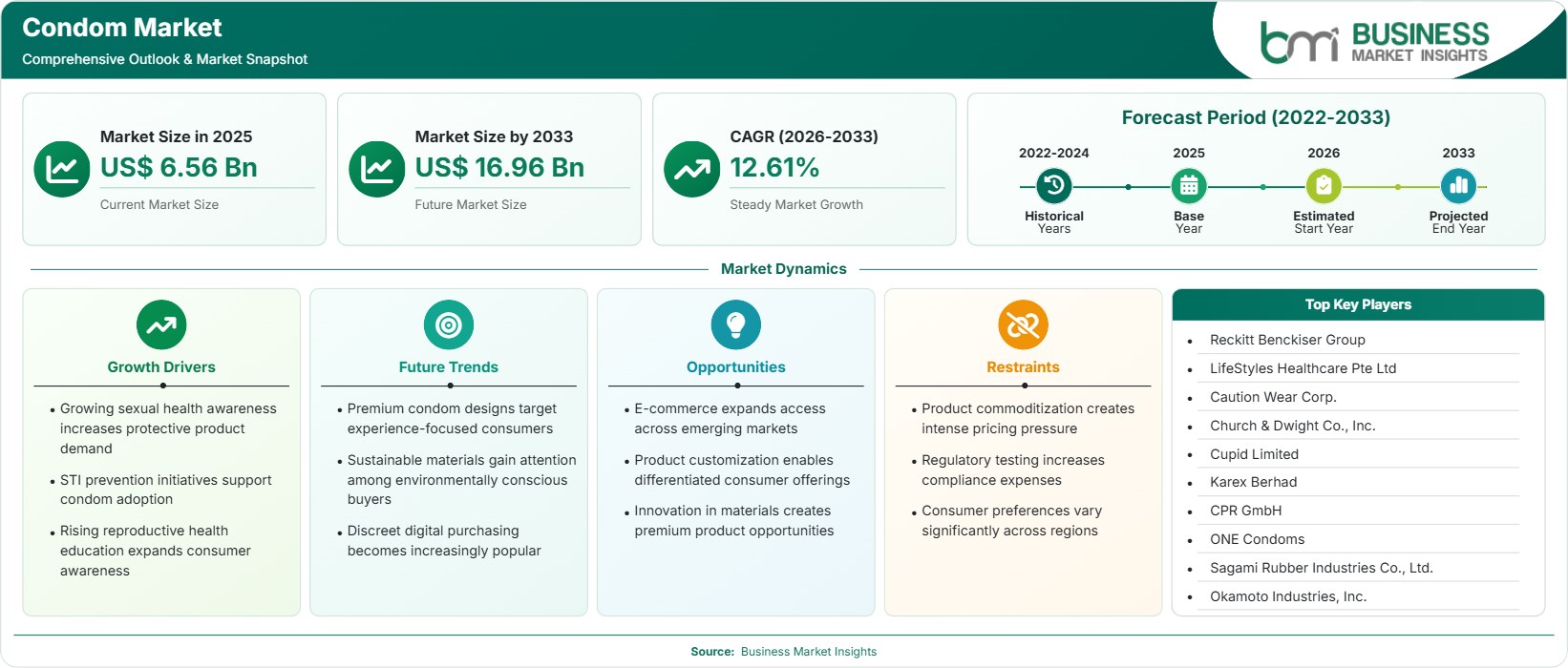
The Condom Market size was valued at USD 6.56 Billion in 2025 and is projected to reach USD 16.96 Billion by 2033, growing at a CAGR of 12.61% during 2026–2033. Rising sexual health awareness, increasing STI prevention initiatives, expanding e-commerce penetration, and growing adoption of premium products create substantial growth opportunities across developed and emerging economies.

Report Coverage
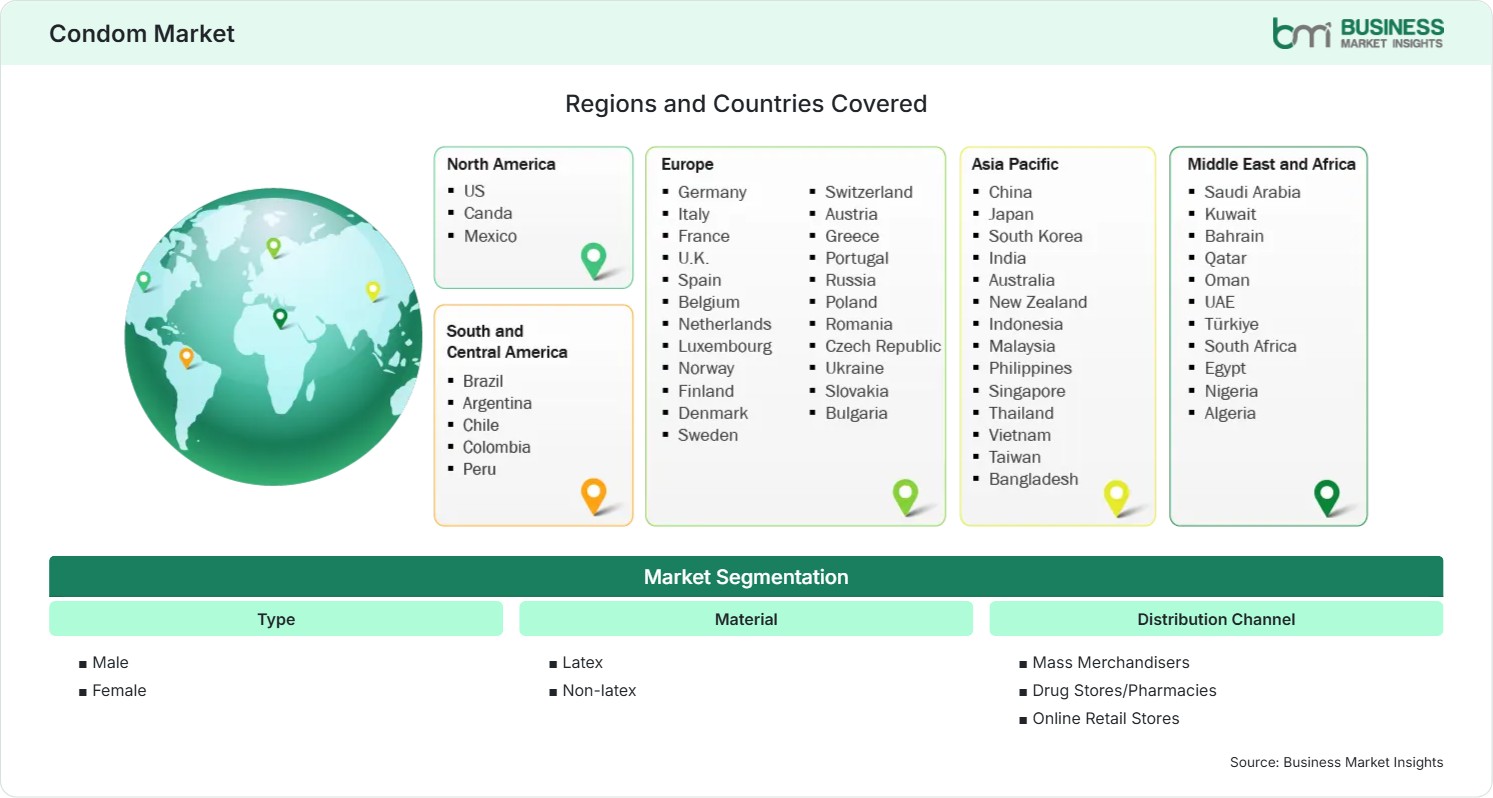
  • Type: Male, Female
  • Material: Latex, Non-latex
  • Distribution Channel: Mass Merchandisers, Drug Stores/Pharmacies, Online Retail Stores
US$ 6.56 Bn Market size in 2025
US$ 16.96 Bn Market Size by 2033
12.61% CAGR, 2026 - 2033
2026-2033 Forecast Period

01 AI Overview

Condom Market Summary

  • North America Region: North America holds a market share of 34%–37% in 2025, growing at a CAGR of 11.2%–11.8% during 2026–2033. Strong sexual wellness awareness, premium product adoption, organized retail presence, and digital health campaigns support sustained demand and innovation across consumer segments.
    US market benefits from extensive retail accessibility, high awareness levels, and growing premium product demand, advancing at 11.4%–12.0% CAGR.
  • Fastest Growing Region: Asia Pacific holds a market share of 25%–28% in 2025, growing at a CAGR of 14.1%–14.8% during 2026–2033. Expanding youth population, improving reproductive education, urbanization, digital commerce growth, and increasing healthcare outreach programs accelerate product consumption and market penetration.
  • Leading Segment: Male condoms account for 82%–86% share in 2025, expanding at 11.8%–12.4% CAGR through 2033. Established consumer familiarity, broad product availability, affordability advantages, and extensive public health distribution programs continue supporting high-volume demand across global markets.
  • High Growth Segment: Online retail stores represent 18%–22% share in 2025, advancing at 15.8%–16.5% CAGR during 2026–2033. Privacy-driven purchasing behavior, subscription models, broad product portfolios, discount offerings, and increasing smartphone penetration accelerate channel expansion globally.
  • Key Market Opportunity: Premiumization through ultra-thin, textured, hypoallergenic, and technologically enhanced products enables manufacturers to improve margins, attract younger consumers, strengthen brand differentiation, and expand recurring purchases.
  • Major Market Players: Reckitt Benckiser Group plc, LifeStyles Healthcare Pte. Ltd., Caution Wear Corp., Church & Dwight Co., Inc., Cupid Limited, Karex Berhad, CPR GmbH, ONE® Condoms (Global Protection Corp.), Sagami Rubber Industries Co., Ltd., Okamoto Industries, Inc.
02 Strategic Insights

Condom Market: Strategic Insights

Condom Market Strategic Framework
FREE PDF
Request your free sample
Request free sample
03 Stakeholder View

Key Takeaways

  • Raw materials suppliers, brand producers, online retailers, health care product distributors, and government tendering agencies are all becoming integral parts of the value chain, making the supply chain more resilient and widening the retail reach.
  • E-commerce and premium products not made from latex are commercially most attractive owing to the privacy-driven nature of the buying process and the consumers’ readiness to pay for increased comfort.
  • Innovations include making the materials thinner, reducing odors, using sustainable packaging, creating special textures, and developing hypoallergenic products.
  • Asia Pacific offers the most compelling long-term regional opportunity due to favorable demographics, urbanization, digital commerce expansion, and improving awareness related to reproductive health.
  • Competition increasingly centers around brand differentiation, product innovation, and digital marketing capabilities rather than solely manufacturing scale and pricing strategies.
  • Healthcare firms, pharmacists, education providers, and online marketplaces are forming strategic alliances that are essential for customer acquisition and branding.
04 Geographic Outlook

Condom Market Regional Highlights

North America Condom Market

North America accounted for approximately 34%–37% Condom Market share in 2025 and is anticipated to expand at 11.2%–11.8% CAGR through 2033. High consumer awareness, robust retail infrastructure, increasing use of high-end sexual wellness products, and educational programs provide an impetus for the development of this market. The market demand is still highest in the U.S. and Canada, and digital retail platforms are continually improving accessibility.

  • Established pharmacy and mass retail networks improve product visibility and support broad consumer accessibility across both urban and suburban populations.
  • Premium and ultra-thin products continue gaining traction among younger demographics seeking enhanced comfort and differentiated experiences.
  • Subscription-based online purchasing models are boosting recurring demand while improving customer retention rates.
  • Public health campaigns emphasizing STI prevention continue strengthening product awareness and consumer acceptance.
  • Increased adoption of sustainable packaging supports environmentally conscious purchasing behavior.

US Condom Market

The United States represents approximately 78%–82% share within North America and is forecast to expand at 11.4%–12.0% CAGR during 2026–2033. Strong purchasing power, widespread distribution channels, advanced e-commerce penetration, and growing sexual wellness discussions contribute to continued market momentum. Consumer preference increasingly favors premium products with specialized features, including enhanced sensitivity and hypoallergenic materials.

  • E-commerce channels continue expanding through discreet delivery solutions that improve convenience and purchasing confidence.
  • Premium products generate stronger revenue growth compared with standard offerings due to greater consumer differentiation.
  • Educational outreach programs contribute to improved awareness regarding reproductive health practices.
  • Brand-led digital marketing campaigns effectively engage younger consumer demographics across multiple platforms.

Europe Condom Market

Europe held an estimated 27%–30% Condom Market share in 2025 and is expected to grow at 11.0%–11.6% CAGR through 2033. Mature healthcare systems, strong sexual wellness awareness, and broad retail availability underpin demand. Germany remains the leading country, while Poland and several Eastern European markets exhibit comparatively higher growth rates near 12.0%–12.8% CAGR due to increasing awareness and retail penetration.

  • Premium latex and non-latex offerings continue attracting consumers seeking superior comfort and reliability.
  • Government-supported awareness campaigns help sustain stable consumption patterns.
  • Digital health and wellness platforms are expanding consumer engagement opportunities.
  • Growth remains supported by broad pharmacy distribution and organized retail channels.
  • Product innovation increasingly focuses on sustainable and hypoallergenic materials.

Asia Pacific Condom Market

Asia Pacific represented approximately 25%–28% Condom Market share in 2025 and records the fastest expansion at 14.1%–14.8% CAGR through 2033. Rising urbanization, large reproductive-age populations, increasing digital commerce participation, and improving healthcare awareness drive demand. China and India remain leading revenue generators, while Southeast Asian countries demonstrate some of the strongest growth prospects across the region.

  • Expanding smartphone penetration accelerates online product purchases and brand discovery, while increasing consumer access to digital marketplaces, product information, and emerging brands across both developed and developing markets.
  • Awareness initiatives increasingly target younger demographics and first-time users, helping improve product familiarity, encourage informed purchasing decisions, and strengthen long-term consumer engagement.
  • Manufacturing investments strengthen regional supply capabilities and export competitiveness by improving production capacity, supporting localized supply chains, and reducing dependence on imported products.
  • Premium segment adoption is rising among urban consumers with higher disposable incomes, supported by growing product awareness, changing lifestyle preferences, and increasing willingness to spend on higher-quality offerings.
  • Educational efforts improve consumer understanding of disease prevention and reproductive health, while promoting informed decision-making, encouraging preventive practices, and supporting greater awareness of available healthcare products and services.

Rest of World Condom Market

Rest of World accounts for 9%–12% market share and is anticipated to grow at 12.4%–13.1% CAGR through 2033. South and Central America benefit from increasing healthcare outreach and retail expansion. The Middle East and Africa region gains momentum from awareness initiatives, urbanization, and improving distribution networks. Brazil is the leading revenue contributor, while selected Gulf countries and parts of Africa display accelerating growth potential.

  • Expanding healthcare programs help improve accessibility and availability across underserved populations, while also supporting broader awareness and adoption of relevant products and services.
  • Urban retail development strengthens product availability in major metropolitan centers by expanding distribution networks, increasing consumer access, and improving the presence of products across established retail channels.
  • Public sector procurement remains an important demand contributor in several markets, supported by government-led initiatives, institutional purchasing programs, and continued investment in healthcare and public services.
  • Online commerce platforms increasingly support discreet and convenient purchasing practices, offering consumers greater accessibility, product choice, and flexibility while reducing barriers associated with traditional purchasing channels.
  • Younger demographic structures create favorable long-term consumption fundamentals, as growing populations of younger consumers can contribute to sustained demand, increased product awareness, and broader adoption over the coming years.
Global Market Geography
FREE PDF
Request your free sample
Request free sample
05 Segment Analysis

Condom Market Segmentation

Type

This segment represents core industry demand dynamics. Male condoms account for approximately 82%–86% market share in 2025 and are expected to grow at 11.8%–12.4% CAGR through 2033. The Condom Market scope within this segment remains substantial due to widespread availability, affordability, and global awareness efforts. Female products continue gaining traction through empowerment-focused initiatives and product accessibility improvements.

  • Male: Dominates global consumption due to widespread awareness, extensive product availability, affordability advantages, and integration into public health programs supporting disease prevention and family planning.
  • Female: Increasing awareness regarding reproductive autonomy, growing advocacy efforts, and product improvements contribute to stronger adoption rates across select developed and emerging markets.

Material

Material selection increasingly influences product differentiation and consumer preferences. Latex products maintain 68%–72% share in 2025 and are expected to advance at 11.5%–12.1% CAGR. Demand for non-latex alternatives continues expanding among allergy-sensitive consumers seeking enhanced comfort, improved fit, and premium experiences aligned with evolving purchasing preferences.

  • Latex: Maintains leadership through cost-effectiveness, established manufacturing infrastructure, and broad consumer acceptance across retail, healthcare, and public distribution channels.
  • Non-latex: Benefiting from growing demand for allergy-friendly, premium-quality, and high-sensitivity products among consumers prioritizing comfort and specialized functionality.

Distribution Channel

Distribution diversification continues reshaping purchasing behaviors. Mass merchandisers hold the largest 40%–44% share in 2025, expanding at 10.8%–11.4% CAGR. The Condom Market trends indicate increasing migration toward digital purchasing, with online channels exhibiting the strongest momentum driven by privacy, convenience, and expanded product selection.

  • Mass Merchandisers: Maintain leadership through high visibility, broad geographic coverage, competitive pricing, and strong consumer familiarity.
  • Drug Stores/Pharmacies: Trusted healthcare positioning and professional guidance support stable demand across diverse consumer groups.
  • Online Retail Stores: Rapid expansion supported by discreet purchasing options, broad inventories, subscription services, and digital promotional strategies.
06 Market Forces

Condom Market Dynamics

Key Market Drivers

Growing sexual health awareness increases protective product demand

Growing consumer awareness of sexually transmitted infections and reproductive health responsibilities continues supporting long-term industry expansion. Educational programs, public awareness campaigns, advice from healthcare providers, and online wellness programs enhance knowledge of preventive measures. The younger generation is more receptive to discussions about sexual health compared to past generations, thus providing a conducive environment for product uptake. Retailers are addressing the trend by diversifying their product offerings and conducting educational programs. Product manufacturers are still incorporating comfort-related technologies and other features to increase usage. These trends work together to foster more frequent purchases.

STI prevention initiatives support condom adoption

Government agencies, healthcare organizations, educational institutions, and community health groups continue implementing prevention-oriented strategies supporting broader product acceptance. Distributive campaigns enhance access for less privileged populations, whereas awareness campaigns promote preventive messages about disease. Cooperation of public health agencies and the manufacturers enhances the effectiveness of communication. Knowledge on infection risks by consumers has been enhanced in many countries, which promotes preventive purchases. Increased accessibility through pharmacies, health centers, and community programs also helps. Such actions help in creating favorable demand dynamics.

Rising reproductive health education expands consumer awareness

Educational improvements across schools, healthcare institutions, nonprofit organizations, and public campaigns continue encouraging informed reproductive health decisions. Information leads to fewer misunderstandings and responsible buying behavior. The use of technology through digital platforms, social media interaction, and counseling helps to extend education further. Manufacturing companies are now ensuring their marketing campaigns align with the objective of raising awareness to promote preventive health information. It ensures that consumers feel more confident about the products, especially first time buyers.

Key Market Opportunities

E-commerce expands access across emerging markets

Digital retail channels represent a major growth avenue as consumers increasingly value privacy, convenience, and product variety. Expanding internet penetration and smartphone adoption improve access across developing regions. Subscription models, personalized recommendations, and direct-to-consumer strategies create opportunities for recurring revenues. Condom Market Forecasts increasingly reflect stronger digital channel contributions because e-commerce reduces traditional retail limitations. Manufacturers can strengthen margins through controlled branding experiences while reaching underserved customer segments. Enhanced logistics infrastructure further supports scalability and geographic expansion.

Product customization enables differentiated consumer offerings

The shift in consumer preference is towards personalization, and hence there is an increased need for customization in terms of texture, taste, ultra thin, ergonomic design, and sensitivity. It will allow the manufacturers to practice premium pricing and build brand loyalty. Increased consumer experimentation will create opportunities to develop unique portfolios. Innovation in products will enable the manufacturers to remain distinct from the competitive environment.

Innovation in materials creates premium product opportunities

Innovations in synthetic material technology and special formulations help in creating allergy-free, odorless, and comfort-enhancing products. The non-latex innovations offer consumers with a variety of options, while also catering to any sensitivity issues. Innovative products have high profit potential and help companies differentiate their brands in the marketplace. Companies that invest in innovations are thus poised to capitalize on the changing consumer demands. Innovations also allow companies to better target premium wellness categories.

Market Restraints and Challenges

Product commoditization creates intense pricing pressure

Factor: Extensive availability of similar products across global markets intensifies competition among established and emerging brands. Impact: Constantly high pressure from pricing may lower the profitability and pose challenges in relation to premium positioning strategies. Competition at the retail level may lead to increased promotion, making pricing less flexible. Bargaining position for smaller companies may be undermined when dealing with distributors and retailers. In such an environment, it becomes important to focus on branding, innovation, and customer loyalty programs. Inability to distinguish oneself may result in margin pressure despite the volume increases.

Regulatory testing increases compliance expenses

Factor: Product quality, safety standards, labeling requirements, and certification processes continue becoming more rigorous across key markets. Impact: Compliance costs will increase complexity and can cause delays to product releases. The company needs to make investments in areas such as testing, quality assurance systems, documentation, and compliance. It can be difficult for small businesses with limited capital. Even though compliance is beneficial to improve customer confidence and reliability of products, it also causes costs and barriers in entering markets.

07 Company Analysis

Competitive Landscape

The Condom Market analysis indicates that competition is driven by brand strength, product innovation, manufacturing scale, distribution reach, and premium product development.

Company Name

Overview

Products and Services relevant to this market

Reckitt Benckiser Group plc

Global consumer health company with strong sexual wellness brand presence and extensive retail distribution.

Condoms, lubricants, intimate wellness products, brand marketing, retail distribution services.

LifeStyles Healthcare Pte. Ltd.

International sexual wellness specialist operating across developed and emerging markets.

Condoms, personal lubricants, reproductive wellness products, retail and healthcare distribution.

Caution Wear Corp.

Specialty manufacturer focused on unique and differentiated protective products.

Condoms, novelty designs, specialty variants, customized offerings.

Church & Dwight Co., Inc.

Consumer goods company with recognized wellness and personal care brands.

Sexual wellness products, condoms, retail marketing and distribution solutions.

Cupid Limited

Large-scale manufacturer serving domestic and international healthcare channels.

Male condoms, female condoms, public health supply programs.

Karex Berhad

Major global condom manufacturer with large production capacity.

Private-label condoms, branded products, OEM manufacturing services.

CPR GmbH

European producer focused on quality-certified reproductive health products.

Condoms, specialty variants, healthcare distribution support.

ONE® Condoms (Global Protection Corp.)

Brand-focused company emphasizing innovation and consumer engagement.

Premium condoms, educational campaigns, customized product offerings.

Sagami Rubber Industries Co., Ltd.

Technology-oriented manufacturer known for premium products and material innovation.

Polyurethane condoms, ultra-thin variants, premium wellness solutions.

Okamoto Industries, Inc.

Leading Japanese manufacturer recognized for advanced product development.

Ultra-thin condoms, premium products, material technology innovations.

10 Trust & Transparency

Research Methodology

The market analysis combines proprietary research with secondary data from government agencies, company disclosures, regulatory filings, industry databases and expert interviews. Market estimates are validated through data triangulation, cross-market benchmarking and analyst review.

View Full Research Methodology

11 Questions Answered

Frequently Asked Questions

What does a Condom Market Report typically evaluate?

A Market Report evaluates market size, competitive positioning, growth drivers, regulatory influences, regional performance, technological developments, and future opportunities.

What role does e-commerce play?

Online retail improves convenience, privacy, product variety, and customer engagement, making it one of the fastest-growing distribution channels.

Which product category leads revenue generation?

Male condoms remain the dominant category due to established awareness, affordability, and extensive public health distribution programs.

Which region is growing the fastest?

Asia Pacific is the fastest-growing region, supported by demographic advantages, urbanization, e-commerce expansion, and increasing healthcare awareness initiatives.

What is driving demand in the industry?

Rising awareness of STI prevention, broader reproductive health education, premium product innovation, and expanding online accessibility are major demand drivers.

Access the Full Condom Market Report

Get segment-level forecasts, regional estimates, competitive benchmarking, company profiles and downloadable Excel datasets.

Access the full Condom Market Report
350 pages PDF & Excel | 2026-08-20