
Lab Grown Diamond Market Outlook: Size, Share, Trends, Growth Analysis, Competitive Landscape & Forecast, 2026-2033

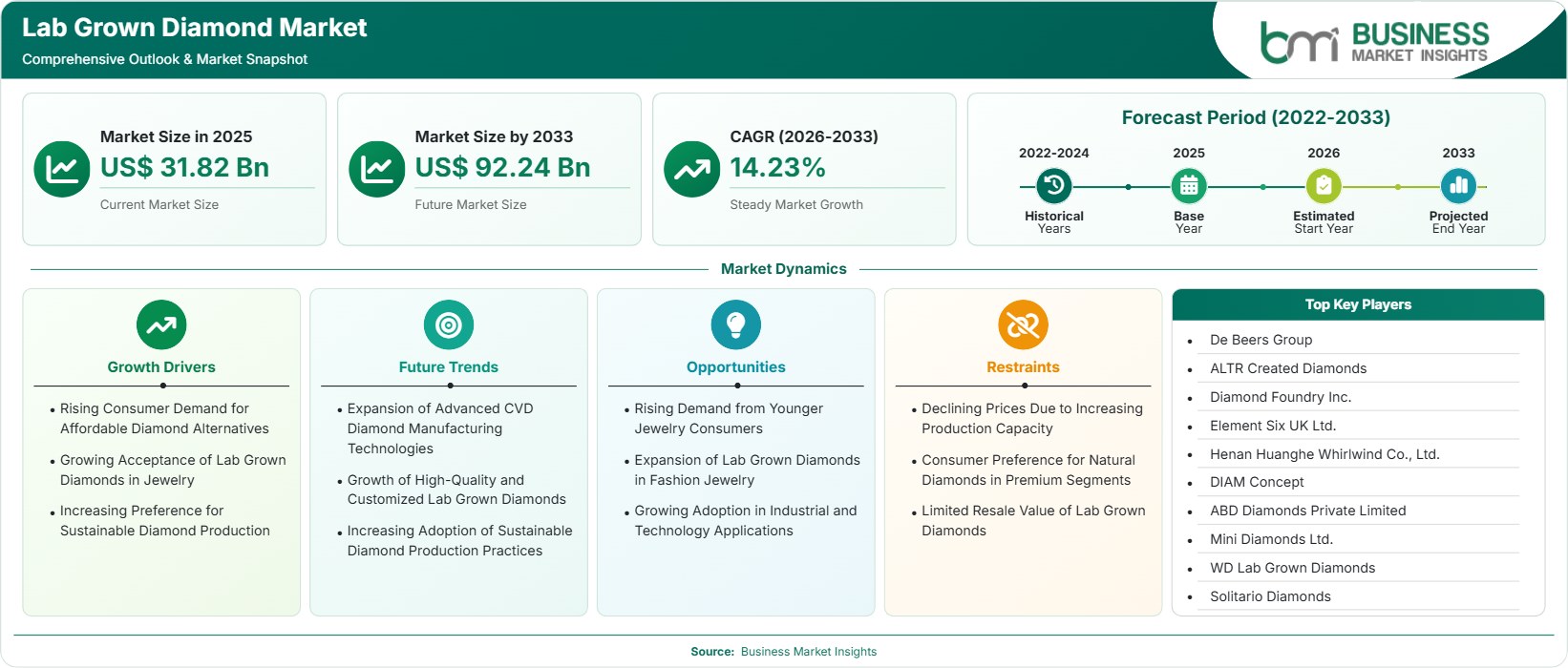
The Lab Grown Diamond Market size was valued at US$ 31.82 Billion in 2025 and is projected to reach US$ 92.24 Billion by 2033, growing at a CAGR of 14.23% during 2026–2033. Rising consumer acceptance of sustainable diamonds, technological advancements in diamond synthesis, growing jewelry demand, expanding industrial applications, and increasing retail penetration are driving significant market opportunities.

Report Coverage
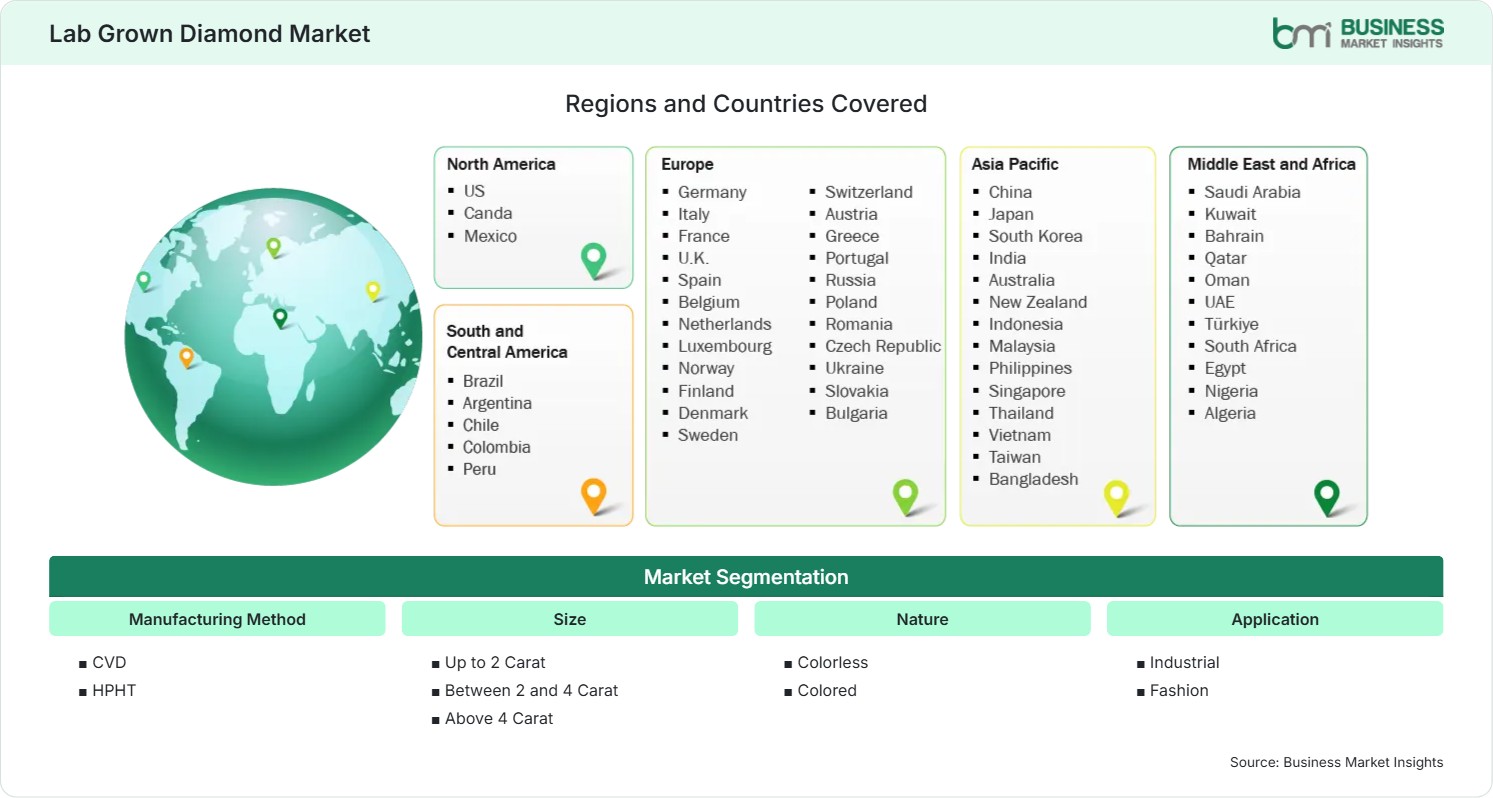
  • Manufacturing Method: CVD, HPHT
  • Size: Up to 2 Carat, Between 2 and 4 Carat, Above 4 Carat
  • Nature: Colorless, Colored
  • Application: Industrial, Fashion
US$ 31.82 Bn Market size in 2025
US$ 92.24 Bn Market Size by 2033
14.23% CAGR, 2026 - 2033
2026-2033 Forecast Period

01 AI Overview

Lab Grown Diamond Market Summary

  • North America Region: North America holds a lab grown diamond market share of 34%–38% in 2025 and is projected to grow at a CAGR of 13.2%–14.0% during 2026–2033. Growth is supported by increasing consumer awareness, sustainability preferences, premium jewelry demand, technological innovation, strong retail distribution networks, expanding online sales, ethical sourcing initiatives, luxury market growth, customization trends, and rising disposable incomes. The U.S. remains the dominant market due to strong jewelry consumption and growing acceptance of lab-created gemstones, advancing at a CAGR of 13.4%–14.2%.
  • Fastest Growing Region: Asia Pacific accounts for 28%–32% share in 2025 and is expected to register a CAGR of 15.6%–16.4% through 2033. Growth is fueled by expanding middle-class populations, rising jewelry demand, manufacturing capacity expansion, increasing disposable incomes, e-commerce growth, technological advancements, export opportunities, changing consumer preferences, affordability advantages, and growing awareness of lab-grown products.
  • Leading Segment: CVD represents 56%–60% share in 2025 and is anticipated to grow at a CAGR of 14.8%–15.5% through 2033. Demand is supported by production efficiency, quality consistency, scalability advantages, technological improvements, increasing jewelry applications, customization capabilities, enhanced crystal quality, lower defect rates, and expanding commercial production.
  • High Growth Segment: Fashion captures 68%–72% share in 2025 and is forecast to expand at a CAGR of 15.2%–16.0% during 2026–2033. Expansion is driven by changing consumer preferences, affordability benefits, sustainability awareness, luxury product adoption, innovative jewelry designs, growing retail availability, online sales growth, brand promotion activities, and ethical purchasing considerations.
  • Key Market Opportunity: Growing consumer demand for sustainable luxury products is creating opportunities for premium jewelry collections, customized diamond offerings, omnichannel retail expansion, and certified ethical sourcing programs.
  • Major Market Players: De Beers Group, ALTR Created Diamonds, Diamond Foundry Inc., Element Six UK Ltd., Henan Huanghe Whirlwind Co., Ltd., DIAM Concept, ABD Diamonds Private Limited, Mini Diamonds Ltd., WD Lab Grown Diamonds, and Solitario Diamonds.
02 Strategic Insights

Lab Grown Diamond Market: Strategic Insights

Lab Grown Diamond Market Strategic Framework
FREE PDF
Request your free sample
Request free sample
03 Stakeholder View

Key Takeaways

  • The lab grown diamond market value chain is becoming increasingly integrated, with manufacturers, certification providers, jewelry brands, and retailers collaborating to improve transparency, traceability, and consumer confidence.
  • Fashion applications represent the strongest growth opportunity as consumers increasingly seek affordable luxury, customization options, and sustainable alternatives to mined diamonds.
  • Manufacturing innovation continues to improve crystal quality, reduce production costs, enhance scalability, and support wider adoption across both jewelry and industrial applications.
  • Asia Pacific remains a highly attractive investment destination due to expanding manufacturing capacity, rising consumer purchasing power, and increasing acceptance of lab-grown diamonds among younger buyers.
  • Strategic partnerships between production companies, online retailers, and luxury jewelry brands are accelerating market penetration and broadening product accessibility.
  • Environmental sustainability and ethical sourcing continue to emerge as key purchasing drivers, particularly among millennials and Gen Z consumers.
04 Geographic Outlook

Lab Grown Diamond Market Regional Highlights

North America Lab Grown Diamond Market

North America accounted for 34%–38% of global revenue in 2025 and is projected to grow at a CAGR of 13.2%–14.0% through 2033. The region benefits from strong consumer awareness, established jewelry retail networks, and increasing demand for sustainable luxury products. The Lab Grown Diamond Market share remains the largest globally due to strong acceptance among younger consumers and growing retailer participation. Expanding online sales channels and product customization trends continue supporting market growth.

  • Sustainability-conscious consumers increasingly prefer ethically sourced alternatives to traditional mined diamonds.
  • Major jewelry retailers continue expanding lab-grown diamond collections to meet evolving customer demand.
  • Growing digital engagement and direct-to-consumer sales models are improving market accessibility.
  • Bridal jewelry remains a key application area supporting consistent product demand.
  • Product certification and transparency initiatives continue strengthening consumer confidence.

US Lab Grown Diamond Market

The United States represents 81%–85% of North American demand and is expected to grow at a CAGR of 13.4%–14.2% through 2033. Strong consumer awareness, premium jewelry demand, and extensive retail availability are supporting growth. Increasing adoption among younger demographics and rising emphasis on sustainability continue creating favorable lab grown diamond market conditions.

  • Bridal and engagement jewelry categories remain significant demand drivers across the country.
  • Online jewelry retailers continue expanding their lab-grown diamond portfolios.
  • Sustainability messaging plays an important role in consumer purchasing decisions.
  • Product affordability compared to mined diamonds encourages broader customer adoption.

Europe Lab Grown Diamond Market

Europe held 23%–27% of global revenue in 2025 and is anticipated to expand at a CAGR of 13.5%–14.3% through 2033. Consumer preference for sustainable luxury products and strict environmental awareness support market growth. Germany remains the leading market, while the Netherlands represents a high-growth country with a CAGR of 14.5%–15.2%. Increasing demand for ethically sourced gemstones is encouraging product adoption across the region.

  • Sustainability initiatives continue influencing jewelry purchasing behavior across European markets.
  • Germany benefits from strong consumer spending on premium jewelry products.
  • Retailers are increasingly emphasizing traceability and responsible sourcing practices.
  • Demand for customized and designer jewelry continues rising.
  • Certification programs help strengthen consumer trust and product acceptance.

Asia Pacific Lab Grown Diamond Market

Asia Pacific accounted for 28%–32% of global revenue in 2025 and is expected to record the fastest CAGR of 15.6%–16.4% through 2033. Rising disposable incomes, expanding jewelry demand, and significant manufacturing capacity support strong growth. China and India remain dominant markets, while Southeast Asia demonstrates notable growth potential with a CAGR of 16.2%–17.0%. Consumer awareness and affordability advantages continue driving market expansion.

  • India remains a major production hub supporting global lab-grown diamond supply.
  • Rising middle-class populations are contributing to increased jewelry consumption.
  • E-commerce platforms are expanding product accessibility across regional markets.
  • Technological advancements continue improving manufacturing efficiency and scalability.
  • Growing awareness of sustainable products supports increasing demand.

Rest of World Lab Grown Diamond Market

Rest of World accounted for 8%–12% of global revenue in 2025 and is forecast to grow at a CAGR of 12.8%–13.6% through 2033. Demand is supported by growing luxury consumption, increasing retail penetration, and rising awareness of ethical jewelry alternatives. The United Arab Emirates and Brazil are among the notable markets benefiting from expanding premium jewelry demand and retail development.

  • Luxury retail expansion is improving market visibility and consumer access.
  • Consumers increasingly evaluate products based on sustainability and ethical considerations.
  • Growing digital commerce channels are supporting broader geographic market reach.
  • Premium jewelry demand continues increasing across affluent consumer groups.
  • Retailer investments in product education strengthen market awareness.
Global Market Geography
FREE PDF
Request your free sample
Request free sample
05 Segment Analysis

Lab Grown Diamond Market Segmentation

Manufacturing Method

CVD accounts for 56%–60% share in 2025 and is expected to grow at a CAGR of 14.8%–15.5% through 2033. The segment benefits from production scalability, improved crystal quality, and cost efficiencies that support increasing commercial adoption. The Lab Grown Diamond Market scope continues to expand as manufacturers invest in advanced production technologies and higher-capacity facilities to meet growing global demand.

  • CVD: Widely adopted due to superior production control, consistency, scalability, and suitability for high-quality gemstone and industrial diamond applications.
  • HPHT: Maintains strong demand through established manufacturing processes, industrial applications, and capability to produce high-quality gem-grade diamonds.

Size

Between 2 and 4 Carat diamonds account for 38%–42% share in 2025 and are projected to grow at a CAGR of 14.5%–15.2% through 2033. Demand is driven by consumer preference for larger diamonds at competitive prices and growing adoption in bridal and premium jewelry segments.

  • Up to 2 Carat: Popular among first-time buyers and fashion jewelry consumers seeking affordability and design flexibility.
  • Between 2 and 4 Carat: Benefits from strong demand in engagement rings, bridal collections, and premium jewelry applications.
  • Above 4 Carat: Attracts luxury consumers seeking larger stones with greater visual impact and customization opportunities.

Nature

Colorless diamonds hold 64%–68% share in 2025 and are expected to expand at a CAGR of 14.0%–14.8% through 2033. Their close resemblance to natural diamonds and strong consumer preference within jewelry applications continue supporting segment leadership.

  • Colorless: Dominates global demand due to broad jewelry acceptance, premium appearance, and strong retail market visibility.
  • Colored: Gains traction through fashion-driven designs, product differentiation strategies, and increasing consumer interest in unique gemstone aesthetics.

Application

Fashion remains the leading application with 68%–72% share in 2025 and is projected to grow at a CAGR of 15.2%–16.0% through 2033. Increasing consumer awareness, affordability advantages, and broader retail availability continue supporting adoption. Current Lab Grown Diamond Market trends indicate strong momentum across contemporary jewelry categories and premium fashion accessories.

  • Industrial: Utilized in cutting, grinding, drilling, semiconductor, optics, and advanced manufacturing applications requiring exceptional hardness and precision.
  • Fashion: Driven by growing jewelry demand, sustainability preferences, affordability benefits, and expanding designer collections incorporating lab-grown diamonds.
06 Market Forces

Lab Grown Diamond Market Dynamics

Key Market Drivers

Rising Consumer Demand for Affordable Diamond Alternatives

More customers are seeking diamonds with the same appearance and properties as mined diamonds but at a much lower cost. Lab-made diamonds are very good value for money because they help people buy either larger stones or higher-quality diamonds without changing the budget. Price sensitivity has been impacting the purchasing behavior of more and more customers, leading to the search for products which combine luxury and value. The increasing availability of lab-grown diamonds through brick-and-mortar stores and the Internet makes it even easier for customers to make their choice.

Growing Acceptance of Lab Grown Diamonds in Jewelry

There has been quite some evolution in consumer attitudes towards lab-grown diamonds in the last ten years. Improved technology, certification from external agencies, and education in the retail space have contributed to consumer confidence in these products. More jewelry brands are now adding lab grown diamonds to their regular and premium collections. The retailers still emphasize the same features like sparkle, quality and durability along with affordability. As more consumers gain awareness and misconceptions dissipate, confidence in the products increases.

Increasing Preference for Sustainable Diamond Production

Sustainability considerations are playing a larger role in purchasing decisions, particularly among younger consumers. Lab-grown diamonds are frequently marketed as an environmentally responsible and ethically sourced alternative to mined diamonds. Consumers increasingly evaluate product origin, production practices, and environmental impact when selecting luxury goods. Jewelry manufacturers and retailers are responding by emphasizing transparency and sustainability credentials in marketing campaigns. As environmental awareness continues increasing globally, demand for products perceived as sustainable is expected to support further adoption. Sustainability-driven purchasing behavior remains one of the most influential factors supporting market growth.

Key Market Opportunities

Rising Demand from Younger Jewelry Consumers

Millennials and Generation Z consumers are increasingly influencing jewelry market dynamics through changing purchasing preferences. These demographic groups often prioritize sustainability, transparency, affordability, and customization. Lab-grown diamonds align closely with these values, positioning manufacturers and retailers to capture long-term market opportunities. Social media influence, digital-first shopping behavior, and evolving attitudes toward luxury ownership are supporting market expansion. Lab Grown Diamond Market Forecasts indicate sustained demand growth from younger buyers as awareness continues increasing. Companies capable of delivering innovative products and engaging brand experiences are likely to benefit significantly from this demographic shift.

Expansion of Lab Grown Diamonds in Fashion Jewelry

The fashion jewelry segment presents substantial growth opportunities as consumers increasingly seek high-quality gemstones for everyday wear. Lab-grown diamonds enable brands to offer attractive designs at more accessible price points while maintaining desirable visual characteristics. Designers are introducing broader product ranges that target diverse customer demographics and lifestyles. Retail expansion, celebrity endorsements, and digital marketing campaigns are further enhancing product visibility. As fashion-focused consumers continue prioritizing affordability and design versatility, manufacturers have significant opportunities to expand sales through new product launches and innovative jewelry collections.

Growing Adoption in Industrial and Technology Applications

Beyond jewelry, lab-grown diamonds are gaining importance in industrial and technological applications due to their hardness, thermal conductivity, and durability. Industries including electronics, semiconductors, optics, aerospace, and advanced manufacturing increasingly utilize synthetic diamond materials. Technological advancements continue improving material quality and application suitability. Expanding research into diamond-based technologies is creating new commercial opportunities for producers. As demand for high-performance materials increases across industrial sectors, manufacturers can diversify revenue streams beyond gemstone applications and capitalize on emerging technology markets.

Market Restraints and Challenges

Declining Prices Due to Increasing Production Capacity

Factor: Rapid expansion of manufacturing capacity and technological improvements are increasing global lab-grown diamond supply. Impact: Growing production volumes can place downward pressure on prices and compress profit margins for manufacturers and retailers. While lower prices may encourage consumer adoption, sustained pricing declines can create challenges for maintaining profitability and brand positioning. Increased competition among producers may further intensify pricing pressures, requiring companies to focus on operational efficiency, product differentiation, and premium branding strategies to protect margins and market share.

Consumer Preference for Natural Diamonds in Premium Segments

Factor: Many luxury consumers continue associating natural diamonds with rarity, exclusivity, and long-term prestige. Impact: Persistent preference for mined diamonds within premium and high-net-worth customer segments may limit adoption of lab-grown alternatives in certain luxury categories. Heritage branding, emotional value, and perceptions regarding investment potential continue influencing purchasing decisions. Manufacturers and retailers must invest in consumer education, branding initiatives, and product positioning to overcome these perception barriers and increase acceptance within higher-end jewelry markets.

07 Company Analysis

Competitive Landscape

The Lab Grown Diamond Market analysis reflects a competitive industry landscape characterized by technology-driven manufacturers, diamond producers, and jewelry-focused companies competing through production innovation, sustainability positioning, certification standards, and retail expansion.

Company Name

Overview

Products and Services Relevant to this Market

De Beers Group

Global diamond leader with investments in both natural and laboratory-created diamond businesses.

Lab-grown diamonds, diamond grading, jewelry applications, and branded diamond solutions.

ALTR Created Diamonds

Specialized lab-grown diamond company serving jewelry manufacturers and retailers globally.

Certified lab-grown diamonds, bridal jewelry stones, and customized diamond solutions.

Diamond Foundry Inc.

Technology-driven producer focused on sustainable diamond manufacturing and premium gemstone applications.

Lab-grown diamonds, jewelry-grade stones, and sustainable diamond production technologies.

Element Six UK Ltd.

Advanced materials company and technology leader in synthetic diamond manufacturing.

Industrial diamonds, engineered diamond materials, and technology-focused diamond applications.

Henan Huanghe Whirlwind Co., Ltd.

Major synthetic diamond manufacturer with extensive production capacity and international presence.

Lab-grown diamonds, industrial diamond products, and synthetic diamond materials.

DIAM Concept

European diamond technology company focused on laboratory-created diamond solutions.

Cultivated diamonds, gemstone production, and jewelry-related diamond applications.

ABD Diamonds Private Limited

Indian manufacturer serving jewelry and gemstone markets through lab-grown diamond production.

Lab-grown diamonds, polished stones, and customized jewelry-grade diamond offerings.

Mini Diamonds Ltd.

Producer of laboratory-created diamonds serving domestic and international jewelry markets.

Synthetic diamonds, gemstone processing, and lab-grown diamond supply solutions.

WD Lab Grown Diamonds

Established producer recognized for laboratory-created gemstone innovation and sustainability initiatives.

Lab-grown diamonds, certified stones, and jewelry-focused diamond products.

Solitario Diamonds

Diamond company focused on jewelry-grade lab-grown diamond products and retail market development.

Fashion diamonds, bridal jewelry stones, and certified lab-grown diamond offerings.

10 Trust & Transparency

Research Methodology

The market analysis combines proprietary research with secondary data from government agencies, company disclosures, regulatory filings, industry databases and expert interviews. Market estimates are validated through data triangulation, cross-market benchmarking and analyst review.

View Full Research Methodology

11 Questions Answered

Frequently Asked Questions

What does this Lab Grown Diamond Market Report evaluate?

This market report evaluates market dynamics, competitive landscape, manufacturing technologies, consumer trends, regional opportunities, growth drivers, and industry challenges through 2033.

How do lab-grown diamonds differ from mined diamonds?

Lab-grown diamonds possess the same physical, chemical, and optical properties as mined diamonds but are produced in controlled laboratory environments using advanced manufacturing technologies.

Why is Asia Pacific the fastest-growing region?

Asia Pacific benefits from strong manufacturing capabilities, increasing disposable incomes, growing jewelry demand, expanding e-commerce activity, and rising awareness of lab-grown diamonds.

Which manufacturing method dominates the market?

CVD is the leading manufacturing method because of its scalability, production efficiency, crystal quality improvements, and growing adoption in jewelry applications.

What is driving growth in the lab-grown diamond industry?

Growth is being driven by affordability advantages, increasing sustainability awareness, evolving consumer preferences, expanding retail availability, and ongoing advancements in diamond manufacturing technologies.

Access the Full Lab Grown Diamond Market Report

Get segment-level forecasts, regional estimates, competitive benchmarking, company profiles and downloadable Excel datasets.

Access the full Lab Grown Diamond Market Report
350 pages PDF & Excel | 2026-08-24