
Beauty And Wellness Products Market Outlook: Size, Share, Trends, Growth Analysis, Competitive Landscape & Forecast, 2026-2033

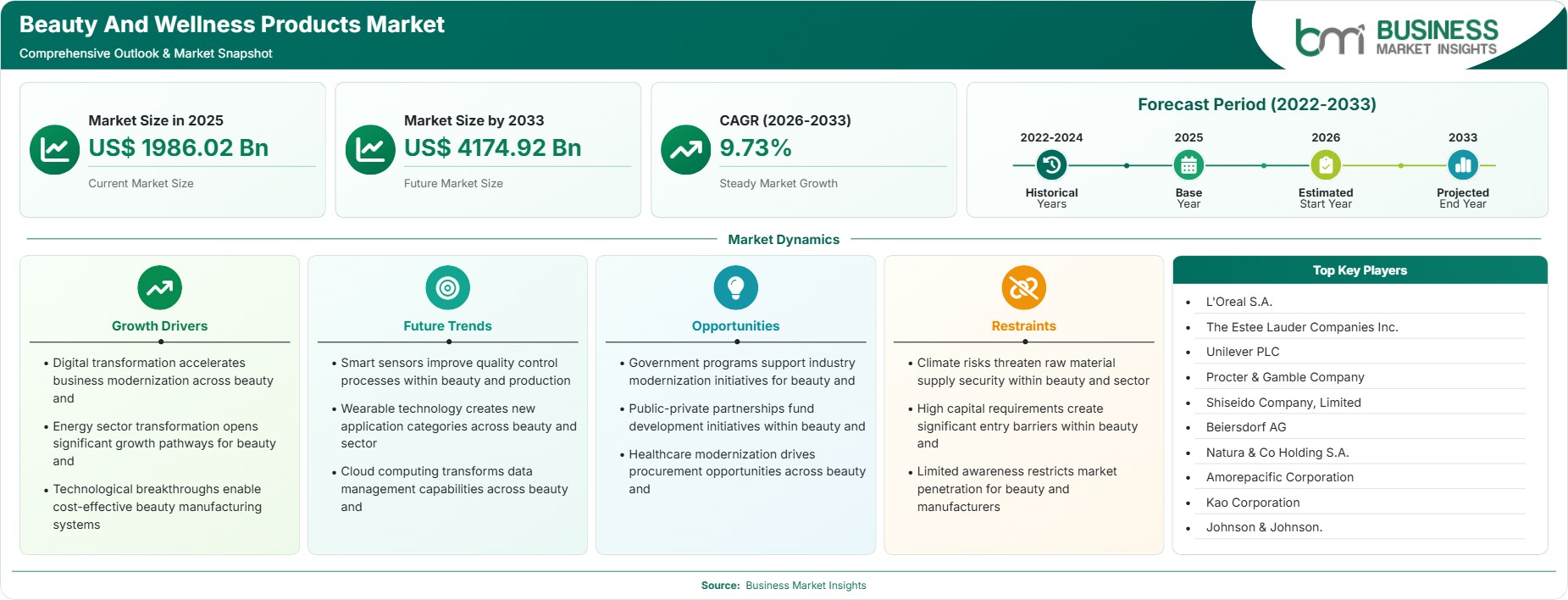
The Beauty and Wellness Products Market size was valued at US$ 1986.02 Billion in 2025 and is projected to reach US$ 4174.92 Billion by 2033, growing at a CAGR of 9.73% during 2026–2033, driven by premiumization, preventive wellness demand, digital commerce expansion, personalized formulations, clean-label innovation, aging populations, and increasing consumer spending on holistic beauty and health solutions.

Report Coverage
  • Type: Hair Care Products, Skincare Products, Makeup Products, Food & Nutrition Products, Medicinal Products, Wellness Products
  • Distribution Channel: Supermarkets & Hypermarkets, Specialty Stores, Online Channels
US$ 1986.02 Bn Market size in 2025
US$ 4174.92 Bn Market Size by 2033
9.73% CAGR, 2026 - 2033
2026-2033 Forecast Period

AI Overview

Beauty And Wellness Products Market Summary

  • North America Region: North America holds a market share of 34%–37% in 2025, growing with a CAGR of 8.4%–9.1% during 2026–2033. Key drivers include premium skincare adoption, nutraceutical demand, omnichannel retail expansion, personalization technologies, wellness subscriptions, and advanced product innovation ecosystems supporting consumer engagement and spending. US market remains innovation-led, supported by high wellness expenditure and digital beauty adoption, advancing at 8.7%–9.2% CAGR.
  • Fastest Growing Region: Asia Pacific holds market share of 28%–31% in 2025, growing with a CAGR of 11.4%–12.3% during 2026–2033. Rising disposable incomes, beauty-conscious consumers, e-commerce penetration, local brand development, wellness nutrition demand, social commerce influence, and urbanization continue accelerating regional market expansion.
  • Leading Segment: Skincare Products account for 28%–32% share in 2025 and are advancing at 9.8%–10.5% CAGR. Growth is supported by dermocosmetics uptake, anti-aging demand, ingredient transparency, premium formulations, clinical validation, wellness-oriented consumption patterns, and product innovation investments.
  • High Growth Segment: Online Channels represent 22%–26% share in 2025 and are expected to grow at 12.8%–13.8% CAGR. Mobile commerce adoption, influencer-driven purchasing, direct-to-consumer models, subscription services, AI recommendations, and broader accessibility across emerging economies strengthen momentum.
  • Key Market Opportunity: Personalized wellness ecosystems integrating supplements, beauty diagnostics, connected devices, preventive healthcare insights, and AI-driven recommendations create strong monetization opportunities across premium consumer segments worldwide.
  • Major Market Players: L'Oréal S.A., The Estée Lauder Companies Inc., Unilever PLC, Procter & Gamble Company, Shiseido Company, Limited, Beiersdorf AG, Natura & Co Holding S.A., Amorepacific Corporation, Kao Corporation, Johnson & Johnson.
Strategic Insights

Beauty And Wellness Products Market: Strategic Insights

Beauty And Wellness Products Market Strategic Framework
FREE PDF
Request your free sample
Request free sample
Stakeholder View

Key Takeaways

  • The value chain is increasingly interconnected, linking ingredient suppliers, biotechnology innovators, wellness brands, specialty retailers, and digital health platforms to create differentiated consumer experiences.
  • Online distribution and wellness-focused nutrition products present substantial upside due to rising consumer interest in preventive health, convenience purchasing, and recurring subscription-based consumption.
  • Innovation is shifting toward clinically validated formulations, microbiome science, AI-guided personalization, and multifunctional solutions combining beauty enhancement and wellness benefits.
  • India, Indonesia, Vietnam, Saudi Arabia, and the UAE offer attractive investment potential because of growing disposable income, digital retail expansion, and evolving lifestyle preferences.
  • Strategic acquisitions continue to reshape competition as global companies pursue high-growth brands specializing in clean beauty, nutraceuticals, personalized skincare, and premium wellness solutions.
  • Sustainability is becoming a competitive differentiator, with refill systems, recyclable packaging, ingredient traceability, and carbon reduction initiatives influencing purchasing decisions.
Geographic Outlook

Beauty And Wellness Products Market Regional Highlights

North America Beauty and Wellness Products Market

The North American region accounts for 34%-37% of the Beauty and Wellness Products Market share in 2025 and is estimated to record a CAGR of 8.4%-9.1% during 2033. Consumers spend on high-end skin care products, wellness supplements, and customized products, all of which remain among the highest globally. Highly advanced retail facilities, established brands, and extensive use of digital wellness platforms ensure high demand. Clinical beauty products, preventive health products, and wellness subscription services continue to attract investment and consumers.

  • Premium skincare and nutraceutical categories are expanding due to increased demand for clinically proven efficacy and preventive wellness benefits.
  • AI-enabled beauty diagnostics and personalized recommendations are improving consumer retention and average transaction values.
  • Sustainability regulations and consumer expectations are accelerating adoption of recyclable packaging and cleaner formulations.
  • Subscription models enhance recurring revenues while strengthening customer engagement across beauty and wellness categories.

US Beauty and Wellness Products Market

The U.S. accounts for around 78%–82% of regional demand and is growing at an 8.7%–9.2% CAGR. Consumer spending capacity, innovative edge, and e-commerce penetration facilitate market growth. Wellness-related consumption is diversifying, from dietary supplements to skin care products, from functional nutrition to personalized beauty solutions. The role of venture capital and innovations increases competitiveness in the industry.

  • Dermocosmetics and clinical skincare continue gaining traction among consumers seeking measurable outcomes and professional-grade solutions.
  • Direct-to-consumer brands leverage data analytics to improve personalization and customer lifetime value.
  • Wellness nutrition and beauty-from-within offerings are increasingly integrated into mainstream retail channels.
  • Premium consumers remain receptive to science-backed products supported by transparent ingredient disclosure.

Europe Beauty and Wellness Products Market

The Europe region holds a market share of 25%-28% in 2025 and is expected to witness growth at a CAGR of 8.6%-9.4%. Germany, France, and the UK are key markets, whereas Poland and Spain have faster-growing markets. A strong emphasis on sustainability, safety regulations, and premium skincare drives the regional market. Regulatory rigor encourages innovation in natural ingredients and environmentally responsible packaging solutions.

  • Germany leads regional consumption, supported by advanced personal care and wellness retail ecosystems.
  • Spain records one of the fastest regional growth trajectories through premium beauty and tourism-driven demand.
  • Sustainable packaging initiatives increasingly influence brand differentiation and product development priorities.
  • Wellness supplements and functional nutrition categories are becoming mainstream across key European markets.

Asia Pacific Beauty and Wellness Products Market

The Asia Pacific region represents a 28% to 31% market share and is projected to remain the fastest-growing regional market, with a CAGR of 11.4% to 12.3%. The major demand generators include China, Japan, South Korea, and India, with rapid expansion in Southeast Asia. The factors contributing to the region’s success include an expanding middle class, social commerce, e-commerce adoption, and growing awareness of wellness.

  • China remains the largest regional market due to broad digital commerce adoption and premium beauty spending.
  • India demonstrates high-growth potential through expanding disposable income and rising wellness awareness.
  • South Korea continues influencing global innovation through advanced skincare and ingredient development.
  • Social commerce platforms significantly impact product discovery, consumer engagement, and conversion rates.
  • Cross-border e-commerce supports international brand penetration across emerging Asian markets.

Rest of World Beauty and Wellness Products Market

Rest of World accounts for 9%–12% share in 2025 and is projected to grow at 9.6%–10.4% CAGR through 2033. South and Central America benefit from expanding beauty culture and premiumization trends. Meanwhile, the Middle East and Africa experience increasing wellness spending, retail modernization, and premium product adoption.

Brazil dominates regional consumption, while Saudi Arabia and the UAE show promising signs of growth in luxury beauty products and wellness initiatives. Increased urbanization and online retailing contribute to the future market growth of the Beauty and Wellness Products Market.

  • Brazil remains a key contributor due to strong beauty consumption and established local industry capabilities.
  • Saudi Arabia records robust demand growth supported by wellness investments and lifestyle diversification initiatives.
  • Premium fragrances, skincare, and wellness products gain traction across affluent consumer segments.
  • Digital retail expansion improves market penetration and product accessibility throughout developing economies.
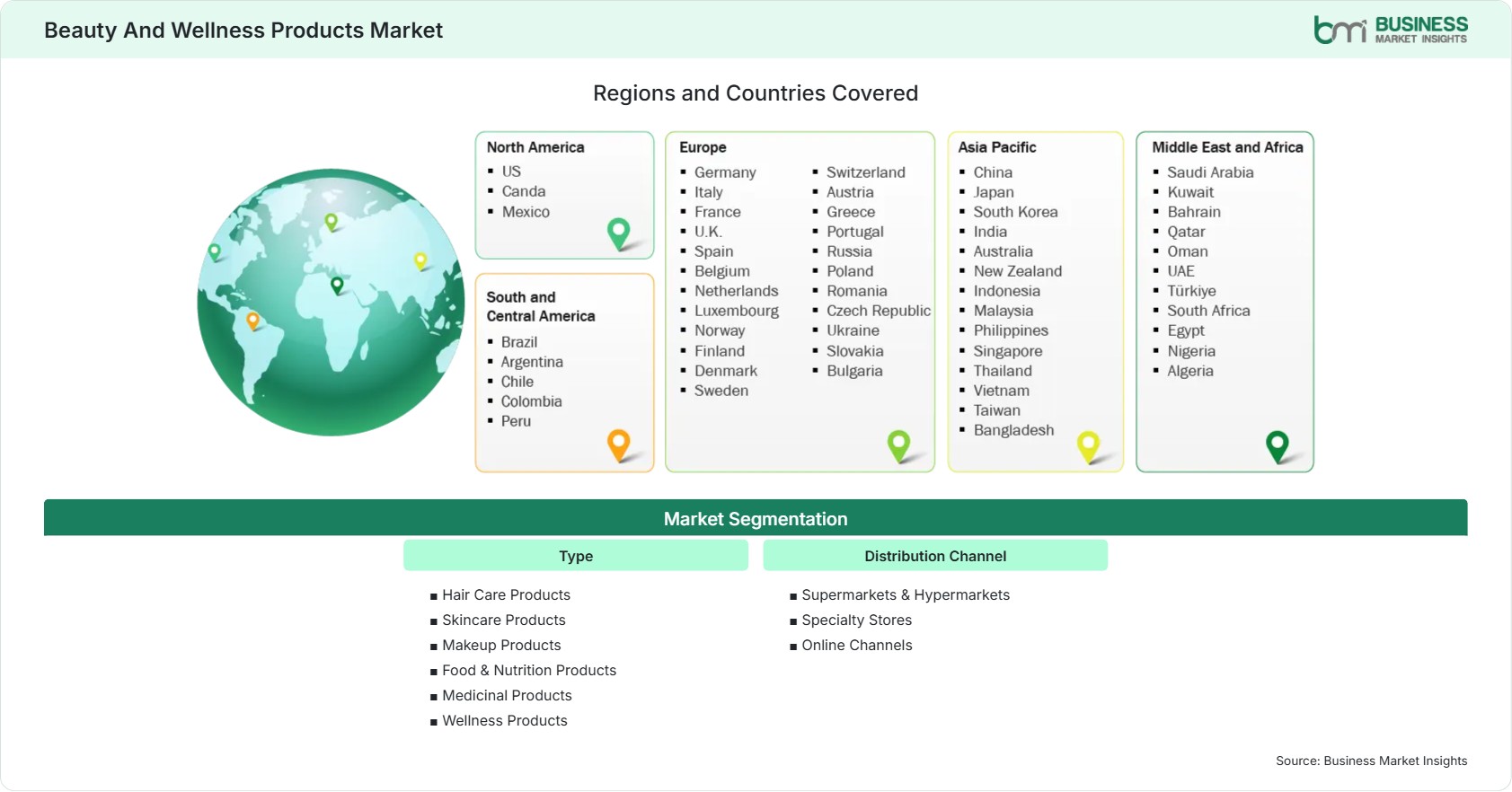
Global Market Geography
FREE PDF
Request your free sample
Request free sample
Segment Analysis

Beauty And Wellness Products Market Segmentation

Type

The Type segment holds around 74%-78% market share in 2025 and is expected to register a CAGR of 9.5%-10.2%. The Beauty and Wellness Products Market scope is expanding through premiumization, personalization, and wellness. Consumers are increasingly attracted to products that are scientifically proven and sustainable.

  • Hair Care Products: Demand benefits from scalp health awareness, premium ingredients, personalization trends, and innovation in damage repair, styling, and preventive care formulations.
  • Skincare Products: The largest product category, supported by anti-aging solutions, dermocosmetics adoption, ingredient transparency, and growing consumer focus on preventive skincare routines.
  • Makeup Products: Premium cosmetics, hybrid beauty solutions, and skin-friendly formulations drive adoption among digitally engaged consumers seeking enhanced performance and convenience.
  • Food & Nutrition Products: Beauty-from-within concepts and functional nutrition products gain popularity through preventive wellness positioning and healthy lifestyle integration.
  • Medicinal Products: Increasing consumer focus on self-care and preventive health supports demand for OTC wellness and therapeutic beauty-related offerings.
  • Wellness Products: Sleep support, stress management, fitness-oriented, and holistic wellness solutions continue experiencing strong consumer acceptance.

Distribution Channel

The distribution channels account for around 22%-26% of the share via digital channels and a 10.4%-11.2% CAGR in channel growth. The Beauty and Wellness Products Market trends point towards increasing adoption of an omnichannel approach, combining physical retailing with personalized digital touchpoints and convenience-oriented buying behavior.

  • Supermarkets & Hypermarkets: Large retail formats offer product accessibility, broad assortment selection, and promotional campaigns that support mass-market category growth.
  • Specialty Stores: Expert recommendations, premium product portfolios, and experiential retail environments support differentiation and consumer trust.
  • Online Channels: Strong growth reflects convenience, broader product access, subscription models, influencer marketing, and personalized recommendation capabilities.
Market Forces

Beauty And Wellness Products Market Dynamics

Key Market Drivers

Rising Consumer Focus on Preventive Wellness and Self-Care

Increasing recognition of healthy aging, prevention, and overall well-being is driving higher demand. Health promotion programs supported by the WHO and increased customer knowledge about nutrition, mental well-being, and the impact of lifestyle on one’s health are driving purchasing decisions. Beauty sections are currently converging with the supplementary and functional nutrition product lines and with wellness solutions. Consumers look for both effectiveness and truthfulness in claims about ingredients. High-end products geared towards sleep, stress, skincare, and healthy aging are in greater demand. The change in the structure of consumption opens up new addressable markets.

Digital Commerce and Personalized Consumer Engagement

The use of e-commerce sites, social commerce, and AI-powered recommendation engines is revolutionizing the way consumers discover and buy products. Businesses are using consumer data, online consultations, and diagnostics to enhance retention and conversion ratios. Skincare recommendations, health diagnostics, and subscription-based services create revenue-generating opportunities for businesses. Improved accessibility helps reach more customers in urban and semi-urban areas. With the rise of smartphone use and digital payments worldwide, companies have direct access to consumers without relying on conventional distribution channels.

Scientific Innovation and Clinical Validation

Advances in biotech, microbiology, dermatology, and active-ingredient formulation provide the basis for differentiation. There is a growing trend among consumers to choose products that have been proven effective through clinical testing. Studies on peptides, probiotics, collagen, and customized wellness options continue to grow. The regulatory requirement for substantiation also drives innovative development efforts. These trends help high-end brands justify their pricing and performance across skincare, nutrition, and wellness segments.

Key Market Opportunities

Expansion of Personalized Beauty and Wellness Platforms

The combination of AI diagnostics, wearable devices, health data, and personalized product suggestions represents a promising area for growth. Customers are becoming more demanding and expect personalized experiences rather than generic products. Businesses that invest in predictive analytics, customization, and engagement platforms will benefit from increased customer loyalty and repeat business. Personalization is expected to be an important factor for the Beauty and Wellness Products Market Forecasts. An increased willingness of customers to adopt wellness subscriptions and online consultations will provide additional value for the future. Cross-category personalization combining nutrition, skincare, and wellness programs offers additional monetization opportunities.

Growth Across Emerging Consumer Economies

Urbanization, rising disposable incomes, and modern retail in Asia, Latin America, and the Middle East create an environment of sustained demand growth. The younger population is more tech-savvy and eager to try premium products. Foreign enterprises are setting up manufacturing units locally, collaborating with distribution partners, and offering their portfolios tailored to different regions. Increased consciousness about wellness creates additional market segments to address. In emerging economies, one can find opportunities for both volume and premium growth product penetration among aspirational consumers.

Convergence of Beauty, Nutrition, and Health

Appearance, nutrition, and mental and physical well-being are becoming increasingly interlinked among consumers. This trend provides scope to develop products that are multifaceted in their applications and deliver multiple benefits to consumers. Products developed to help people look good from within, such as beverages, nutritional supplements, and holistic well-being brands, will remain investors' favorites. Companies that can leverage science, digital interaction, and lifestyle positioning have greater access to consumers' spending power. The convergence trend supports innovation, premium pricing, and portfolio diversification strategies.

Market Restraints and Challenges

Regulatory Complexity and Higher Compliance Costs

Factor: Diverse regulatory standards governing ingredients, claims substantiation, labeling, and product safety create operational complexity. Companies operating across multiple jurisdictions must maintain extensive compliance frameworks and testing requirements.

Impact: Higher regulatory costs may delay product launches and reduce flexibility for smaller market participants. Frequent updates to environmental, packaging, and health-claim regulations require continuous investment. The challenge is particularly significant for brands expanding internationally while maintaining product consistency and profitability. Additionally, non-compliance risks can lead to product recalls, financial penalties, reputational damage, and legal disputes. Companies must also invest in regulatory monitoring, documentation management, employee training, and third-party certifications to ensure ongoing adherence to evolving global standards and market requirements.

Supply Chain Volatility and Margin Pressure

Factor: Dependence on specialized ingredients, botanical extracts, packaging materials, and global sourcing networks creates exposure to disruption risks. Geopolitical uncertainty, logistics constraints, climate-related events, and commodity price fluctuations influence procurement costs.

Impact: Higher input expenses can compress margins and affect pricing competitiveness. Supply instability may also limit product availability, particularly for premium and natural formulations. Companies increasingly diversify suppliers and regional manufacturing networks to improve resilience, though such transitions require substantial investment. In addition, extended lead times, inventory shortages, currency exchange rate fluctuations, and evolving regulatory requirements can further increase operational complexity. These challenges may disrupt production schedules, delay product launches, reduce customer satisfaction, and necessitate higher safety stock levels, ultimately impacting overall profitability and growth.

Company Analysis

Competitive Landscape

The Beauty and Wellness Products Market analysis reflects competition driven by innovation, branding strength, digital capabilities, sustainability initiatives, and premium product development.

Company Name

Overview

Products and Services relevant to this market

L'Oréal S.A.

Global beauty leader with extensive consumer, luxury, professional, and dermatological portfolios.

Skincare, haircare, cosmetics, beauty technology, dermatological products, and personalized solutions.

The Estée Lauder Companies Inc.

Premium beauty company operating across skincare, makeup, fragrance, and haircare categories.

Prestige skincare, cosmetics, fragrances, wellness-aligned beauty solutions.

Unilever PLC

Consumer goods multinational with strong personal care and wellness presence globally.

Beauty products, personal care, wellness-oriented brands, and nutrition solutions.

Procter & Gamble Company

Major consumer goods manufacturer focused on innovation-led personal care segments.

Haircare, skincare, grooming, wellness-related personal care products.

Shiseido Company, Limited

Japanese beauty specialist emphasizing science and premium skincare innovation.

Skincare, cosmetics, wellness beauty products, and dermatological solutions.

Beiersdorf AG

International personal care company with strong skincare and wellness positioning.

Skincare, dermatological care, wellness-focused personal care products.

Natura & Co Holding S.A.

Sustainability-focused beauty group with global market presence.

Cosmetics, skincare, personal care, and wellness-related offerings.

Amorepacific Corporation

Leading Asian beauty innovator known for advanced skincare development.

Premium skincare, wellness beauty products, and cosmetics.

Kao Corporation

Consumer products company active in beauty, hygiene, and wellness categories.

Haircare, skincare, personal care, and wellness solutions.

Johnson & Johnson

Healthcare-oriented company participating through consumer health and skin health segments.

Skin health products, wellness solutions, and consumer healthcare offerings.

Trust & Transparency

Research Methodology

The market analysis combines proprietary research with secondary data from government agencies, company disclosures, regulatory filings, industry databases and expert interviews. Market estimates are validated through data triangulation, cross-market benchmarking and analyst review.

View Full Research Methodology

Questions Answered

Frequently Asked Questions

What does the Beauty and Wellness Products Market Report typically evaluate?

The Market Report generally assesses market size, segmentation, regional trends, competitive positioning, innovation pipelines, growth opportunities, and investment developments.

What role does e-commerce play in industry development?

E-commerce enables broader accessibility, direct consumer engagement, subscription services, personalized recommendations, and faster new-product commercialization across geographies.

Which product category leads revenue generation?

Skincare products remain the largest category, supported by anti-aging demand, dermocosmetics adoption, premiumization, and science-backed product innovation.

Which region offers the strongest growth potential?

Asia Pacific provides the strongest growth outlook due to rising incomes, expanding e-commerce ecosystems, and increasing wellness awareness among large consumer populations.

What factors are driving demand for beauty and wellness products?

Growing interest in preventive health, premium skincare, personalized solutions, wellness nutrition, and digital purchasing experiences are key demand drivers globally.

Access the Full Beauty And Wellness Products Market Report

Get segment-level forecasts, regional estimates, competitive benchmarking, company profiles and downloadable Excel datasets.

Access the full Beauty And Wellness Products Market Report
350 pages PDF & Excel | 2026-08-31