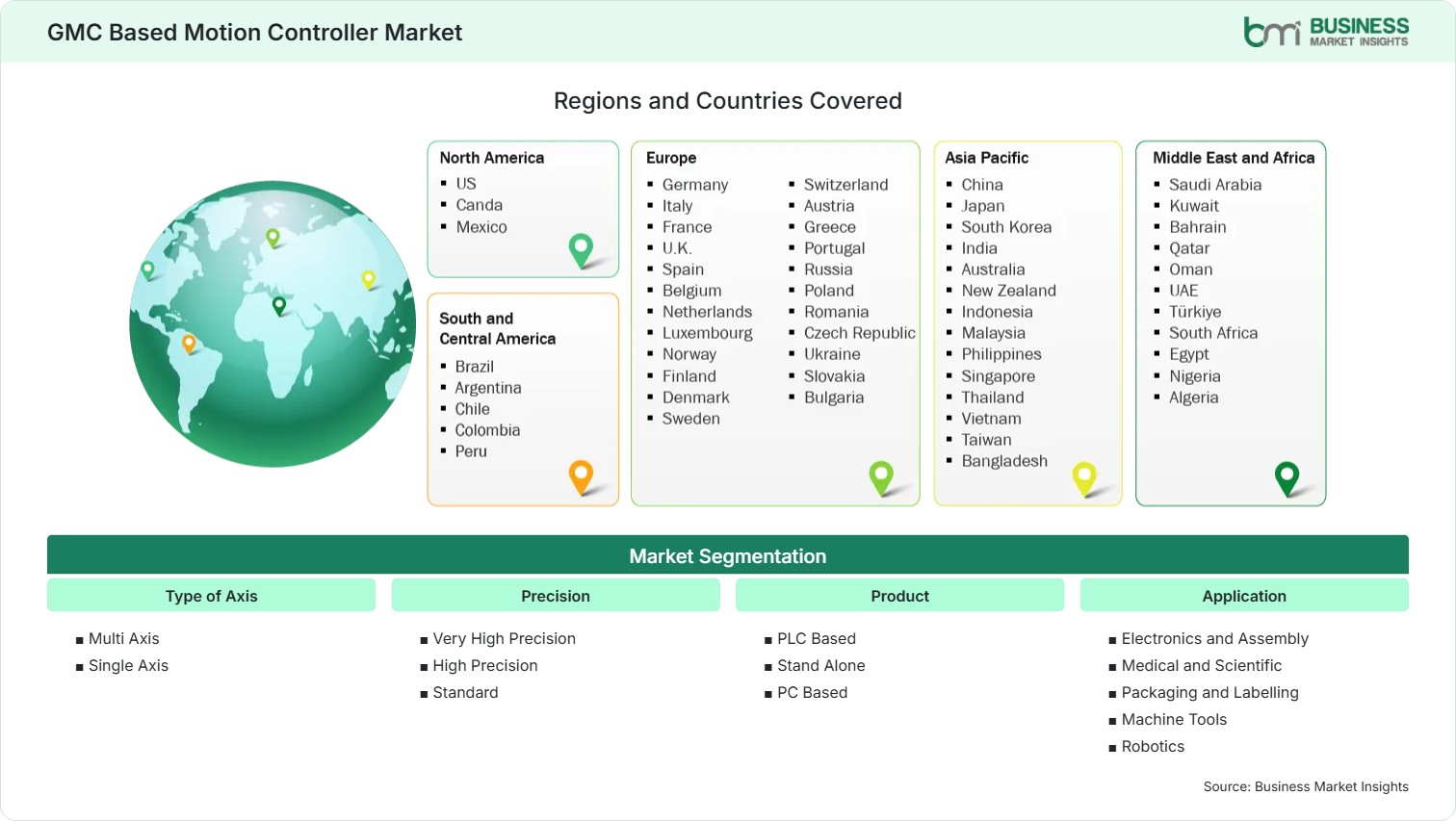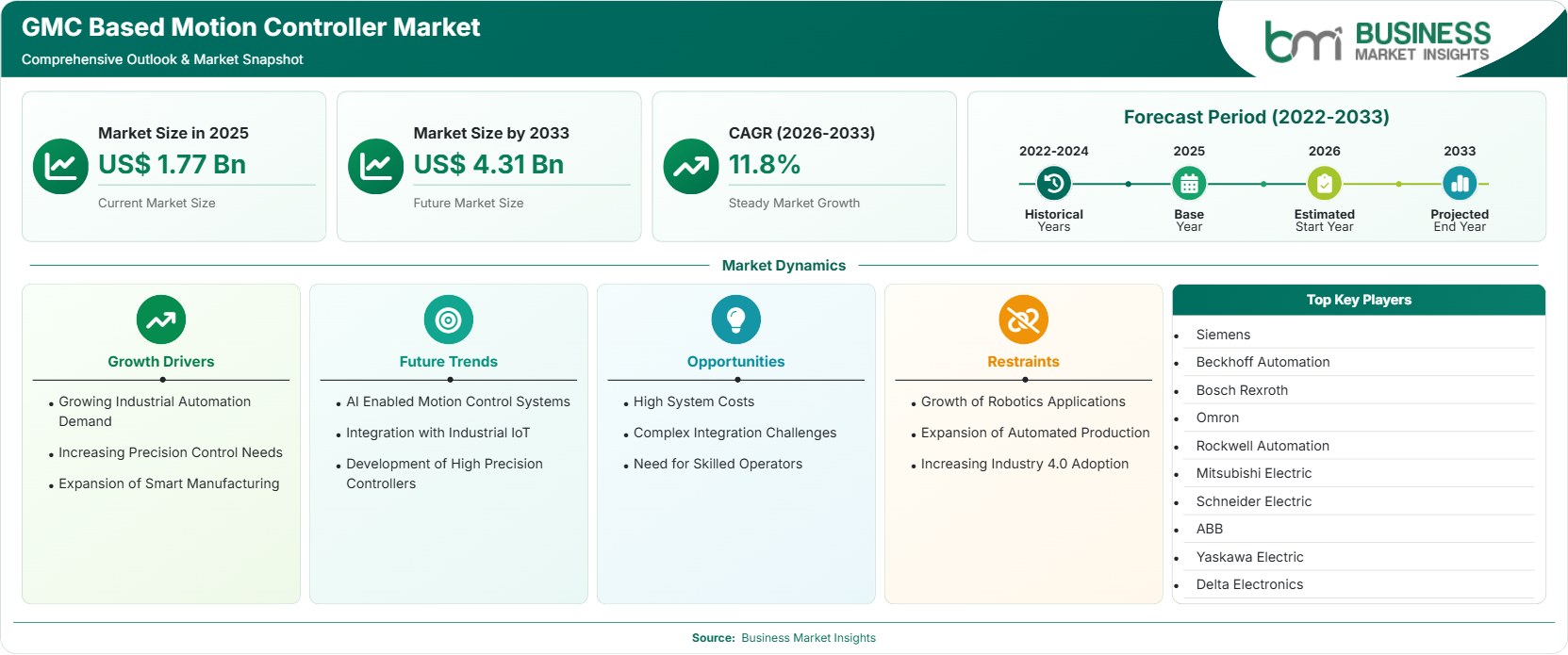
GMC Based Motion Controller Market Regional Highlights
North America GMC Based Motion Controller Market
North America accounts for 33%–36% of the GMC Based Motion Controller Market share in 2025 and is anticipated to register a CAGR of 10.6%–11.2% during 2026–2033. The region benefits from a mature industrial automation ecosystem, significant investments in advanced manufacturing, and strong demand from automotive, aerospace, semiconductor, and food processing industries. Increasing adoption of Industry 4.0 technologies and AI-enabled production systems continues strengthening demand for high-performance motion controllers across both greenfield and brownfield manufacturing facilities.
- Manufacturers continue replacing legacy motion control systems with Ethernet-based programmable controllers capable of supporting synchronized multi-machine operations, improving production flexibility, reducing downtime, and enhancing manufacturing efficiency across diverse industrial applications.
- Semiconductor fabrication investments across the United States and Canada are increasing demand for ultra-precise motion control solutions capable of maintaining positioning accuracy during high-speed wafer handling and automated inspection processes.
- Industrial robotics deployment continues accelerating across automotive and logistics sectors, encouraging manufacturers to integrate scalable motion controllers supporting predictive maintenance, machine diagnostics, and real-time operational monitoring.
- Strong investment in digital manufacturing technologies and cybersecurity frameworks enables enterprises to securely connect motion controllers with cloud platforms, industrial IoT infrastructure, and enterprise resource planning systems.
- Government incentives supporting domestic manufacturing expansion continue encouraging automation upgrades, increasing demand for flexible motion control architectures that improve productivity while reducing long-term operating costs.
US GMC Based Motion Controller Market
The United States represents the largest contributor within North America, accounting for 25%–28% of global revenue while expanding at a CAGR of 10.8%–11.4% through 2033. Continuous investments in semiconductor manufacturing, electric vehicle production, warehouse automation, and industrial robotics support sustained demand for intelligent motion control technologies capable of delivering precision, flexibility, and operational efficiency across advanced manufacturing environments.
- Automotive manufacturers are investing in intelligent assembly systems with synchronized multi-axis motion control to improve welding accuracy, material handling, and production efficiency.
- Expanding semiconductor manufacturing is increasing demand for precision motion controllers supporting high-speed wafer processing, inspection, and automated packaging.
- Logistics automation and warehouse robotics are driving adoption of AI-enabled controller platforms with machine vision and predictive maintenance capabilities.
- Industrial software modernization is accelerating deployment of interoperable motion control systems integrated with MES, ERP, and industrial cloud platforms.
Europe GMC Based Motion Controller Market
Europe accounts for 24%–27% of the GMC Based Motion Controller market share in 2025 and is projected to expand at a CAGR of 10.9%–11.6% during the forecast period. The region maintains strong demand through advanced automotive manufacturing, industrial machinery production, and widespread adoption of smart factory technologies. Germany leads regional revenue generation, while Poland emerges as the fastest-growing national market with a CAGR of 12.6%–13.3%, supported by expanding industrial investments and automation upgrades.
- Automotive manufacturers are increasingly deploying high-performance motion controllers for flexible manufacturing, collaborative robotics, and automated quality inspection.
- European machine tool manufacturers are integrating advanced controller technologies to improve machining precision, energy efficiency, and production reliability.
- Industrial sustainability initiatives are driving replacement of aging automation infrastructure with intelligent motion control systems that optimize energy use and reduce production waste.
- Growth in pharmaceutical and medical device manufacturing is increasing demand for precise, validated automation systems in regulated production environments.
- Small and medium-sized manufacturers are investing in scalable, modular motion control platforms that reduce implementation costs.
Asia Pacific GMC Based Motion Controller Market
Asia Pacific captures 30%–33% of global revenue in 2025 while registering the highest CAGR of 13.2%–13.9% through 2033. China remains the largest regional GMC Based Motion Controller market owing to its extensive manufacturing base, whereas India records the fastest growth with a CAGR of 14.2%–14.9% supported by industrial modernization, production-linked incentive programs, and accelerating investments in factory automation and electronics manufacturing.
- Government-backed smart manufacturing initiatives are accelerating deployment of intelligent motion control technologies across electronics, automotive, and heavy industrial facilities.
- Rising industrial robot adoption is driving implementation of synchronized multi-axis controller platforms for high-speed, precision-driven production.
- Expanding semiconductor and consumer electronics manufacturing is increasing demand for accurate motion control systems in automated assembly, inspection, and packaging.
- Growing electric vehicle manufacturing is boosting adoption of programmable motion controllers for battery production, automated welding, and precision assembly.
- Rapid industrial digitalization is integrating motion controllers with industrial IoT, AI, and cloud-based manufacturing platforms.
Rest of World GMC Based Motion Controller Market
The Rest of World region accounts for 10%–13% of global revenue in 2025 and is projected to expand at a CAGR of 11.5%–12.2% during 2026–2033. South & Central America continue experiencing increased manufacturing automation investments, while the Middle East and Africa benefit from industrial diversification initiatives, infrastructure development, and growing adoption of advanced manufacturing technologies.
Brazil dominates the demand in South & Central America due to its growing automobile and food processing industries. On the other hand, the UAE has the highest growth rate in the region, at 12.8%- 13.5%, driven by intelligent manufacturing programs, industrial diversification policies, and state-of-the-art manufacturing infrastructure.
- Manufacturing modernization programs encourage enterprises to replace conventional production equipment with intelligent automation systems that improve operational efficiency, product consistency, and equipment utilization.
- Governments continue supporting industrial diversification through investment incentives that accelerate deployment of advanced robotics, programmable automation, and digital manufacturing technologies.
- Expansion of food processing, packaging, and consumer goods manufacturing creates increasing demand for flexible motion control systems capable of supporting high-speed production environments.
- Industrial infrastructure development and growing foreign direct investment strengthen opportunities for automation technology providers seeking expansion across emerging manufacturing economies.
- Rising awareness of predictive maintenance and operational analytics encourages manufacturers to integrate intelligent controller platforms capable of supporting long-term production optimization and equipment reliability.