
Programmable Logic Controller Market Outlook: Size, Share, Trends, Growth Analysis, Competitive Landscape & Forecast, 2026-2033

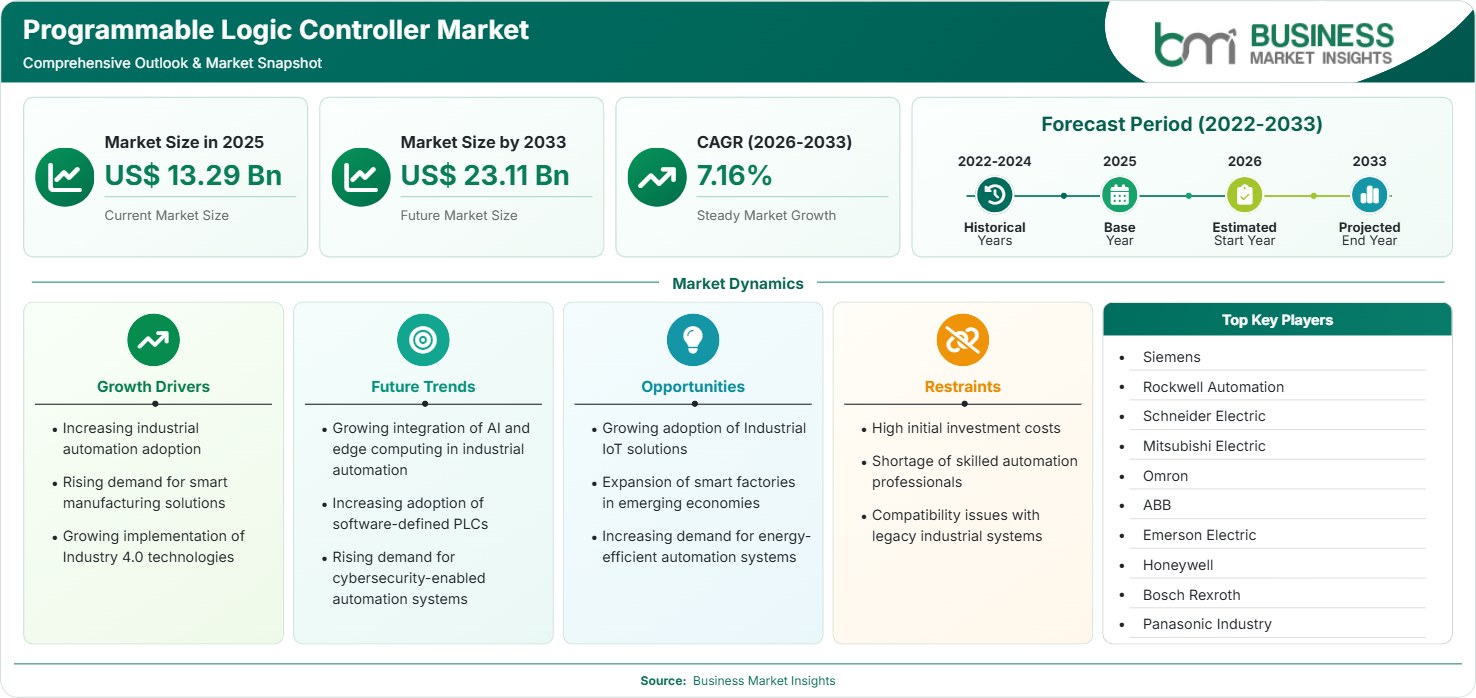
The Programmable Logic Controller Market size was valued at US$ 13.29 Billion in 2025 and is projected to reach US$ 23.11 Billion by 2033, growing at a CAGR of 7.16% during 2026–2033. Increasing industrial automation adoption, rising demand for smart manufacturing solutions, and growing implementation of Industry 4.0 technologies are accelerating adoption, while Industrial IoT integration, smart factory expansion, and energy-efficient automation systems create significant opportunities.

Report Coverage
  • Type: Modular, Rack Mounted, Compact
  • Component: Hardware, Software, Services
  • End-use Industry: Automotive, Food & Beverages, Energy & Utilities, Pharmaceuticals, Others
US$ 13.29 Bn Market size in 2025
US$ 23.11 Bn Market Size by 2033
7.16% CAGR, 2026 - 2033
2026-2033 Forecast Period

AI Overview

Programmable Logic Controller Market Summary

  • North America Region: North America holds a 30%–33% market share in 2025, growing at a 6.5%–7.2% CAGR during 2026–2033. Advanced manufacturing facilities, automation upgrades, industrial digitalization, and demand for connected production systems are supporting regional expansion. The US market maintains leadership through automotive, semiconductor, and pharmaceutical automation investments, recording a 6.7%–7.3% CAGR during 2026–2033.
  • Fastest Growing Region: Asia Pacific represents a 34%–37% market share in 2025 and is expanding at a 7.8%–8.5% CAGR through 2033. Manufacturing expansion, smart factory investments, industrial modernization programs, and increasing Industry 4.0 adoption are driving PLC deployment across emerging economies.
  • Leading Segment: Modular PLC systems account for a 42%–45% market share in 2025 and are projected to grow at a 7.3%–7.9% CAGR during 2026–2033. Scalability, flexibility, processing capability, and suitability for complex automation applications are strengthening adoption across large industrial facilities.
  • High Growth Segment: Software components hold a 22%–25% market share in 2025 and are expected to expand at an 8.0%–8.6% CAGR during 2026–2033. Industrial analytics, remote monitoring, predictive maintenance, and digital automation platforms are increasing demand for advanced PLC software capabilities.
  • Key Market Opportunity: Industrial IoT integration, smart factory development, and energy-efficient automation solutions create opportunities for PLC providers to deliver connected control systems supporting productivity improvement, predictive maintenance, operational visibility, and sustainable manufacturing.
  • Major Market Players: Siemens, Rockwell Automation, Schneider Electric, Mitsubishi Electric, Omron, ABB, Emerson Electric, Honeywell, Bosch Rexroth, Panasonic Industry.
Strategic Insights

Programmable Logic Controller Market: Strategic Insights

Programmable Logic Controller Market Strategic Framework
FREE PDF
Request your free sample
Request free sample
Stakeholder View

Key Takeaways

  • The industrial automation value chain is shifting toward connected control ecosystems where PLC providers collaborate with robotics companies, sensor manufacturers, software developers, and Industrial IoT specialists to deliver integrated manufacturing solutions.
  • Modular PLC architecture provides strong expansion opportunities because manufacturers increasingly require flexible automation systems capable of supporting production changes, equipment upgrades, and complex industrial applications.
  • Software-driven automation is becoming a key innovation area as PLC vendors invest in programming platforms, digital twins, analytics integration, remote diagnostics, and cybersecurity capabilities.
  • Asia Pacific offers strong investment potential due to manufacturing expansion, increasing automation adoption, government-supported industrial modernization, and rapid development of smart factory infrastructure across emerging economies.
  • Strategic partnerships and technology collaborations are increasing as automation companies combine PLC expertise with industrial software, robotics integration, and data-driven solutions to strengthen competitive positioning.
  • Energy-efficient automation is gaining importance as industries focus on reducing operational costs, improving resource utilization, and achieving sustainability targets through intelligent production management.
Geographic Outlook

Programmable Logic Controller Market Regional Highlights

North America Programmable Logic Controller Market

North America accounted for 30%–33% of the Programmable Logic Controller Market share in 2025 and is projected to expand at a 6.5%–7.2% CAGR from 2026–2033. The region benefits from established industrial automation infrastructure, advanced manufacturing capabilities, and increasing investments in connected production systems. The United States remains the largest contributor, supported by automotive, semiconductor, pharmaceutical, and energy industries adopting modern automation solutions. Growing demand for smart manufacturing and operational efficiency continues supporting PLC deployment across industrial facilities.

  • Automotive manufacturers are upgrading production lines with advanced PLC systems, robotics integration, and automated quality monitoring technologies to improve manufacturing precision, productivity, and operational consistency.
  • Industrial companies are investing in connected control systems that enable real-time equipment monitoring, predictive maintenance, and improved production visibility across manufacturing environments.
  • Energy and utility operators are adopting automation technologies to enhance infrastructure management, improve reliability, and optimize industrial processes through advanced control capabilities.
  • Pharmaceutical manufacturers are implementing PLC-based automation solutions to support precise production control, regulatory compliance, and consistent quality management throughout manufacturing operations.

US Programmable Logic Controller Market

The United States represented approximately 26%–29% of the Programmable Logic Controller Market in 2025 and is expected to grow at a 6.7%–7.3% CAGR between 2026–2033. The country maintains a strong position due to advanced manufacturing infrastructure, industrial modernization initiatives, and increasing adoption of Industry 4.0 technologies. Demand is rising across automotive, aerospace, semiconductor, pharmaceutical, and energy sectors as enterprises focus on improving automation efficiency and reducing production complexity.

  • Manufacturers are modernizing existing facilities with intelligent PLC platforms to improve operational flexibility, automate repetitive processes, and enhance production performance.
  • Semiconductor and electronics industries are increasing automation investments to support precision manufacturing requirements and improve process control capabilities.
  • Industrial cybersecurity requirements are encouraging enterprises to adopt PLC solutions with improved communication security and advanced monitoring features.
  • Smart factory initiatives are increasing demand for integrated automation systems connecting machines, sensors, and enterprise software platforms.

Europe Programmable Logic Controller Market

Europe accounted for 24%–27% of the Programmable Logic Controller Market in 2025 and is projected to register a 6.8%–7.5% CAGR during 2026–2033. Germany remains the leading regional market due to its strong industrial automation ecosystem and engineering capabilities, while France and Italy demonstrate steady adoption across manufacturing sectors. The region emphasizes energy-efficient production, industrial sustainability, and digital transformation, encouraging companies to implement advanced PLC solutions for automated and connected manufacturing environments.

  • Germany leads PLC adoption through advanced manufacturing operations, industrial engineering expertise, and widespread implementation of smart factory technologies.
  • Automotive companies across Europe are deploying automation solutions to support electric vehicle production, flexible manufacturing, and highly automated assembly processes.
  • Food and beverage manufacturers are adopting PLC systems to improve production efficiency, quality monitoring, and compliance with safety requirements.
  • Sustainability initiatives are increasing demand for automation systems that optimize energy usage and reduce manufacturing resource consumption.
  • Digital transformation programs are encouraging industries to integrate PLC systems with industrial software, analytics platforms, and connected production networks.

Asia Pacific Programmable Logic Controller Market

Asia Pacific held the largest regional share of 34%–37% in the Programmable Logic Controller Market during 2025 and is forecast to expand at the fastest pace with a 7.8%–8.5% CAGR through 2033. Manufacturing growth, industrial automation adoption, and smart factory investments are driving demand across China, Japan, India, and Southeast Asia. China remains the largest market, while India represents a high-growth opportunity due to manufacturing expansion, infrastructure development, and digital industrial transformation initiatives.

  • China’s manufacturing sector continues investing in automation technologies to improve production efficiency, product quality, and global competitiveness.
  • India’s industrial development programs are increasing PLC adoption across automotive, pharmaceuticals, food processing, and infrastructure-related manufacturing applications.
  • Japan continues advancing automation deployment through robotics integration, precision engineering, and sophisticated industrial control systems.
  • Southeast Asian economies are attracting manufacturing investments, increasing demand for scalable automation platforms supporting new production facilities.
  • Smart factory development across Asia Pacific is accelerating adoption of connected PLC systems integrated with Industrial IoT technologies.

Rest of World Programmable Logic Controller Market

The Rest of World region accounted for 8%–11% of the Programmable Logic Controller Market share in 2025 and is expected to grow at a 6.5%–7.4% CAGR during 2026–2033. Latin America, the Middle East, and Africa are witnessing increased automation investments due to manufacturing modernization, infrastructure expansion, and industrial diversification strategies. Brazil, Mexico, Saudi Arabia, and the UAE represent important markets as industries adopt automation technologies to improve efficiency and operational reliability.

  • Latin American manufacturers are implementing PLC systems to modernize production facilities and improve competitiveness within global supply chains.
  • Middle Eastern industries are investing in automation technologies to support manufacturing diversification, energy optimization, and industrial infrastructure development.
  • Mining companies are adopting PLC-based control systems to improve operational monitoring, equipment management, and workplace safety.
  • Renewable energy projects are creating demand for automation solutions supporting efficient power generation and infrastructure management.
  • Industrial development initiatives across emerging markets are encouraging adoption of connected automation platforms and modern control technologies.
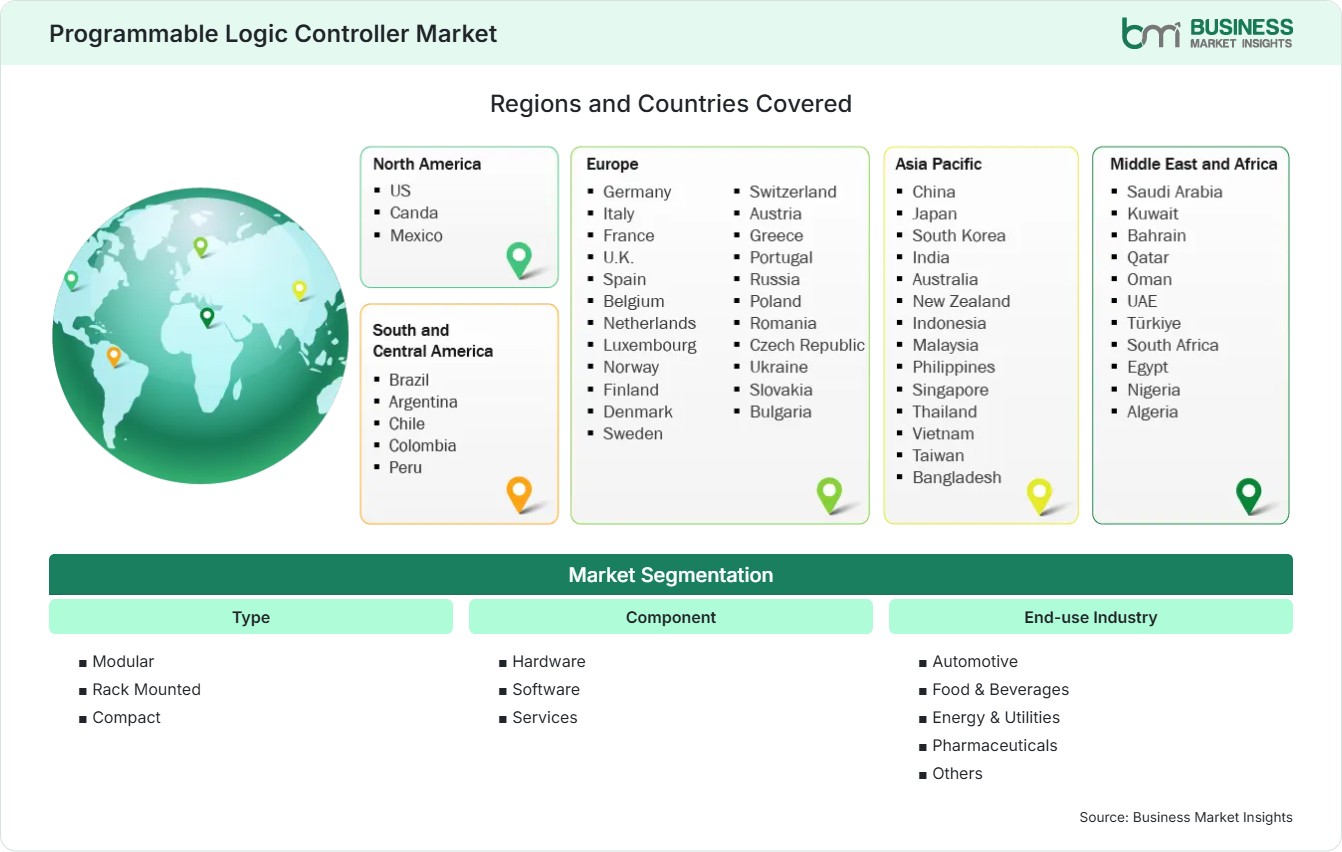
Global Market Geography
FREE PDF
Request your free sample
Request free sample
Segment Analysis

Programmable Logic Controller Market Segmentation

Type

The type segment includes Modular, Rack Mounted, and Compact PLC systems, each addressing different industrial automation requirements based on scalability, processing capacity, and application complexity. The segment accounted for the complete Programmable Logic Controller Market structure in 2025, with Modular systems representing 42%–45% share and expanding at a 7.3%–7.9% CAGR during 2026–2033. Increasing demand for flexible manufacturing, scalable automation infrastructure, and connected production systems is supporting adoption across automotive, energy, pharmaceutical, and process industries.

  • Modular: Modular PLC systems provide expandable architectures, enhanced processing capabilities, and flexible configurations, making them suitable for complex industrial automation applications requiring future upgrades and customization.
  • Rack Mounted: Rack Mounted PLC solutions support large-scale industrial operations requiring centralized control, extensive input-output capacity, reliable communication, and integration with advanced manufacturing environments.
  • Compact: Compact PLC systems are preferred for smaller machines and applications requiring space efficiency, simplified installation, cost advantages, and reliable automation control within limited operational environments.

Component

The Component segment includes Hardware, Software, and Services, representing essential elements required for PLC installation, operation, programming, and lifecycle management. Hardware remained the leading component with a 58%–62% share in 2025 and is projected to grow at a 6.6%–7.3% CAGR during 2026–2033 due to continuous demand for industrial controllers, communication modules, and automation equipment. Software is emerging as the fastest-growing category, supported by digitalization, analytics integration, Industrial IoT connectivity, and intelligent automation requirements across manufacturing environments.

  • Hardware: Hardware components form the foundation of automation systems, including processors, input-output modules, communication interfaces, and industrial controllers required for reliable production operations.
  • Software: Software solutions enable advanced PLC programming, system simulation, data analytics, remote monitoring, and integration with digital manufacturing platforms supporting intelligent automation.
  • Services: Services include installation, maintenance, consulting, training, and system upgrades that help industries optimize PLC performance and extend automation infrastructure lifecycle value.

End-use Industry

The End-use Industry segment includes Automotive, Food & Beverages, Energy & Utilities, Pharmaceuticals, and Others, reflecting diverse industrial applications of PLC technology. Automotive represented the leading end-use industry with a 28%–32% share in 2025 and is expected to grow at a 7.2%–7.8% CAGR during 2026–2033 due to increasing robotics adoption, automated assembly processes, and smart manufacturing investments. Growing automation requirements across food processing, energy infrastructure, and pharmaceutical production are further supporting PLC adoption.

  • Automotive: Automotive manufacturers utilize PLC systems for robotic assembly, automated production lines, quality monitoring, and flexible manufacturing processes supporting efficient vehicle production.
  • Food & Beverages: Food and beverage industries implement PLC solutions for automated processing, packaging control, production monitoring, and compliance with strict safety and quality standards.
  • Energy & Utilities: Energy and utility operators adopt PLC technologies for infrastructure automation, process monitoring, power management, and improved operational reliability across facilities.
  • Pharmaceuticals: Pharmaceutical companies deploy PLC systems for precise manufacturing control, automated processing, validation requirements, and consistent production quality management.
Market Forces

Programmable Logic Controller Market Dynamics

Key Market Drivers

Increasing Industrial Automation Adoption

Industrial automation adoption remains a primary factor supporting the expansion of the market as manufacturers prioritize productivity improvement, operational reliability, and reduced production complexity. Automotive, pharmaceutical, food processing, and energy industries are increasingly replacing conventional control approaches with automated systems capable of managing sophisticated production environments. Rising demand for manufacturing efficiency, workforce optimization, and consistent product quality is encouraging investment in PLC-based control infrastructure. The Programmable Logic Controller Market growth is further supported by integration with robotics, industrial sensors, and communication networks that enable precise process control and improved operational performance.

Rising Demand for Smart Manufacturing Solutions

The increasing adoption of smart manufacturing solutions is accelerating demand for advanced PLC platforms capable of connecting machines, production systems, and enterprise-level applications. Manufacturers are focusing on real-time monitoring, predictive maintenance, flexible production, and improved resource utilization to remain competitive. Modern PLC systems provide essential control capabilities required for connected factories by enabling communication between industrial equipment and digital platforms. Enterprises are upgrading legacy automation infrastructure to support higher visibility, faster decision-making, and optimized production workflows. The Programmable Logic Controller Market trends indicate growing preference for intelligent automation systems that combine hardware reliability with software-driven industrial capabilities.

Growing Implementation of Industry 4.0 Technologies

The adoption of Industry 4.0 is revolutionizing industrial practices, increasing the need for PLCs with greater connectivity and cybersecurity capabilities. Manufacturers are adopting IoT networks, edge computing, and smart sensors to create a connected manufacturing environment. PLC systems are transcending the boundaries of conventional machinery control roles into intelligent automation devices capable of handling data exchange in real time and optimizing operations. Digital twin technology, remote monitoring, and cloud industrial platforms are leading to the adoption of PLCs in other manufacturing industries. Such developments are driving organizations to upgrade their automation systems with new programmable control systems.

Key Market Opportunities

Growing Adoption of Industrial IoT Solutions

The use of industrial IoT presents a huge opportunity for PLC providers as more industries need to adopt automated systems that can offer real-time information on their operations. The firms are adopting sensors and cloud technology that helps in the analysis of machines and enhances efficiency in their operations. PLC systems with enhanced communication features allow the interconnection between the machines and software. IoT-enabled controllers could help satisfy the need for predictive maintenance, remote diagnosis, and smart factory operations. The growth of interconnected industrial ecosystems creates new opportunities for automation vendors to sell integrated hardware and software solutions as part of their digital transformation strategy.

Expansion of Smart Factories in Emerging Economies

There are new possibilities for growth because the emergence of smart factories in developing economies will enable manufacturers to automate their infrastructures to enhance their production processes. Emerging countries in the Asia Pacific, Latin America, and the Middle East have been ramping up industrial investment, production capacity, and digitization efforts. Automated control systems are increasingly common in new production plants during the early stages of planning and development, thereby driving demand for sophisticated PLC solutions. Providers offering scalable and cost-effective PLC solutions are positioned to benefit from rising demand among manufacturers developing digitally enabled production environments, as supported by programmable logic controller market forecasts.

Increasing Demand for Energy-efficient Automation Systems

The growing need for sustainable manufacturing has increased demand for efficient automated systems to optimize resource consumption. The PLC system enables firms to measure the performance of the machines, control their operation, and increase energy efficiency. Increasing cost of energy and sustainability goals are motivating businesses to use automated technology that will minimize wastage and increase efficiency. Providers who combine energy management functionality, analytics and control algorithms can help organizations implement environment-friendly production processes. This is especially pertinent to energy intensive businesses where increasing productivity and minimizing environmental footprint are two sides of the same coin.

Market Restraints and Challenges

High Initial Investment Costs

Factor: High upfront investment requirements associated with PLC hardware, automation software, industrial networking infrastructure, engineering services, and system integration create challenges for organizations with limited capital availability. Impact: Small and medium-sized enterprises may delay automation upgrades or continue using traditional control systems, restricting adoption in certain industrial segments. The adoption of advanced PLCs may require additional investment to train the workforce, perform maintenance, and modernize infrastructure. Even though automation offers future gains to productivity, it is still an important aspect to consider when adopting digital transformation initiatives.

Shortage of Skilled Automation Professionals

Factor: Limited availability of professionals with expertise in PLC programming, industrial communication networks, cybersecurity, and automation system integration affects implementation efficiency. Impact: Companies may experience longer deployment timelines, increased reliance on external specialists, and operational difficulties when managing advanced automation environments. With the increase in connectivity and software-based operations in PLC systems, there will be a demand for people capable of setting up and managing complex automation systems. The shortage of experienced automation workers will slow technology adoption, especially in firms moving away from traditional production processes.

Company Analysis

Competitive Landscape

The Programmable Logic Controller Market analysis highlights a competitive industrial automation ecosystem driven by global automation companies offering programmable controllers, engineering software, industrial communication solutions, and lifecycle support services. Market participants are increasingly focusing on integrated automation platforms that combine PLC hardware with Industrial IoT connectivity, cybersecurity, analytics, robotics integration, and digital manufacturing capabilities. Competitive differentiation is shifting from standalone controllers toward complete automation ecosystems that support smart factories, flexible production, and efficient industrial operations.

Company Name

Overview

Products and Services relevant to this market

Siemens

Global industrial technology company providing automation and digitalization solutions across manufacturing industries.

SIMATIC PLC systems, automation software, industrial communication platforms, engineering tools, and digital factory solutions.

Rockwell Automation

Industrial automation company specializing in control systems and connected manufacturing technologies.

Allen-Bradley PLCs, programmable automation controllers, industrial software, control platforms, and automation services.

Schneider Electric

Energy management and automation provider supporting industrial digital transformation worldwide.

Modicon PLCs, EcoStruxure automation platforms, industrial control systems, software, and lifecycle services.

Mitsubishi Electric

Technology company delivering factory automation solutions for industrial applications globally.

MELSEC PLC systems, industrial controllers, motion control solutions, automation components, and engineering software.

Omron

Automation technology provider focused on industrial control, sensing, and manufacturing innovation.

PLC controllers, machine automation systems, industrial sensors, control software, and integrated automation solutions.

ABB

Industrial technology company providing electrification, automation, and digital industrial solutions.

AC500 PLC systems, automation platforms, industrial control solutions, and process automation technologies.

Emerson Electric

Automation and engineering company serving process industries and industrial operations.

Programmable automation controllers, industrial control systems, automation software, and engineering services.

Honeywell

Technology provider delivering industrial automation and control solutions across multiple sectors.

Industrial controllers, process automation systems, control software, and connected automation technologies.

Bosch Rexroth

Industrial automation company specializing in drive, control, and manufacturing technologies.

PLC-based automation solutions, motion control systems, industrial software, and production technologies.

Panasonic Industry

Industrial technology provider offering automation components and manufacturing solutions.

PLC controllers, factory automation products, industrial control components, and automation technologies.

Trust & Transparency

Research Methodology

The market analysis combines proprietary research with secondary data from government agencies, company disclosures, regulatory filings, industry databases and expert interviews. Market estimates are validated through data triangulation, cross-market benchmarking and analyst review.

View Full Research Methodology

Questions Answered

Frequently Asked Questions

What challenges affect PLC adoption among industries?

High initial investment costs, shortage of skilled automation professionals, integration complexity, and cybersecurity requirements remain major challenges affecting PLC deployment across industrial environments.

Why is the Programmable Logic Controller Market Report important for stakeholders?

The report provides insights into technology trends, competitive positioning, adoption patterns, investment opportunities, and evolving automation requirements across industrial sectors.

How is Industry 4.0 influencing PLC technology development?

Industry 4.0 is encouraging PLC manufacturers to integrate advanced connectivity, cybersecurity features, analytics capabilities, and Industrial IoT compatibility into modern automation platforms.

Which PLC type is expected to maintain strong adoption?

Modular PLC systems are expected to maintain strong adoption because they provide scalability, flexibility, higher processing capabilities, and suitability for complex industrial automation applications.

What factors are driving the Programmable Logic Controller Market growth?

The market is driven by increasing industrial automation adoption, smart manufacturing implementation, Industry 4.0 transformation, Industrial IoT integration, and rising demand for efficient production control systems.

Access the Full Programmable Logic Controller Market Report

Get segment-level forecasts, regional estimates, competitive benchmarking, company profiles and downloadable Excel datasets.

Access the full Programmable Logic Controller Market Report
350 pages PDF & Excel | 2026-08-06
Similar Research

Related Market Reports