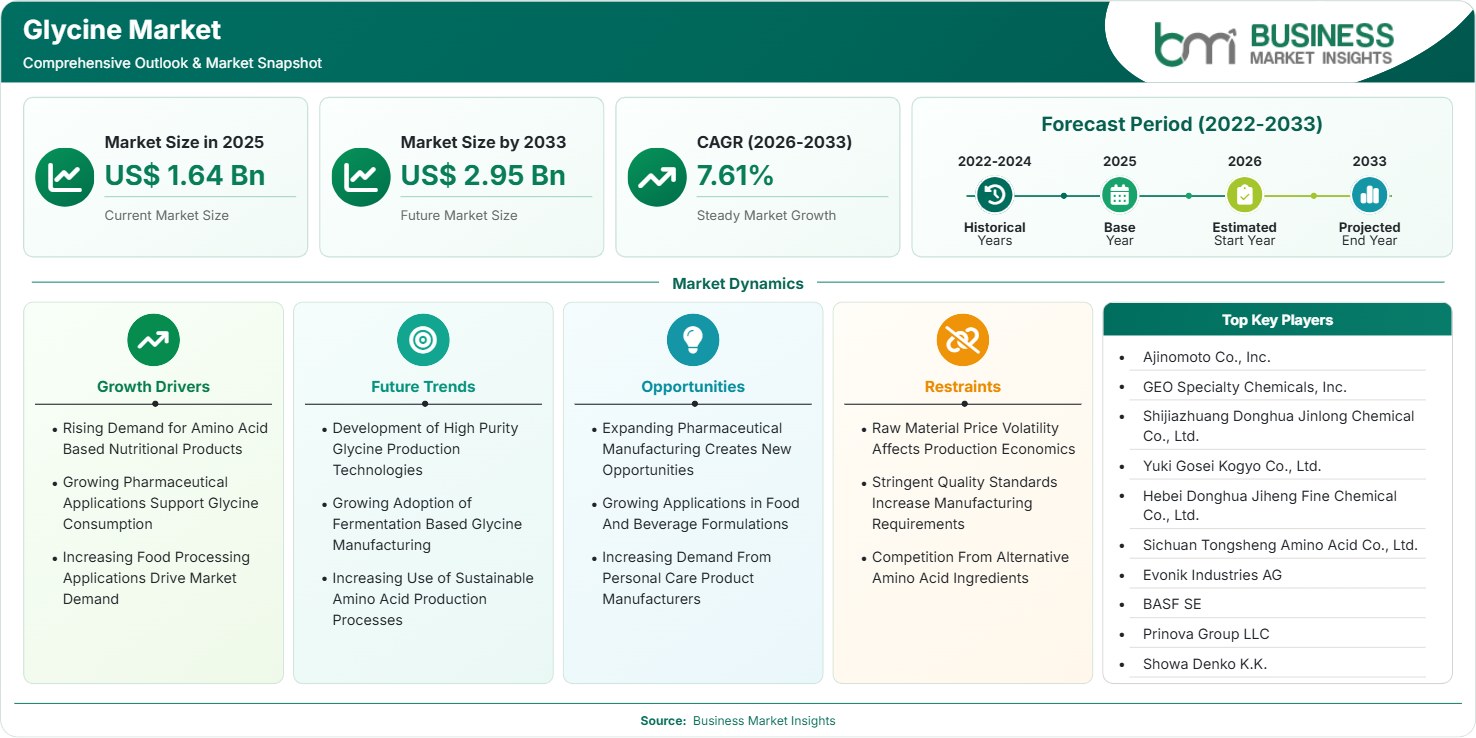
Key Market Drivers
Rising Demand for Amino Acid Based Nutritional Products
Glycine's role in nutritional formulations supports demand across food, feed, and specialized wellness products. Its functional characteristics allow formulators to use it as an ingredient alongside other amino acids and nutritional components. Increasing attention to protein quality and functional nutrition is broadening the range of products that incorporate amino acid ingredients. Demand also benefits from glycine's established use in animal nutrition, where formulation economics and nutritional performance influence purchasing decisions. Producers are responding by emphasizing consistent purity, particle characteristics, and reliable supply. The Glycine Market growth therefore reflects both conventional nutritional applications and the gradual diversification of amino acid-based formulations. Suppliers with flexible grades and strong quality systems can serve multiple nutritional customer groups while reducing dependence on a narrow application base.
Growing Pharmaceutical Applications Support Glycine Consumption
Pharmaceutical applications require controlled specifications and reliable batch consistency, making glycine an important input for selected formulations and manufacturing processes. Higher-purity products can command differentiated positioning because customers require tighter control of impurities and supporting documentation. Pharmaceutical manufacturing expansion in Asia Pacific and other emerging production centers is widening the customer base for quality-sensitive glycine. Contract manufacturing and formulation development also create recurring requirements for qualified raw materials. The Glycine Market trend toward higher-value applications encourages suppliers to invest in purification, testing, documentation, and customer qualification. These capabilities can create stronger relationships with regulated users while reducing exposure to purely commodity-oriented pricing. As pharmaceutical supply chains diversify geographically, reliable local and regional sourcing can become increasingly important.
Increasing Food Processing Applications Drive Market Demand
Some of the functions that are provided by glycine in food processing include taste modulation, buffering, stability, and formulation as a source of nutrition. Glycine’s versatility gives food producers the option of using the ingredient in various products without depending on one particular food application. Increased production of processed foods and functional formulations will favor the repeated usage of the ingredient, especially when producers need an ingredient that fulfills various functions within the formulation. Food applications still matter in this case, owing to the requirement for consistent purity and adherence to regulations. Hence, suppliers can distinguish themselves through the quality of grade, paperwork, packaging, and reliability in deliveries. Growing capabilities in food processing in the Asia Pacific and developing nations should ensure sustained demand for the ingredient. In addition, the diversity in food uses ensures that the company is resilient to changes in consumer tastes and formulating techniques for each product category.
Key Market Opportunities
Expanding Pharmaceutical Manufacturing Creates New Opportunities
Expansion of pharmaceutical manufacturing creates opportunities for suppliers capable of meeting higher purity, traceability, and documentation requirements. Emerging production centers are increasing their need for qualified raw materials as formulation and contract manufacturing activities broaden. Suppliers can capture value by developing dedicated pharmaceutical-grade portfolios, strengthening quality-control systems, and supporting customer qualification processes. This approach can reduce exposure to commodity pricing while creating relationships with customers that prioritize consistency over the lowest purchase price. Regional manufacturing expansion also encourages localized distribution and inventory strategies. The Glycine Market forecast therefore benefits from the movement toward specialized grades and dependable supply arrangements. Producers that can combine manufacturing scale with rigorous quality management are better positioned to address pharmaceutical demand across established and emerging manufacturing clusters.
Growing Applications in Food and Beverage Formulations
Food and beverage processors present a promising route for expanding operations because glycine is able to play a number of roles in formulation. These may include applications in nutritional drinks, food products, flavoring systems, and unique formulations that rely on buffers or taste profiles. Producers have the chance of growing by assisting with customized formulations and suitable packaging. The diversity inherent in food processing will create chances to reach out to regional small-scale manufacturers through distributors and technical support. In an environment where product developers are looking for ingredients that serve multiple purposes, glycine will be able to compete through functionality rather than being limited to its role as just an amino acid. Such an environment creates a competitive edge for producers who offer food-grade quality in a reliable and flexible way. The demand coming from the food industry production sector can add to the customer diversity.
Increasing Demand From Personal Care Product Manufacturers
This presents a particular niche since many formulators are evaluating multi-purpose ingredients that can add value through stability, conditioning, and overall formulation performance. Glycine can find use in certain cosmetics and personal care formulations when chemically viable. Suppliers can create more valuable propositions by offering consistency in specifications, the right particle size, and formulation support. Cosmetics are also a means for diversifying the customer base, away from pharmaceuticals and food, where the supply cycles are dependent on individual customers. Further penetration can be sought with the growing manufacture of personal care products in the Asia Pacific, Latin America, and other emerging markets. Businesses that make connections with formulation developers and specialty ingredient suppliers can gain better insight into new applications and tailor their products according to changing formulation needs.
Market Restraints and Challenges
Raw Material Price Volatility Affects Production Economics
Factor: Glycine manufacturing economics are influenced by upstream feedstocks, utilities, energy, transportation, and chemical inputs, creating exposure to cost fluctuations across the supply chain. Impact: volatile input costs can compress producer margins, complicate contract pricing, and create uncertainty for downstream customers managing annual procurement budgets. Producers may need to optimize sourcing, inventory, production scheduling, and customer agreements to protect profitability. Large manufacturers can have greater flexibility because of purchasing scale and diversified supply relationships, while smaller producers may experience stronger cost pressure. Buyers can also respond by diversifying suppliers or negotiating longer-term arrangements. Production efficiency remains important because incremental improvements in yield, purification, energy consumption, and logistics can partly offset unfavorable upstream movements and support more predictable commercial performance.
Stringent Quality Standards Increase Manufacturing Requirements
Factor: Food, pharmaceutical, and specialized applications require controlled purity, impurity limits, documentation, testing, and traceability that vary according to intended use and market requirements. Impact: compliance increases production complexity, analytical testing needs, qualification timelines, and operating costs, particularly for higher-purity grades. Technical-grade products generally face less demanding specifications than food or pharmaceutical grades, creating clear differences in manufacturing economics. Suppliers targeting regulated customers must maintain appropriate quality systems and demonstrate consistent batch performance. Additional controls can raise barriers to entry but also create differentiation for established producers. Companies seeking international expansion may need to manage multiple customer and regulatory specifications simultaneously. This environment favors manufacturers with strong process control, laboratory capabilities, documentation systems, and established quality-management practices.