
Nanotextiles Market Outlook: Size, Share, Trends, Growth Analysis, Competitive Landscape & Forecast, 2026–2033

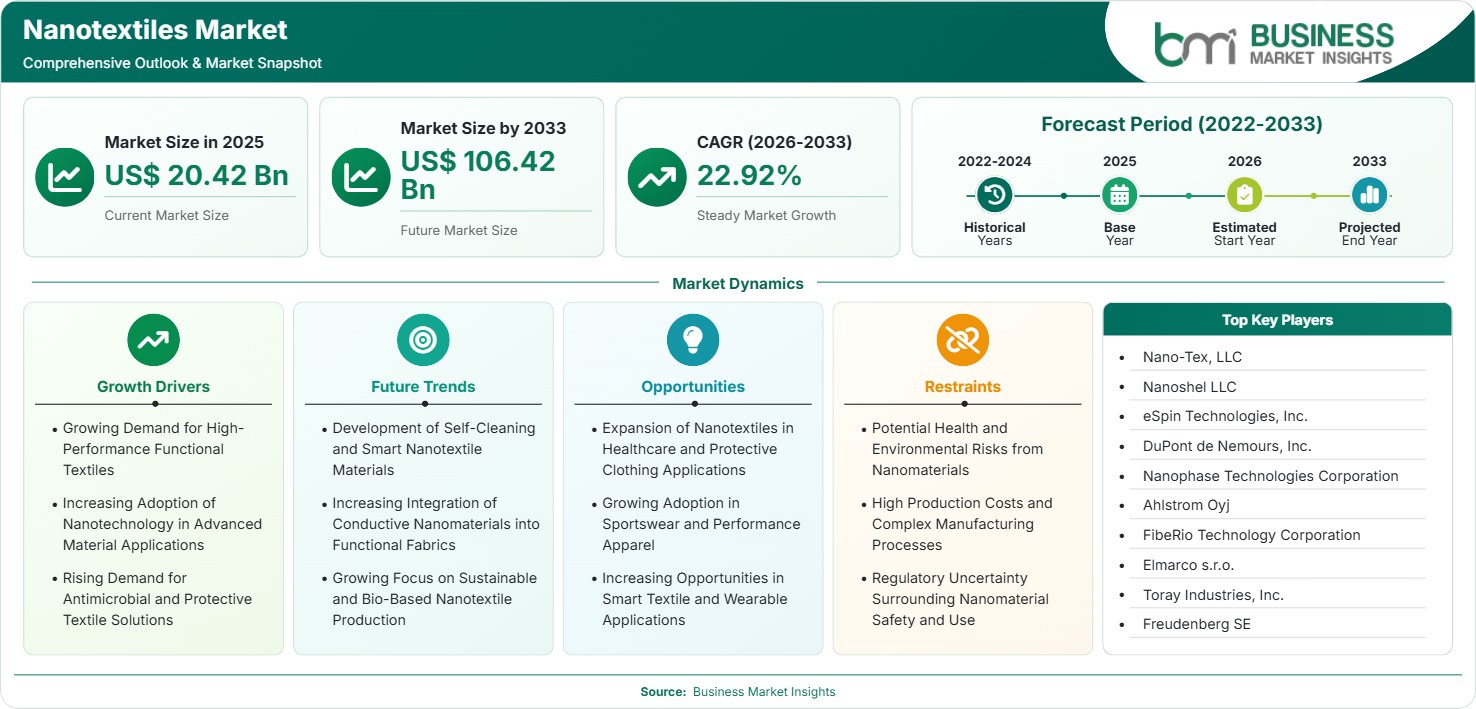
The Nanotextiles market size was valued at US$ 20.42 Billion in 2025 and is projected to reach US$ 106.42 Billion by 2033, growing at a CAGR of 22.92% during 2026–2033, driven by rising demand for functional fabrics, advanced nanomaterial integration, antimicrobial textile solutions, and opportunities in healthcare, smart wearables, and protective apparel applications.

Report Coverage
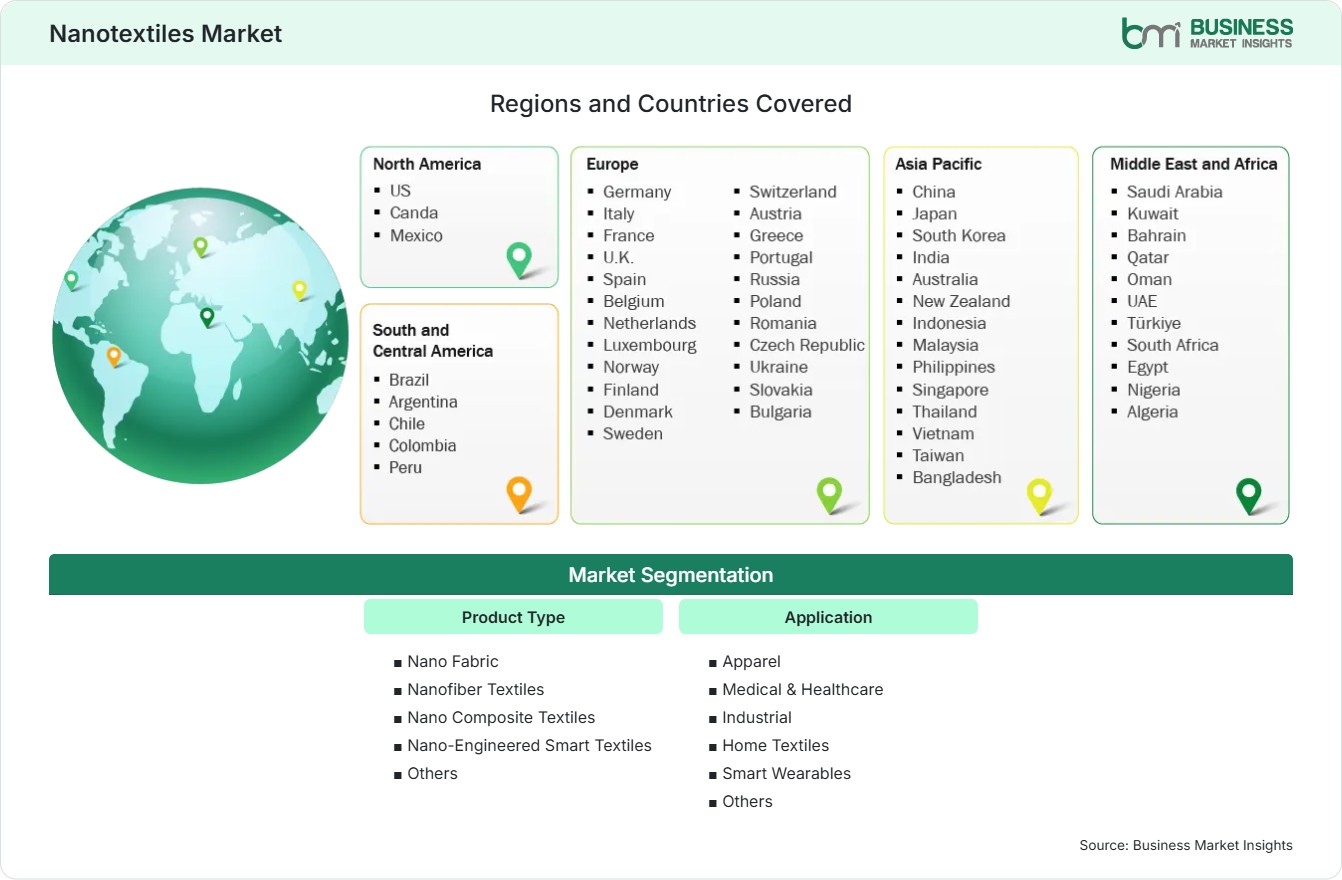
  • Product Type: Nano Fabric, Nanofiber Textiles, Nano Composite Textiles, Nano-Engineered Smart Textiles, Others
  • Application: Apparel, Medical & Healthcare, Industrial, Home Textiles, Smart Wearables, Others
US$ 20.42 Bn Market size in 2025
US$ 106.42 Bn Market Size by 2033
22.92% CAGR, 2026 - 2033
2026-2033 Forecast Period

AI Overview

Nanotextiles Market Summary

  • North America Region: North America holds a 32%–35% share in 2025, growing with a CAGR of 21.50%–22.50% during 2026–2033, supported by advanced textile research, healthcare applications, defense requirements, and smart wearable innovation. The U.S. market is expanding at a CAGR of 22.00%–23.00% during 2026–2033, driven by medical textiles, protective clothing demand, and investments in nanomaterial-based solutions.
  • Fastest Growing Region: Asia Pacific represents a 36%–39% share in 2025, expanding at a CAGR of 23.50%–24.50% during 2026–2033, supported by textile manufacturing capacity, increasing technology adoption, healthcare applications, and growing demand for advanced performance fabrics.
  • Leading Segment: Nanofiber Textiles account for a 34%–37% share in 2025, growing at a CAGR of 23.00%–24.00% during 2026–2033, driven by superior filtration capability, lightweight properties, medical applications, and increasing adoption in protective textile solutions.
  • High Growth Segment: Nano-Engineered Smart Textiles hold a 18%–21% share in 2025, achieving a CAGR of 25.00%–26.00% during 2026–2033, supported by wearable technology integration, sensor-enabled fabrics, and demand for intelligent textile systems.
  • Key Market Opportunity: Nanotextiles providers are expanding applications across healthcare, smart wearables, protective clothing, and performance apparel by developing multifunctional fabrics with improved durability, antimicrobial properties, and advanced sensing capabilities.
  • Major Market Players: Nano-Tex, LLC, Nanoshel LLC, eSpin Technologies, Inc., DuPont de Nemours, Inc., Nanophase Technologies Corporation, Ahlstrom Oyj, FibeRio Technology Corporation, Elmarco s.r.o., Toray Industries, Inc., Freudenberg SE.
Strategic Insights

Nanotextiles Market: Strategic Insights

Nanotextiles Market Strategic Framework
FREE PDF
Request your free sample
Request free sample
Stakeholder View

Key Takeaways

  • Nanotextiles supply chains are becoming increasingly technology-driven, involving nanomaterial suppliers, textile manufacturers, coating specialists, and application developers.
  • Healthcare, protective clothing, and smart wearable applications offer strong growth potential due to increasing demand for multifunctional and high-performance textile solutions.
  • Innovation is shifting toward advanced nanofiber production, conductive textile development, antimicrobial coatings, and sensor-integrated fabric technologies.
  • Asia Pacific presents significant investment opportunities due to strong textile manufacturing capabilities, expanding industrial base, and growing adoption of advanced materials.
  • Strategic collaborations between textile companies, nanotechnology firms, and research institutions are increasing to accelerate commercialization of next-generation textile solutions.
  • Sustainability-focused material development is becoming important as manufacturers explore environmentally responsible nanomaterial integration and efficient production methods.
Geographic Outlook

Nanotextiles Market Regional Highlights

North America Nanotextiles Market

North America accounted for a 32%–35% nanotextiles market share in 2025 and is projected to grow at a CAGR of 21.50%–22.50% during 2026–2033. The region benefits from strong research capabilities, advanced healthcare infrastructure, and demand for protective textile solutions. Nanotextiles share is supported by applications in medical, defense, and industrial sectors. The Nanotextiles market growth outlook is strengthened by investments in smart textiles, nanomaterial innovation, and advanced manufacturing technologies.

  • The United States represents the largest contributor due to strong research activity and demand for advanced healthcare and protective textiles.
  • Canada is witnessing adoption through technical textile development and increasing focus on sustainable material solutions.
  • Defense and industrial sectors are increasing demand for high-performance protective fabrics with enhanced functionality.
  • Healthcare companies are adopting nanotechnology-based textiles for filtration, antimicrobial protection, and medical applications.

US Nanotextiles Market

The U.S. accounted for a 27%–30% share of the global market in 2025 and US Nanotextiles Market forecast to expand at a CAGR of 22.00%–23.00% between 2026–2033. Market expansion is supported by strong textile innovation, healthcare applications, defense requirements, and smart wearable development. Research institutions and companies are investing in nanomaterial-based textile solutions to improve performance characteristics. Increasing adoption of advanced protective fabrics is supporting commercialization opportunities.

  • Medical and healthcare applications are driving demand for antimicrobial and filtration-based nanotextile solutions.
  • Smart wearable developers are integrating nanomaterials to improve sensing and electronic functionality.
  • Industrial users are adopting advanced fabrics for protective and performance-oriented applications.

Europe Nanotextiles Market

Europe Nanotextiles Market represented a 23%–26% share in 2025 and is projected to grow at a CAGR of 21.00%–22.00% during 2026–2033. The region is supported by advanced textile research, sustainability initiatives, and demand for technical textiles. Germany, the United Kingdom, France, and Italy are key markets due to industrial innovation and healthcare applications. Increasing focus on functional materials and environmentally responsible manufacturing is supporting adoption.

  • Germany leads adoption due to advanced material research, industrial applications, and strong technical textile capabilities.
  • The United Kingdom is increasing demand through healthcare innovation and smart textile development.
  • France is adopting nanotextile solutions for protective clothing and sustainable textile applications.
  • Italy supports market development through advanced textile manufacturing and specialty fabric production.
  • European regulations encouraging sustainable materials are influencing research into safer nanomaterial applications.

Asia Pacific Nanotextiles Market

Asia Pacific Nanotextiles Market accounted for a 36%–39% share in 2025 and is expected to achieve a CAGR of 23.50%–24.50% during 2026–2033. The region represents the fastest-growing market due to large textile manufacturing capacity, increasing industrialization, and growing demand for advanced materials. China, Japan, South Korea, and India are major contributors. Expanding healthcare infrastructure and smart textile investments are accelerating regional adoption.

  • China is leading adoption due to extensive textile manufacturing capabilities and nanotechnology research investments.
  • Japan is focusing on advanced functional textiles for healthcare, electronics, and industrial applications.
  • India is witnessing growth through technical textile initiatives and increasing manufacturing investments.
  • South Korea is developing smart textile solutions integrating nanomaterials and electronic functionalities.
  • Regional manufacturers are expanding production capabilities to meet global demand for advanced textile products.

Rest of World Nanotextiles Market

Rest of World accounted for a 6%–9% share in 2025 and is projected to grow at a CAGR of 20.00%–21.00% during 2026–2033. South and Central America, the Middle East, and Africa are gradually adopting advanced textile technologies due to healthcare expansion, industrial development, and increasing demand for protective materials. Brazil, Mexico, Saudi Arabia, and the UAE are emerging markets supported by industrial applications, healthcare investments, and demand for high-performance fabrics.

  • Brazil and Mexico are expanding adoption through industrial textile applications, healthcare development, and increasing demand for advanced protective materials.
  • Middle Eastern countries are investing in technical textiles for healthcare, industrial safety, and specialized applications.
  • Saudi Arabia and the UAE are adopting advanced textile solutions through healthcare modernization and industrial diversification programs.
  • African markets are gradually integrating nanotextile solutions for medical, filtration, and protective textile requirements.
Global Market Geography
FREE PDF
Request your free sample
Request free sample
Segment Analysis

Nanotextiles Market Segmentation

Product Type

The Product Type segment accounted for a 55%–58% Nanotextiles Market share in 2025 and is expected to grow at a CAGR of 22.50%–23.50% during 2026–2033. Increasing demand for functional materials with enhanced mechanical strength, filtration efficiency, antimicrobial performance, and smart capabilities is driving adoption across textile applications.

  • Nano Fabric: Nano fabrics provide enhanced properties such as stain resistance, water repellency, UV protection, and antimicrobial performance. Increasing demand for functional apparel and protective clothing is supporting adoption across consumer and industrial applications.
  • Nanofiber Textiles: Nanofiber textiles offer high surface area, filtration efficiency, and lightweight characteristics. Their adoption is increasing in medical filtration, protective equipment, and industrial applications requiring advanced material performance.
  • Nano Composite Textiles: Nano composite textiles combine nanomaterials with conventional fibers to improve strength, durability, conductivity, and functional properties. Growing demand for high-performance materials is supporting development across multiple industries.
  • Nano-Engineered Smart Textiles: Nano-engineered smart textiles integrate sensing, conductive, and responsive capabilities into fabrics. Increasing interest in wearable electronics, health monitoring, and intelligent clothing is driving market adoption.

Application

The Application segment accounted for a 68%–71% Nanotextiles Market share in 2025 and is projected to grow at a CAGR of 22.00%–23.00% during 2026–2033. Growing adoption across healthcare, apparel, industrial safety, and smart wearable sectors is driving demand for advanced textile solutions.

  • Apparel: Apparel applications are adopting nanotextiles to provide enhanced comfort, durability, moisture management, and antimicrobial properties. Increasing consumer demand for performance clothing is supporting integration of nanotechnology into textile products.
  • Medical & Healthcare: Medical applications utilize nanotextiles for filtration, wound care, antimicrobial protection, and advanced healthcare products. Growing demand for infection control and specialized medical materials is accelerating adoption.
  • Industrial: Industrial sectors are adopting nanotextiles for protective clothing, filtration systems, and high-performance applications. Enhanced durability and resistance properties support usage in demanding operating environments.
  • Home Textiles: Home textile applications are incorporating nanotextile solutions to improve stain resistance, durability, and hygiene performance. Increasing consumer preference for functional household fabrics is supporting adoption.
  • Smart Wearables: Smart wearable applications utilize nanotextiles for conductive fabrics, sensors, and electronic integration. Growing demand for health monitoring and connected devices is creating new opportunities.
Market Forces

Nanotextiles Market Dynamics

Key Market Drivers

Growing Demand for High-Performance Functional Textiles

Rising demand for textiles with higher tensile strength, durability, water absorption capacity, filtration efficacy, and protective capability has led to rapid uptake of nanotextile technology across various industries. Manufacturers are working on the creation of new fabrics made from nanomaterials that will perform better than traditional textiles. Industries such as apparel, healthcare, industrial safety, and defense are increasingly using functional textiles to meet their performance needs. An increased preference for lightweight, multifunctional materials is driving firms to develop nanofibers, nanocoatings, and composite textiles. This Nanotextiles market trend includes growing applications that require specific material characteristics.

Increasing Adoption of Nanotechnology in Advanced Material Applications

Incorporation of nanotechnology in textile industry is increasing owing to the capability of nanotechnology in improving physical, chemical and functional properties of textiles. Nanoparticles such as nanofibers and nano-coatings used in textile industry to increase conductivity, durability and other resistant characteristics. Companies are increasingly using high-performance materials to create products that provide better performance. R&D carried out by the textile industry and nanotechnology industries is contributing toward commercialization of innovative solutions. Increased spending on material science has helped in developing next generation of fabrics for healthcare, electronics, industrial and consumer purposes.

Rising Demand for Antimicrobial and Protective Textile Solutions

Rising awareness about hygiene, infections, and protective measures is contributing to the increasing demand for antimicrobial and protective nanotextiles. Hospitals, industries, and consumers are desirous of obtaining fabrics that offer better protection against the threat of microbes and contamination. Nanotechnology technology allows textile makers to produce textiles that offer better antimicrobial properties, improved filtration efficiency, and better protection against contamination. Medical textiles, protective wear, and filtration systems are some of the benefits of the above-mentioned material properties. Increasing demand for safety-based products in the healthcare sector and industrial sectors is motivating textile makers to produce more nanotextiles.

Key Market Opportunities

Expansion of Nanotextiles in Healthcare and Protective Clothing Applications

Healthcare and protective clothing applications represent significant growth opportunities due to increasing demand for advanced materials offering enhanced protection, filtration, and antimicrobial performance. Medical institutions and industrial users are adopting functional textiles to improve safety standards and operational efficiency. Nanotextiles enable development of specialized products including medical filtration materials, protective garments, and advanced wound care solutions. Growing healthcare expenditure, increasing focus on infection control, and rising workplace safety requirements are supporting investment in these applications. Manufacturers are developing scalable production methods to address growing demand from healthcare and industrial sectors. The expansion of specialized textile applications is expected to create new opportunities for nanotextile providers during the forecast period.

Growing Adoption in Sportswear and Performance Apparel

The sportswear and performance apparel industry is increasingly adopting nanotextiles to develop lightweight, breathable, durable, and moisture-managing fabrics. Consumers are showing higher preference for clothing products offering enhanced comfort and improved athletic performance. Nanotechnology enables manufacturers to introduce features such as temperature regulation, and improved fabric strength. Sportswear brands are investing in innovative textile materials to differentiate product offerings and meet changing consumer expectations. Increasing participation in fitness activities and demand for premium performance clothing are creating opportunities for nanotextile suppliers. The integration of advanced materials into sportswear is expected to support market expansion as brands focus on functional and technology-enabled apparel.

Increasing Opportunities in Smart Textile and Wearable Applications

Growing adoption of smart textiles and wearable technologies is creating new opportunities for nanotextile manufacturers. Nanomaterials enable integration of conductive properties, sensors, and electronic functionality into textile structures, supporting applications in healthcare monitoring, connected clothing, and interactive garments. Increasing demand for wearable health devices and intelligent fabrics is encouraging collaboration between textile manufacturers, electronics companies, and technology developers. Advances in flexible electronics and material engineering are improving the feasibility of smart textile commercialization. The expansion of connected devices and personalized healthcare solutions is expected to accelerate demand for nano-engineered textiles. Companies developing scalable and durable smart textile solutions are positioned to benefit from emerging wearable technology applications.

Market Restraints and Challenges

Potential Health and Environmental Risks from Nanomaterials

Factor: Nanomaterials used in textile applications may raise concerns related to human exposure, environmental release, and long-term safety impacts due to limited understanding of certain nanoparticle interactions. Impact: Regulatory uncertainty and safety concerns can slow commercialization, increase compliance requirements, and create challenges for manufacturers developing nanotextile products. Companies must invest in safety testing, lifecycle assessments, and responsible production methods to address environmental and health-related concerns.

High Production Costs and Complex Manufacturing Processes

Factor: Nanotextile manufacturing requires advanced equipment, specialized materials, and precise production techniques that increase operational complexity and investment requirements. Impact: High production costs can limit adoption among smaller manufacturers and affect the price competitiveness of nanotextile-based products compared with conventional textiles. Companies need scalable manufacturing processes, improved production efficiency, and technological advancements to reduce costs and expand commercial adoption.

Company Analysis

Competitive Landscape

The Nanotextiles market analysis highlights a competitive ecosystem consisting of nanomaterial manufacturers, textile technology companies, filtration specialists, and advanced materials providers. Companies are focusing on nanofiber development, functional coatings, smart textile integration, and healthcare applications to strengthen their market presence. Strategic collaborations between research organizations and textile manufacturers are increasing as companies aim to commercialize advanced nanotextile solutions.

Company Name

Overview

Products and Services relevant to this market

Nano-Tex, LLC

Textile technology company specializing in nanotechnology-based fabric enhancement solutions.

Nano-enhanced textile treatments, performance coatings, moisture management, and functional fabric technologies.

Nanoshel LLC

Nanomaterials company providing nanoparticle solutions for advanced material applications.

Nanoparticles, nanomaterials, coatings, and solutions supporting textile innovation.

eSpin Technologies, Inc.

Nanofiber technology company focused on scalable electrospinning solutions.

Nanofiber materials, electrospinning equipment, and advanced textile applications.

DuPont de Nemours, Inc.

Global materials science company developing advanced materials and protective solutions.

Functional fibers, protective textiles, specialty materials, and advanced coating technologies.

Nanophase Technologies Corporation

Nanomaterials manufacturer specializing in engineered nanoparticles.

Nanomaterials, surface treatments, functional additives, and advanced material solutions.

Ahlstrom Oyj

Specialty materials company producing advanced fiber-based solutions.

Filtration textiles, medical materials, and engineered fiber solutions.

FibeRio Technology Corporation

Nanofiber technology provider specializing in production equipment and materials.

Nanofiber manufacturing systems and textile technology solutions.

Elmarco s.r.o.

Nanofiber production technology company supporting industrial-scale manufacturing.

Nanofiber production equipment, electrospinning technology, and textile solutions.

Toray Industries, Inc.

Advanced materials company developing high-performance fibers and composites.

Functional fibers, carbon materials, specialty textiles, and advanced textile technologies.

Freudenberg SE

Global technology company providing engineered textile and material solutions.

Nonwoven materials, medical textiles, filtration products, and advanced fiber solutions.

Trust & Transparency

Research Methodology

The market analysis combines proprietary research with secondary data from government agencies, company disclosures, regulatory filings, industry databases and expert interviews. Market estimates are validated through data triangulation, cross-market benchmarking and analyst review.

View Full Research Methodology

Questions Answered

Frequently Asked Questions

What factors will influence the Nanotextiles Report outlook?

The Nanotextiles market report outlook will be influenced by nanotechnology advancements, healthcare demand, smart textile adoption, manufacturing scalability, regulatory developments, and sustainability-focused material innovation.

Are nanotextiles suitable for smart wearable applications?

Yes, nano-engineered textiles enable integration of sensors, conductive materials, and electronic components, supporting applications in health monitoring, connected clothing, and intelligent wearable systems.

What role do nanotextiles play in healthcare applications?

Nanotextiles support healthcare applications through advanced filtration materials, antimicrobial fabrics, wound care products, and protective medical textiles requiring improved performance characteristics.

How do nanotextiles improve conventional textile performance?

Nanotextiles enhance textile properties by improving strength, filtration efficiency, antimicrobial performance, water resistance, conductivity, and durability through integration of nanoscale materials.

Which industries are expected to drive demand for nanotextiles?

Healthcare, protective clothing, industrial filtration, sportswear, and smart wearable industries are expected to drive demand due to increasing requirements for functional, lightweight, and high-performance textile materials.

Access the Full Nanotextiles Market Report

Get segment-level forecasts, regional estimates, competitive benchmarking, company profiles and downloadable Excel datasets.

Access the full Nanotextiles Market Report
350 pages PDF & Excel | 2026-08-25
Similar Research

Related Market Reports