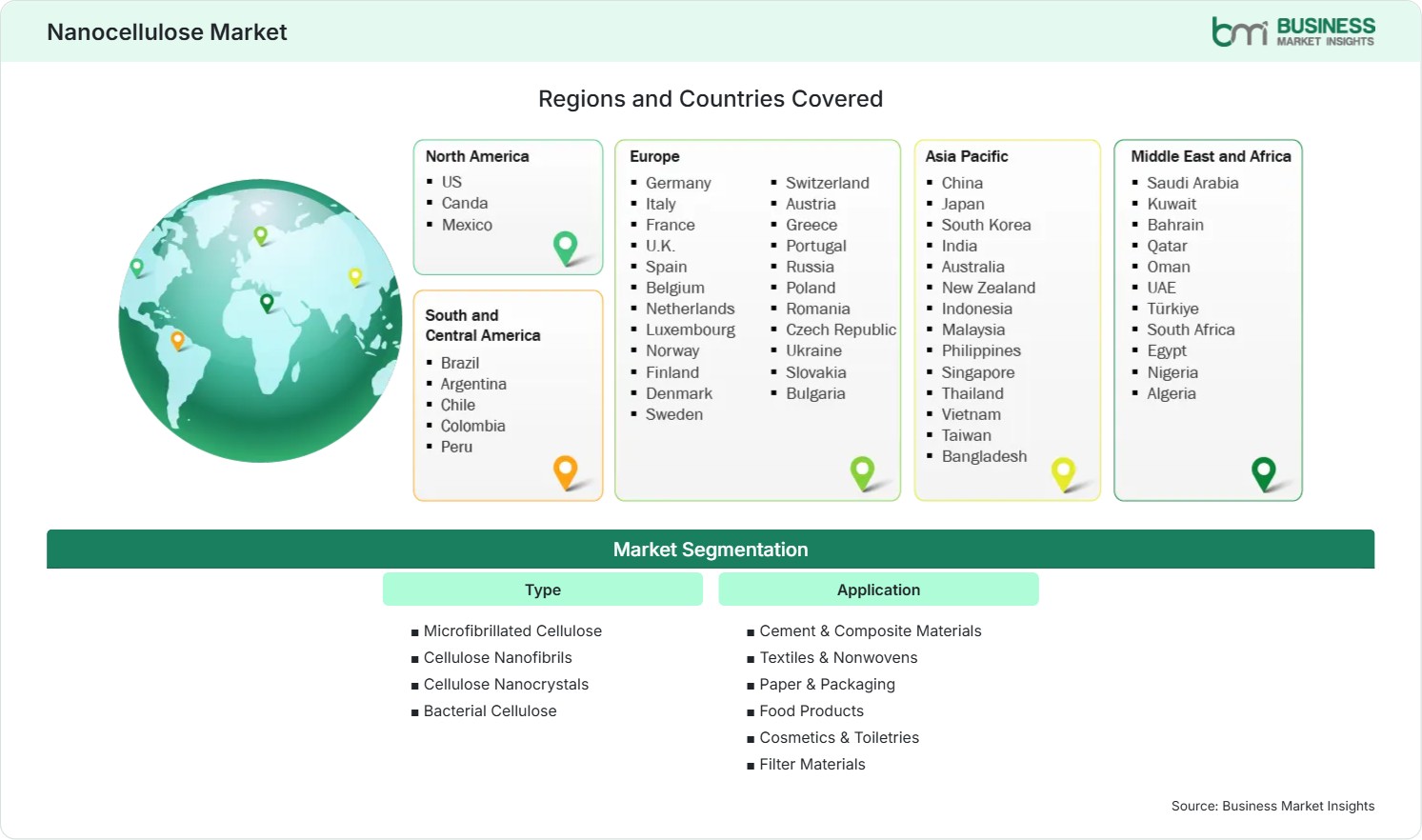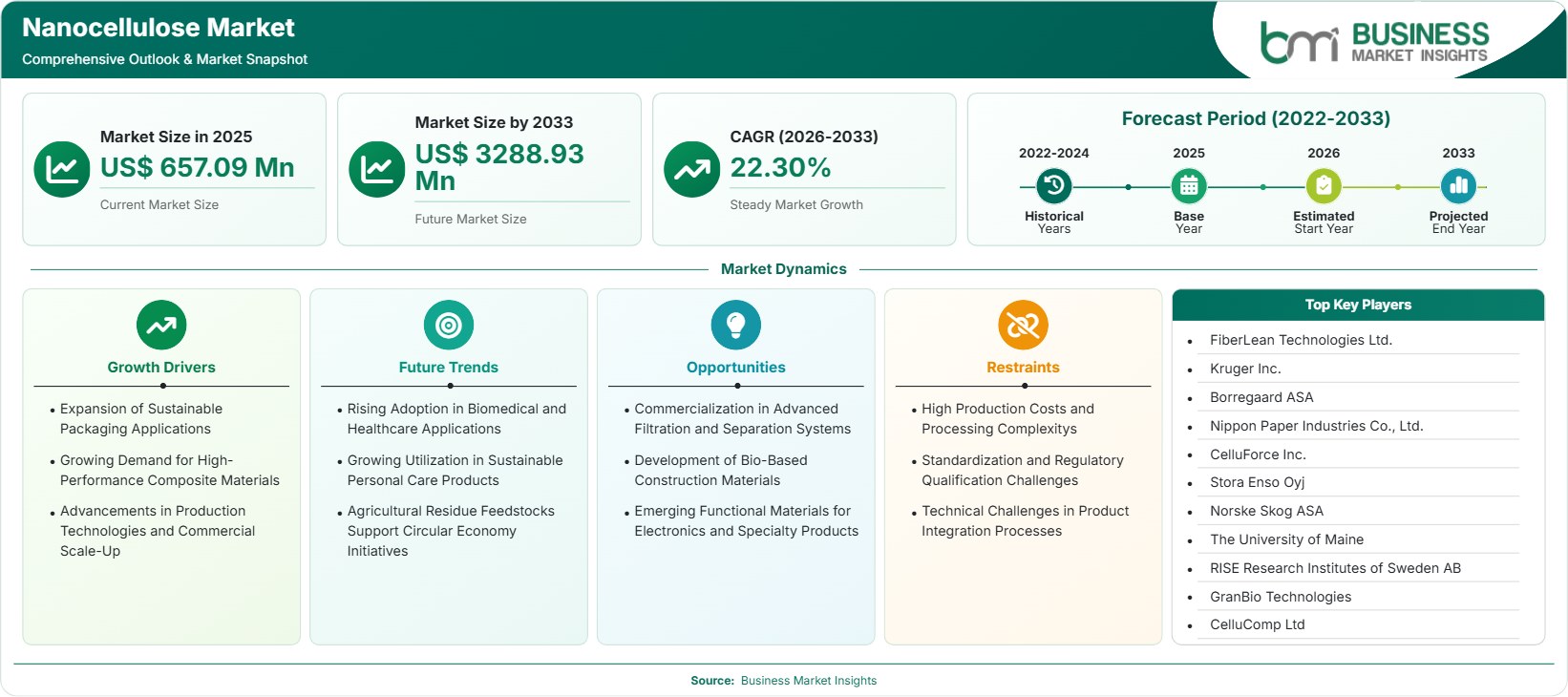
Nanocellulose Market Regional Highlights
North America Nanocellulose Market
North America Nanocellulose Market accounted for approximately 27%–30% of global revenue in 2025 and is projected to register a CAGR of 20.5%–22.0% through 2033. Regional demand is facilitated by strong commercialization efforts, strong research base and increasing utilization of sustainable materials in packaging, composite and specialty applications. Public and private funding initiatives continue to invest in next generation biomaterials development. Industrial users are now testing cellulose-based nano-materials in order to improve performance and sustainability benefits of products.
- Bioeconomy initiatives by the federal government and states are encouraging industry adoption through funding assistance, commercialization at the pilot-scale level, and research collaborations involving universities, manufacturing firms, and advanced-materials firms.
- Packaging firms are using renewable reinforcing materials to boost their strength, barrier effectiveness, and green credentials as consumer and regulatory demands keep shifting.
- The automotive and composites industries are looking into using lighter weight materials that will enhance mechanical properties and minimize environmental footprint.
- Increased collaboration between forest-products firms and technology firms is speeding up product qualification efforts.
US Nanocellulose Market
The United States represents approximately 74%–78% of North American demand and is anticipated to grow at a CAGR of 21.0%–22.5% during the forecast period. Strong research capabilities, commercialization initiatives, and sustainable manufacturing investments continue driving adoption. Universities, national laboratories, and private companies actively collaborate to develop next-generation applications spanning packaging, biomedical materials, filtration systems, and construction products. Government support for domestic advanced-material manufacturing further strengthens innovation and scaling activities across the value chain.
- Significant R&D activity supports development of advanced barrier coatings, engineered composites, and specialty functional materials for high-value industrial applications.
- Packaging sustainability commitments from consumer goods companies continue stimulating demand for renewable performance-enhancing materials across supply chains.
- Construction material developers increasingly evaluate bio-based additives to improve durability, strength, and sustainability performance in infrastructure applications.
- Strong university-industry collaboration facilitates technology transfer and commercialization of emerging material innovations.
Europe Nanocellulose Market
Europe remains the leading regional market with a share of 35%–38% in 2025 and a projected CAGR of 21.0%–22.5% through 2033. The region is characterized by well-developed forestry industry assets, sustainability policies, and robust industrialization. The Nanocellulose Market share leadership is attributed to the widespread deployment of renewable materials and circular economy projects. Commercialization in the region is spearheaded by Finland and Sweden, with Germany being one of the fastest growing demand regions with support from industrial sustainability programs.
- European Green Deal objectives continue encouraging adoption of renewable materials across packaging, construction, transportation, and consumer product industries.
- Nordic countries maintain leadership through integrated forestry operations, advanced production technologies, and strong commercialization ecosystems.
- Demand for recyclable and compostable packaging solutions supports ongoing investment in sustainable barrier material development.
- Automotive and industrial manufacturing sectors increasingly utilize bio-based reinforcement materials to support carbon reduction initiatives.
- Research collaboration between industry and academic institutions accelerates product development and application expansion.
Asia Pacific Nanocellulose Market
Asia Pacific accounted for approximately 24%–27% of global revenue in 2025 and is expected to achieve the fastest CAGR of 24.0%–26.0% through 2033. Rapid industrialization, packaging demand growth, and investments in sustainable materials are creating favorable market conditions. Japan remains a leading technology and production hub, while India demonstrates some of the strongest growth potential due to expanding manufacturing activity and increasing sustainability awareness. Regional governments continue supporting bio-based material innovation and commercialization initiatives.
- Packaging sector growth drives increased usage of renewable additives and materials to enhance product performance.
- Japan is technologically superior due to constant innovation, skilled manufacturing practices, and commercialized manufacturing facilities.
- India has advantages due to increased investments in sustainable materials, modernization of industries, and manufacturing end users.
- Environmental regulations in the region promote lower reliance on petroleum-based materials.
- Growing construction and infrastructure activity supports adoption of advanced composite and reinforcement materials.
Rest of World Nanocellulose Market
The Rest of World region accounts for approximately 9%–12% of global revenue in 2025 and is projected to grow at a CAGR of 22.0%–24.0% through 2033. South and Central America benefit from abundant biomass resources and expanding bioeconomy initiatives. Meanwhile, Middle East and Africa markets are gradually increasing investments in sustainable manufacturing and advanced materials. Brazil leads regional demand, while selected Gulf countries are emerging as higher-growth markets due to industrial diversification strategies and sustainability-focused investments.
- Brazil leverages strong forestry resources and bio-based industrial capabilities to support commercialization and application development activities.
- Industrial diversification programs in Gulf economies create opportunities for sustainable material adoption across manufacturing sectors.
- Increasing environmental awareness encourages exploration of renewable alternatives for packaging, construction, and specialty industrial applications.
- Academic and industrial partnerships are strengthening regional innovation ecosystems and facilitating technology transfer.
- Expanding investments in circular economy initiatives support long-term market development across emerging economies.