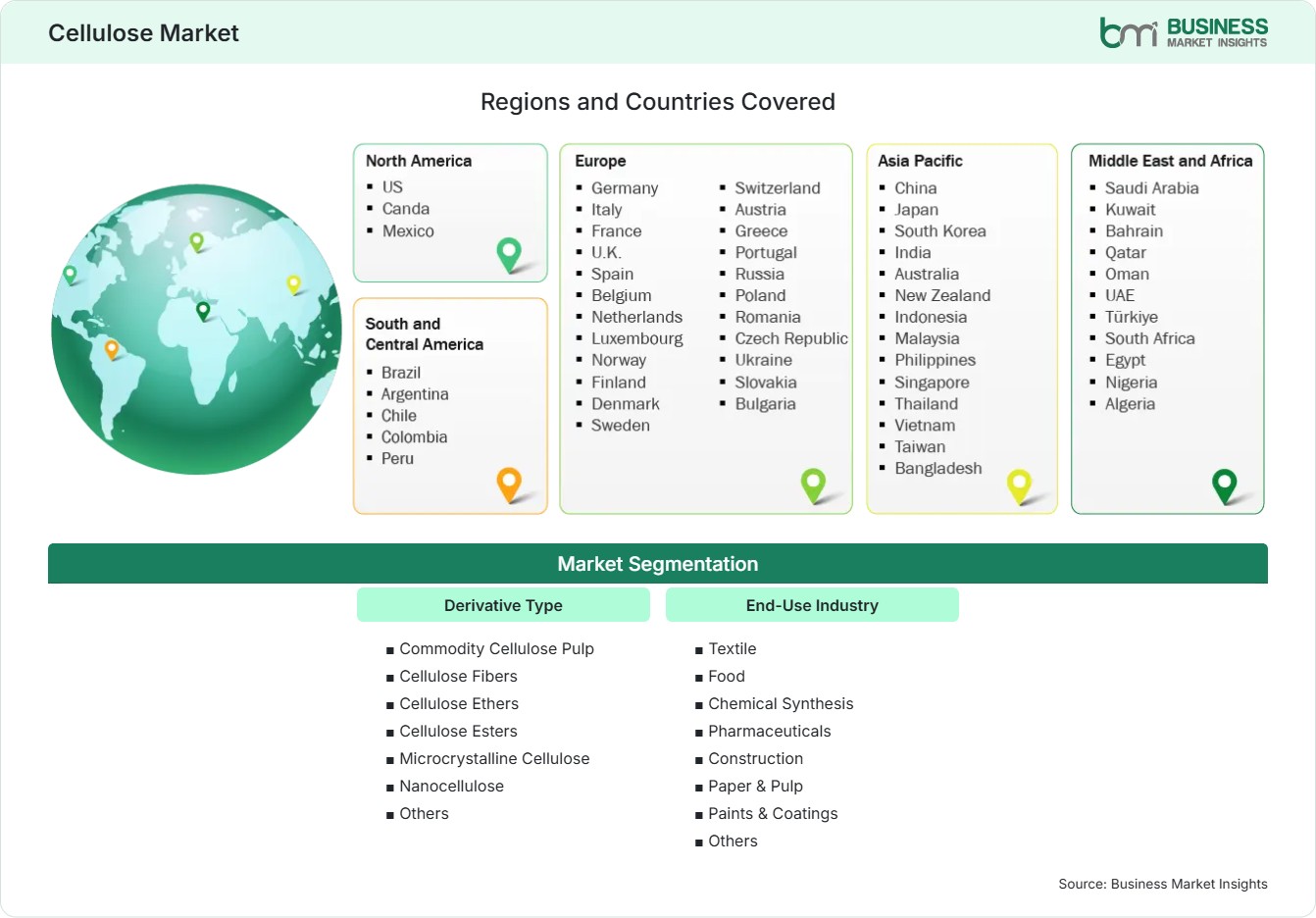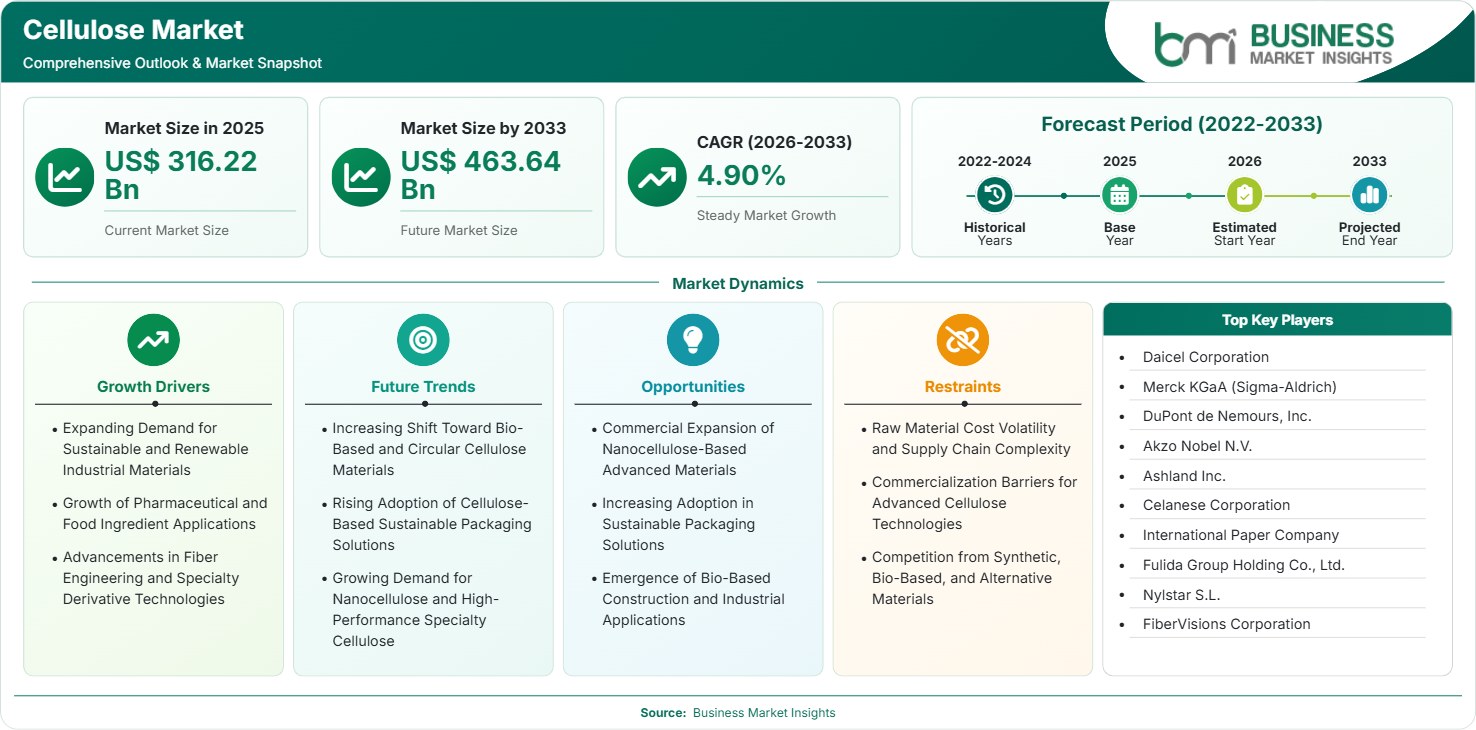
Cellulose Market Regional Highlights
North America Cellulose Market
North America accounted for approximately 31%–34% of global revenue in 2025 and is projected to register a CAGR of 4.1%–4.6% through 2033. There are well-established pulp and specialty chemicals industries, pharmaceutical production capacity, and increased investments in biomaterials within the region. There is sustained demand for sustainable packaging solutions, cellulose derivatives, and industrial uses of high-end materials. The Cellulose Market share in North America is benefiting from technology, premium products, and an integrated value chain to enable commercial scalability.
- Strong pharmaceutical manufacturing drives demand for microcrystalline cellulose and specialty excipients.
- Sustainability efforts are increasing the use of renewable cellulose-based packaging materials.
- Advanced fiber technologies improve efficiency and support high-value cellulose applications.
- Integrated forestry and pulp supply chains ensure raw material availability and cost competitiveness.
- Research partnerships accelerate bio-based solutions and next-generation cellulose applications.
US Cellulose Market
The United States represented approximately 72%–76% of North American demand in 2025 and is expected to expand at a CAGR of 4.2%–4.7% through 2033. High production of pharmaceuticals, chemicals, and advanced materials provides support for market growth. Investments made in sustainable packaging, renewable materials, and innovations keep on creating demand in different industries in the Cellulose Market.
- Pharmaceutical manufacturers increasingly utilize high-purity cellulose ingredients for excipient applications requiring consistency, regulatory compliance, and reliable performance across multiple therapeutic formulations.
- Growing investments in sustainable packaging technologies support the development of renewable material alternatives aligned with evolving corporate environmental targets and consumer preferences.
- Advanced materials research involving nanocellulose and engineered fibers is creating opportunities in composites, coatings, filtration systems, and lightweight industrial applications.
- Strong industrial and consumer markets provide stable demand for specialty cellulose derivatives used in food processing, personal care products, and chemical synthesis activities.
Europe Cellulose Market
Europe held approximately 24%–27% of global revenue in 2025 and is forecast to expand at a CAGR of 4.3%–4.8% during 2026–2033. Stringent sustainability regulations, advanced manufacturing capabilities, and strong demand for renewable materials support regional growth. Germany remains a leading Cellulose Market with an estimated CAGR of 4.2%–4.7%, while Poland and selected Central European countries exhibit faster expansion at approximately 5.0%–5.6%. Circular economy initiatives and investments in sustainable materials continue influencing procurement and product development strategies across industries.
- Regulatory frameworks promoting renewable materials and resource efficiency encourage wider adoption of cellulose-based solutions across packaging, construction, and industrial manufacturing sectors.
- Germany maintains leadership through advanced specialty chemicals production, research capabilities, and strong integration between industrial manufacturers and technology providers.
- Increasing investments in sustainable textile manufacturing support demand for regenerated fibers and high-performance cellulose-based materials across European markets.
- Construction and coatings industries are adopting cellulose derivatives to enhance product functionality, performance consistency, and environmental compliance requirements.
- Central and Eastern European countries continue attracting investments due to competitive manufacturing environments and growing participation in regional supply chains.
Asia Pacific Cellulose Market
Asia Pacific accounted for approximately 28%–31% of global revenue in 2025 and is expected to register the fastest CAGR of 5.8%–6.4% through 2033. Expanding textile production, pharmaceutical manufacturing, food processing activities, and industrial development support demand growth. China remains the largest regional market with a CAGR of 5.7%–6.2%, while India demonstrates stronger momentum at approximately 6.4%–7.0%. The region benefits from large-scale manufacturing ecosystems, favorable production economics, and increasing investments in sustainable industrial materials in Cellulose Market.
- Textile manufacturing expansion continues driving demand for regenerated fibers and specialty cellulose products used in apparel, industrial fabrics, and consumer applications.
- China remains a leading production hub due to extensive industrial infrastructure, integrated supply chains, and growing investments in value-added cellulose derivatives.
- India is emerging as a high-growth market supported by pharmaceutical expansion, food ingredient demand, and increasing investments in specialty chemical manufacturing.
- Rising environmental awareness encourages industries to adopt renewable raw materials, supporting broader acceptance of cellulose-based products across applications.
- Government initiatives supporting bioeconomy development and sustainable manufacturing practices create favorable conditions for long-term industry expansion.
Rest of World Cellulose Market
Rest of World represented approximately 12%–15% of global revenue in 2025 and is projected to grow at a CAGR of 4.7%–5.3% through 2033 in Cellulose Market. South & Central America benefit from abundant forestry resources and expanding pulp production investments. Brazil remains the leading regional market with growth ranging between 5.0%–5.6%.
Middle East & Africa markets are gradually expanding through investments in construction materials, food processing, and industrial manufacturing. Saudi Arabia and the United Arab Emirates demonstrate increasing demand for specialty derivatives, while South Africa supports regional consumption through established industrial and packaging activities.
- Brazil strengthens its global position through competitive pulp production, abundant forestry resources, and export-focused processing.
- Sustainable packaging initiatives are increasing demand for renewable materials across food, consumer, and industrial sectors.
- Industrial diversification in Gulf countries is driving demand for specialty cellulose in construction chemicals, coatings, and manufacturing.
- Food processors increasingly use cellulose ingredients to improve stability, texture, and product consistency.
- Infrastructure development creates opportunities for cellulose derivatives that enhance construction material performance and efficiency.