Glaucoma Surgery Devices Market Outlook: Size, Share, Trends, Growth Analysis, Competitive Landscape & Forecast, 2026–2033

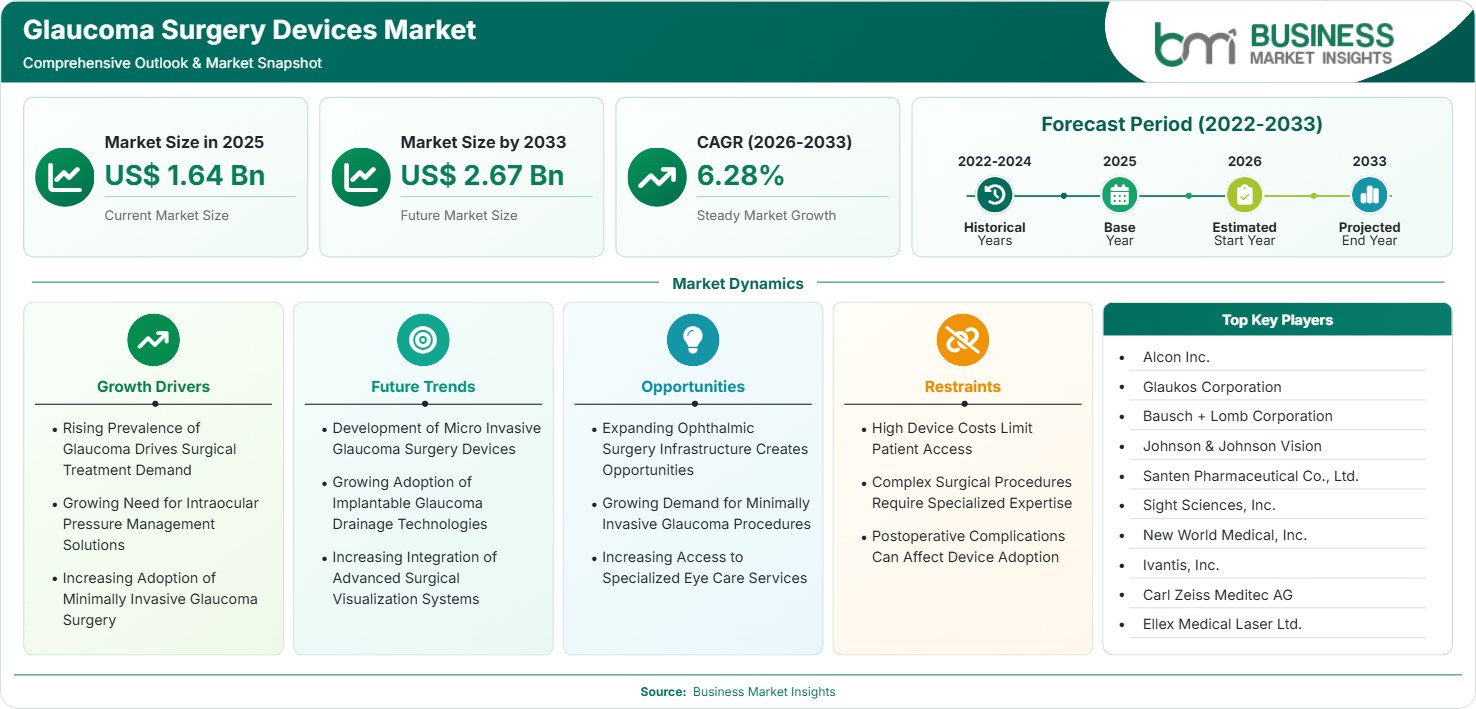
The Glaucoma Surgery Devices Market size was valued at US$ 1.64 Billion in 2025 and is projected to reach US$ 2.67 Billion by 2033, growing at a CAGR of 6.28% during 2026–2033, supported by glaucoma prevalence, pressure management needs, minimally invasive procedures, and expanding ophthalmic infrastructure.

Report Coverage
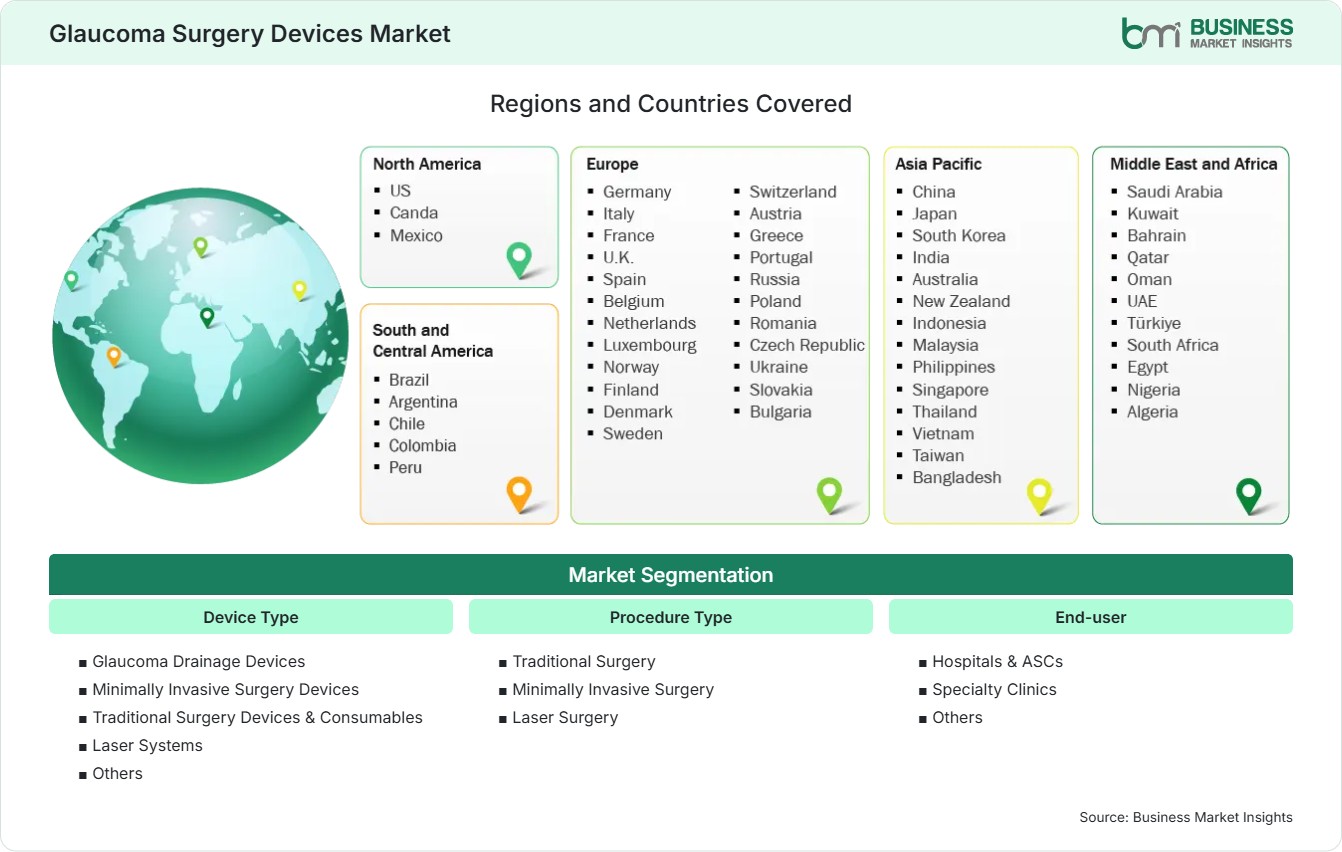
  • Device Type: Glaucoma Drainage Devices, Minimally Invasive Surgery Devices, Traditional Surgery Devices & Consumables, Laser Systems, Others
  • Procedure Type: Traditional Surgery, Minimally Invasive Surgery, Laser Surgery
  • End-user: Hospitals & ASCs, Specialty Clinics, Others
US$ 1.64 Bn Market size in 2025
US$ 2.67 Bn Market Size by 2033
6.28% CAGR, 2026 - 2033
2026-2033 Forecast Period

AI Overview

Glaucoma Surgery Devices Market Summary

  • North America Region: North America holds an estimated 39%–43% share in 2025 and is projected to grow at 5.8%–6.5% CAGR during 2026–2033, supported by established ophthalmic infrastructure, specialist expertise, advanced surgical technologies, and growing adoption of minimally invasive glaucoma surgery.
  • Fastest Growing Region: Asia Pacific accounts for an estimated 25%–29% share in 2025 and is projected to record 7.2%–8.1% CAGR during 2026–2033, supported by expanding eye-care infrastructure, increasing glaucoma awareness, specialist capacity, and broader access to surgical treatment.
  • Leading Segment: Glaucoma Drainage Devices represent an estimated 31%–35% share in 2025 and are projected to grow at 5.9%–6.6% CAGR through 2033, supported by established clinical use, pressure-control requirements, and demand for treatment options in advanced disease.
  • High Growth Segment: Minimally Invasive Surgery Devices hold an estimated 25%–29% share within device type in 2025 and are projected to grow at 8.0%–8.9% CAGR through 2033, supported by less invasive treatment approaches and growing surgeon adoption.
  • Key Market Opportunity: Expansion of specialized ophthalmic infrastructure, wider adoption of minimally invasive procedures, and improved access to glaucoma specialists can broaden surgical treatment penetration across developing and underserved markets.
  • Major Market Players: Alcon Inc.; Glaukos Corporation; Bausch + Lomb Corporation; Johnson & Johnson Vision; Santen Pharmaceutical Co., Ltd.; Sight Sciences, Inc.; New World Medical, Inc.; Ivantis, Inc.; Carl Zeiss Meditec AG; Ellex Medical Laser Ltd.
Strategic Insights

Glaucoma Surgery Devices Market: Strategic Insights

Glaucoma Surgery Devices Market Strategic Framework
FREE PDF
Request your free sample
Request free sample
Stakeholder View

Key Takeaways

  • The value chain spans device manufacturers, ophthalmic surgeons, hospitals, ambulatory surgical centers, specialty clinics, distributors, and training ecosystems, making clinical adoption dependent on more than device performance alone.
  • Minimally invasive procedures provide the strongest product expansion pathway because they can complement medication management and conventional surgery while supporting differentiated treatment strategies across suitable patient groups.
  • Innovation is moving toward smaller implantation profiles, improved tissue interaction, simplified surgical handling, enhanced procedural predictability, and technologies that integrate naturally with modern ophthalmic treatment pathways.
  • Asia Pacific provides a compelling expansion base as ophthalmic capacity develops, specialist availability improves, and awareness of glaucoma-related vision loss increases across large patient populations.
  • Procurement decisions increasingly consider clinical evidence, surgeon familiarity, training requirements, device economics, postoperative management, and the ability of suppliers to provide comprehensive procedural support.
  • Companies with differentiated minimally invasive platforms, established surgeon relationships, broad distribution networks, and complementary ophthalmic portfolios can strengthen their positions as surgical treatment pathways diversify.
Geographic Outlook

Glaucoma Surgery Devices Market Regional Highlights

North America Glaucoma Surgery Devices Market

North America accounts for an estimated 39%–43% Glaucoma Surgery Devices Market share in 2025 and is projected to expand at 5.8%–6.5% CAGR through 2033. Mature ophthalmic infrastructure, specialist availability, advanced surgical capabilities, and established reimbursement environments support adoption of sophisticated glaucoma interventions.

  • Established glaucoma specialists support adoption of advanced surgical platforms and implants.
  • Minimally invasive procedures are increasingly incorporated into treatment strategies for appropriate patients.
  • Ambulatory surgical centers provide an important channel for procedural expansion.
  • Clinical evidence and physician training strongly influence device selection.

US Glaucoma Surgery Devices Market

The US represents an estimated 35%–39% share of regional demand in 2025 and is projected to grow at 5.9%–6.6% CAGR through 2033. Advanced ophthalmic facilities, specialist density, technology adoption, and established surgical pathways support continued demand for glaucoma devices.

  • Ophthalmologists are turning their attention to minimally invasive procedures as well as existing surgeries.
  • There is support for decentralization due to specialty clinics and ambulatory centers.
  • Physicians' experience and evidence are still relevant for adopting innovations.
  • Premium products are compared based on efficiency and effectiveness.

Europe Glaucoma Surgery Devices Market

Europe holds an estimated 24%–28% share in 2025 and is projected to grow at 5.7%–6.5% CAGR through 2033. Germany, the UK, France, and Italy represent important markets, while Spain and selected Central European countries provide additional expansion potential through improving ophthalmic treatment access.

  • Germany can capitalize on an already existing ophthalmology infrastructure and expertise.
  • The UK has its strengths in glaucoma treatment procedures and surgeries.
  • France and Italy represent the markets already built for implants and lasers.
  • In Spain, there are opportunities for growth in private and specialized eye-care services.

Asia Pacific Glaucoma Surgery Devices Market

Asia Pacific represents an estimated 25%–29% Glaucoma Surgery Devices Market share in 2025 and is projected to record 7.2%–8.1% CAGR through 2033. China, Japan, India, and South Korea anchor demand, while Southeast Asia offers additional potential as specialist services and ophthalmic infrastructure expand.

  • China combines a large patient base with expanding specialist ophthalmology capacity.
  • Japan provides demand for advanced surgical technologies through mature eye-care infrastructure.
  • India offers substantial penetration potential as specialist services become more accessible.
  • Southeast Asian markets are developing ophthalmic capacity beyond major metropolitan centers.

Rest of World Glaucoma Surgery Devices Market

Rest of World accounts for an estimated 7%–11% share in 2025 and is projected to grow at 6.3%–7.4% CAGR through 2033. Brazil and Mexico lead Latin American demand, while Saudi Arabia, the UAE, and South Africa provide important opportunities as specialized eye-care capacity develops.
The Latin American market is driven by growth in private sector ophthalmic care and the availability of specialist surgeries. The Middle Eastern Glaucoma Surgery Devices Market is driven by healthcare reform, whereas South Africa is a regional base for specialized ophthalmic care and distribution.

  • Brazil represents the largest regional opportunity through its established ophthalmic treatment infrastructure.
  • Mexico provides room for expansion as private specialty clinics increase treatment availability.
  • Saudi Arabia and the UAE support advanced ophthalmic services through healthcare modernization.
  • South Africa provides a specialized treatment and distribution platform for surrounding markets.
Global Market Geography
FREE PDF
Request your free sample
Request free sample
Segment Analysis

Glaucoma Surgery Devices Market Segmentation

Device Type

Glaucoma Drainage Devices lead device demand with an estimated 31%–35% share in 2025 and 5.9%–6.6% CAGR through 2033. Minimally Invasive Surgery Devices provide faster expansion, while lasers and conventional products retain important clinical roles.

  • Glaucoma Drainage Devices: Proven utility in pressure reduction and in treating complex cases of glaucoma drives demand, especially when traditional medical treatment is not sufficient.
  • Minimally Invasive Surgery Devices: Invasive alternatives have the attraction of surgeons in their search for solutions for suitable candidates.
  • Traditional Surgery Devices & Consumables: Traditional surgery remains relevant to complex cases, thereby driving demand for surgical devices, consumables, and other equipment.
  • Laser Systems: Laser-based interventions provide established treatment pathways for selected glaucoma patients and complement medication and surgical management strategies.

Procedure Type

Traditional Surgery remains an important procedural category because of its established role in advanced glaucoma management. Minimally Invasive Surgery is projected to expand faster at 8.0%–8.9% CAGR through 2033 as clinicians broaden procedure selection.

  • Traditional Surgery: Established surgical approaches remain relevant for patients requiring substantial pressure reduction or treatment after insufficient response to less invasive interventions.
  • Minimally Invasive Surgery: MIGS approaches support treatment diversification by providing less invasive procedural options for appropriately selected patients and encouraging broader surgical consideration.
  • Laser Surgery: Laser procedures offer established approaches for pressure management and can complement medication-based and incisional treatment strategies.

End-user

Hospitals & ASCs represent the leading end-user category because complex glaucoma procedures require operating-room infrastructure, specialized equipment, and trained ophthalmic personnel. Specialty Clinics provide an important channel for targeted procedures and follow-up care.

  • Hospitals & ASCs: Surgical infrastructure, multidisciplinary support, specialized equipment, and access to ophthalmic surgeons make these facilities central to device utilization.
  • Specialty Clinics: Dedicated eye-care centers support focused glaucoma management, specialist consultations, procedural treatment, and longitudinal postoperative monitoring.
Market Forces

Glaucoma Surgery Devices Market Dynamics

Key Market Drivers

Rising Prevalence of Glaucoma Drives Surgical Treatment Demand

Increasing glaucoma prevalence is expanding the population requiring sustained intraocular pressure management and specialist intervention. As disease progression can result in irreversible vision loss, treatment pathways increasingly emphasize timely diagnosis and escalation when medication or laser approaches provide insufficient control. Greater awareness among patients and primary-care providers can increase referrals to ophthalmologists and expand opportunities for surgical intervention. Aging demographics also contribute to the need for long-term glaucoma management, although treatment decisions remain dependent on disease severity and individual clinical circumstances. The Glaucoma Surgery Devices Market growth is consequently supported by a broad clinical need extending from established incisional procedures to newer minimally invasive technologies. Device suppliers can benefit from this demand by developing products suited to different disease stages and surgeon preferences.

Growing Need for Intraocular Pressure Management Solutions

Pressure management remains an integral component of glaucoma therapy, hence the continuous need for products that will be able to lower pressure whenever there are challenges associated with standard treatment options. Surgical products offer additional routes for treatment to the physician in situations where patients are not compliant, do not tolerate drugs well, have progressive conditions, and are unable to control their pressure. Drainage devices, minimally invasive implants, and laser products will cater to various clinical scenarios, thus making the process of therapy more personalized. Durable pressure management will justify further developments of the devices and methods. Suppliers will now compete on the basis of clinical feasibility and performance predictability of their products rather than simply being available in the market. The more personalized the treatments become, the greater the ability of companies that have several procedures within their portfolio to cater to more needs.

Increasing Adoption of Minimally Invasive Glaucoma Surgery

Minimally invasive glaucoma surgery is reshaping device demand by providing less invasive procedural options for appropriately selected patients. Smaller devices and simplified implantation techniques can support treatment earlier in the disease pathway while complementing established glaucoma management strategies. Growing surgeon familiarity is important because adoption depends heavily on procedural confidence, patient selection, training, and clinical evidence. Hospitals and specialty clinics also evaluate these technologies according to operating-room workflow, equipment requirements, and postoperative management. The Glaucoma Surgery Devices Market trends therefore increasingly favor products that combine procedural simplicity with dependable pressure-control performance. Continued clinical development and broader physician experience can further influence the position of minimally invasive devices relative to conventional surgery and other pressure-management approaches.

Key Market Opportunities

Expanding Ophthalmic Surgery Infrastructure Creates Opportunities

Investment in ophthalmic hospitals, ambulatory surgical centers, specialty clinics, and diagnostic capabilities can broaden the addressable market for glaucoma surgery devices. Emerging healthcare systems are gradually developing specialist capacity, creating opportunities for manufacturers to establish distribution, training, and clinical-support networks. Infrastructure development is particularly relevant where patients previously had limited access to glaucoma specialists or advanced surgical procedures. Suppliers can support expansion by offering equipment packages, procedure-specific consumables, education programs, and technical support alongside core devices. The Glaucoma Surgery Devices Market forecast is therefore influenced not only by disease prevalence but also by the ability of healthcare systems to convert clinical need into accessible surgical capacity. Manufacturers that build strong local partnerships can accelerate adoption while improving practitioner familiarity with newer procedural technologies.

Growing Demand for Minimally Invasive Glaucoma Procedures

The growth of minimally invasive treatments for glaucoma opens up an excellent opportunity for device innovations. Companies can leverage their unique device size, delivery system, ease of implantation, tissue behavior and compatibility, and integration with traditional surgical methods. Increased adoption of minimally invasive procedures will also drive educational needs and the creation of clinical evidence, since there is a need to assure doctors of patient selection and outcome certainty. It may be more appealing to healthcare facilities to have a product that will fit into the current surgery workflow without changing many other processes. This will be the competitive advantage for procedure-specific small-scale systems with relatively simple handling. As the clinicians become experienced with various patient profiles, the target population for the particular minimally invasive approach can be expanded. Device manufacturers who offer devices along with complete education can make their process more successful.

Increasing Access to Specialized Eye Care Services

Better access to the specialized eye services may transform many underdiagnosed or under-treated cases of glaucoma into candidates for sophisticated treatments. An increased number of clinics, referral systems, diagnostic centers, and ophthalmic surgery may enhance the process from diagnosis to treatment. It is possible to stimulate such development by means of distribution programs, specialist training, service programs, and devices that are applicable for different levels of facilities' infrastructure. Developing countries may have especially high potential in this regard due to existing limited coverage by specialists, mainly in big cities, and the development of healthcare infrastructure developing in the direction of secondary facilities. Better access will also provide for more active involvement of ophthalmologists in the process and a broader choice of possible treatment options. Commercial prospects do not end on sales of the device, since expansion presupposes training, servicing, procedural support, and availability of complementary surgery consumables.

Market Restraints and Challenges

High Device Costs Limit Patient Access

Factor: Advanced glaucoma devices, implant platforms, special tools, and supplies used in the procedure can elevate the cost of treatments for the healthcare facilities and the patients. Impact: Higher costs may restrict the use of the technology in healthcare facilities where cost is an important criterion and may delay the process of conducting the procedure on account of the higher costs involved. Hospitals may assess devices based on cost of acquisition, effectiveness of the procedure, scientific proof, and economics of reimbursement before widening the range of devices. Patients from regions where patients have to pay a part of the cost of the procedure may be further deterred due to the higher costs involved. The manufacturers may tackle such issues through scalable production, optimal distribution, value-oriented evidence from a clinical standpoint, and products that fit within varying budgets for health care. Economic value is especially relevant where new technology is competing against traditional techniques. Suppliers that bring both economic and clinical value will enhance purchasing confidence.

Complex Surgical Procedures Require Specialized Expertise

Factor: Glaucoma procedures can require advanced anatomical knowledge, precise surgical technique, patient selection expertise, and postoperative monitoring. Impact: Limited availability of trained ophthalmic surgeons can slow adoption of sophisticated devices, particularly in emerging markets and facilities without dedicated glaucoma services. Training requirements also increase the resources needed for healthcare providers to introduce unfamiliar technologies. Manufacturers therefore need to support adoption through structured education, procedural demonstrations, technical assistance, and evidence-based guidance. Hospitals may prefer established systems when specialist expertise is limited, creating an adoption barrier for newer devices. Expanding ophthalmic training programs and specialist networks can gradually reduce this constraint. Successful commercialization consequently depends on developing clinical capability alongside product availability rather than relying on distribution alone.

Company Analysis

Competitive Landscape

The Glaucoma Surgery Devices Market analysis indicates that competitive differentiation increasingly depends on supporting the complete treatment pathway. Companies with strong surgeon relationships, training capabilities, broad ophthalmic portfolios, and scalable distribution can improve adoption across established and developing healthcare systems.

Company Name

Overview

Products and Services relevant to this market

Alcon Inc.

Global eye-care company with broad ophthalmic surgical and vision-care capabilities.

Ophthalmic surgical systems, glaucoma-related technologies, instruments, consumables, and supporting eye-care solutions.

Glaukos Corporation

Ophthalmic medical technology company specializing in glaucoma treatment innovations.

Minimally invasive glaucoma surgery devices, implants, delivery systems, and related glaucoma treatment technologies.

Bausch + Lomb Corporation

Eye-health company serving surgical, pharmaceutical, and vision-care markets.

Ophthalmic surgical products, glaucoma-related technologies, instruments, and supporting eye-care products.

Johnson & Johnson Vision

Vision-care business serving ophthalmic professionals with surgical and related technologies.

Ophthalmic surgical equipment, intraocular technologies, instruments, and solutions supporting eye-care procedures.

Santen Pharmaceutical Co., Ltd.

Ophthalmology-focused company with expertise in eye diseases and treatment technologies.

Ophthalmic products and technologies supporting glaucoma management and specialized eye-care treatment.

Sight Sciences, Inc.

Medical technology company focused on innovative surgical solutions for glaucoma and ocular conditions.

Minimally invasive glaucoma surgery devices and procedure-specific technologies for intraocular pressure management.

New World Medical, Inc.

Ophthalmic device company specializing in glaucoma surgical technologies.

Glaucoma drainage implants, surgical devices, and related products for pressure management procedures.

Ivantis, Inc.

Ophthalmic technology company focused on minimally invasive glaucoma treatment.

MIGS implant technologies and delivery systems designed to support intraocular pressure management.

Carl Zeiss Meditec AG

Ophthalmic technology company providing surgical and diagnostic systems.

Ophthalmic surgical platforms, visualization systems, diagnostics, and technologies supporting glaucoma procedures.

Ellex Medical Laser Ltd.

Ophthalmic laser technology provider focused on therapeutic eye-care applications.

Laser systems and technologies supporting glaucoma and other ophthalmic treatment procedures.

Trust & Transparency

Research Methodology

The market analysis combines proprietary research with secondary data from government agencies, company disclosures, regulatory filings, industry databases and expert interviews. Market estimates are validated through data triangulation, cross-market benchmarking and analyst review.

View Full Research Methodology

Questions Answered

Frequently Asked Questions

What does the Glaucoma Surgery Devices Market report indicate about future competition?

The report indicates that competition will increasingly focus on clinical evidence, procedural efficiency, device design, surgeon training, patient selection, pricing, and distribution reach. Companies combining innovative minimally invasive technologies with strong ophthalmic relationships and comprehensive procedural support can improve competitive positioning.

Why are expanding ophthalmic services creating new opportunities for glaucoma surgery devices?

Additional hospitals, ambulatory surgical centers, specialty clinics, diagnostic services, and trained ophthalmologists can improve the pathway from glaucoma detection to specialist treatment. As healthcare systems develop greater surgical capacity, manufacturers gain opportunities to introduce devices through distribution, training, clinical support, and localized service networks.

How are minimally invasive technologies influencing glaucoma surgery adoption?

Minimally invasive technologies are expanding procedural choice by offering less invasive approaches for appropriately selected patients. Smaller devices, specialized delivery systems, streamlined implantation techniques, and growing clinical experience are encouraging ophthalmologists to incorporate these procedures alongside established glaucoma treatment pathways.

Which applications present the strongest opportunity in the market?

Minimally invasive glaucoma surgery, drainage implant procedures, laser-based treatment, and specialized surgical interventions for patients inadequately controlled through conventional management represent strong opportunities. These applications benefit from expanding procedure selection, greater surgeon familiarity, and demand for treatments tailored to disease severity and patient characteristics.

What factors are improving Glaucoma Surgery Devices Market return on investment?

Rising glaucoma treatment needs, wider specialist access, increasing use of minimally invasive procedures, technological improvements, and demand for effective intraocular pressure management support return on investment. Devices can also improve procedural options for ophthalmologists while creating differentiated treatment pathways for hospitals, ASCs, and specialty clinics.

Access the Full Glaucoma Surgery Devices Market Report

Get segment-level forecasts, regional estimates, competitive benchmarking, company profiles and downloadable Excel datasets.

Access the full Glaucoma Surgery Devices Market Report
350 pages PDF & Excel | 2026-09-20
Similar Research

Related Market Reports