Telemedicine Market Regional Highlights
North America Telemedicine Market
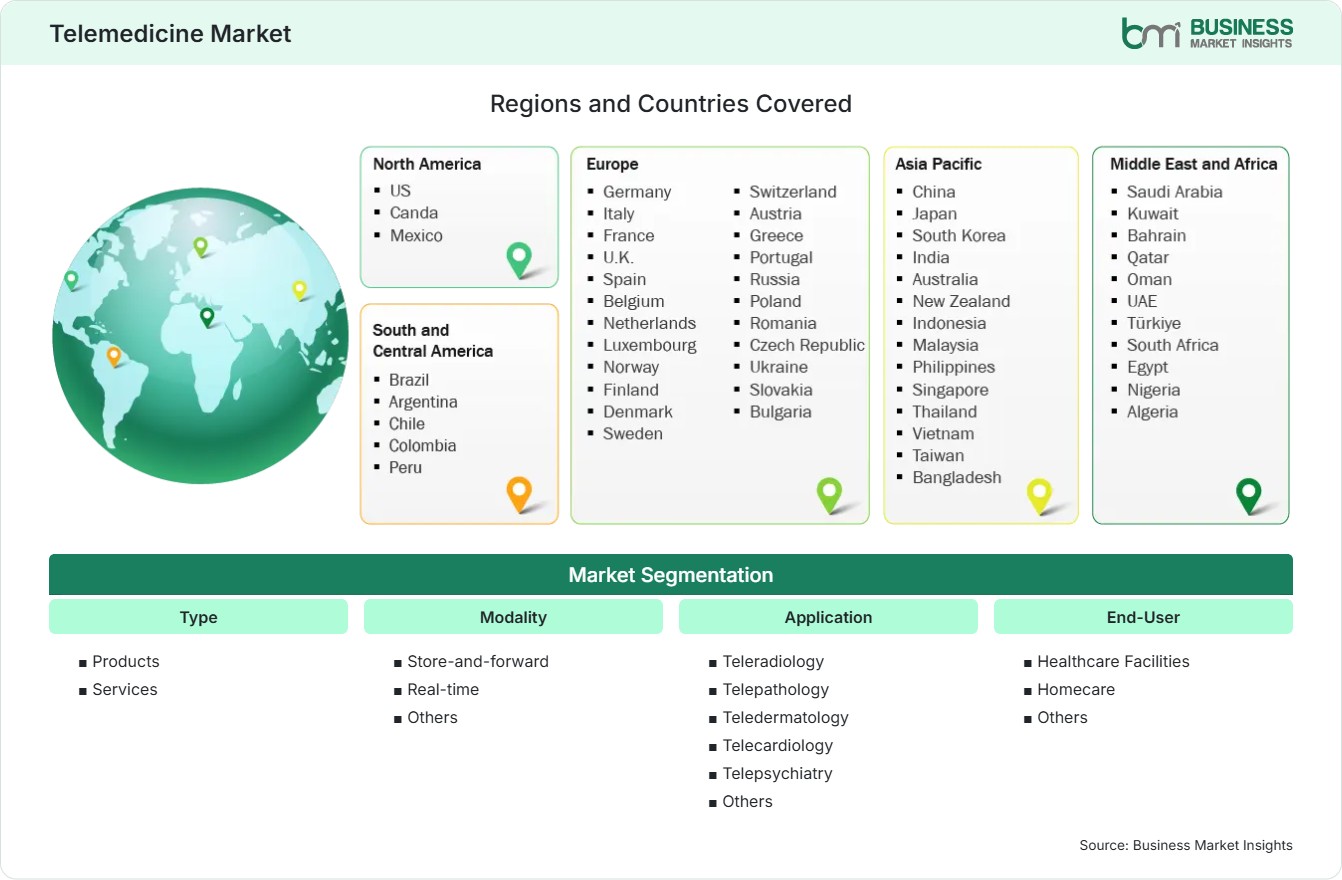
North America accounted for 37%–40% of the global market in 2025 and is projected to expand at a CAGR of 15.8%–16.5% through 2033. The region benefits from advanced healthcare digitalization, favorable reimbursement reforms, widespread broadband connectivity, and strong adoption of remote patient monitoring technologies. Healthcare providers continue integrating artificial intelligence into virtual consultations, while insurers increasingly support telehealth-based preventive care. The Telemedicine Market share remains the highest globally because of mature healthcare infrastructure, continuous innovation, and growing acceptance of hybrid care delivery across hospitals and homecare settings.
- Healthcare providers continue integrating electronic health records with virtual consultation platforms, improving clinical workflow efficiency, physician collaboration, and patient engagement while supporting broader reimbursement eligibility across public and private healthcare systems.
- Growing adoption of remote patient monitoring for cardiovascular diseases, diabetes, respiratory disorders, and post-operative recovery enables continuous care management, reducing avoidable hospital admissions while improving long-term patient outcomes across healthcare organizations.
- Artificial intelligence supports automated clinical documentation, intelligent patient triage, appointment optimization, and predictive analytics, allowing providers to improve consultation efficiency while reducing administrative workload and enhancing personalized treatment recommendations.
US Telemedicine Market
The United States Telemedicine Market represents 82%–85% of North America's regional market and is anticipated to register a CAGR of 15.9%–16.6% during 2026–2033. Strong commercial insurance participation, Medicare telehealth expansion, widespread electronic health record deployment, and continuous digital health investments support sustained adoption.
- Federal agencies continue supporting digital healthcare interoperability standards, enabling secure information exchange between hospitals, physicians, laboratories, pharmacies, and insurers while improving continuity of patient care.
- Large integrated healthcare networks increasingly deploy hybrid care models combining physical examinations with virtual follow-up consultations, improving patient satisfaction, physician productivity, and resource optimization throughout healthcare facilities.
- Growing investment in behavioral healthcare platforms, chronic disease management applications, and AI-assisted clinical support systems strengthens virtual healthcare accessibility while expanding specialized care services across urban and rural populations.
Europe Telemedicine Market
Europe Telemedicine Market held 27%–30% of global revenue in 2025 and is forecast to grow at a CAGR of 16.2%–17.0% through 2033. Government-backed healthcare digitalization strategies, expanding cross-border health data interoperability, and rising demand for elderly care services continue supporting regional adoption. Germany remains the leading national market, while Spain demonstrates one of the fastest expansion rates with an estimated CAGR between 17.4%–18.2%, supported by increasing investments in digital healthcare infrastructure and teleconsultation services.
- National digital health strategies encourage healthcare providers to integrate teleconsultation, electronic prescriptions, and secure health information exchanges, improving service accessibility while reducing administrative complexity across healthcare systems.
- Germany maintains regional leadership through extensive hospital digitalization, favorable reimbursement mechanisms, and continuous investments in artificial intelligence-supported clinical workflows and remote patient management technologies.
- Spain records accelerated expansion through increased public investment, improved broadband infrastructure, and growing consumer acceptance of virtual specialist consultations across primary and secondary healthcare services.
- Aging populations throughout Western Europe continue driving demand for remote chronic disease monitoring, medication adherence programs, and home-based healthcare services integrated with digital consultation platforms.
Asia Pacific Telemedicine Market
Asia Pacific Telemedicine Market accounted for 24%–27% of global revenue in 2025 and is expected to achieve the fastest regional expansion with a CAGR of 19.3%–20.2% through 2033. Government digital health initiatives, expanding healthcare accessibility, rapid smartphone adoption, and improving internet infrastructure continue accelerating demand. China remains the regional leader, while India demonstrates one of the highest projected growth rates with a CAGR between 20.5%–21.3%, supported by expanding digital healthcare investments and policy initiatives.
- China strengthens regional leadership through large-scale digital healthcare ecosystems, artificial intelligence deployment, expanding online hospital networks, and continuous investment in cloud-enabled healthcare platforms.
- India experiences rapid expansion through national digital health programs, growing teleconsultation adoption, increasing smartphone penetration, and broader participation from public and private healthcare providers.
- Japan and South Korea continue investing in remote elderly care solutions, wearable health technologies, and artificial intelligence-assisted diagnostics to address demographic changes and healthcare workforce shortages.
Rest of World Telemedicine Market
The Rest of World region represented 8%–10% of global revenue in 2025 and is projected to expand at a CAGR of 17.0%–17.8% through 2033. South & Central America continue benefiting from expanding mobile healthcare accessibility and digital health investments, while the Middle East & Africa increasingly prioritize healthcare modernization through government-led digital transformation initiatives. Brazil remains the leading market within South & Central America, whereas the United Arab Emirates records one of the fastest regional growth trajectories driven by smart healthcare investments.
- Brazil expands virtual healthcare accessibility through broader internet connectivity, increasing insurer participation, and supportive healthcare modernization programs improving specialist consultation availability beyond major metropolitan areas.
- The United Arab Emirates accelerates adoption through smart hospital investments, artificial intelligence integration, and government-supported healthcare digitalization strategies focused on enhancing patient experience and operational efficiency.
- Gulf Cooperation Council countries continue investing in remote healthcare infrastructure, cloud-based medical records, and secure teleconsultation platforms supporting national healthcare diversification objectives.
- African healthcare providers increasingly utilize mobile health applications and virtual consultations to improve healthcare accessibility within underserved rural populations while addressing physician shortages through digital service delivery.