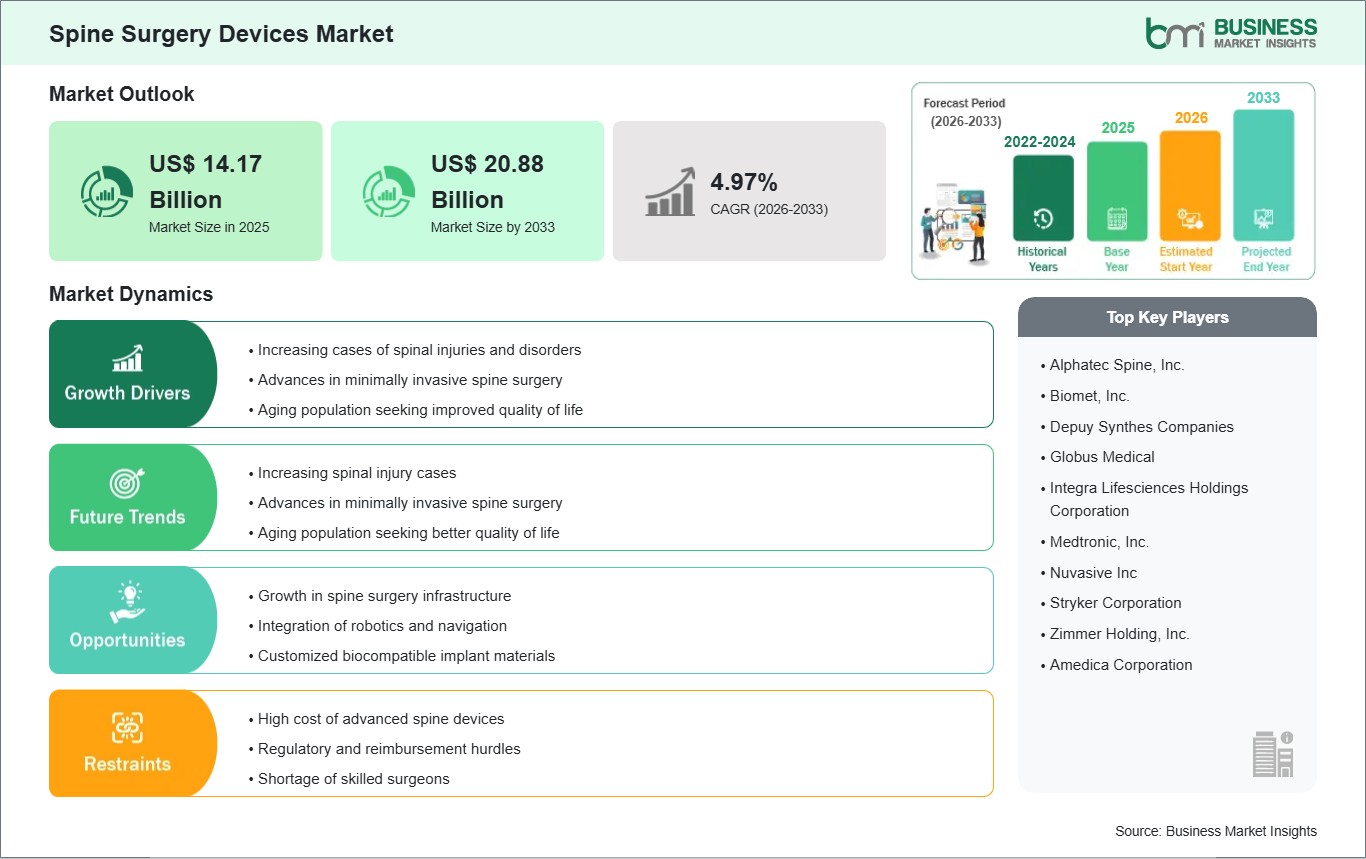
The Spine Surgery Devices Market size is expected to reach US$ 20.88 billion by 2033 from US$ 14.17 billion in 2025. The market is estimated to record a CAGR of 4.97% from 2026 to 2033.
Spine surgery devices are specialized medical tools and implants used in corrective and reconstructive procedures on the vertebral column to treat conditions such as degenerative disc disease, spinal stenosis, deformities, trauma, and fractures. The system includes multiple components which consist of implants (e.g., pedicle screws, rods, interbody cages) and biologics and motion‑preserving systems and navigation and robotic platforms and instruments for both open and minimally invasive procedures which serve to stabilize the spine and enable fusion and maintain motion while delivering surgical accuracy and better results for patients.
The global spine surgery devices market is experiencing robust expansion driven by demographic shifts and clinical demand. The combination of an aging population and increased spinal disorder cases leads to higher global surgical rates, while technological progress through robotic systems and real-time navigation and customized 3D-printed implants transforms medical work and enhances patient safety and recovery outcomes. Hospitals and ambulatory surgical centers are expanding investment in advanced devices as minimally invasive techniques become more prevalent, reducing hospital stays and complications. North America maintains leadership due to established healthcare infrastructure and reimbursement support, while Asia‑Pacific is emerging as a high‑growth region with improving access and rising healthcare expenditure. Market dynamics show that various regions face difficulties because of expensive devices and medical procedures and through strict regulatory processes and the requirement for certified experts, which results in limited acceptance. The main trends which create competitive environments for businesses and drive their upcoming development involve technological advancements and manufacturing companies forming partnerships to establish local production facilities and improve their educational programs.

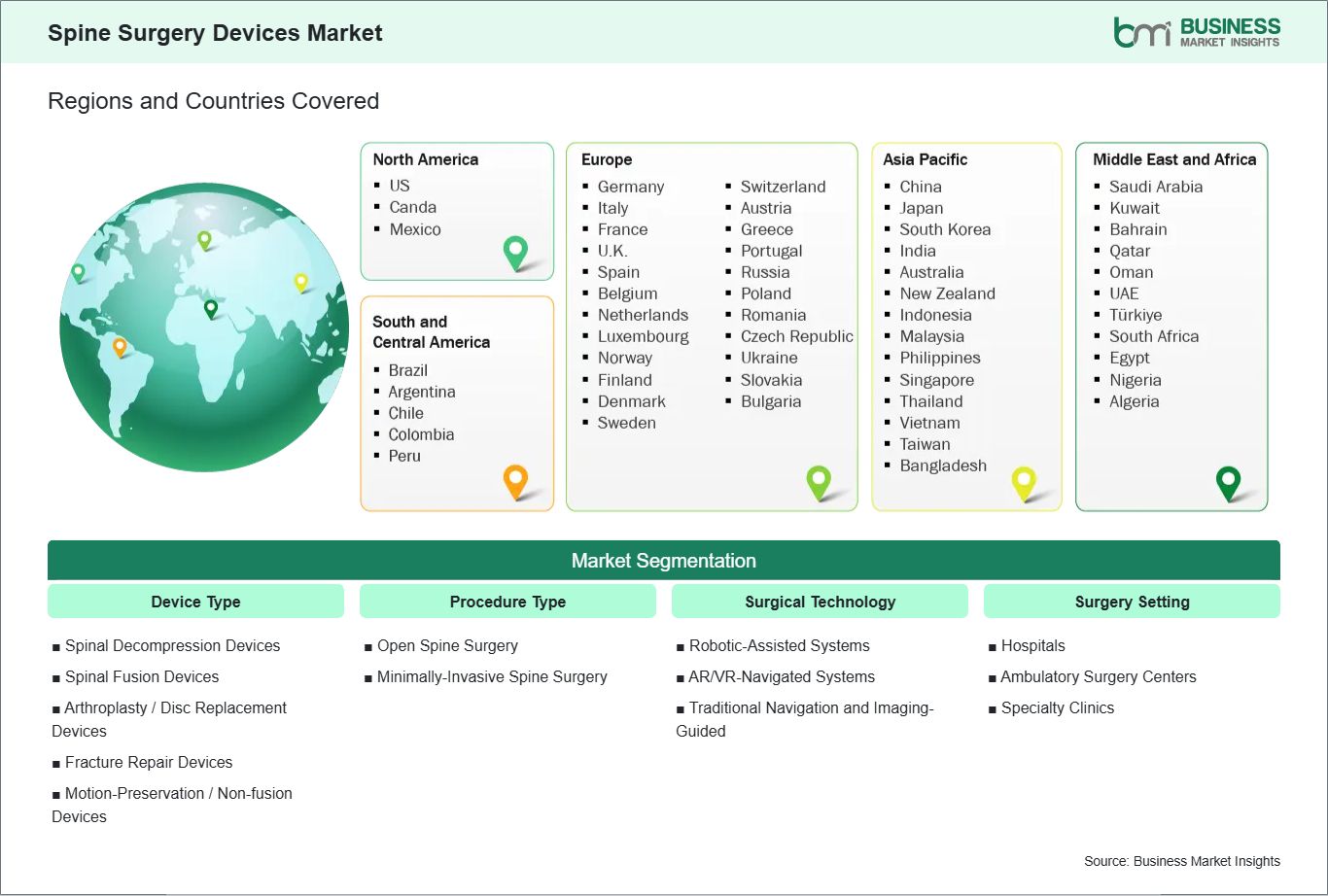
Key segments that contributed to the derivation of the spine surgery devices market analysis are device type, procedure type, surgical technology, and surgery setting.
The global spine surgery devices market experiences its primary growth driver because rising spinal disorders demand more surgical treatments which include procedures for degenerative disc disease and spinal stenosis and spinal trauma. For example, spinal stenosis affects about 10–12% of the global population and nearly 48% of adults aged over 60, which creates a higher demand for medical procedures and the use of medical devices. Surgeons now choose advanced techniques because they prefer minimally invasive procedures and robotics which provide them with better control during operations, therefore creating more opportunities to use specialized medical devices. The rising number of spinal conditions in population centers throughout the world requires more people to undergo decompression and fusion and motion-preserving surgery procedures, which results in greater demand for surgical instruments. The spine surgery devices market maintains its growth trend because clinical requirements have increased and healthcare organizations invest in patient care and patients learn about effective treatment results.
The spine surgery devices market presents a significant opportunity because technological advances now create novel surgical methods which medical professionals can use to treat new patient conditions. The industry is experiencing growth through the development of robotic-assisted spine surgery systems and AI-integrated platforms and real-time navigation systems and 3D-printed patient-specific implants. The industry has introduced new products through acquisition partnerships which combine artificial intelligence and robotics to create spine procedures with precise screw placement and real-time planning adjustments that decrease complications while improving results. Leading companies are also partnering to strengthen robotic capabilities and digital surgical ecosystems, illustrating how technological leadership can differentiate product portfolios. The market for surgical solutions will experience growth because surgeons adopt these systems for both advanced surgical procedures and minimally invasive treatments, while manufacturers who develop innovative technologies will benefit from this adoption trend.
By device type, the spine surgery devices market is categorized into spinal decompression devices, spinal fusion devices, arthroplasty / disc replacement devices, fracture repair devices, motion-preservation / non-fusion devices. The spinal fusion devices segment dominated the market in 2025. Spinal fusion devices dominance stems from their wide application in treating degenerative disc disease, spinal instability, deformities, and trauma. Fusion procedures are well established clinically with predictable long-term outcomes, driving physician preference and reimbursement support. Surgeons also rely on fusion implants (e.g., pedicle screws, interbody cages) for structural stability across diverse pathology severities.
By procedure type, the market is bifurcated into open spine surgery, minimally-invasive spine surgery. The open spine surgery segment held a larger share of the market in 2025. Open spine surgery leads because it remains the standard for complex, multi-level fusions, severe deformity corrections, and extensive neural decompressions. Its long clinical history, surgeon familiarity, and ability to directly visualize anatomy make it indispensable for challenging cases where minimally invasive access is limited or unsuitable. However, MIS is growing rapidly in simpler procedures due to lower trauma and quicker recovery.
By surgical technology, the market is segmented into robotic-assisted systems, AR/VR-navigated systems, traditional navigation and imaging-guided. The traditional navigation and imaging-guided segment held the largest share of the market in 2025. Traditional navigation and imaging guided technologies generate the most revenue as they are widely adopted across spine procedures due to established accuracy, surgeon trust, and integration with existing operating room workflows. While newer technologies like robotic assistance and AR/VR navigation are expanding fast and improving precision, traditional systems remain foundational in many surgical centers because of lower complexity, broader clinical validation, and lower incremental cost.
By surgery setting, the spine surgery devices market is segmented into hospitals, ambulatory surgery centers, specialty clinics. The hospitals segment dominated the market in 2025. Hospitals lead as the primary setting for spine surgery devices, driven by their capacity to handle complex cases, invest in costly equipment, and support multidisciplinary care teams. They maintain high patient volume, advanced imaging/OR infrastructure, and specialist surgeons, making them the default for both traditional and advanced minimally invasive or robotic procedures. Ambulatory surgical centers are growing rapidly for less complex or same day surgeries, but hospitals remain the dominant venue.

| Report Attribute | Details |
|---|---|
| Market size in 2025 | US$ 14.17 Billion |
| Market Size by 2033 | US$ 20.88 Billion |
| Global CAGR (2026 - 2033) | 4.97% |
| Historical Data | 2022-2024 |
| Forecast period | 2026-2033 |
| Segments Covered | By Device Type
|
|
Regions and Countries Covered
| |
| North America | US, Canada, Mexico |
| Europe | Belgium, Austria, Finland, Denmark, Greece, Poland, Romania, Russia, Ukraine, Czech Republic, Slovakia, Bulgaria, Italy, Luxembourg, Germany, Switzerland, France, Netherlands, Norway, Portugal, Spain, Sweden, United Kingdom |
| Asia-Pacific | Australia, China, India, Japan, South Korea, Indonesia, Malaysia, Philippines, Singapore, Thailand, Vietnam, Bangladesh, New Zealand, Taiwan |
| South and Central America | Brazil, Argentina, Peru, Chile, Colombia |
| Middle East and Africa | Bahrain, Kuwait, Oman, Qatar, Saudi Arabia, United Arab Emirates, Turkiye, South Africa, Egypt, Algeria, Nigeria |
| Market leaders and key company profiles |
|
The " Spine Surgery Devices Market Size and Forecast (2022–2033)" report provides a detailed analysis of the market covering below areas:
The geographical scope of the spine surgery devices market report is divided into five regions: North America, Asia Pacific, Europe, Middle East and Africa, and South and Central America. The spine surgery devices market in Asia Pacific is expected to grow significantly during the forecast period.
The Asia-Pacific spine surgery devices market is segmented into China, Japan, South Korea, India, Australia, New Zealand, Indonesia, Malaysia, the Philippines, Singapore, Thailand, Vietnam, Taiwan, Bangladesh, and the Rest of Asia. The Asia-Pacific spine surgery devices market is experiencing robust growth, due to several interrelated factors. The healthcare infrastructure of China, India, and Japan is experiencing rapid expansion through their increasing financial investments which enable hospitals to acquire advanced surgical technologies that include robotic-assisted systems and navigation-guided devices for performing complex spinal surgeries. The rising prevalence of spinal disorders which results from aging populations and sedentary lifestyles and increased trauma incidence creates a growing need for both corrective and minimally invasive spine surgeries. The increasing awareness of patients about advanced surgical methods has resulted in more people choosing to use spinal implants and motion-preserving devices. Spine procedures in the region see increased patient treatment rates because of government programs and insurance system changes which make treatment more affordable and accessible. International patients choose to undergo spine surgeries in Thailand and Malaysia because these countries provide affordable yet high-quality medical treatment which leads to increased medical tourism in these nations. The companies operate their own local manufacturing and distribution systems which lets them cut expenses while making their products more accessible to customers. The spine surgery devices market in the Asia-Pacific region experiences continuous growth due to these factors which establish the market as one of the fastest expanding markets in the world.

The spine surgery devices market is evaluated by gathering qualitative and quantitative data post primary and secondary research, which includes important corporate publications, association data, and databases. A few of the key developments in the spine surgery devices market are:
The Spine Surgery Devices Market is valued at US$ 14.17 Billion in 2025, it is projected to reach US$ 20.88 Billion by 2033.
As per our report Spine Surgery Devices Market, the market size is valued at US$ 14.17 Billion in 2025, projecting it to reach US$ 20.88 Billion by 2033. This translates to a CAGR of approximately 4.97% during the forecast period.
The Spine Surgery Devices Market report typically cover these key segments-
The historic period, base year, and forecast period can vary slightly depending on the specific market research report. However, for the Spine Surgery Devices Market report:
The Spine Surgery Devices Market is populated by several key players, each contributing to its growth and innovation. Some of the major players include:
The Spine Surgery Devices Market report is valuable for diverse stakeholders, including:
Essentially, anyone involved in or considering involvement in the Spine Surgery Devices Market value chain can benefit from the information contained in a comprehensive market report.
Please tell us your area of interest
(Market Segments/ Regions and Countries/ Companies)