Market Summary
Executive Summary and Global Market Analysis
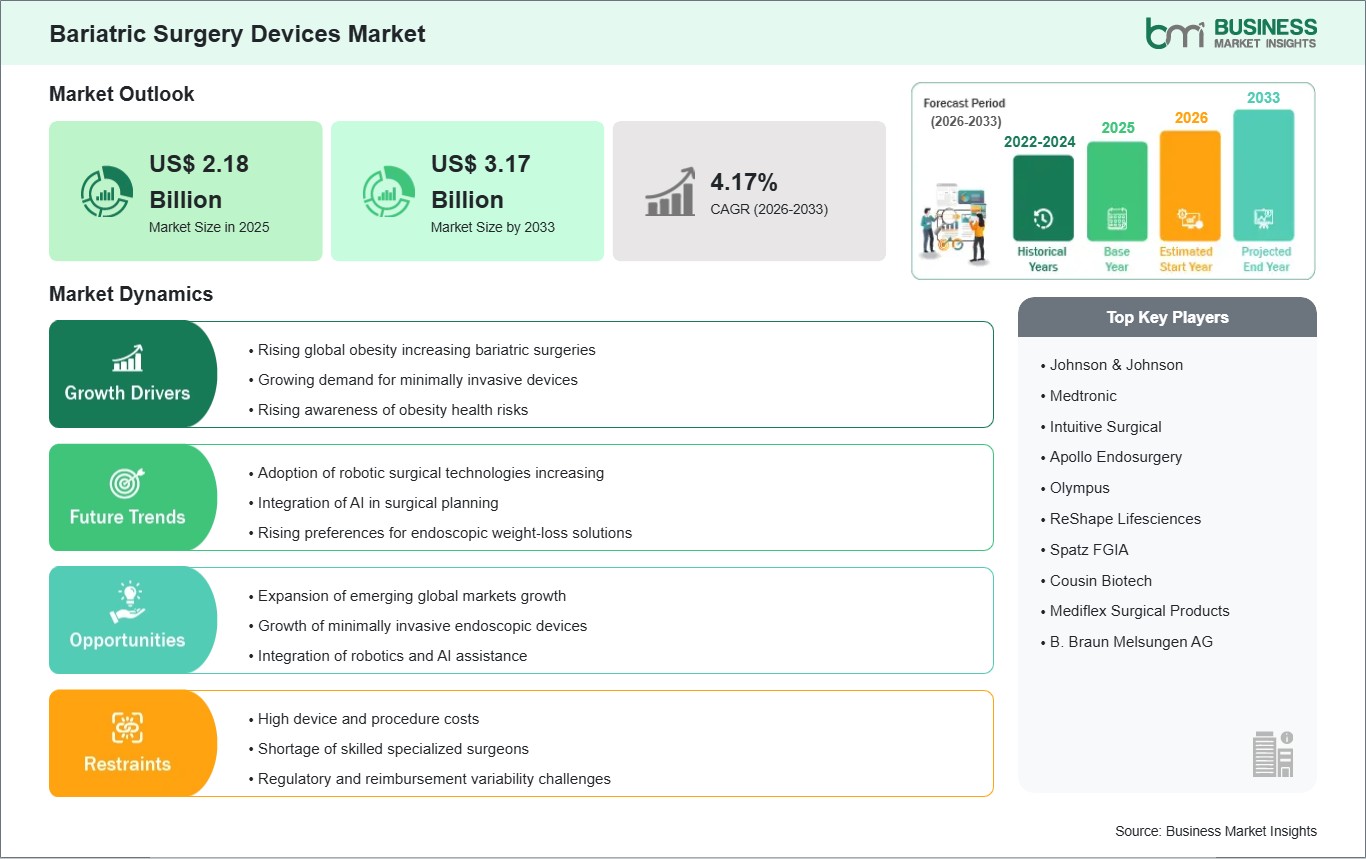
Bariatric surgery devices encompass a specialized array of surgical instruments and implantable systems designed to facilitate weight loss by altering the anatomy of the gastrointestinal tract. It provides immense strategic value by offering definitive therapeutic solutions for morbid obesity and related metabolic conditions, such as type 2 diabetes and hypertension. Market expansion is fundamentally propelled by the escalating global prevalence of obesity, which has reached epidemic proportions across both developed and developing regions. Furthermore, the shift toward minimally invasive and robotic-assisted techniques is accelerating the demand for sophisticated instrumentation that offers reduced procedural trauma and faster patient recovery. The expansion of Ambulatory Surgical Centers (ASCs), which prioritize high-efficiency outpatient revascularization, continues to serve as a primary catalyst for sustained demand.
However, several factors may restrain market progression. The high cost of advanced surgical systems and the associated hospital stay can be prohibitive for patients in regions with limited healthcare funding. Stringent regulatory pathways for Class III medical devices, particularly for novel implantable systems, necessitate extensive clinical validation and increase development timelines. Additionally, the industry faces challenges related to the rising adoption of pharmacological alternatives, such as GLP-1 receptor agonists, which may deter some patients from pursuing surgical intervention.
Despite these hurdles, the market holds significant opportunities in the integration of artificial intelligence (AI) for intraoperative guidance and the development of next-generation endoscopic devices that facilitate incision-less procedures. The rise of bariatric revision surgery, addressing weight regain or complications from previous operations, and the expansion of specialized metabolic centers in emerging economies are expected to support long-term development. Manufacturers are also finding growth potential in the development of smart stapling technologies that utilize sensors to optimize tissue compression and staple line integrity.
Segment Analysis
Bariatric Surgery Devices Market Segmentation
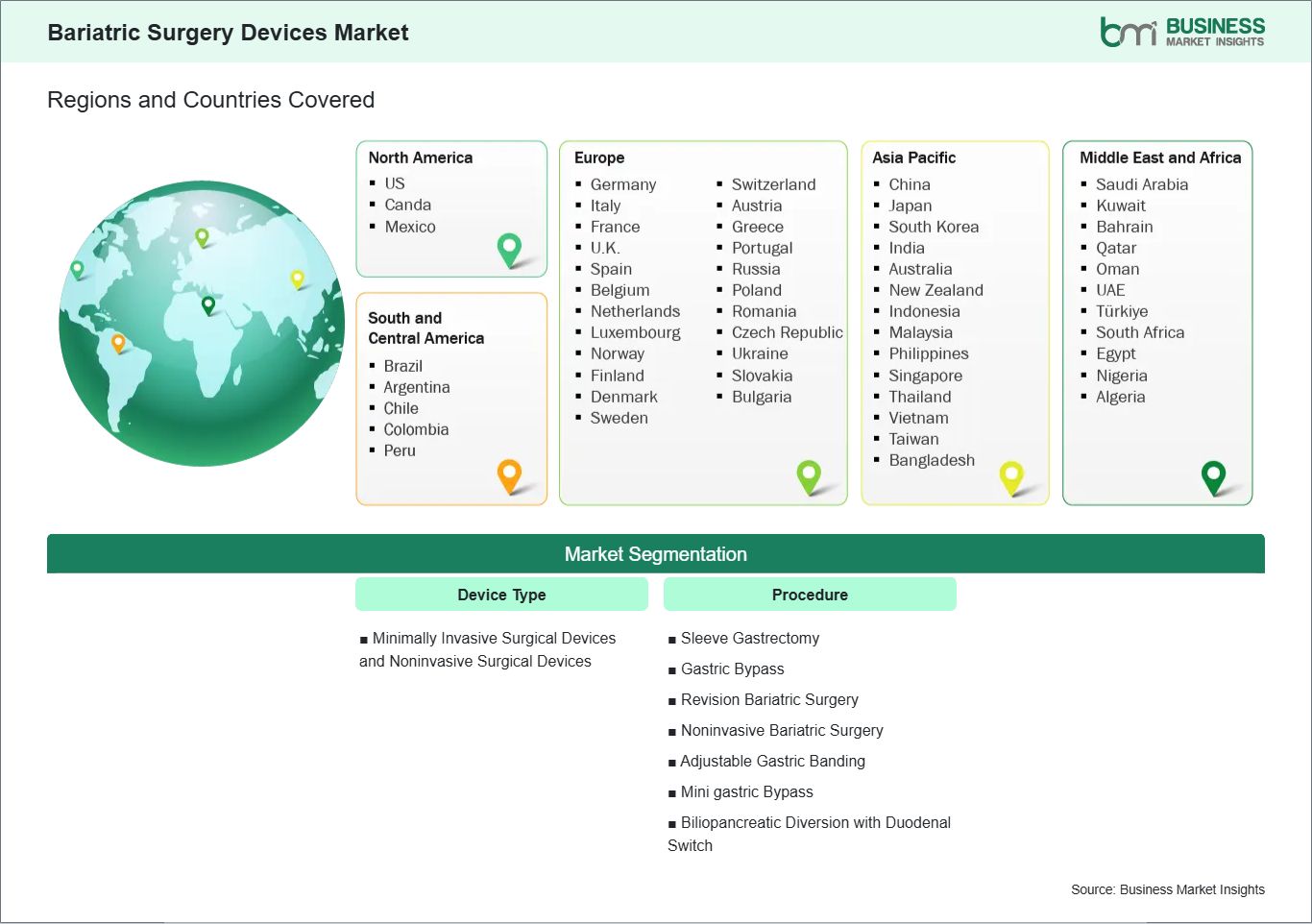
Key segments that contributed to the derivation of the Bariatric Surgery Devices market analysis are device type and procedure.
- By Device Type, the market is segmented into Minimally Invasive Surgical Devices and Noninvasive Surgical Devices.
- By Procedure, the market is divided into Sleeve Gastrectomy, Gastric Bypass, Revision Bariatric Surgery, Noninvasive Bariatric Surgery, Adjustable Gastric Banding, Mini‑gastric Bypass, and Biliopancreatic Diversion with Duodenal Switch (BPD/DS).
Market Forces
Bariatric Surgery Devices Market Drivers and Opportunities
Escalating Global Metabolic Burden and the Industrialization of Robotic Precision
The primary driver for the Bariatric Surgery Devices Market is the systemic global rise in the prevalence of severe obesity and the subsequent demand for effective, long-term weight-management solutions. The Rapid Increase in Morbid Obesity and Related Chronic Pathologies acts as a foundational catalyst, as the limitations of pharmacological and lifestyle interventions drive a record volume of patients toward surgical options. This momentum is further propelled by the Global Mainstreaming of Robotic-Assisted Bariatric Surgery; robotic platforms provide surgeons with enhanced visualization and articulating dexterity, which are critical for navigating the complex abdominal anatomy of high-BMI patients with greater safety and precision. In the technological sphere, the Development of Smart Stapling and Vessel Sealing Tools serves as a critical driver, with modern devices now utilizing real-time tissue-feedback algorithms to optimize staple-line integrity and significantly reduce the incidence of postoperative leaks. Furthermore, Expanding Insurance Coverage and Favorable Reimbursement for Metabolic Surgery are dismantling historical financial barriers, allowing specialized bariatric centers to invest in high-capital equipment and disposable portfolios. Together, these factors, disease incidence, robotic innovation, and fiscal accessibility, ensure a robust and essential growth path for the global Bariatric Surgery Devices Market.
AI-Native Surgical Planning and the Non-Invasive Endoluminal Therapies
A significant high-value opportunity lies in the convergence of Bariatric Devices with Artificial Intelligence (AI) and Digital Health Analytics. Next-generation platforms are being developed to utilize AI for preoperative surgical simulation and intraoperative navigation, helping clinicians select the optimal procedural approach based on patient-specific anatomical variations. There is also a major growth frontier in the development of Truly Non-Invasive and Reversible Weight-Loss Technologies; the rise of endoluminal suturing and smart intragastric balloons offers a lucrative opportunity to capture patients who are formerly hesitant about permanent anatomical changes. Furthermore, the expansion of Ambulatory Surgical Center (ASC)-Ready Instrument Kits presents a significant opportunity, as healthcare networks shift high-volume sleeve gastrectomies to outpatient settings to improve throughput and reduce facility costs. Beyond the hardware, the rise of Integrated Perioperative Monitoring and Remote Patient Adherence Tools offers a unique frontier, where connected devices track post-surgical recovery and nutritional compliance, ensuring sustained weight-loss success. Manufacturers who focus on Ultra-Slim Crossing Profiles for Single-Port Access and those pioneering Sustainable, Metal-Recyclable Stapler Architectures are positioned to lead the global Bariatric Surgery Devices Market.
Size and Share Analysis
Bariatric Surgery Devices Market Size and Share Analysis
The Bariatric Surgery Devices market demonstrates steady growth, with size and share analysis revealing evolving trends and competitive positioning among key players. The report examines subsegments categorized within device type and procedure, offering insights into their contribution to overall market performance.
Based on the device type, the Minimally Invasive Surgical Devices subsegment holds the primary market presence, acting as the indispensable foundational tools for the overwhelming majority of bariatric procedures performed globally. These systems, comprising advanced staplers, vessel sealers, and trocars, maintain a dominant influence due to their proven ability to reduce tissue trauma, post-operative pain, and hospital duration. Noninvasive Surgical Devices provide a critical alternative for patients seeking scarless interventions. A notable trend is the surge in the Robotic-Assisted and Smart Stapling subsegments, which are registering the highest pace of adoption. These technologies are becoming essential for Intraoperative Tissue Intelligence, as the move toward platforms that provide real-time feedback on tissue thickness and compression allows for the creation of superior, leak-resistant staple lines in challenging anatomical environments.
Report Coverage
Bariatric Surgery Devices Market Report Coverage and Deliverables
The "Bariatric Surgery Devices Market Size and Forecast (2022–2033)" report provides a detailed analysis of the market covering below areas:
- Bariatric Surgery Devices market size and forecast at global, regional, and country levels for all market segments covered under the scope
- Bariatric Surgery Devices market trends, as well as drivers, restraints, and opportunities
- Bariatric Surgery Devices market analysis covering key trends, global and regional framework, major players, regulations, and recent developments
- Industry landscape and competition analysis covering market concentration, heat map analysis, prominent players, and recent developments for the Bariatric Surgery Devices market
- Detailed company profiles, including SWOT analysis
Geographic Insights
Bariatric Surgery Devices Market Geographic Insights
The geographical scope of the Bariatric Surgery Devices market report is divided into five regions: North America, Asia Pacific, Europe, Middle East & Africa, and South & Central America.
North America maintains the preeminent market position, supported by a highly developed healthcare infrastructure and a substantial clinical demand driven by a significant population requiring metabolic intervention. Europe represents a mature and technologically advanced market where growth is sustained by strong government-funded healthcare programs and a rigorous institutional focus on reducing long-term comorbidities such as type 2 diabetes through surgical weight management. Asia Pacific is identified as the most rapidly advancing region, propelled by accelerating healthcare modernization, increasing investments in specialized bariatric centers, and a rising awareness of minimally invasive weight-loss solutions in emerging economies.
The Asia-Pacific Bariatric Surgery Devices Market is witnessing a notable transition as private healthcare networks in China, India, and Japan expand their bariatric portfolios to address the needs of an increasing urban patient population. China serves as a central engine for regional expansion, driven by large-scale government programs to enhance hospital capacity and a growing adoption of advanced surgical staplers and energy devices. India is experiencing significant growth in medical tourism, offering high-quality, cost-effective bariatric interventions that attract an international patient base, thereby solidifying the region's role as a vital hub for the evolution and future scaling of the industry.
Industry Activity
Recent Developments
Bariatric Surgery Devices Market is evaluated by gathering qualitative and quantitative data post primary and secondary research, which includes important corporate publications, association data, and databases. A few of the key developments in the Bariatric Surgery Devices market are:
- In June 2025, Johnson & Johnson MedTech launched the ETHICON™ 4000 Stapler with advanced 3D stapling technology, enhancing staple line integrity and reducing surgical complications. The device, showcased at the American Society for Metabolic and Bariatric Surgery Annual Meeting, supports bariatric procedures and signals positive growth for the market.
- In November 2025, Nitinotes received CE Mark approval for EndoZip™, the first fully automated suturing system for endoscopic sleeve gastroplasty, enabling faster, single-physician bariatric procedures. The launch in Europe expands access to minimally invasive obesity treatments and strengthens market growth potential.
Trust & Transparency
Research Methodology
The market analysis combines proprietary research with secondary data from government agencies, company disclosures, regulatory filings, industry databases and expert interviews. Market estimates are validated through data triangulation, cross-market benchmarking and analyst
review.
View Full Research Methodology
Key Sources Referred:
World Bank – Global Trade IndicatorsWorld Trade Organization (WTO)(International Monetary Fund )IMFInternational Trade Administration (ITA)Company websiteCompany annual reportsCompany investor presentations