Orthopedic Devices Market Outlook (2022-2033)

Historic Data: 2022 - 2024   |   Base Year: 2025   |   Forecast Period: 2026-2033
Report Content: Market Scope, Market Segmentation, Market Dynamics, and Competitive Analysis

Report Coverage:
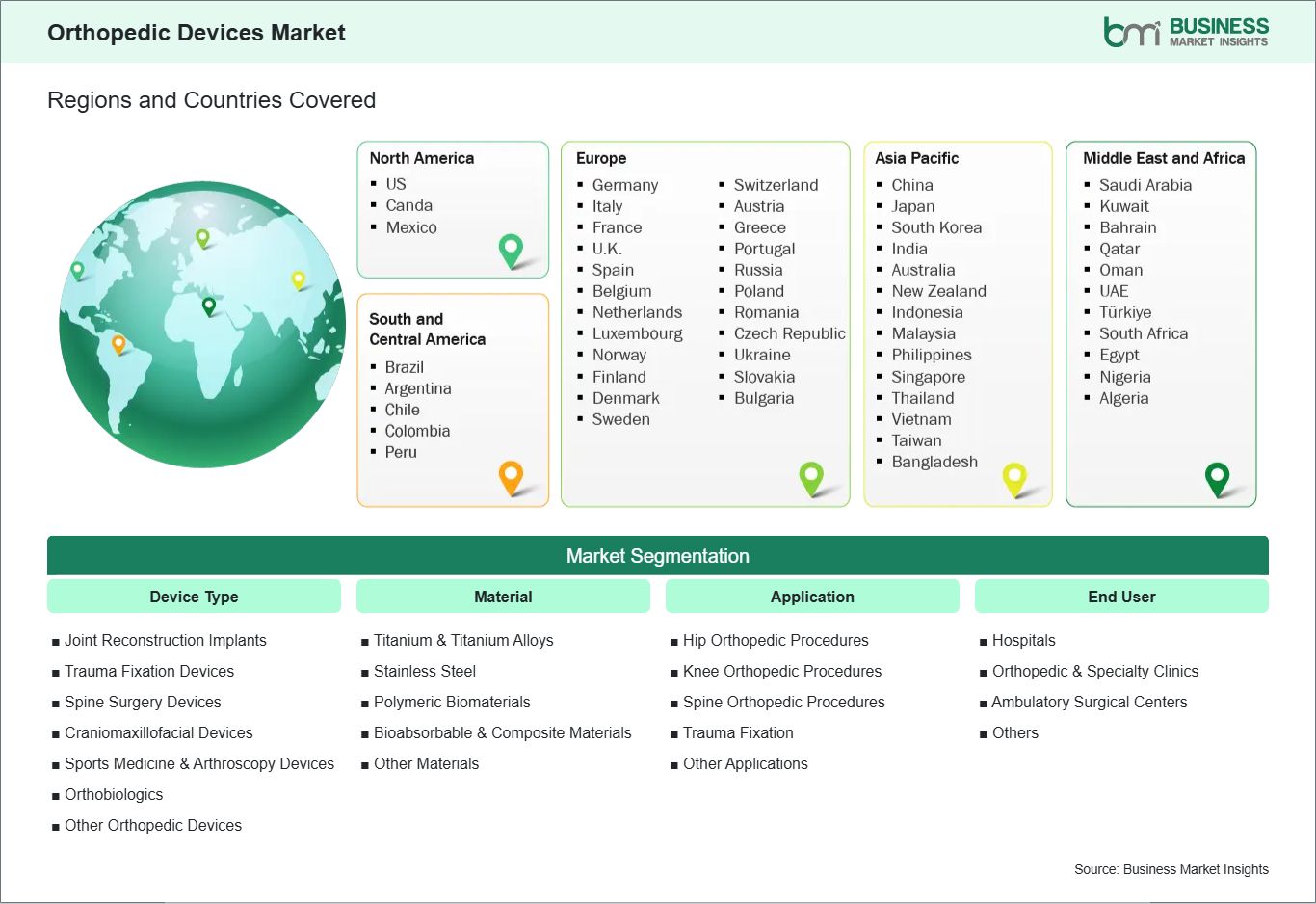
  • Device Type (Joint Reconstruction Implants, Trauma Fixation Devices, Spine Surgery Devices, Craniomaxillofacial Devices, Sports Medicine & Arthroscopy Devices, Orthobiologics, Other Orthopedic Devices)
  • Material (Titanium & Titanium Alloys, Stainless Steel, Polymeric Biomaterials, Bioabsorbable & Composite Materials, Other Materials)
  • Application (Hip Orthopedic Procedures, Knee Orthopedic Procedures, Spine Orthopedic Procedures, Trauma Fixation, Other Applications)
  • End User (Hospitals, Orthopedic & Specialty Clinics, Ambulatory Surgical Centers (ASCs), Others)

No. of Pages: 400
Report Code: BMIPUB00032508
Category: Life Sciences
Orthopedic Devices Market
Buy Now

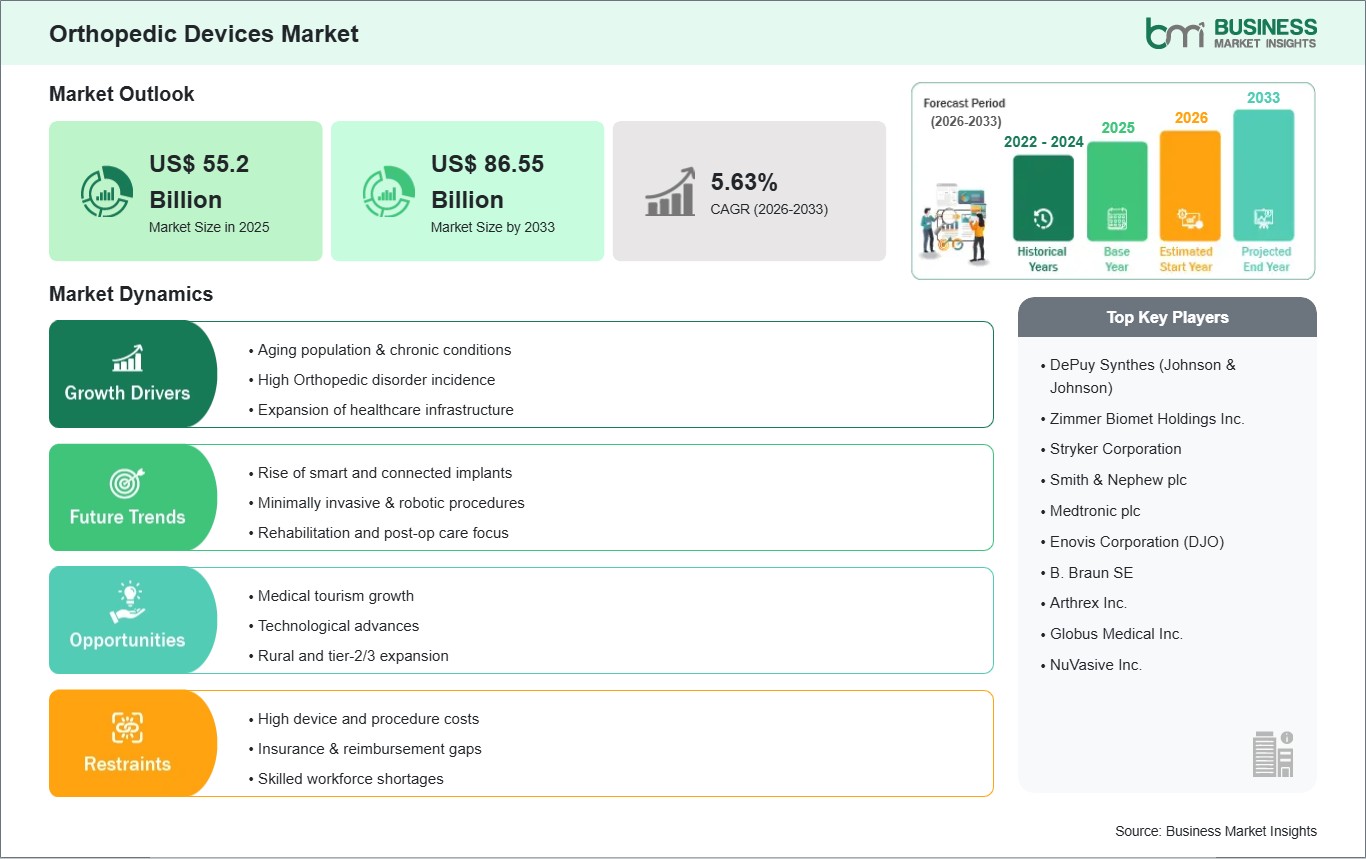
The orthopedic devices market size is expected to reach US$ 86.55 billion by 2033 from US$ 55.20 billion in 2025. The market is estimated to record a CAGR of 5.63% from 2026 to 2033.

Executive Summary and Global Market Analysis:

Orthopedic equipment refers to medical tools used to diagnose, treat, or support the healing of conditions and injuries affecting bones, ligaments, muscles, and related tissues in the musculoskeletal system. The orthopedic device market is a substantial and steadily growing segment of the medical device industry. Growth is driven by an increasing number of people with musculoskeletal issues, an aging population, and the expanded use of new technology for sports injuries and surgeries. Older adults worldwide continue to be a key source of demand.

New technologies, including robotics, 3D printing, biomaterials, and digital health tools, are enhancing patient outcomes and recovery. Improved healthcare systems and increased insurance coverage in emerging markets also support growth. However, challenges remain, including the high cost of surgeries, stringent regulations, and implant failure. The growing use of robots in orthopedic surgery is a major factor behind market growth. For instance, Stryker UK Limited reports that almost 13,000 patients worldwide have Mako robotic arm surgery each month. Robotic-assisted surgery offers greater precision and less tissue damage. Advanced imaging and real-time feedback enable patients to recover more quickly and effectively. Robots also help create treatment plans tailored to each person's anatomy. This leads to better results and fewer complications.

The market is also growing due to the introduction of new orthopedic devices and the improvement of healthcare infrastructure. More people are aware of and have access to minimally invasive surgery, which offers many benefits. Participation in sports and active lifestyles is on the rise. As a result, sports injuries are becoming more common. These injuries often require medical care and contribute to market growth. According to the American Academy of Pediatrics and the National SAFE KIDS Campaign, over 3.5 million children under 14 are injured each year while playing sports or doing recreational activities. More than 775,000 children in this age group visit emergency rooms every year for sports-related injuries.

Orthopedic Devices Market - Strategic Insights:

global-market-strategic-framework
Get more information on this report

Orthopedic Devices Market Segmentation Analysis:

Key segments that contributed to the derivation of the orthopedic devices market analysis are device type, material, application, and end user.

  • By device type, the orthopedic devices market is bifurcated into joint reconstruction implants, trauma fixation devices, spine surgery devices, craniomaxillofacial devices, sports medicine & arthroscopy devices, orthobiologics, other orthopedic devices. The joint reconstruction implants segment dominated the market in 2025.
  • By material, the market is bifurcated into titanium & titanium alloys, stainless steel, polymeric biomaterials, bioabsorbable & composite materials, other materials. The titanium & titanium alloys segment held the largest share of the market in 2025.
  • By application, the market is segmented into hip orthopedic procedures, knee orthopedic procedures, spine orthopedic procedures, trauma fixation, other applications. The knee orthopedic procedures segment held the largest share of the market in 2025.
  • By end user, the market is segmented into hospitals, orthopedic & specialty clinics, ambulatory surgical centers (ASCs), others. The hospitals segment held the largest share of the market in 2025.
  • Orthopedic Devices Market Drivers and Opportunities:

    Aging Population Driving Degenerative-Joint Procedures

    The global orthopedic solutions market is being driven by the demand created by the aging population. Aging is one of the primary factors contributing to bone weakening due to the extensive loss of bone mass, which typically occurs between the ages of 25 and 54. After 55, the decrease in bone density becomes even more pronounced, thus facilitating market growth. It is projected that the population aged 60 years and above will experience a significant increase by 2030. It is also anticipated that one in six people worldwide will belong to this age category. By 2050, this number is projected to reach 2.1 billion, thus doubling the previous figure.

    Moreover, the ever-increasing technological advancements in the orthopedic sector are in turn accelerating market growth. In November 2023, the UCLA School of Dentistry, in collaboration with a group of researchers from other institutions, announced the unveiling of a new dental implant technology that utilizes ultraviolet (UV) light. The new method consists of a one-minute UV light treatment of titanium implants, followed by a one-minute UV light treatment of the same implants. The procedure effectively detaches hydrocarbons from the surface, thereby greatly reducing the possibility of complications after treatment. The introduction of state-of-the-art technologies will lead to the widespread adoption of dental implants, which in turn will drive market growth.

    By 2030, hip replacements in the US are expected to reach 635,000, while knee replacements are projected to rise to 1.28 million. This shows that more people, especially older adults, are choosing large-joint implants. Similar patterns are seen in other countries. For example, Colombia is projected to have 39,270 lower limb arthroplasties by 2050, and Germany may experience a 55% increase in total knee arthroplasties by 2040. Younger, active people are also opting for surgery, which helps implants last longer and leads to greater use of high-quality materials. To keep up, healthcare systems need to expand surgical capacity, strengthen rehabilitation services, and find more effective ways to track patient outcomes. These changes will help manage the growing number of procedures.

    Technological Advances in 3-D Printed & Bioabsorbable Implants

    The technological progress in the realm of 3D-printed and bioabsorbable implants is an issue that has a large upside in the orthopedic devices market because it has the potential to offer more personal, efficient, and patient-centered treatment solutions. Implants with the assistance of a 3D printer can totally be designed and manufactured to suit the anatomy of the individual patient, thus resulting in a better fit, heightened stability, and an overall improvement in surgical outcomes, as well as a decrease in operating time and the number of post-operative complications. This whole situation in terms of a patient's specific needs and concerns is of immense worth especially in difficult orthopedic cases like trauma reconstruction, correction of spinal deformities, and revision surgeries, where the use of a standard implant may not give rise to the best possible results.

    Moreover, the area of 3D printing provides very fast prototyping and very low-cost production of small batches, which means the manufacturers are in a position to push their innovations and reduce the time taken to get the products into the market at the same time. The bioabsorbable implants are offering a great enhancement to this opportunity as they tackle the problems that have been associated with the permanent metallic world for the longest time, such as the irritation that lasts for a very long time, the implant failure, and the secondary surgery that has to be one for the removal of the implant. The implant is designed to dissolve by itself in the body over the period of time when the natural healing process is taking place; therefore, it has less surgical risk, costs less, and the patient has fewer days in the hospital before he/she recovers.

    The adoption of the trend that is coming along with the increased demand for less invasive operations, prompt recovery and tailored patient care is being further accelerated. Additionally, the market penetration is being strengthened by higher expenses on research and development, medical devices with a supportive regulatory pathway, and partnership between orthopedic manufacturers, hospitals, and tech companies. When health care systems are leaning more and more towards the value-based care, the 3D-printed and bio-absorbable implants are bringing a disruptive chance to enhance clinical efficacy, lower total treatment expenses, and generate environmentally friendly growth in the orthopedic devices market.

    Orthopedic Devices Market Size and Share Analysis:

    By device type, the orthopedic devices market is bifurcated into joint reconstruction implants, trauma fixation devices, spine surgery devices, craniomaxillofacial devices, sports medicine & arthroscopy devices, orthobiologics, other orthopedic devices. The joint reconstruction implants segment dominated the market in 2025. There is no doubt that joint reconstruction implants are the top sellers in the market due to the rampant cases of osteoarthritis, more old people, and greater worldwide acceptance of hip and knee replacements.

    By material, the market is bifurcated into titanium & titanium alloys, stainless steel, polymeric biomaterials, bioabsorbable & composite materials, other materials. The titanium & titanium alloys segment held the largest share of the market in 2025. Titanium and titanium alloys have been the most used materials because of their combination of wonderful properties like strength, resistance to corrosion, compatibility with the body, and long-lasting life in the case of orthopedic implants.

    By application, the market is segmented into hip orthopedic procedures, knee orthopedic procedures, spine orthopedic procedures, trauma fixation, other applications. The knee orthopedic procedures segment held the largest share of the market in 2025. Knee orthopedic procedures are the most treated ones in the orthopedic field because of the great number of people suffering from knee arthritis, the large number of sports injuries, obesity-related joint harm, and the increasing demand for knee replacements.

    By end user, the market is segmented into hospitals, orthopedic & specialty clinics, ambulatory surgical centers (ASCs), others. The hospitals segment held the largest share of the market in 2025. Hospitals are still the major consumers since they have top-notch surgical equipment, experts in orthopedics, a huge number of patients, and post-operative services that include taking very good care of the patients.

    Orthopedic Devices Market Report Highlights:

    Report Attribute Details
    Market size in 2025 US$ 55.2 Billion
    Market Size by 2033 US$ 86.55 Billion
    Global CAGR (2026 - 2033)5.63%
    Historical Data 2022 - 2024
    Forecast period 2026-2033
    Segments Covered By Device Type
    • Joint Reconstruction Implants
    • Trauma Fixation Devices
    • Spine Surgery Devices
    • Craniomaxillofacial Devices
    • Sports Medicine & Arthroscopy Devices
    • Orthobiologics
    • Other Orthopedic Devices
    By Material
    • Titanium & Titanium Alloys
    • Stainless Steel
    • Polymeric Biomaterials
    • Bioabsorbable & Composite Materials
    • Other Materials
    By Application
    • Hip Orthopedic Procedures
    • Knee Orthopedic Procedures
    • Spine Orthopedic Procedures
    • Trauma Fixation
    • Other Applications
    By End User
    • Hospitals
    • Orthopedic & Specialty Clinics
    • Ambulatory Surgical Centers
    • Others
    Regions and Countries Covered North America
    • US
    • Canada
    • Mexico
    Europe
    • Belgium
    • Austria
    • Finland
    • Denmark
    • Greece
    • Poland
    • Romania
    • Russia
    • Ukraine
    • Czech Republic
    • Slovakia
    • Bulgaria
    • Italy
    • Luxembourg
    • Germany
    • Switzerland
    • France
    • Netherlands
    • Norway
    • Portugal
    • Spain
    • Sweden
    • United Kingdom
    Asia-Pacific
    • Australia
    • China
    • India
    • Japan
    • South Korea
    • Indonesia
    • Malaysia
    • Philippines
    • Singapore
    • Thailand
    • Vietnam
    • Bangladesh
    • New Zealand
    • Taiwan
    South and Central America
    • Brazil
    • Argentina
    • Peru
    • Chile
    • Colombia
    Middle East and Africa
    • Bahrain
    • Kuwait
    • Oman
    • Qatar
    • Saudi Arabia
    • United Arab Emirates
    • Turkiye
    • South Africa
    • Egypt
    • Algeria
    • Nigeria
    Market leaders and key company profiles
    • DePuy Synthes (Johnson & Johnson)
    • Zimmer Biomet Holdings Inc.
    • Stryker Corporation
    • Smith & Nephew plc
    • Medtronic plc
    • Enovis Corporation (DJO)
    • B. Braun SE
    • Arthrex Inc.
    • Globus Medical Inc.
    Get more information on this report

    Orthopedic Devices Market Report Coverage and Deliverables:

    The Orthopedic devices Market Size and Forecast (2025-2033) report provides a detailed analysis of the market covering below areas:

    • Orthopedic devices market size and forecast at global, regional, and country levels for all the key market segments covered under the scope
    • Orthopedic devices market trends, as well as market dynamics such as drivers, restraints, and key opportunities
    • Orthopedic devices market analysis covering key market trends, global and regional framework, major players, regulations, and recent market developments
    • Industry landscape and competition analysis covering market concentration, heat map analysis, prominent players, and recent developments for the Orthopedic devices market
    • Detailed company profiles, including SWOT analysis
    • Orthopedic Devices Market Geographic Insights:

      The geographical scope of the orthopedic devices market report is divided into five regions: North America, Asia Pacific, Europe, Middle East & Africa, and South & Central America. The orthopedic devices market in Asia Pacific is expected to grow significantly during the forecast period.

      The Asia-Pacific Orthopedic devices market is segmented into China, Japan, South Korea, India, Australia, and the Rest of Asia. Market in Asia Pacific is growing at a fast pace which is primarily attributed to the rising incidence of musculoskeletal disorders, the growth of the human population, and an increased number of injuries from accidents and sports. Better healthcare facilities, more hospitals, and more orthopedic surgeries being done are some of the factors that lead to market growth in this area. The region is experiencing a rapid growth of the orthopedic market because of the increasing awareness about the different treatment options available, the advancement in diagnostic techniques, and the government policies geared towards improving healthcare access. Furthermore, the growing demand for joint replacement surgeries, spinal implants, and minimally invasive procedures is luring global orthopedic device manufacturers to invest in the area.

      Besides, the increasing number of people traveling for medical treatments in places like India, Thailand, and Malaysia coupled with the fact that these treatments are much cheaper than in the Western markets is providing a strong support to the orthopedic devices market. In addition, the financial backing from the government for medical procedures and the growing healthcare budget are among the factors that keep the Philippines a major market for these products.         

      global-market-geography
      Get more information on this report

      Orthopedic Devices Market Research Report Guidance:

    • The report includes qualitative and quantitative data in the orthopedic devices market across product, material, and end user, and geography.
    • The report starts with the key takeaways (chapter 2), highlighting the key trends and outlook of the orthopedic devices market.
    • Chapter 3 includes the research methodology of the study.
    • Chapter 4 further includes ecosystem analysis.
    • Chapter 5 highlights the major industry dynamics in the orthopedic devices market, including factors that are driving the market, prevailing deterrents, potential opportunities, as well as future trends. Impact analysis of these drivers and restraints is also covered in this section.
    • Chapter 6 discusses the orthopedic devices market scenario, in terms of historical market revenues, and forecast till the year 2031.
    • Chapters 7 to 11 cover orthopedic devices market segments by device type, material, application, end user, and geography across North America, Europe, Asia Pacific, Middle East and Africa, and South and Central America. They cover the market value revenue forecast and factors driving the market.
    • Chapter 12 describes the competitive analysis along with the heat map analysis for the key players operating in the market.
    • Chapter 13 describes the industry landscape analysis. It provides detailed descriptions of business activities such as market initiatives, new developments, mergers, and joint ventures globally, along with a competitive landscape.
    • Chapter 14 provides detailed profiles of the major companies operating in the orthopedic devices market. Companies have been profiled on the basis of their key facts, business descriptions, products and services, financial overview, SWOT analysis, and key developments.
    • Chapter 15, i.e., the appendix is inclusive of a brief overview of the company, list of abbreviations, and disclaimer.
    • Orthopedic Devices Market News and Key Development:

      The orthopedic devices market is evaluated by gathering qualitative and quantitative data post primary and secondary research, which includes important corporate publications, association data, and databases. A few of the key developments in the orthopedic devices market are:

      • In January 2025, Stryker finalized an agreement to sell its spinal implant business segment to Viscogliosi Brothers, LLC (US), leading to the creation of a new entity, VB Spine, LLC, which will oversee the acquired spinal implant operations.
      • In December 2025, Zimmer Biomet received FDA clearance for the Persona Solution PPS Femur, a total knee implant specifically designed for patients sensitive to bone cement or metal, thereby expanding treatment options in orthopedic knee replacement procedures.
      • In July 2025, Smith+Nephew partnered with Healthcare Outcomes Performance Company (US) to provide healthcare professionals, patients, and ASCs with enhanced solutions by leveraging the company’s digital analytics platform for improved outcomes and operational efficiency.
      • Key Sources Referred:

        • World Bank – Global Trade Indicators
        • European Chemicals Agency
        • International Council of Chemical Associations
        • (International Monetary Fund )IMF
        • World Trade Organization (WTO)
        • International Trade Administration (ITA)
        • Company website
        • Company annual reports
        • Company investor presentations

The List of Companies - Orthopedic Devices Market

  • DePuy Synthes (Johnson & Johnson)
  • Zimmer Biomet Holdings Inc.
  • Stryker Corporation
  • Smith & Nephew plc
  • Medtronic plc
  • Enovis Corporation (DJO)
  • B. Braun SE
  • Arthrex Inc.
  • Globus Medical Inc.
  • NuVasive Inc.
Frequently Asked Questions
How big is the Orthopedic Devices Market?

The Orthopedic Devices Market is valued at US$ 55.2 Billion in 2025, it is projected to reach US$ 86.55 Billion by 2033.

What is the CAGR for Orthopedic Devices Market by (2026 - 2033)?

As per our report Orthopedic Devices Market, the market size is valued at US$ 55.2 Billion in 2025, projecting it to reach US$ 86.55 Billion by 2033. This translates to a CAGR of approximately 5.63% during the forecast period.

What segments are covered in this report?

The Orthopedic Devices Market report typically cover these key segments-

  • Device Type (Joint Reconstruction Implants, Trauma Fixation Devices, Spine Surgery Devices, Craniomaxillofacial Devices, Sports Medicine & Arthroscopy Devices, Orthobiologics, Other Orthopedic Devices)
  • Material (Titanium & Titanium Alloys, Stainless Steel, Polymeric Biomaterials, Bioabsorbable & Composite Materials, Other Materials)
  • Application (Hip Orthopedic Procedures, Knee Orthopedic Procedures, Spine Orthopedic Procedures, Trauma Fixation, Other Applications)
  • End User (Hospitals, Orthopedic & Specialty Clinics, Ambulatory Surgical Centers (ASCs), Others)

What is the historic period, base year, and forecast period taken for Orthopedic Devices Market?

The historic period, base year, and forecast period can vary slightly depending on the specific market research report. However, for the Orthopedic Devices Market report:

  • Historic Period : 2022 - 2024
  • Base Year : 2025
  • Forecast Period : 2026-2033
  • Who are the major players in Orthopedic Devices Market?

    The Orthopedic Devices Market is populated by several key players, each contributing to its growth and innovation. Some of the major players include:

  • DePuy Synthes (Johnson & Johnson)
  • Zimmer Biomet Holdings Inc.
  • Stryker Corporation
  • Smith & Nephew plc
  • Medtronic plc
  • Enovis Corporation (DJO)
  • B. Braun SE
  • Arthrex Inc.
  • Globus Medical Inc.
  • NuVasive Inc.
  • Who should buy this report?

    The Orthopedic Devices Market report is valuable for diverse stakeholders, including:

    • Investors: Provides insights for investment decisions pertaining to market growth, companies, or industry insights. Helps assess market attractiveness and potential returns.
    • Industry Players: Offers competitive intelligence, market sizing, and trend analysis to inform strategic planning, product development, and sales strategies.
    • Suppliers and Manufacturers: Helps understand market demand for components, materials, and services related to concerned industry.
    • Researchers and Consultants: Provides data and analysis for academic research, consulting projects, and market studies.
    • Financial Institutions: Helps assess risks and opportunities associated with financing or investing in the concerned market.

    Essentially, anyone involved in or considering involvement in the Orthopedic Devices Market value chain can benefit from the information contained in a comprehensive market report.

    Available Report Formats

    pdf-format excel-format pptx-format
    Buy Now

    Customization Form

    Please tell us your area of interest
    (Market Segments/ Regions and Countries/ Companies)