Market Summary
Executive Summary and Global Market Analysis
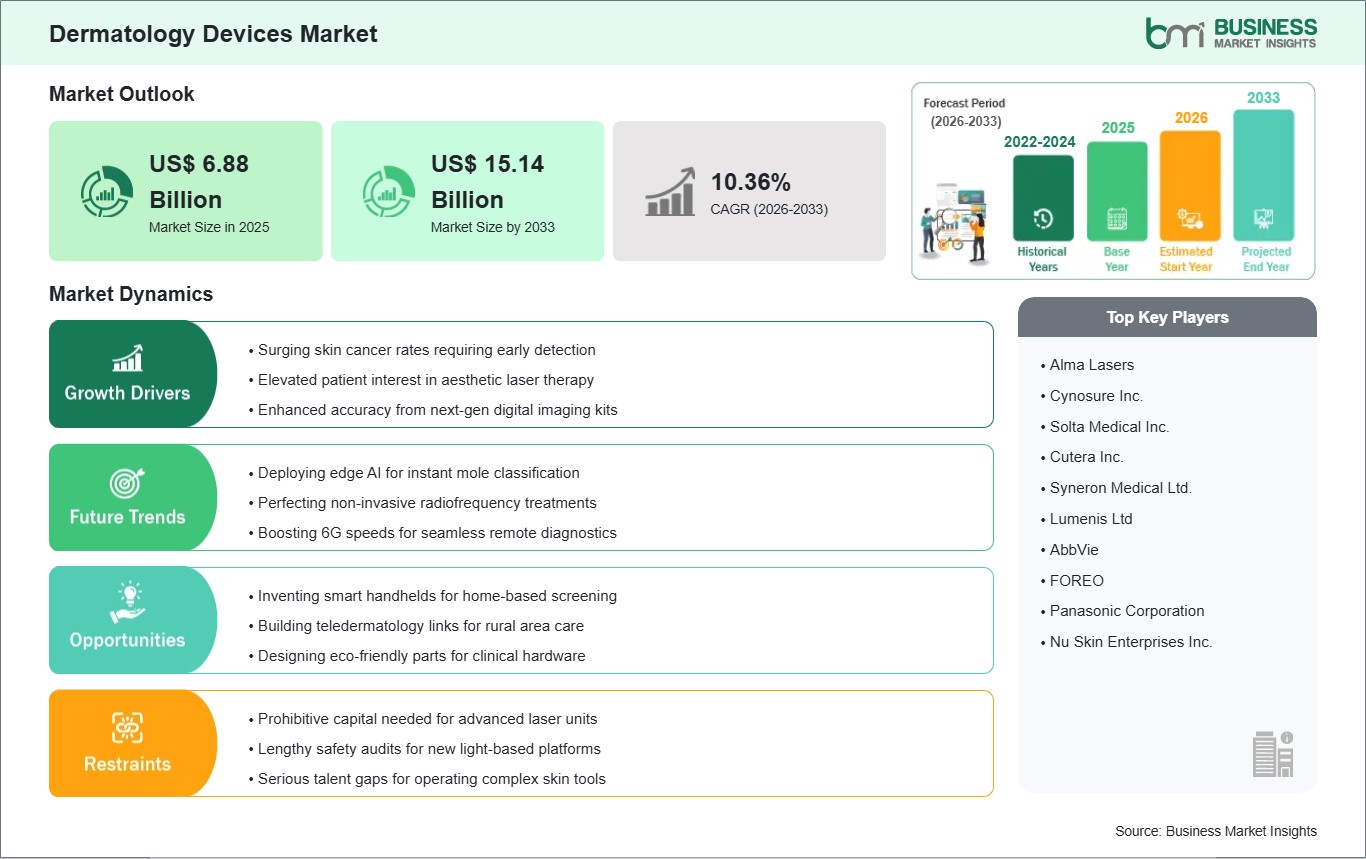
Dermatology devices encompass a range of advanced tools used for diagnosing and treating skin conditions. Lasers, LED therapy systems, imaging devices, and electrosurgical units enable precise, non-invasive or minimally invasive interventions, improving patient outcomes in skin cancer detection, cosmetic enhancements, and chronic dermatological disorders. Robotic-assisted elements and AI integration are emerging in high-end systems for automated lesion analysis.
The Dermatology Devices market is experiencing steady growth, driven by the rising incidence of skin cancers, increasing demand for aesthetic treatments amid social media influence, and growing awareness of personalized skincare. Expansion is further supported by an aging population susceptible to skin conditions, technological advancements in laser and light-based therapies, and the shift toward outpatient procedures in dermatology clinics.
Segment Analysis
Dermatology Devices Market Segmentation
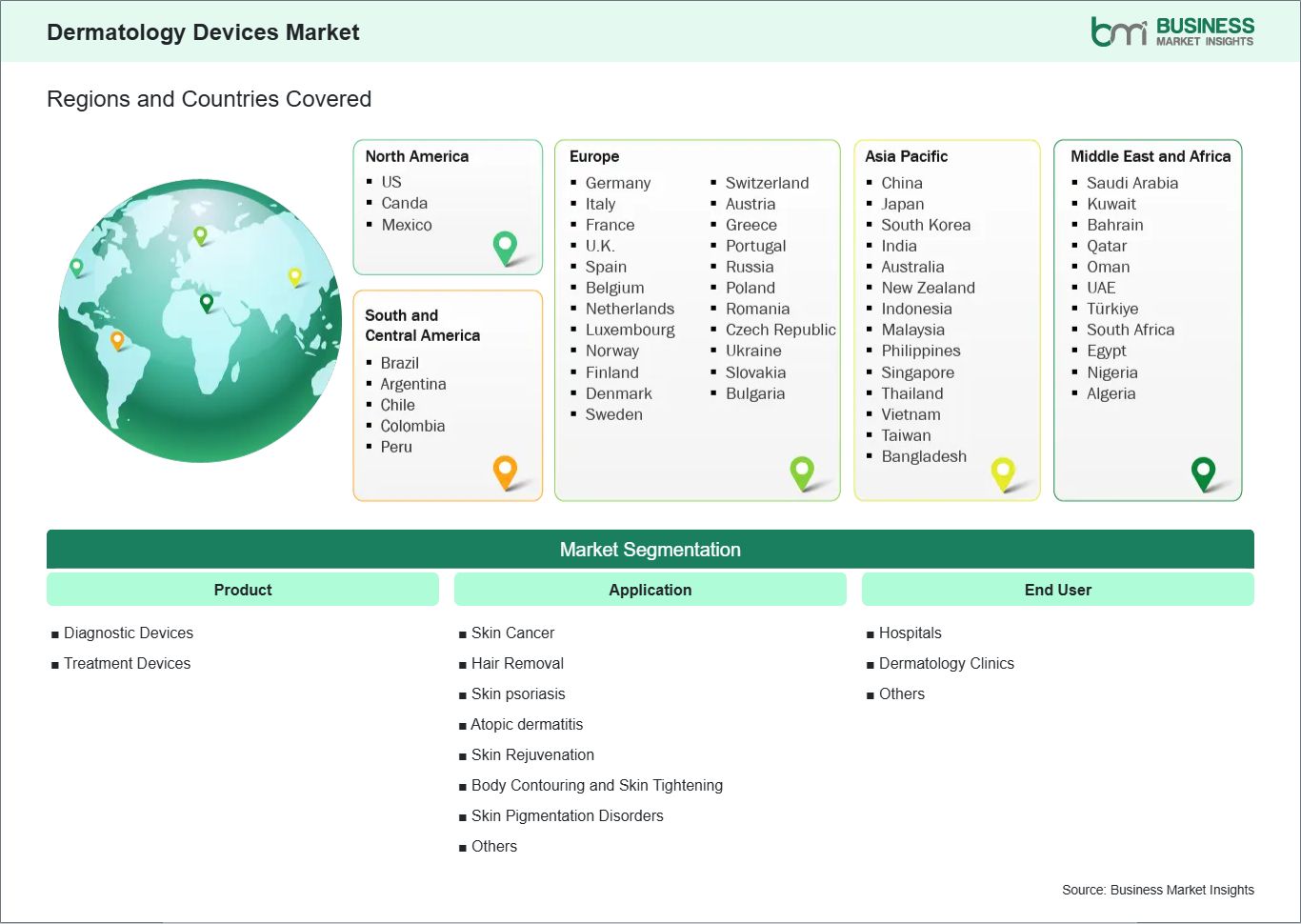
Key segments that contributed to the derivation of the Dermatology Devices Market analysis are product, application, and end user.
- By Product, the market is segmented into Diagnostic Devices and Treatment Devices.
- By Application, the market is segmented into Skin Cancer, Hair Removal, Skin Psoriasis, Atopic Dermatitis, Skin Rejuvenation, Body Contouring and Skin Tightening, Skin Pigmentation Disorders, and Others.
- By End User, the market is segmented into Hospitals, Dermatology Clinics, and Others.
Market Forces
Dermatology Devices Market Drivers and Opportunities
Rising Prevalence of Skin Disorders and Aesthetic Demand
The primary driver accelerating the Dermatology Devices Market is the surging global incidence of skin conditions, including melanoma, basal cell carcinoma, psoriasis, eczema, and acne, coupled with booming demand for non-invasive aesthetic procedures. Skin cancer rates have climbed due to factors like UV exposure, environmental pollution, and lifestyle changes, with the World Health Organization estimating over 2 million new cases annually worldwide. Patients seek early detection via advanced imaging devices like dermoscopes and AI-powered confocal microscopes, which offer higher accuracy than traditional biopsies.
Simultaneously, the aesthetic segment thrives on consumer trends favoring procedures like laser hair removal, fractional CO2 resurfacing for wrinkles, and intense pulsed light (IPL) therapy for pigmentation, driven by minimal downtime and natural-looking results. These devices reduce treatment sessions, lower complication risks, and appeal to millennials and Gen Z, prioritizing preventive dermatology, ensuring sustained adoption across clinics, and boosting recurring sales of consumables like laser tips.
Integration of AI-Driven Imaging and Tele-Dermatology Platforms
An exciting market space arises with the integration of artificial intelligence and machine learning in dermatology technology, specifically for teledermatology. In a matter of milliseconds, AI algorithms successfully assess dermatoscopic images to identify malignancy at a rate greater than 90%, pointing out potential irregularities in asymmetry and border modification beyond human capabilities. This has been confirmed in research published in the Journal of the American Academy of Dermatology. Similarly, for at-home patient monitoring with a portable device combined with a telemedicine application.
Machine learning algorithms trained on big data also enable predictions of treatment outcomes, for instance, flare-ups of psoriasis using hyperspectral imaging. Innovations such as these reduce costs associated with health care, improve accessibility of health services in rural areas, and create opportunities for hybrid systems that integrate treatment solutions with diagnosis, making early adopters poised to reap benefits from this growing health technology market.
Size and Share Analysis
Dermatology Devices Market Size and Share Analysis
The Dermatology Devices Market demonstrates consistent growth, with size and share analysis revealing strong positioning for leaders in lasers and diagnostics amid innovative entrants. The report examines subsegments within product, application, and end user, highlighting their roles in market performance.
For instance, the Treatment Devices subsegment leads the market by product, holding the largest share due to high demand for lasers and energy-based systems in aesthetics. Skin Cancer Diagnosis subsegment dominates the market by application. It is fueled by high procedure volumes like Botox adjuncts and melanoma screenings. Dermatology Clinics are the leading end users, benefiting from lower overheads and patient preference for specialized outpatient care.
Report Coverage
Dermatology Devices Market Report Coverage and Deliverables
The "Dermatology Devices Market Size and Forecast (2022 - 2033)" report provides a detailed analysis of the market covering below areas:
- Dermatology Devices Market size and forecast at global, regional, and country levels for all the key market segments covered under the scope
- Dermatology Devices Market trends, as well as market dynamics such as drivers, restraints, and key opportunities
- Dermatology Devices Market analysis covering key market trends, global and regional framework, major players, regulations, and recent market developments
- Industry landscape and competition analysis covering market concentration, heat map analysis, prominent players, and recent developments for the Dermatology Devices Market
- Detailed company profiles, including SWOT analysis
Geographic Insights
Dermatology Devices Market Geographic Insights
The geographical scope of the Dermatology Devices Market report is divided into five regions: North America, Asia Pacific, Europe, Middle East & Africa, and South & Central America. North America holds the largest revenue share, propelled by advanced dermatology infrastructure, high aesthetic spending, robust FDA approvals, and key players like Candela and Cynosure. Asia Pacific is poised for the fastest growth, driven by expanding middle-class demand for cosmetics, rising skin cancer awareness, medical tourism in India and South Korea, and investments in local manufacturing.
Industry Activity
Recent Developments
The Dermatology Devices Market is evaluated by gathering qualitative and quantitative data post primary and secondary research, which includes important corporate publications, association data, and databases. A few of the key developments in the Dermatology Devices Market are:
- In October 2025, Cynosure Lutronic, a global leader in laser and energy-based aesthetic medical devices, announced the launch of eCO2 3D, the most versatile fractional CO2 laser in aesthetics. Built on the proven foundation of the eCO2 Plus, eCO2 3D sets a new standard in CO2 laser resurfacing by delivering power, precision, and control into one innovative platform offering unmatched versatility. The eCO2 3D received U.S. FDA clearance (K244060) in late July 2025 for a broad range of dermatological and plastic surgery indications.
- In September 2025, Bausch Health Companies Inc. and Solta Medical featured The Balancing Act in a special episode spotlighting its portfolio of non-invasive skin rejuvenation and tightening technologies: Thermage® FLX, Clear + Brilliant® and Fraxel FTX™. The Balancing Act offers viewers real-world solutions to uplift and empower more confident living.
- In September 2025, CUTERA, INC., a leading provider of aesthetic and dermatological solutions, announced the launch of its Cutera Residency Program, a new program designed to expand access to AviClear®, the first FDA-cleared 1726 nm laser for the long-term treatment of mild, moderate, and severe acne, into dermatology training programs across North America.
Trust & Transparency
Research Methodology
The market analysis combines proprietary research with secondary data from government agencies, company disclosures, regulatory filings, industry databases and expert interviews. Market estimates are validated through data triangulation, cross-market benchmarking and analyst
review.
View Full Research Methodology
Key Sources Referred:
World Bank - Global Trade IndicatorsWorld Trade Organization (WTO)International Monetary Fund (IMF)International Trade Administration (ITA)Company WebsitesCompany Annual ReportsCompany Investor Presentations