Market Summary
Executive Summary and Global Market Analysis
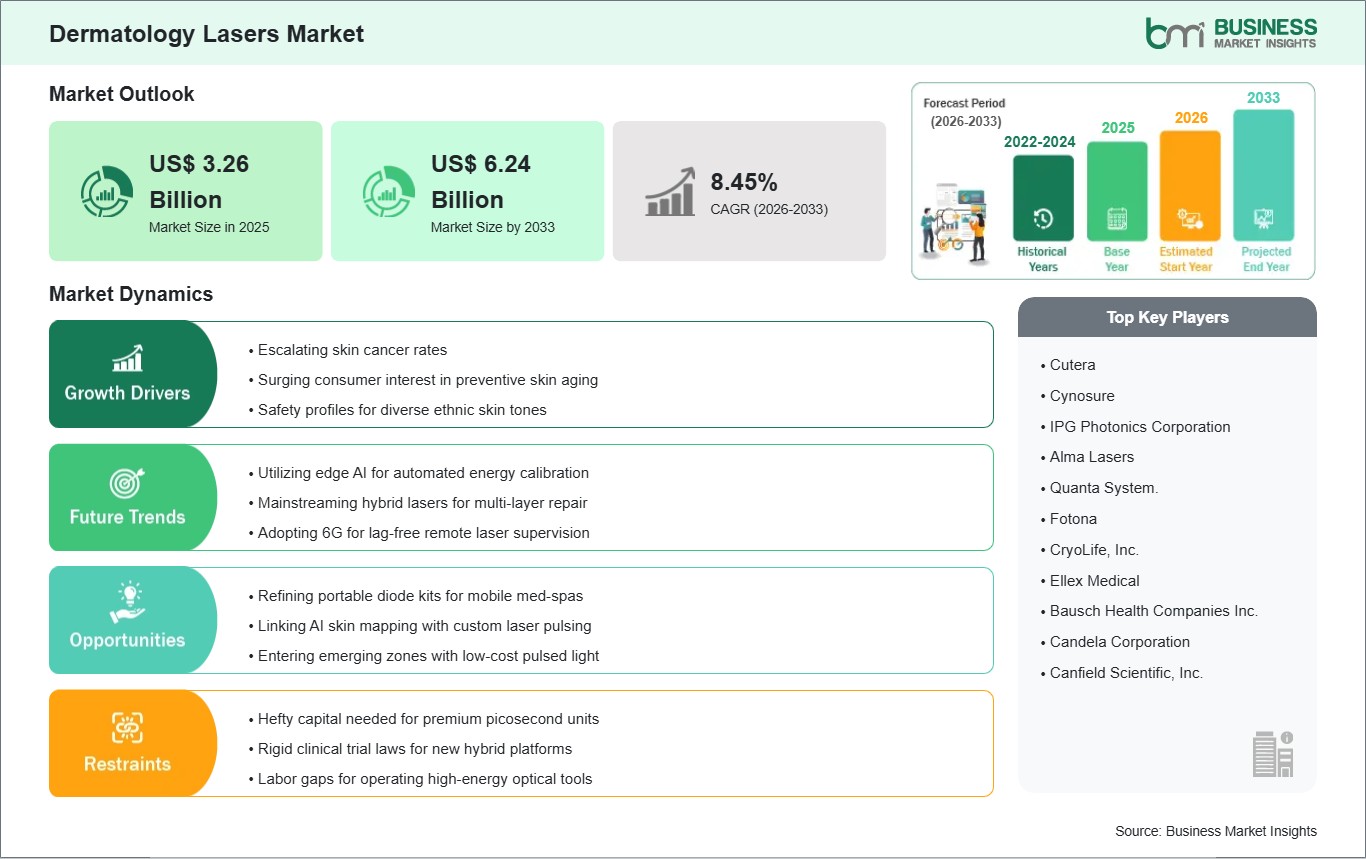
Dermatology lasers are medical-grade light amplification devices that emit coherent, monochromatic beams of light to target specific chromophores in the skin, such as melanin, hemoglobin, or water. These systems utilize varying wavelengths to treat a wide range of conditions, including aesthetic skin resurfacing and hair removal, as well as clinical therapies for vascular lesions, psoriasis, and skin malignancies, by inducing controlled thermal damage to specific tissue layers. The dermatology lasers market provides the high-precision, light-based infrastructure essential for modern aesthetic and therapeutic skin care. It encompasses key equipment and services: ablative (CO2, Erbium) and non-ablative lasers, fractional systems, picosecond lasers, and specialized cooling accessories. Dermatology lasers offer several benefits, such as precise tissue removal, shorter recovery times, and the ability to treat tough cases such as deep scars or multi-coloured tattoos that do not respond to standard topical treatments. The market is growing as people are aware of aesthetics due to the "Zoom-effect." There are more cases of skin disorders and UV-related cancers, and medical tourism is expanding quickly in places such as Southeast Asia. Using multi-wavelength platforms also lets practitioners treat different conditions with one device, which helps clinics get a better return on their investment.
However, several challenges can restrain market growth: Independent practitioners face high upfront costs and complex operations when buying top-tier multi-platform laser systems. Continued financial challenges arise from competing with cheaper options and not getting insurance reimbursement for elective cosmetic procedures. Furthermore, the industry faces constraints due to stringent safety regulations regarding light-based radiation and a persistent technical knowledge gap in treating diverse skin phototypes safely. Despite these hurdles, the market holds immense opportunities as a result of the universal mandate for personalized skincare, the accelerating deployment of AI-driven real-time skin analysis for automated parameter adjustment, and the increasing reliance on fractional picosecond technology for safer treatments on darker skin tones. The transition toward portable, home-use medical lasers and the integration of robotic-assisted delivery systems are expected to create significant opportunities for market growth.
Segment Analysis
Dermatology Lasers Market Segmentation
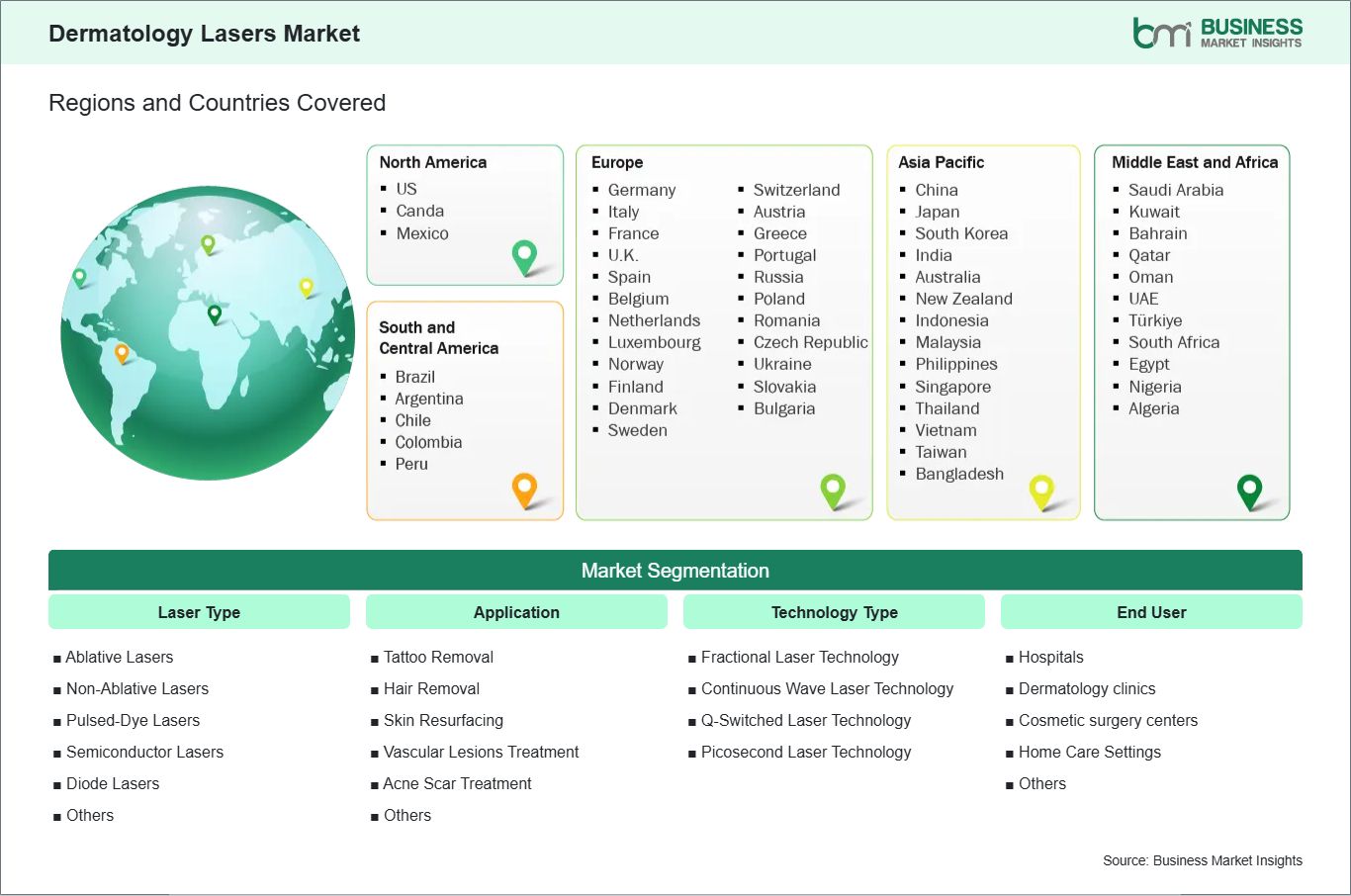
Key segments that contributed to the derivation of the Dermatology Lasers market analysis are laser type, application, technology type, and end user.
- By Laser Type, the market is segmented into Ablative Lasers, Non-Ablative Lasers, Pulsed-Dye Lasers, Semiconductor Lasers, Diode Lasers, and Others.
- By Application, the market is segmented into Tattoo Removal, Hair Removal, Skin Resurfacing, Vascular Lesions Treatment, Acne Scar Treatment, and Others.
- By Technology Type, the market is segmented into Fractional Laser Technology, Continuous Wave Laser Technology, Q-Switched Laser Technology, and Picosecond Laser Technology.
- By End User, the market is segmented into Hospitals, Dermatology clinics, Cosmetic surgery centers, Home Care Settings, and Others.
Market Forces
Dermatology Lasers Market Drivers and Opportunities
Rising Aesthetic Consciousness and Chronic Skin Prevalence
The primary driver for the Dermatology Lasers market is the dual pressure of an aging global population seeking anti-aging solutions and the increasing incidence of chronic skin conditions like psoriasis, rosacea, and skin cancer. As societal standards increasingly prioritize a youthful appearance, there is a massive surge in demand for non-invasive aesthetic procedures such as skin resurfacing, tattoo removal, and hair reduction. Simultaneously, environmental factors like rising UV radiation and pollution are contributing to a higher prevalence of malignant and benign skin lesions.
Dermatology lasers, specifically CO2, Nd: YAG, and Pulsed-Dye systems, provide the high precision necessary to treat these conditions with minimal downtime. This shift from invasive surgery to outpatient laser therapy is further accelerated by the influence of social media and the growing "pre-juvenation" trend among younger demographics, making laser-based care a core component of both medical and cosmetic dermatology.
AI-Enhanced Precision and Rise of Home-Use Devices
A transformative opportunity lies in the integration of Artificial Intelligence (AI) with laser systems to provide hyper-personalized treatment protocols and the emergence of advanced home-care devices. Modern AI-driven platforms can now analyze a patient’s skin type, pigmentation, and lesion depth in real time, automatically adjusting laser parameters to maximize efficacy while nearly eliminating the risk of burns or scarring. This technology is particularly valuable for expanding treatment safety to diverse skin tones, which were historically underserved by traditional laser settings.
Furthermore, as consumers seek more cost-effective and convenient solutions, there is a burgeoning market for high-safety, low-intensity laser and LED devices designed for home use. By bridging the gap between professional clinical results and consumer-level accessibility, manufacturers can tap into a massive retail segment while utilizing cloud-based apps to maintain a digital connection between the patient and their dermatologist.
Size and Share Analysis
Dermatology Lasers Market Size and Share Analysis
The Dermatology Lasers market demonstrates steady growth, with size and share analysis revealing evolving trends and competitive positioning among key players. The report further examines subsegments categorized within laser type, application, technology type, and end user, offering insights into their contribution to overall market performance.
For instance, the Ablative Lasers segment, which includes CO2 and Erbium systems, holds a significant market share. Ablative lasers are traditionally utilized for Skin Resurfacing and Acne Scar Treatment. These lasers use Continuous Wave or Fractional Laser Technology to vaporize damaged skin tissue, stimulating deep collagen remodeling. While these procedures are primarily performed in Hospitals and Cosmetic surgery centers due to the required clinical expertise and recovery management, they are favored for providing dramatic results in treating severe photo-aging and deep structural scars.
Report Coverage
Dermatology Lasers Market Report Coverage and Deliverables
The Dermatology Lasers Market Size and Forecast (2022–2033) report provides a detailed analysis of the market covering below areas:
- Dermatology Lasers market size and forecast at global, regional, and country levels for all the key market segments covered under the scope
- Dermatology Lasers market trends, as well as market dynamics such as drivers, restraints, and key opportunities
- Dermatology Lasers market analysis covering key market trends, global and regional framework, major players, regulations, and recent market developments
- Industry landscape and competition analysis covering market concentration, heat map analysis, prominent players, and recent developments for the Dermatology Lasers market
- Detailed company profiles, including SWOT analysis
Geographic Insights
Dermatology Lasers Market Geographic Insights
The geographical scope of the Dermatology Lasers market report is divided into five regions: North America, Asia Pacific, Europe, Middle East & Africa, and South & Central America.
The Asia-Pacific Dermatology Lasers Market is segmented into China, Japan, South Korea, India, Australia, New Zealand, Indonesia, Malaysia, the Philippines, Singapore, Thailand, Vietnam, Taiwan, Bangladesh, and the Rest of Asia. The market is primarily driven by a cultural emphasis on "perfect skin" and the rapid expansion of the medical tourism industry in countries such as South Korea and Thailand. China and Japan remain the regional heavyweights in terms of total spend, fueled by an aging population and high demand for anti-aging and pigmentation treatments.
Growth is further bolstered by the rising prevalence of skin disorders such as acne, psoriasis, and skin cancer, alongside a surging interest in non-invasive procedures like laser hair removal and skin resurfacing. The introduction of AI-integrated laser systems for precision targeting and the growing popularity of K-beauty standards across Southeast Asia secures Asia Pacific’s position as global hub for dermatology laser innovation and adoption.
Industry Activity
Recent Developments
The Dermatology Lasers market is evaluated by gathering qualitative and quantitative data post primary and secondary research, which includes important corporate publications, association data, and databases. A few of the key developments in the Dermatology Lasers market are:
- In October 2025, Cynosure Lutronic, a global leader in laser and energy-based aesthetic medical devices, proudly announces the launch of eCO2 3D, the most versatile fractional CO2 laser in aesthetics. Built on the proven foundation of the eCO2 Plus, eCO2 3D sets a new standard in CO2 laser resurfacing by delivering power, precision, and control into one innovative platform offering unmatched versatility.
- In September 2025, CUTERA, INC., a leading provider of aesthetic and dermatological solutions, announces the launch of its Cutera Residency Program, a new program designed to expand access to AviClear®, the first FDA-cleared 1726 nm laser for the long-term treatment of mild, moderate, and severe acne, into dermatology training programs across North America.
Trust & Transparency
Research Methodology
The market analysis combines proprietary research with secondary data from government agencies, company disclosures, regulatory filings, industry databases and expert interviews. Market estimates are validated through data triangulation, cross-market benchmarking and analyst
review.
View Full Research Methodology
Key Sources Referred:
World Bank – Global Trade IndicatorsWorld Trade Organization (WTO)International Monetary Fund (IMF)International Trade Administration (ITA)Company WebsitesCompany Annual ReportsCompany Investor Presentations