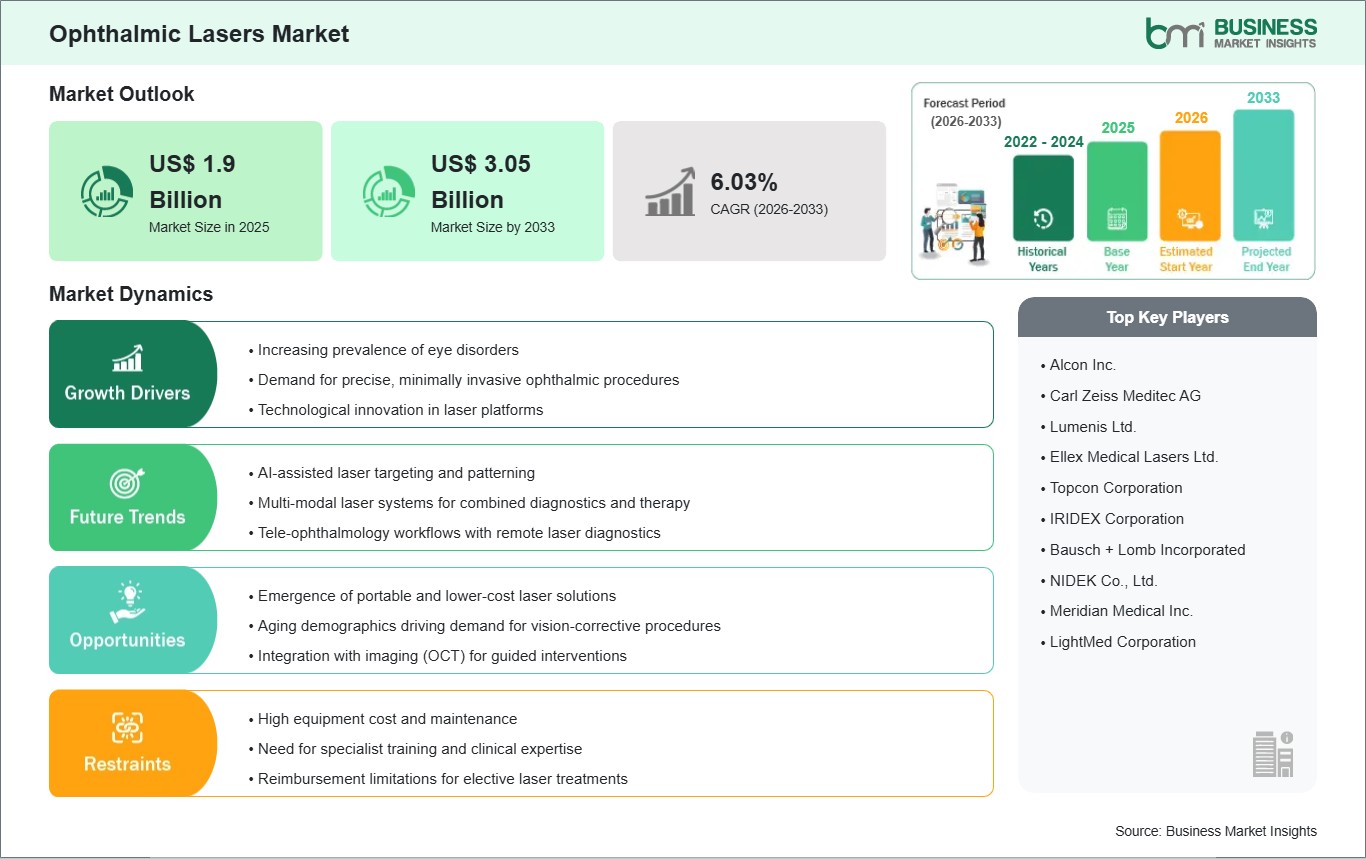
The Ophthalmic Lasers Market size is expected to reach US$ 3.05 billion by 2033 from US$ 1.90 billion in 2025. The market is estimated to record a CAGR of 6.03% from 2026 to 2033.
Ophthalmic lasers are the medical laser systems that are used for the treatment of eye problems with precision, which also have the additional virtue of non-invasiveness and a very short recovery time. The main ocular tissues receive light energy that is focused precisely during the procedures of refractive surgery, cataract surgery, glaucoma management, retinopathy in diabetics, and other retinal disorders, and these treatments are attractive for the patients. Femtosecond, excimer, SLT, and AI-enhanced laser systems have been some of the technological advancements that have brought about a significant increase in clinical capabilities and procedural efficiency in ophthalmology.
The ophthalmic lasers market is registering a hefty growth spurt mainly due to the higher number of chronic eye diseases, patients getting older, and higher demand for state-of-the-art, less invasive treatment modalities. Trends in adoption: AI integration, miniaturization for portability, and digital connectivity that not only improve clinical workflows but also increase accessibility, particularly in developing areas, are headed. The market is presently North America-centric because of good healthcare infrastructure and a high number of procedures, while the Asia-Pacific region is the fastest-growing one due to better eye care services and unfulfilled medical needs. The competitive scene is constituted of the companies Alcon, Carl Zeiss Meditec, Lumenis, and NIDEK, who base their rivalry on innovating with precision laser technologies. Regulatory challenges and high R&D costs create a tough environment for newcomers; however, the continuous push towards technology and the development of outpatient treatment facilities are the factors that keep the market expanding.

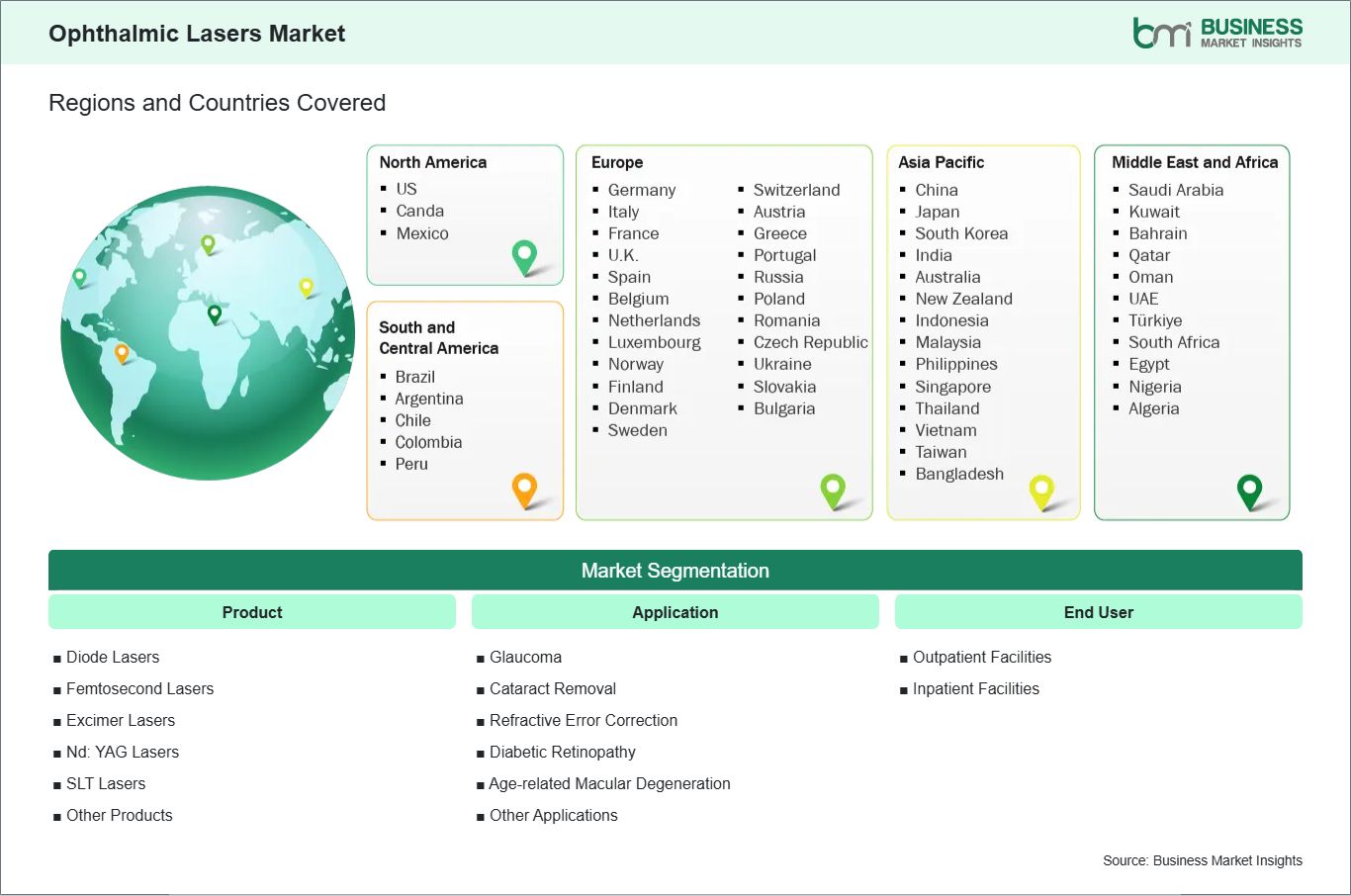
Key segments that contributed to the derivation of the ophthalmic lasers market analysis are product, application, and end user.
The global ophthalmic lasers market is significantly driven by the increasing number of ocular disorders, which, in turn, create the demand for laser-based interventions that are effective and minimally invasive. Among the very common eye diseases are cataracts, glaucoma, diabetic retinopathy, and refractive errors. Their prevalence is on the rise mainly because of the ageing population and some lifestyle choices. Cataracts, for instance, now cause about 20% of the vision impairment cases across the planet, and the number of glaucoma patients is likely to be greatly increased in the future, which further underlines the necessity for more advanced treatment tools. Among the technologies used in the treatment of the above-mentioned conditions, lasers (e.g., femtosecond and photocoagulation systems) have won over the medical community for their ability to enhance the precision of the procedure, reduce the time that a patient has to stay in the hospital, and improve clinical outcomes when compared to the traditional methods. Thus, the use of lasers in both developed and developing markets is getting a push. Moreover, giving rise to the very use of lasers are developments like AI-enhanced targeting and real-time imaging. They have made the whole process very accurate and have also made the surgeon very confident, thus speeding up the doctors' and hospital patients’ acceptance. These clinical advantages, together with the growing awareness of eye health issues, are the main factors that are pushing the medical community to install the latest ophthalmic laser technologies in all eye care facilities.
The ongoing technological innovation and new product developments that broaden clinical capabilities and open up new therapeutic areas are among the major factors driving growth in the ophthalmic lasers market. The year 2025 saw the launch of highly efficient systems by major players in the industry, which would not only empower the doctors but also enhance the entire process of surgery in terms of workflow, precision, and accessibility. Alcon, for example, released a state-of-the-art femtosecond laser with real-time corneal topography integration, thus significantly improving alignment accuracy during cataract procedures. On the other hand, Carl Zeiss Meditec introduced a robotic laser platform that cut down the intraoperative time by a third. Besides, AI and portability are also being combined, and new products are being developed based on these concepts; Lumenis marketed a mobile diode laser for glaucoma that was purchased and used by doctors in developing countries, while Nidek’s AI-assisted slit-lamp laser system has increased clinic workflow in the Asia-Pacific region. These breakthroughs not only improve existing methods of treatment, such as refractive surgery and glaucoma therapy, but also lay down paths for discovering new applications, improving operational efficiency, and attracting wider patient populations to the advanced care services.
By product, the ophthalmic lasers market is categorized into diode lasers, femtosecond lasers, excimer lasers, Nd: Yag lasers, SLT lasers, other products. The femtosecond lasers segment dominated the market in 2025. The femtosecond lasers segment is capturing the largest share due to its ultra-short pulse delivery, high precision, and minimal collateral tissue damage. These features make femtosecond systems especially valuable in premium procedures like refractive surgeries (e.g., LASIK/SMILE) and laser-assisted cataract surgery, where accuracy, safety, and faster recovery are paramount. As a result, femtosecond lasers outperform traditional devices in clinical adoption.
By application, the market is segmented into glaucoma, cataract removal, refractive error correction, diabetic retinopathy, age-related macular degeneration, other applications. The refractive error correction segment held the largest share of the market in 2025. Refractive error correction segment is driven by the global rise in myopia, hyperopia, and astigmatism across all age groups. Ophthalmic laser procedures such as PRK, LASIK, and SMILE have become widely accepted vision-correction options due to their safety, predictable outcomes, and reduced dependence on corrective lenses. Growing patient awareness and technological advances further boost refractive surgery adoption, making it the dominant application category.
By end user, the market is bifurcated into outpatient facilities, inpatient facilities. The outpatient facilities segment held a larger share of the market in 2025. Outpatient facilities (e.g., ambulatory surgical centers and specialized eye clinics) lead as they align with trends toward minimally invasive, same-day ophthalmic procedures. Advancements in laser technologies have enabled many treatments—including cataract, refractive, and glaucoma procedures—to be performed safely outside traditional hospitals. Patients increasingly prefer outpatient care for convenience, lower costs, and shorter recovery times, fueling this segment’s higher share relative to inpatient hospital settings.
| Report Attribute | Details |
|---|---|
| Market size in 2025 | US$ 1.9 Billion |
| Market Size by 2033 | US$ 3.05 Billion |
| Global CAGR (2026 - 2033) | 6.03% |
| Historical Data | 2022 - 2024 |
| Forecast period | 2026-2033 |
| Segments Covered | By Product
|
| Regions and Countries Covered | North America
|
| Market leaders and key company profiles |
|
The " Ophthalmic Lasers Market Size and Forecast (2022–2033)" report provides a detailed analysis of the market covering below areas:
The geographical scope of the ophthalmic lasers market report is divided into five regions: North America, Asia Pacific, Europe, Middle East & Africa, and South & Central America. The ophthalmic lasers market in Asia Pacific is expected to grow significantly during the forecast period.
The Asia-Pacific ophthalmic lasers market is segmented into China, Japan, South Korea, India, Australia, New Zealand, Indonesia, Malaysia, the Philippines, Singapore, Thailand, Vietnam, Taiwan, Bangladesh, and the Rest of Asia. The Asia-Pacific ophthalmic lasers market is experiencing robust growth due to a triad of factors, namely demographics, technology, and the economy. The increasing number of patients suffering from eye diseases like cataracts, glaucoma, diabetic retinopathy, and refractive errors, as well as the corresponding growth of the eye care market, are major reasons for the demand. Elderly populations in such countries as Japan, China, and South Korea are the main reason for acquiring more laser-based treatments as a result of being more prone to age-related eye diseases. Additionally, the urban population's growing awareness of eye health and vision correction procedures like LASIK, SMILE, and laser-assisted cataract surgery has rapidly increased the number of patients wanting non-invasive and quick-recovery treatments.
Furthermore, the tech world has also been a big boost to the ophthalmic laser market with such advancements like the introduction of portable laser systems, AI-assisted imaging, and femtosecond and excimer lasers that have really made the treatments less scary, more efficient, and better in the medical results thus allowing the major cities and even the secondary heath care centers to have more access to the procedures. Along with this, the worldwide increase in patient and physician awareness, technological advancements, and in-depth training of the laser operators have synergistically resulted in the strong competitiveness of the laser system industries in developing countries such as India and China. Market penetration in the region has mainly been due to factors such as rising income, health insurance coverage expansion, and government programs that support eye care screening and surgery.

The ophthalmic lasers market is evaluated by gathering qualitative and quantitative data post primary and secondary research, which includes important corporate publications, association data, and databases. A few of the key developments in the ophthalmic lasers market are:
The Ophthalmic Lasers Market is valued at US$ 1.9 Billion in 2025, it is projected to reach US$ 3.05 Billion by 2033.
As per our report Ophthalmic Lasers Market, the market size is valued at US$ 1.9 Billion in 2025, projecting it to reach US$ 3.05 Billion by 2033. This translates to a CAGR of approximately 6.03% during the forecast period.
The Ophthalmic Lasers Market report typically cover these key segments-
The historic period, base year, and forecast period can vary slightly depending on the specific market research report. However, for the Ophthalmic Lasers Market report:
The Ophthalmic Lasers Market is populated by several key players, each contributing to its growth and innovation. Some of the major players include:
The Ophthalmic Lasers Market report is valuable for diverse stakeholders, including:
Essentially, anyone involved in or considering involvement in the Ophthalmic Lasers Market value chain can benefit from the information contained in a comprehensive market report.
Please tell us your area of interest
(Market Segments/ Regions and Countries/ Companies)