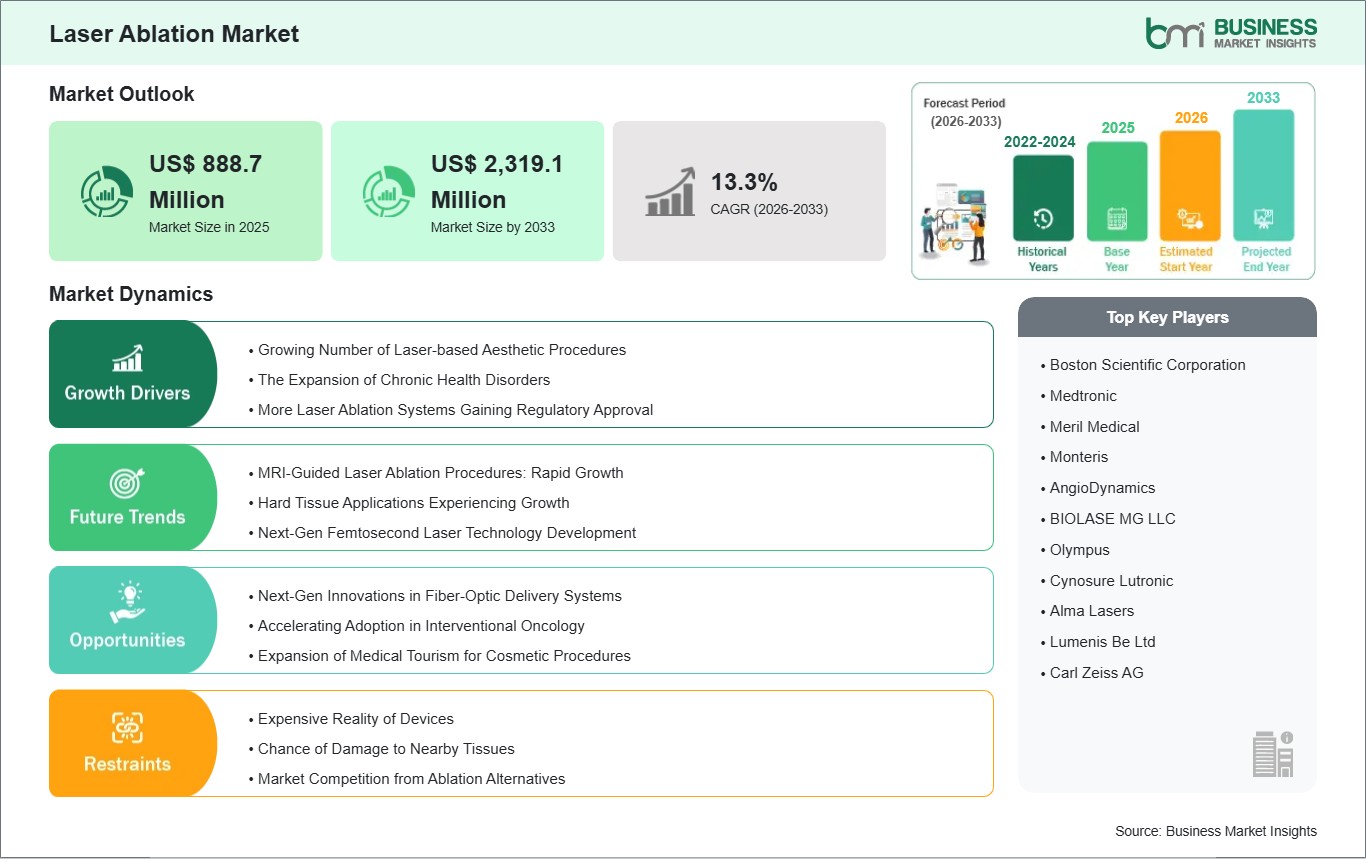
The laser ablation market size is expected to reach US$ 2,319.1 million by 2033 from US$ 888.7 million in 2025. The market is estimated to record a CAGR of 13.3% from 2026 to 2033.
Laser ablation is being used across medical disciplines, including oncology, cardiology, dermatology, and neurosurgery, due to its precision and ability to target specific tissues without extensive damage to surrounding areas. The rising demand for outpatient procedures and shorter hospital stays is encouraging hospitals and specialty clinics to adopt laser-based systems. In oncology, laser ablation is preferred for localized tumor treatment in organs such as the liver and kidneys. In dermatology, it is used for scar removal, skin resurfacing, and cosmetic procedures.
Innovation in laser technologies, including the development of more compact, efficient, and multi-functional systems, is enabling clinical applications and improving procedural outcomes. However, high equipment costs and the need for specialized operator training limit adoption among smaller healthcare providers. Regulatory approvals for novel laser devices vary across regions, slowing market penetration. Despite these challenges, the laser ablation market continues to expand as healthcare providers prioritize minimally invasive, patient-friendly treatments and clinical research explores new therapeutic indications.

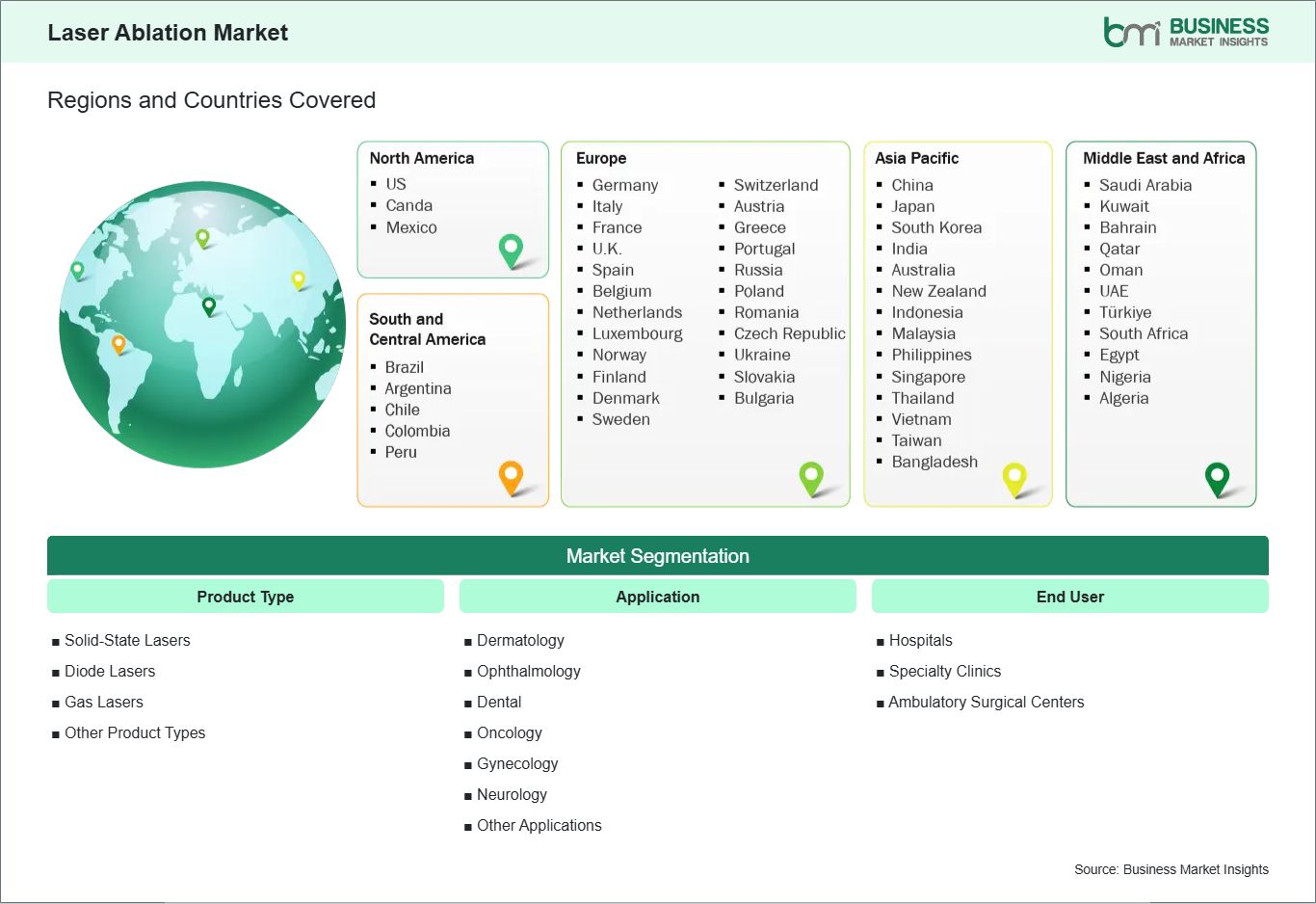
Key segments that contributed to the derivation of the laser ablation market analysis are product type, application, and end user.
Consumers are prioritizing minimally invasive cosmetic solutions over traditional surgical options, leading to greater demand for laser treatments that address skin rejuvenation, hair removal, pigmentation correction, and scar reduction. Laser ablation technologies have become central to aesthetic practice because they offer targeted results with shorter recovery times, aligning with evolving patient expectations for convenience and effectiveness.
Aesthetic clinics and dermatology centers are expanding their service offerings to include advanced laser‑based procedures. As patients are seeking treatments that provide visible improvements in skin texture and appearance, providers are integrating more sophisticated laser ablation systems into their portfolios. This trend is reflected in the presence of laser cosmetic services in established markets and emerging beauty hubs, underscoring the appeal of these procedures.
Multidisciplinary use of laser ablation in aesthetic medicine has expanded its reach. For example, combination treatments that pair laser ablation with injectables or energy‑based modalities are gaining popularity for comprehensive facial rejuvenation. The consistent increase in consumer interest and procedural uptake worldwide highlights laser ablation as a core technology in the continuing evolution of aesthetic healthcare.
Advanced fiber‑optic designs enable more precise transmission of laser energy, improving operator control and treatment efficacy across a range of medical applications. These innovations have made laser ablation more adaptable, particularly in procedures that require access to deep or constrained anatomical regions.
Research and development efforts are focusing on enhancing the flexibility, miniaturization, and durability of fiber‑optic components that support laser ablation systems. Improvements such as ultra‑fine fiber tips and optimized energy transmission characteristics are enabling practitioners to perform complex procedures with reduced procedural trauma. As a result, next‑generation fiber‑optic delivery systems are enhancing the performance of laser ablation across specialties, including oncology, urology, cardiology, and gastroenterology, expanding its utility beyond traditional applications.
Manufacturers are integrating smarter diagnostics and feedback mechanisms into fiber‑optic platforms to support real‑time monitoring and adaptive energy delivery. These technical advancements help clinicians tailor treatments to individual patient anatomy and tissue characteristics, leading to improved safety profiles and procedural outcomes. With continuous innovation in fiber‑optic delivery technology, laser ablation is positioned to become more precise, versatile, and widely adopted in clinical practice.

The laser ablation market is experiencing steady growth, with market size and share analysis reflecting evolving treatment preferences and competitive dynamics among key players. The report evaluates important subsegments categorized within product type, application, and end user, highlighting their respective contributions to overall market performance.
By product type, the solid-state lasers subsegment dominated the market in 2025, driven by the superior performance and versatility of solid-state lasers in clinical applications. These devices offer high precision, consistent energy delivery, and compatibility with a range of tissues, making them the preferred choice for laser ablation procedures. Their efficiency enhances treatment outcomes, minimizes collateral tissue damage, and supports a spectrum of clinical applications, making solid-state lasers a key revenue driver for manufacturers.
In terms of application, the dermatology subsegment dominated the market in 2025, propelled by the increasing prevalence of skin disorders such as acne scars, pigmentation issues, and vascular lesions, coupled with a growing demand for minimally invasive cosmetic procedures. Solid-state laser ablation provides precise and controlled tissue removal, faster recovery times, and reduced risk of scarring, making it attractive for dermatologists and patients.
Based on end user, the hospitals subsegment dominated the market in 2025 due to their well-established dermatology and surgical departments, access to advanced laser ablation systems, and availability of trained physicians and clinical staff. Their capability to perform complex procedures, provide comprehensive patient care, and integrate follow-up therapies ensures better treatment outcomes.
| Report Attribute | Details |
|---|---|
| Market size in 2025 | US$ 888.7 Million |
| Market Size by 2033 | US$ 2,319.1 Million |
| Global CAGR (2026 - 2033) | 13.3% |
| Historical Data | 2022-2024 |
| Forecast period | 2026-2033 |
| Segments Covered | By Product Type
|
|
Regions and Countries Covered
| |
| North America | US, Canada, Mexico |
| Europe | Germany, Italy, France, UK, Spain, Belgium, Netherlands, Luxembourg, Norway, Finland, Denmark, Sweden, Switzerland, Austria, Greece, Portugal, Russia, Poland, Romania, Czech Republic, Ukraine, Slovakia, Bulgaria |
| Asia-Pacific | China, Japan, South Korea, India, Australia, New Zealand, Indonesia, Malaysia, Philippines, Singapore, Thailand, Vietnam, Taiwan, Bangladesh |
| South and Central America | Brazil, Argentina, Chile, Colombia, Peru |
| Middle East and Africa | Saudi Arabia, UAE, Kuwait, Bahrain, Qatar, Oman, Turkiye, South Africa, Egypt, Nigeria, Algeria |
| Market leaders and key company profiles |
|
The "Laser Ablation Market Size and Forecast (2022–2033)" report provides a detailed analysis of the market covering below areas:
The geographical scope of the laser ablation market report is divided into five regions: North America, Asia Pacific, Europe, Middle East & Africa, and South & Central America.
North America leads the laser ablation market due to advanced healthcare infrastructure, high technology adoption, and strong clinical research capabilities. The US has a mature ecosystem of hospitals, cancer centers, and dermatology clinics that implement laser ablation technologies across medical applications. Physicians in the region prefer laser procedures for their precision, reduced complications, and shorter recovery periods compared to traditional surgical options. Device manufacturers invest in product development and collaborate with research institutions to expand clinical applications. Outpatient centers and specialty clinics are adopting advanced laser systems for therapeutic and cosmetic applications, from tumor ablation to aesthetic treatments such as skin tightening and scar removal. Supportive reimbursement frameworks for minimally invasive procedures, combined with a well-established regulatory environment, drive adoption. North America's leadership in the laser ablation market is reinforced by high healthcare expenditure, technological innovation, and the focus on patient-centric, efficient medical solutions.

The Laser Ablation market is evaluated by gathering qualitative and quantitative data post primary and secondary research, which includes important corporate publications, association data, and databases. A few of the key developments in the Laser Ablation market are:
The Laser Ablation Market is valued at US$ 888.7 Million in 2025, it is projected to reach US$ 2,319.1 Million by 2033.
As per our report Laser Ablation Market, the market size is valued at US$ 888.7 Million in 2025, projecting it to reach US$ 2,319.1 Million by 2033. This translates to a CAGR of approximately 13.3% during the forecast period.
The Laser Ablation Market report typically cover these key segments-
The historic period, base year, and forecast period can vary slightly depending on the specific market research report. However, for the Laser Ablation Market report:
The Laser Ablation Market is populated by several key players, each contributing to its growth and innovation. Some of the major players include:
The Laser Ablation Market report is valuable for diverse stakeholders, including:
Essentially, anyone involved in or considering involvement in the Laser Ablation Market value chain can benefit from the information contained in a comprehensive market report.
Please tell us your area of interest
(Market Segments/ Regions and Countries/ Companies)