Market Summary
Executive Summary and Global Market Analysis
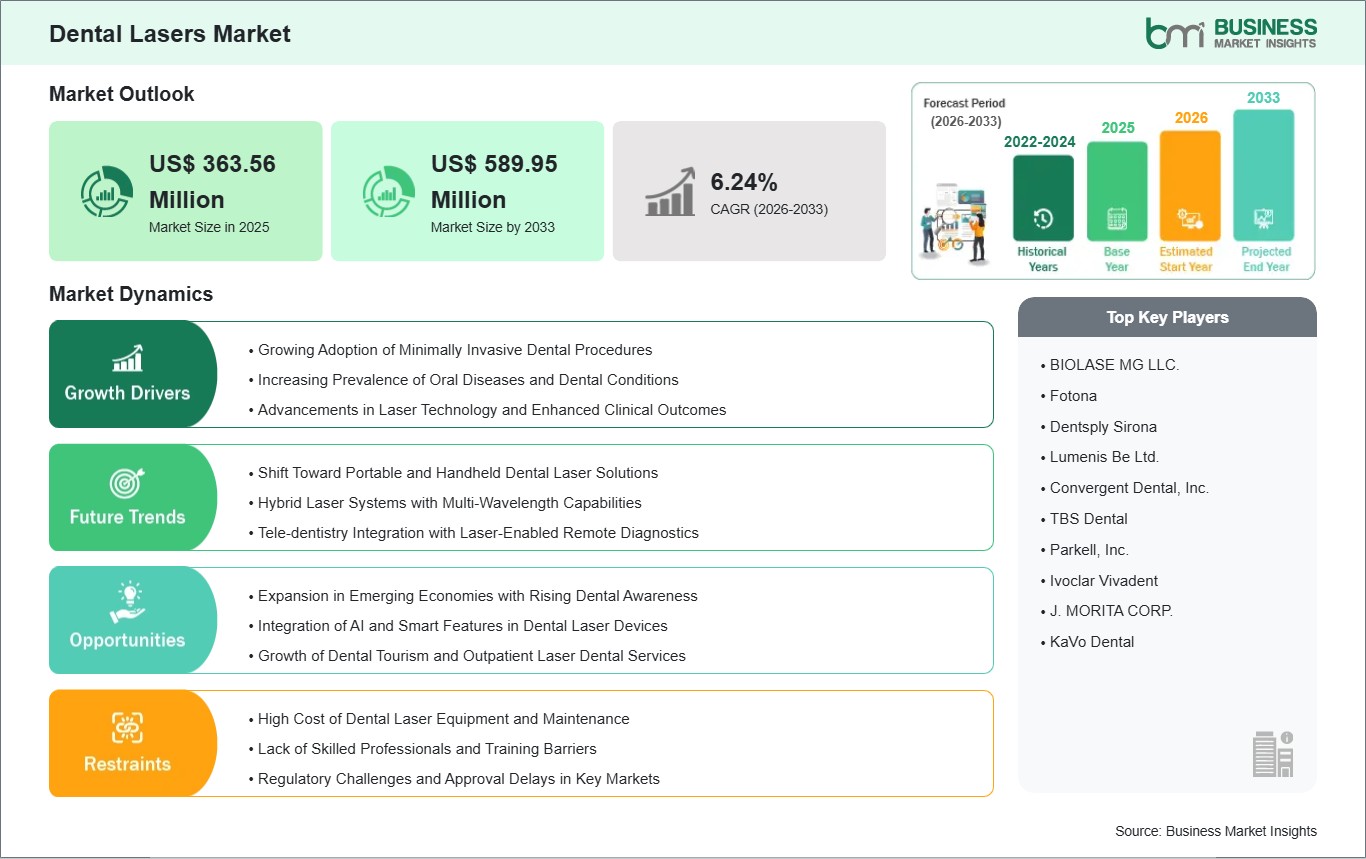
Dental lasers function as modern medical tools which generate concentrated light energy to execute various dental treatments which require them to work on both soft tissue and hard tissue. The executive summary explains how dental lasers have become more valuable to healthcare because they deliver precise results while decreasing blood loss and infection risk and enabling faster recovery and greater comfort for patients which together lead to better clinical results and patient satisfaction. The dental lasers find their primary applications in cavity preparation and periodontal therapy and soft tissue contouring and teeth whitening and treatment of peri-implant diseases.
The dental lasers market experiences continuous growth because more people seek less invasive dental treatments and more people understand oral health and technological progress has made laser systems easier to use because they become smaller and more adaptable. The adoption process receives additional encouragement from rising numbers of elderly people and increasing periodontal disease cases and expansion of dental clinics and cosmetic dentistry services throughout the globe. The developed regions enjoy strong reimbursement systems and advanced dental facilities and high dentist adoption rates while emerging economies attract interest because their healthcare access improves and people gain more disposable income. However, factors such as high initial equipment costs, training requirements, and regulatory considerations continue to influence adoption rates across regions, shaping a competitive and innovation-driven global landscape.
Segment Analysis
Dental Lasers Market Segmentation
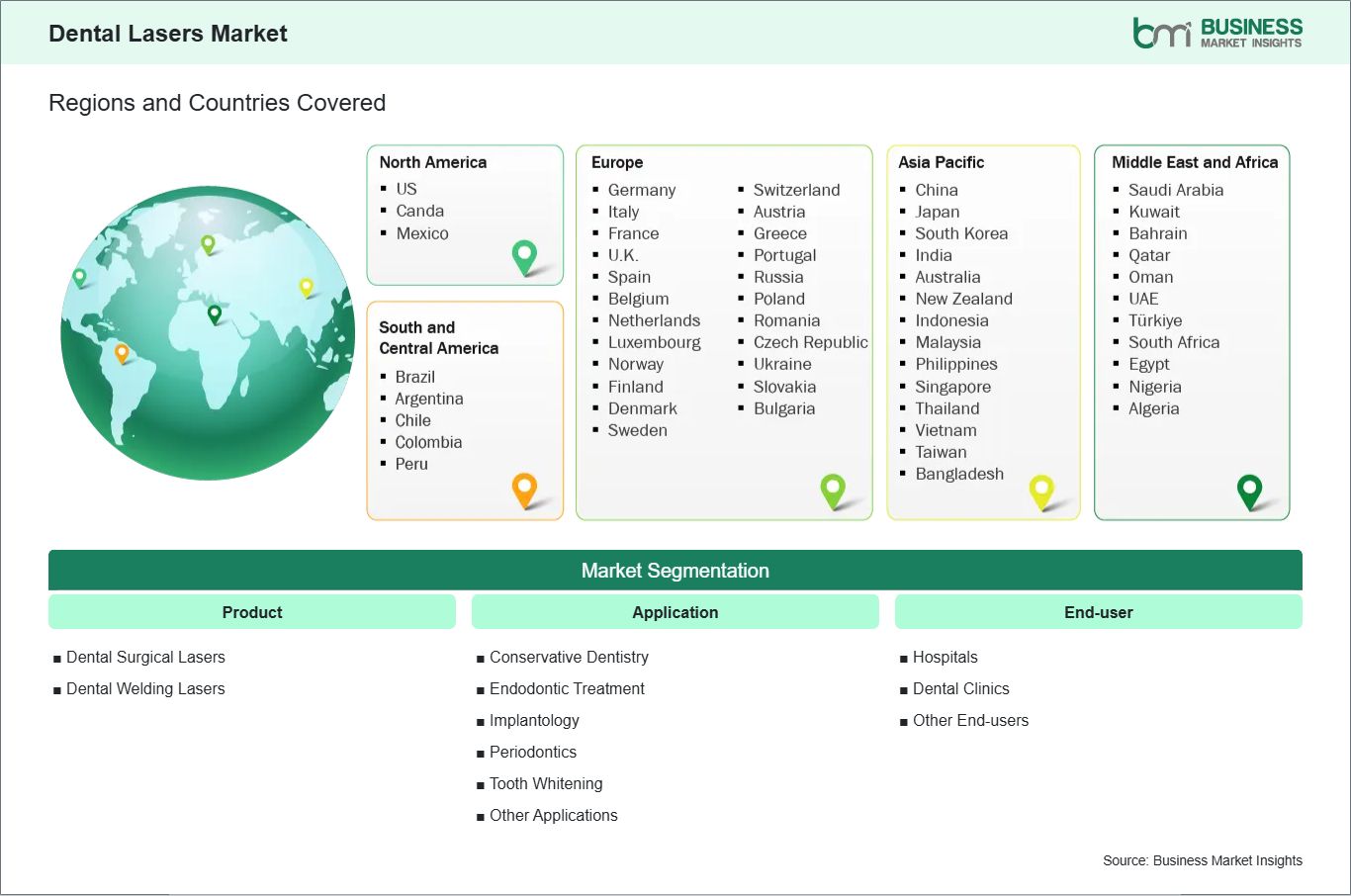
Key segments that contributed to the derivation of the dental lasers market analysis are product, application, and end-user.
- By product, the dental lasers market is bifurcated into dental surgical lasers, dental welding lasers. The dental surgical lasers segment dominated the market in 2025.
- By application, the market is segmented into conservative dentistry, endodontic treatment, implantology, periodontics, tooth whitening, other applications. The periodontics segment held the largest share of the market in 2025.
- By end-user, the dental lasers market is segmented into hospitals, dental clinics, other end-users. The dental clinics segment dominated the market in 2025.
Market Forces
Dental Lasers Market Drivers and Opportunities
Rising Demand for Minimally Invasive and Patient-Friendly Dental Procedures
The rising demand from patients who want less intrusive and more comfortable dental care drives the dental lasers market forward. Dental lasers provide less painful and less bloody dental procedures which enable shorter recovery times than standard drills and scalpels, making them better for patient comfort during dental work. Clinics and dental service organizations invest in laser systems because this trend supports their need to perform periodontal therapy and soft-tissue surgery and cavity treatment. Technological advancements in diode and CO₂ and Nd:YAG and Er:YAG laser systems have made it easier for users to achieve precise results through multiple clinical applications because the technology now provides better accuracy and design flexibility and improved health results. The dental industry now uses dental lasers as part of typical dental procedures because patients prefer treatment options that require no anesthesia and enable quicker recovery times.
Technological Innovation and Expanded Clinical Applications
The dental lasers market presents its main opportunity through two factors which are currently driving both technological advancements and new clinical applications. The current market includes advanced multi-wavelength systems which use AI-assisted workflows to boost operational accuracy while minimizing operator mistakes through products such as Fotona's LightWalker Elite Plus and BIOLASE's Epic Pro 3.0 which features adaptive power modulation and cloud connectivity. The current market features CO₂ laser systems which provide upgrades designed for both pediatric dental procedures and general use across multiple medical applications. The industry demands versatile laser platforms which can perform soft-tissue and hard-tissue procedures while dentists use digital dentistry systems. The market now sees the development of portable and handheld laser systems which doctors can use in their clinical work throughout different medical environments including mobile units and locations with limited access. The combination of these technological improvements and enhanced laser dentistry techniques has created new dental treatment options which are attracting international dental practices to use these methods.
Size and Share Analysis
Dental Lasers Market Size and Share Analysis
By product, the dental lasers market is bifurcated into dental surgical lasers, dental welding lasers. The dental surgical lasers segment dominated the market in 2025. Dental surgical lasers lead the product segment due to their broad clinical utility across both soft- and hard-tissue procedures. They are widely used in periodontics, oral surgery, implantology, and cosmetic dentistry, making them a core investment for dental practices. Their ability to deliver minimally invasive treatment with reduced bleeding, faster healing, and improved patient comfort drives strong adoption. In contrast, dental welding lasers have more limited, niche applications mainly in dental laboratories, restricting their overall market penetration.
By application, the market is segmented into conservative dentistry, endodontic treatment, implantology, periodontics, tooth whitening, other applications. The periodontics segment held the largest share of the market in 2025. Periodontics represents the leading application segment owing to the high global prevalence of periodontal diseases and the strong effectiveness of lasers in gum-related treatments. Dental lasers enable precise removal of infected tissue, bacterial reduction, and improved healing outcomes with minimal discomfort. The growing aging population, increased awareness of gum health, and preference for minimally invasive periodontal therapies significantly support widespread laser adoption in this application compared to others.
By end-user, the dental lasers market is segmented into hospitals, dental clinics, other end-users. The dental clinics segment dominated the market in 2025. Dental clinics dominate the end-user segment as they perform the majority of routine and specialized dental procedures requiring laser technology. The rapid growth of private dental practices, especially cosmetic and specialty clinics, drives demand for in-house laser systems. Clinics benefit from lasers by improving workflow efficiency, expanding service offerings, and enhancing patient satisfaction. Hospitals, while important, generally have lower procedure volumes for laser-based dental treatments.
Report Coverage
Dental Lasers Market Report Coverage and Deliverables
The " Dental Lasers Market Size and Forecast (2022-2033)" report provides a detailed analysis of the market covering below areas:
- Dental lasers market size and forecast at global, regional, and country levels for all the key market segments covered under the scope
- Dental lasers market trends, as well as market dynamics such as drivers, restraints, and key opportunities
- Dental lasers market analysis covering key market trends, global and regional framework, major players, regulations, and recent market developments
- Industry landscape and competition analysis covering market concentration, heat map analysis, prominent players, and recent developments for the dental lasers market
- Detailed company profiles, including SWOT analysis
Geographic Insights
Dental Lasers Market Geographic Insights
The geographical scope of the dental lasers market report is divided into five regions: North America, Asia Pacific, Europe, Middle East and Africa, and South and Central America. The dental lasers market in Asia Pacific is expected to grow significantly during the forecast period.
The Asia-Pacific dental lasers market is segmented into China, Japan, South Korea, India, Australia, New Zealand, Indonesia, Malaysia, the Philippines, Singapore, Thailand, Vietnam, Taiwan, Bangladesh, and the Rest of Asia. The Asia-Pacific dental lasers market is experiencing robust growth, due to multiple fundamental elements which create greater demand for dental lasers and their use. First, rising middle class citizens now understand dental aesthetic treatments together with oral health education which makes them choose less invasive dental laser procedures for periodontal therapy and soft-tissue surgery and teeth whitening. Second, private dental practices together with specialty clinics in China India South Korea and Australia now use advanced technologies to create unique services which attract patients who want high-quality treatment. Third, better healthcare infrastructure together with expanded insurance coverage and government programs for dental care access in urban and semi-urban areas enable dental practices to adopt laser systems. Fourth, a growing geriatric population with higher prevalence of periodontal diseases and implant needs is driving demand for precise and less painful treatments. Finally, training programs together with international collaborations and local distribution partnerships are increasing clinician familiarity and confidence with laser technologies, which helps dental practices in the region adopt these technologies as standard procedures
Industry Activity
Recent Developments
The dental lasers market is evaluated by gathering qualitative and quantitative data post primary and secondary research, which includes important corporate publications, association data, and databases. A few of the key developments in the dental lasers market are:
- In February 2024, The Waterlase iPlus Premier Edition all-tissue laser system from BIOLASE which serves as the worldwide leader in dental laser technology, made its first public showing at the 2024 Chicago Dental Society Midwinter Meeting. The new laser system represents an exceptional improvement which leads the industry as the most advanced dental care solution.
- In March 2025, Fotona's SWEEPS (shock wave-enhanced emission photoacoustic streaming) technology has applications in endodontics, periodontics and oral surgery. The technology improves cleaning and disinfection procedures, supporting better clinical outcomes. At the International Dental Show (IDS) attendees can find SWEEPS technology at Fotona's booth which operates in Hall 10.2 with live sessions and hands-on demonstrations and expert consultations.
Trust & Transparency
Research Methodology
The market analysis combines proprietary research with secondary data from government agencies, company disclosures, regulatory filings, industry databases and expert interviews. Market estimates are validated through data triangulation, cross-market benchmarking and analyst
review.
View Full Research Methodology
Key Sources Referred:
World Health Organization (WHO)Centers for Disease Control and PreventionUnited Nations Children's FundInstitute for Health Metrics and EvaluationWorld Bank Health Nutrition and Population DataCompany websitesCompany annual reportsCompany investor presentations