Market Summary
Executive Summary and Global Market Analysis
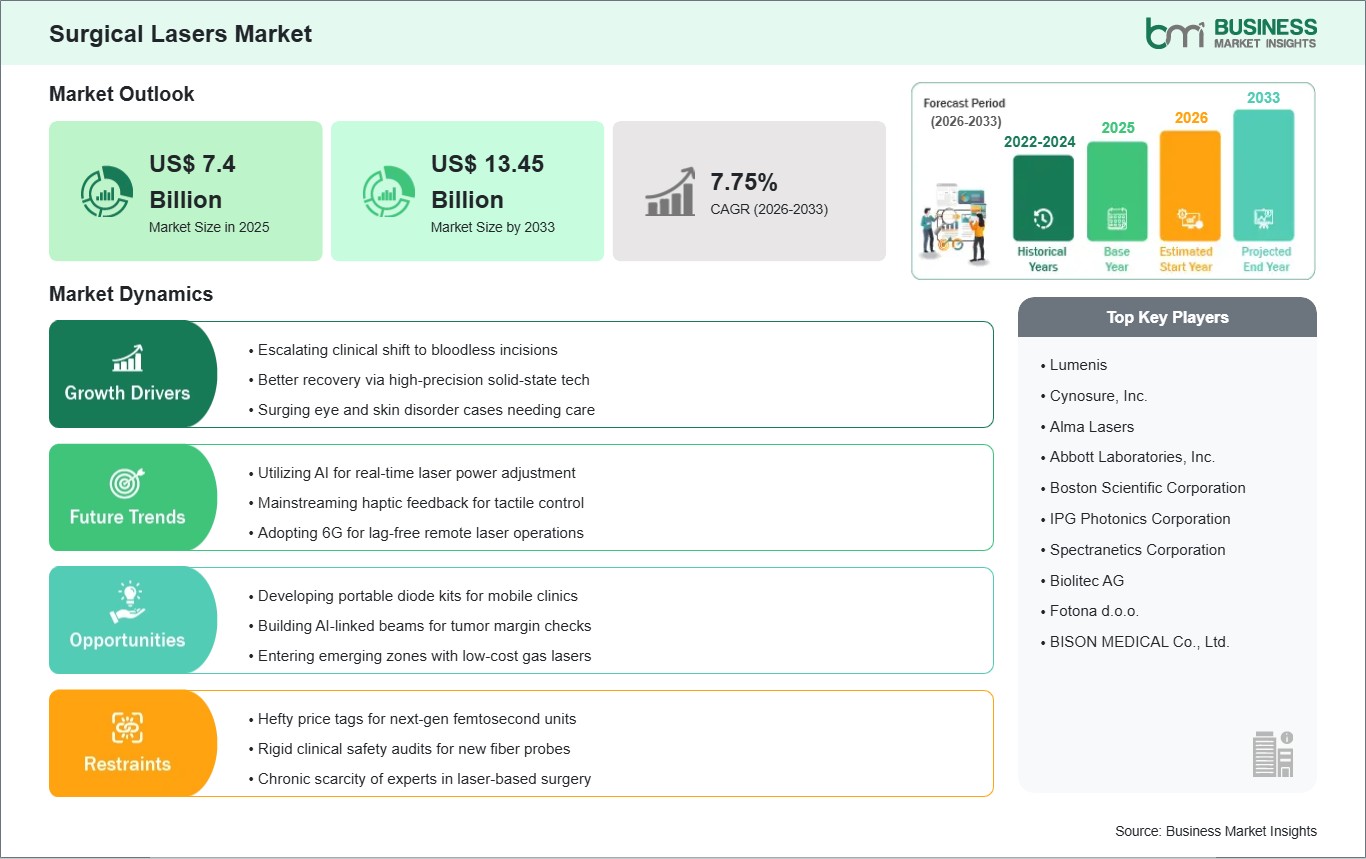
Surgical lasers are specialized medical devices that utilize high-intensity, focused beams of light to cut, vaporize, or cauterize biological tissue with extreme precision. By converting electrical energy into a specific wavelength of light, these systems allow surgeons to perform bloodless procedures and target diseased cells without damaging the surrounding healthy anatomy. The Surgical Lasers Market provides high-precision, minimally invasive tools essential for modern operating rooms, encompassing CO2, diode, Nd: YAG, and Holmium systems. These lasers offer distinct advantages, including reduced bleeding, lower infection risks, and accelerated patient recovery compared to traditional surgery. Growth is fueled by the global demand for minimally invasive procedures, the rising prevalence of chronic diseases, and the expansion of the aesthetic surgery sector. Additionally, the shift toward Ambulatory Surgical Centers (ASCs) is enhancing the accessibility of advanced, compact laser care.
However, several challenges can restrain market growth: the high initial capital expenditure and complexity associated with acquiring and maintaining advanced multi-wavelength laser platforms can be substantial for smaller healthcare facilities. Stringent regulatory hurdles and the requirement for extensive safety certifications (such as FDA and CE markings) pose a constant commercialization and compliance hurdle. Furthermore, the industry faces constraints due to limited reimbursement coverage in emerging economies and a persistent technical skills gap among medical staff required to operate high-energy laser systems. Despite these hurdles, the market holds immense opportunities as a result of the universal mandate for value-based healthcare, the accelerating deployment of robotic-assisted laser surgery, and the increasing reliance on AI-driven real-time dosimetry for automated tissue ablation. The shift to thulium-fiber technology and portable diode units is expected to create significant opportunities for market growth.
Segment Analysis
Surgical Lasers Market Segmentation
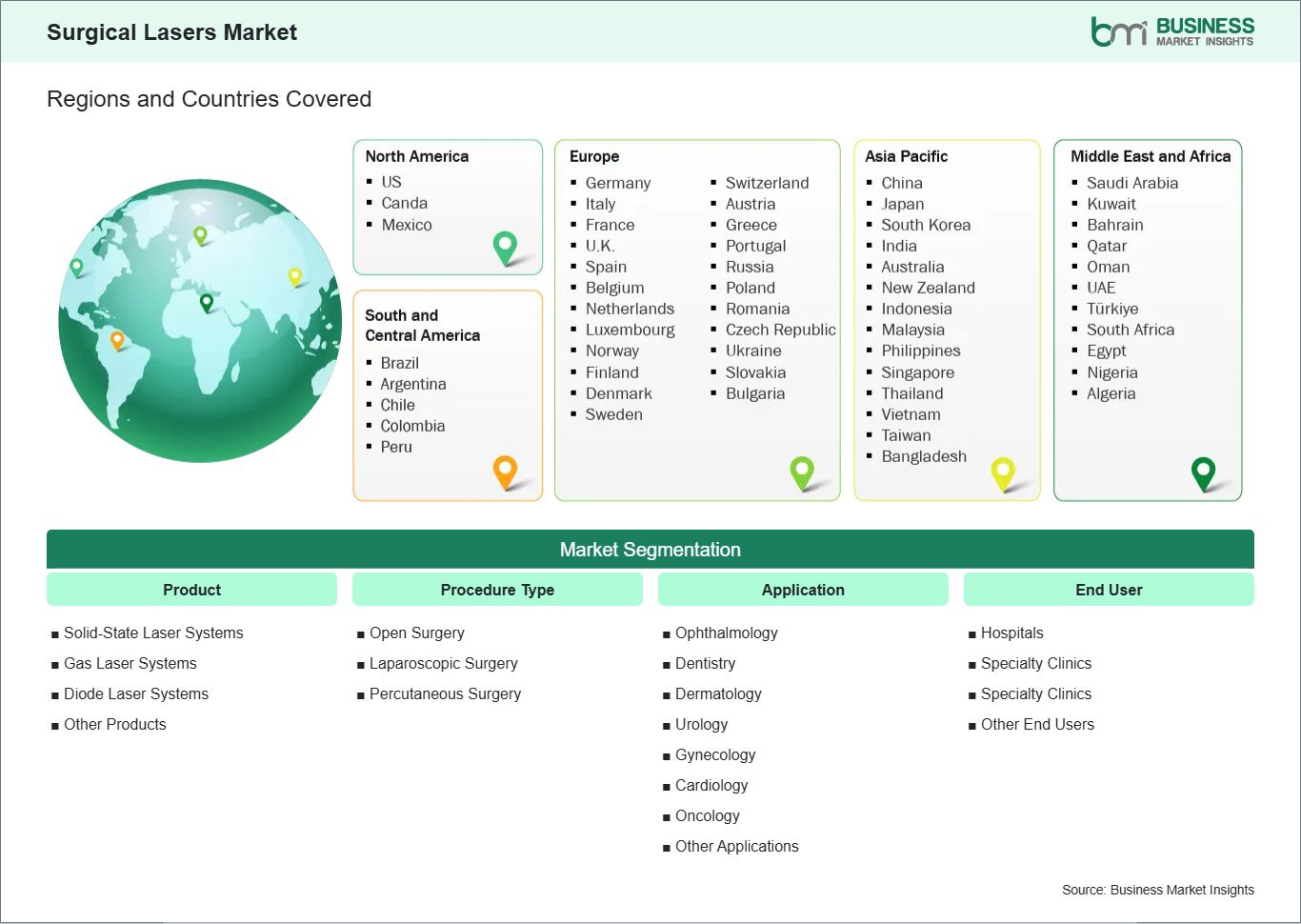
Key segments that contributed to the derivation of the Surgical Lasers market analysis are product, procedure type, application, and end user.
- By Product, the market is segmented into Solid-State Laser Systems (Erbium Yttrium Aluminum Garnet (Er: YAG), Neodymium Yttrium Aluminum Garnet (Nd: YAG), Holmium Yttrium Aluminum Garnet (Ho: YAG), Ruby Laser Systems, and Other Solid-State Laser Systems), Gas Laser Systems (CO2, Excimer, Helium Neon, and Other Gas Laser Systems), Diode Laser Systems, and Other Products.
- By Procedure Type, the market is segmented into Open Surgery, Laparoscopic Surgery, and Percutaneous Surgery.
- By Application, the market is segmented into Ophthalmology, Dentistry, Dermatology, Urology, Gynecology, Cardiology, Oncology, and Other Applications.
- By End User, the market is segmented into Hospitals, Specialty Clinics, Specialty Clinics, and Other End Users.
Market Forces
Surgical Lasers Market Drivers and Opportunities
Rising Preference for Minimally Invasive Surgery (MIS)
The primary driver for the Surgical Lasers market is the global medical transition toward minimally invasive procedures that prioritize reduced patient trauma and faster recovery times. Compared to traditional scalpel-based surgery, laser systems, including CO2, Nd: YAG, and diode lasers, offer the unique ability to cut, vaporize, and coagulate tissue with extreme precision and minimal blood loss. This is critical in specialties such as urology, where lasers are now standard for treating kidney stones and prostate enlargement, and in oncology for precise ablation of tumors in delicate areas. As healthcare systems worldwide face pressure to reduce hospital stays and minimize post-operative complications, integrating surgical lasers into outpatient and ambulatory settings has become a fundamental growth catalyst.
Technological Convergence with Robotics and AI
A significant high-value opportunity lies in the convergence of laser technology with robotic-assisted surgery and Artificial Intelligence (AI). New-generation surgical platforms are increasingly integrating "AI-ready" laser systems that use machine learning algorithms to perform real-time tissue mapping and automated beam-shaping. This allows for sub-micron precision, reducing human error and preventing damage to surrounding healthy structures. Furthermore, the rise of femtosecond and picosecond lasers is revolutionizing refractive and cataract eye surgeries, offering outcomes that often exceed 20/20 vision. Manufacturers who develop modular laser "end-effectors" that can be easily attached to existing robotic arms are positioned to capture the rapidly growing robotic surgery segment, while advancements in portable, energy-efficient diode lasers are opening new revenue streams in emerging markets with developing medical infrastructures.
Size and Share Analysis
Surgical Lasers Market Size and Share Analysis
The Surgical Lasers market demonstrates steady growth, with size and share analysis revealing evolving trends and competitive positioning among key players. The report further examines subsegments categorized within product, procedure type, application, and end user, offering insights into their contribution to overall market performance.
For instance, Solid-State Laser Systems, such as Holmium (Ho: YAG) and Neodymium (Nd: YAG), are integral to Urology and Oncology sectors. These systems are frequently utilized in Laparoscopic Surgery due to their high precision and ability to deliver energy through flexible fibers. This configuration is favored in Hospitals for complex procedures such as lithotripsy and tumor ablation, where minimizing collateral tissue damage and reducing recovery times are critical clinical priorities.
Report Coverage
Surgical Lasers Market Report Coverage and Deliverables
The "Surgical Lasers Market Size and Forecast (2022 - 2033)" report provides a detailed analysis of the market covering below areas:
- Surgical Lasers market size and forecast at global, regional, and country levels for all the key market segments covered under the scope
- Surgical Lasers market trends, as well as market dynamics such as drivers, restraints, and key opportunities
- Surgical Lasers market analysis covering key market trends, global and regional framework, major players, regulations, and recent market developments
- Industry landscape and competition analysis covering market concentration, heat map analysis, prominent players, and recent developments for the Surgical Lasers market
- Detailed company profiles, including SWOT analysis
Geographic Insights
Surgical Lasers Market Geographic Insights
The geographical scope of the Surgical Lasers market report is divided into five regions: North America, Asia Pacific, Europe, Middle East & Africa, and South & Central America.
The Asia-Pacific Surgical Lasers Market is segmented into China, Japan, South Korea, India, Australia, New Zealand, Indonesia, Malaysia, the Philippines, Singapore, Thailand, Vietnam, Taiwan, Bangladesh, and the Rest of Asia. The market is primarily driven by the region's rapidly aging population and the increasing prevalence of ophthalmic disorders and chronic diseases such as cancer and cardiovascular conditions.
Growth is further bolstered by the booming medical tourism industry and a surge in demand for aesthetic and cosmetic laser procedures (such as skin resurfacing and hair removal) in South Korea and India. The rising adoption of advanced diode and femtosecond lasers, coupled with increasing disposable income and awareness of bloodless, precision-based surgeries, solidifies Asia-Pacific as the critical global driver for surgical laser innovation.
Industry Activity
Recent Developments
The Surgical Lasers market is evaluated by gathering qualitative and quantitative data post primary and secondary research, which includes important corporate publications, association data, and databases. A few of the key developments in the Surgical Lasers market are:
- In September 2025, Alcon, the global leader in eye care dedicated to helping people see brilliantly, announced the launch of the first fully personalized Laser-Assisted In Situ Keratomileusis (LASIK) treatment, wavelight plus in the U.S. and Canada. Alcon has been a leader in refractive vision correction for more than 25 years. Its next-generation wavelight plus technology unlocks a new era of precision in refractive surgery, with unprecedented levels of personalization that lead to outstanding visual outcomes with predictability and minimal risk.
- In July 2025, biolitec announced the launch of the LEONARDO Duster Super Pulsed Thulium Fiber Laser (TFL), a significant advancement in urology laser technology. This innovative laser has received FDA approval, marking a major milestone in the biolitec LEONARDO laser portfolio. The LEONARDO Duster is designed for a range of urology applications, including lithotripsy, prostatic hyperplasia, and soft tissue treatment. The new TFL technology is set to become the industry standard, offering superior capabilities such as improved dusting, low retropulsion, higher stone vaporization rates, and effective soft tissue treatments.
Trust & Transparency
Research Methodology
The market analysis combines proprietary research with secondary data from government agencies, company disclosures, regulatory filings, industry databases and expert interviews. Market estimates are validated through data triangulation, cross-market benchmarking and analyst
review.
View Full Research Methodology
Key Sources Referred:
World Bank - Global Trade IndicatorsWorld Trade Organization (WTO)International Monetary Fund (IMF)International Trade Administration (ITA)Company WebsitesCompany Annual ReportsCompany Investor Presentations