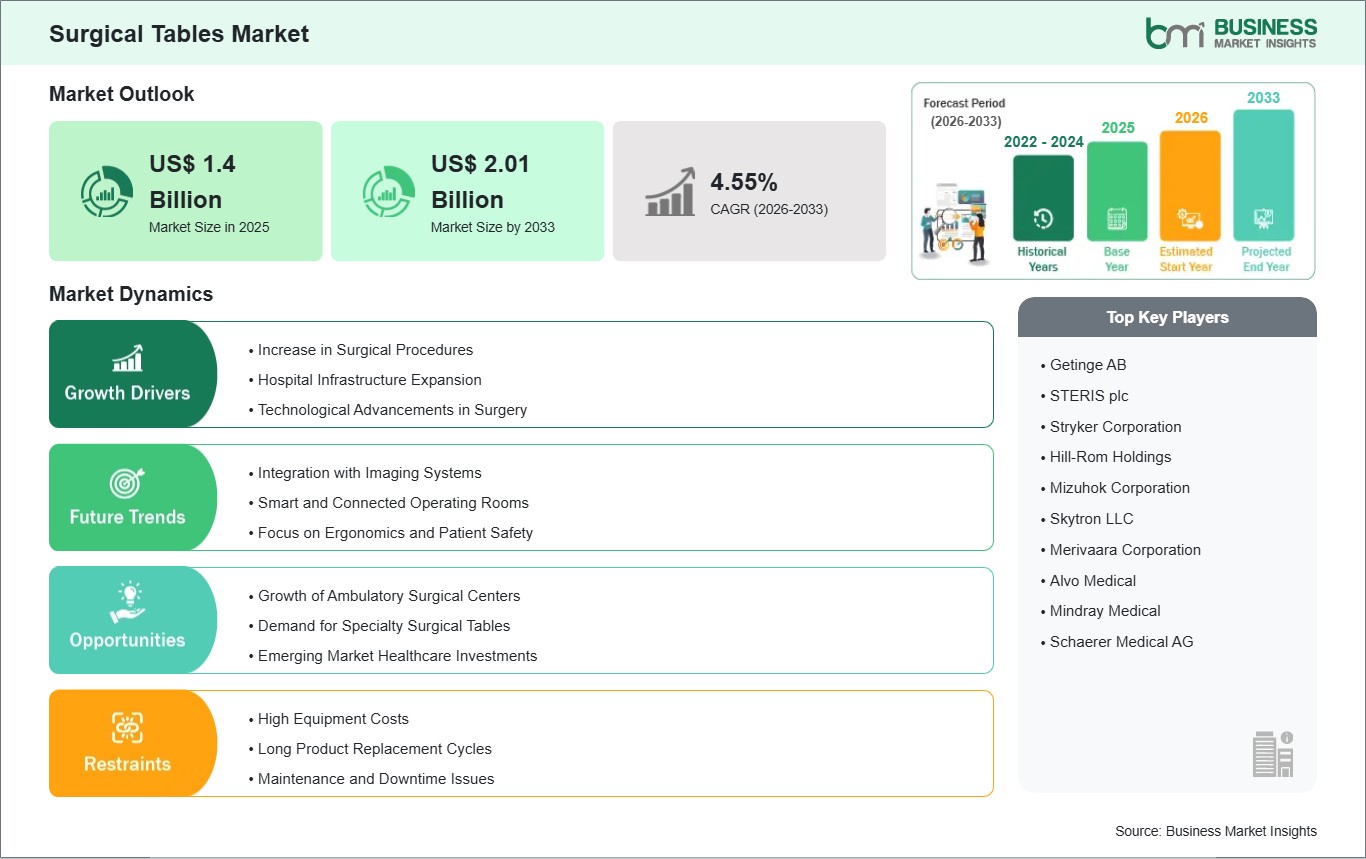
The Surgical Tables Market size is expected to reach US$ 2.01 billion by 2033 from US$ 1.4 billion in 2025. The market is estimated to record a CAGR of 4.55% from 2026 to 2033.
Surgical tables are essential medical instruments that hold patients securely during surgical operations, making it possible to position the patient accurately, keep them stable, and allow easy access to the surgeons. Such tables find their usage in various fields of surgery like general surgery, orthopedics, neurology, and minimally invasive procedures.
The worldwide surgical tables market represents an important segment of the healthcare equipment industry, which is mainly influenced by the increase in the number of surgeries, the aging of populations, and the surgical techniques that keep on improving. Hospitals and ambulatory surgical Centers are in continuous demand for technologically advanced tables that can provide features such as motorized height adjustment, radiolucent tabletops, modular attachments, and compatibility with imaging systems. The trend toward minimally invasive and image, guided surgeries has thus propelled the use of hybrid and electro, hydraulic surgical tables to a great extent.
From a regional perspective, North America and Europe represent mature markets due to well-established healthcare infrastructure and higher healthcare spending, while Asia-Pacific is experiencing the fastest growth, supported by expanding hospital networks, medical tourism, and improving access to surgical care. Competitive dynamics are influenced by factors such as innovation, product customization, and adherence to strict regulatory standards. Therefore, the surgical tables market shows a gradual global expansion, with manufacturers focusing on ergonomic design, patient safety, and integration with digital operating room ecosystems to meet evolving clinical needs.

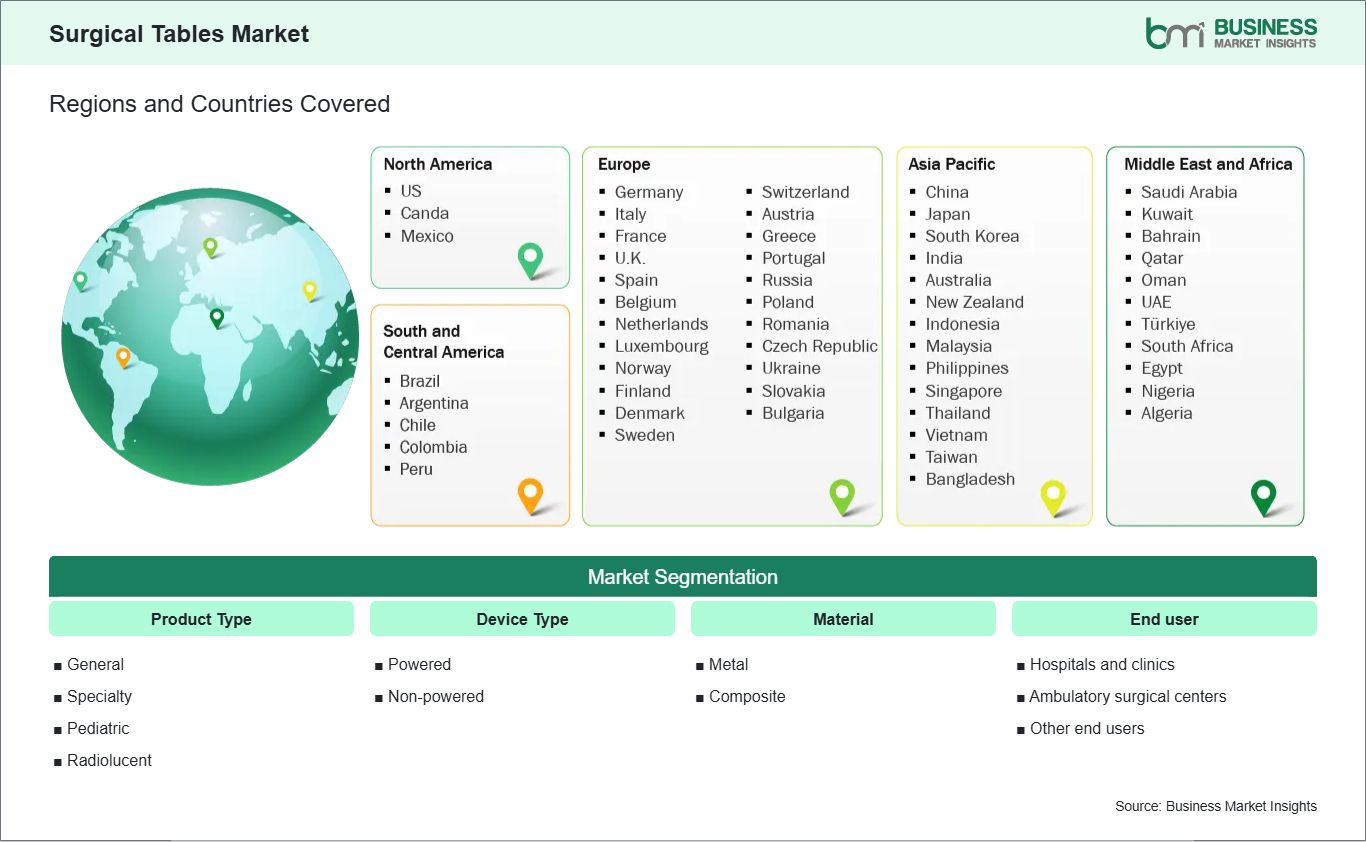
Key segments that contributed to the derivation of the surgical tables market analysis are product type, device type, material, and end user.
One of the main factors that has been pushing up the demand for surgical tables is the large worldwide increase in the number of surgical procedures. This rise in the number of operations is, in turn, a result of changes in the population, increase in the number of people suffering from chronic diseases as well as the progress made in the field of surgical care. The World Health Organization (WHO) reports that the number of surgical procedures is going up all the time as more and more people choose to have operations to treat diseases such as cardiovascular disease, cancer, and orthopedic issues. The health information also indicates that the global population of people aged 60 and over will be 2.1 billion by 2050, which is almost twice as much as the total number in 2020. This will significantly increase the demand for surgeries that require the use of specialized tables.
Hospitals and surgical centers are thus having to upgrade their operating rooms and purchase sophisticated surgical tables with advanced positioning, imaging compatibility, and ergonomic features to cope with this surge. To give an example, hospitals are now increasingly installing powered and hybrid tables in their facilities to facilitate minimally invasive and image, guided procedures, which are rapidly becoming the standard practice for patient safety and better outcomes.
The rise of ambulatory surgical centers, which provide same, day procedures, is another reason behind this trend that is paving the way for the demand of versatile surgical tables capable of supporting a wide range of surgical applications in an efficient and safe manner.
The surgical tables market has a vast potential to expand its reach by syncing its products with a hybrid and smart operating room (OR) setup, which is mainly influenced by the fast adoption of advanced imaging, robotics, and digital workflow solutions. Hybrid ORs that mix surgical capabilities with real, time imaging systems such as intraoperative CT, MRI, and angiography are being increasingly deployed by hospitals. This, in turn, calls for surgical tables that can seamlessly work with these technologies.
Such integrations not only speed up the procedures by doing away with patient transfers between imaging and surgical suites but also precision is improved significantly in cardiovascular and neurosurgical procedures. For example, hybrid OR configurations nowadays typically entail robotic surgical arms, centralized data hubs, and advanced imaging that demand synchronized table movement and data interoperability. These are some of the developments that OEMs are responding to by creating multi, modality compatible tables with modular designs, radiolucent surfaces, and intelligent controls.
More than 35 % of newly built hybrid ORs have been designed to accommodate robotic functionalities right from the start, whereas over 50 % have software platforms that integrate imaging, navigation, and table positioning into a single workflow thus creating a need for smart tables of the next generation. The merging of hybrid and digital OR ecosystems offer a way for manufacturers to distinguish their products through innovation, thus they can command higher value sales and gain entry into the recurring service and upgrade markets as surgical care continues to evolve in a data, driven and connected manner.

By product type, the surgical tables market is segmented into general, specialty, pediatric, and radiolucent. The general segment dominated the market in 2025. General surgical tables lead the market due to their versatility and broad applicability across multiple surgical disciplines such as general surgery, gynecology, urology, and minor orthopedic procedures. Healthcare facilities prefer these tables because they reduce the need for multiple specialized units, optimize operating room utilization, and lower capital expenditure. Their adaptability to various patient positions and compatibility with accessories make them a practical, cost-effective choice for hospitals with high and diverse surgical volumes.
By device type, the market is categorized into powered and non-powered. The powered segment held a larger share of the market in 2025. Powered surgical tables dominate the market because they enhance surgical precision, efficiency, and ergonomics. Motorized controls allow smooth, accurate adjustments of height, tilt, and positioning during procedures, reducing physical strain on surgical staff and minimizing patient repositioning risks. These tables are especially valuable in complex and minimally invasive surgeries where precise alignment is critical. Increasing adoption of advanced operating rooms and hybrid ORs further supports demand for powered systems.
By material, the market is bifurcated into metal and composite. The metal segment held a larger share of the market in 2025. Metal surgical tables hold the largest share due to their superior strength, durability, and ability to withstand heavy patient loads and repeated sterilization cycles. Stainless steel and aluminum alloys offer excellent corrosion resistance and long operational life, making them reliable for high-frequency use. Additionally, metal tables are generally more cost-effective than composite alternatives, which supports widespread adoption in both developed and emerging healthcare markets.
By end user, the surgical tables market is segmented into hospitals and clinics, ambulatory surgical centers, and other end users. The hospitals and clinics segment dominated the market in 2025. Hospitals and clinics lead the end-user segment because they perform the majority of surgical procedures globally, including emergency, complex, and specialty surgeries. These facilities have higher patient inflow, larger operating room capacities, and stronger purchasing power for advanced surgical equipment. Their need for reliable, multi-functional surgical tables across various departments drives consistent demand, reinforcing their dominance over ambulatory surgical centers and other end users.
| Report Attribute | Details |
|---|---|
| Market size in 2025 | US$ 1.4 Billion |
| Market Size by 2033 | US$ 2.01 Billion |
| Global CAGR (2026 - 2033) | 4.55% |
| Historical Data | 2022 - 2024 |
| Forecast period | 2026-2033 |
| Segments Covered | By Product Type
|
|
Regions and Countries Covered
| |
| North America | US, Canada, Mexico |
| Europe | Belgium, Austria, Finland, Denmark, Greece, Poland, Romania, Russia, Ukraine, Czech Republic, Slovakia, Bulgaria, Italy, Luxembourg, Germany, Switzerland, France, Netherlands, Norway, Portugal, Spain, Sweden, United Kingdom |
| Asia-Pacific | Australia, China, India, Japan, South Korea, Indonesia, Malaysia, Philippines, Singapore, Thailand, Vietnam, Bangladesh, New Zealand, Taiwan |
| South and Central America | Brazil, Argentina, Peru, Chile, Colombia |
| Middle East and Africa | Bahrain, Kuwait, Oman, Qatar, Saudi Arabia, United Arab Emirates, Turkiye, South Africa, Egypt, Algeria, Nigeria |
| Market leaders and key company profiles |
|
The Surgical Tables Market Size and Forecast (2025-2033) report provides a detailed analysis of the market covering below areas:
The geographical scope of the surgical tables market report is divided into five regions: North America, Asia Pacific, Europe, Middle East & Africa, and South & Central America. The surgical tables market in Asia Pacific is expected to grow significantly during the forecast period.
The Asia-Pacific surgical tables market is segmented into China, Japan, South Korea, India, Australia, New Zealand, Indonesia, Malaysia, the Philippines, Singapore, Thailand, Vietnam, Taiwan, Bangladesh, and the Rest of Asia. The Asia-Pacific surgical tables market is experiencing robust growth, due to rapid expansion and modernization of healthcare infrastructure in countries like China, India, Japan, and Southeast Asian nations, which are increasing operating room capacity and demand for advanced surgical equipment, including surgical tables.
Investments in new hospitals, the refurbishment of existing medical centers, and the commissioning of tertiary care hospitals are the primary drivers of demand for surgical tables in procurement cycles. Large, scale public health programs in China and India combined with the rapidly growing private health sector are resulting in increased volumes of surgical procedures. The demand for high, quality tables that are able to meet various surgical needs is, therefore, going up. Besides that, growing prevalence of chronic diseases and aging populations in the region mean more surgical interventions are necessary, from orthopedic replacements to cardiovascular and cancer surgeries, thus, the equipment adoption is further propelled.
Medical tourism is another factor that has a great impact on this market. Hospitals in Thailand, India, and Malaysia are equipping themselves with the latest surgical infrastructure to attract patients from abroad who are seeking high-quality, cost-effective care. Moreover, the trend towards minimally invasive and hybrid surgical technologies has led to a growing demand for versatile, imaging-compatible tables in hospitals, which not only improve procedural outcomes but also enhance operational efficiency.

The surgical tables market is evaluated by gathering qualitative and quantitative data post primary and secondary research, which includes important corporate publications, association data, and databases. A few of the key developments in the surgical tables market are:
The Surgical Tables Market is valued at US$ 1.4 Billion in 2025, it is projected to reach US$ 2.01 Billion by 2033.
As per our report Surgical Tables Market, the market size is valued at US$ 1.4 Billion in 2025, projecting it to reach US$ 2.01 Billion by 2033. This translates to a CAGR of approximately 4.55% during the forecast period.
The Surgical Tables Market report typically cover these key segments-
The historic period, base year, and forecast period can vary slightly depending on the specific market research report. However, for the Surgical Tables Market report:
The Surgical Tables Market is populated by several key players, each contributing to its growth and innovation. Some of the major players include:
The Surgical Tables Market report is valuable for diverse stakeholders, including:
Essentially, anyone involved in or considering involvement in the Surgical Tables Market value chain can benefit from the information contained in a comprehensive market report.
Please tell us your area of interest
(Market Segments/ Regions and Countries/ Companies)