Market Summary
Executive Summary and Global Market Analysis
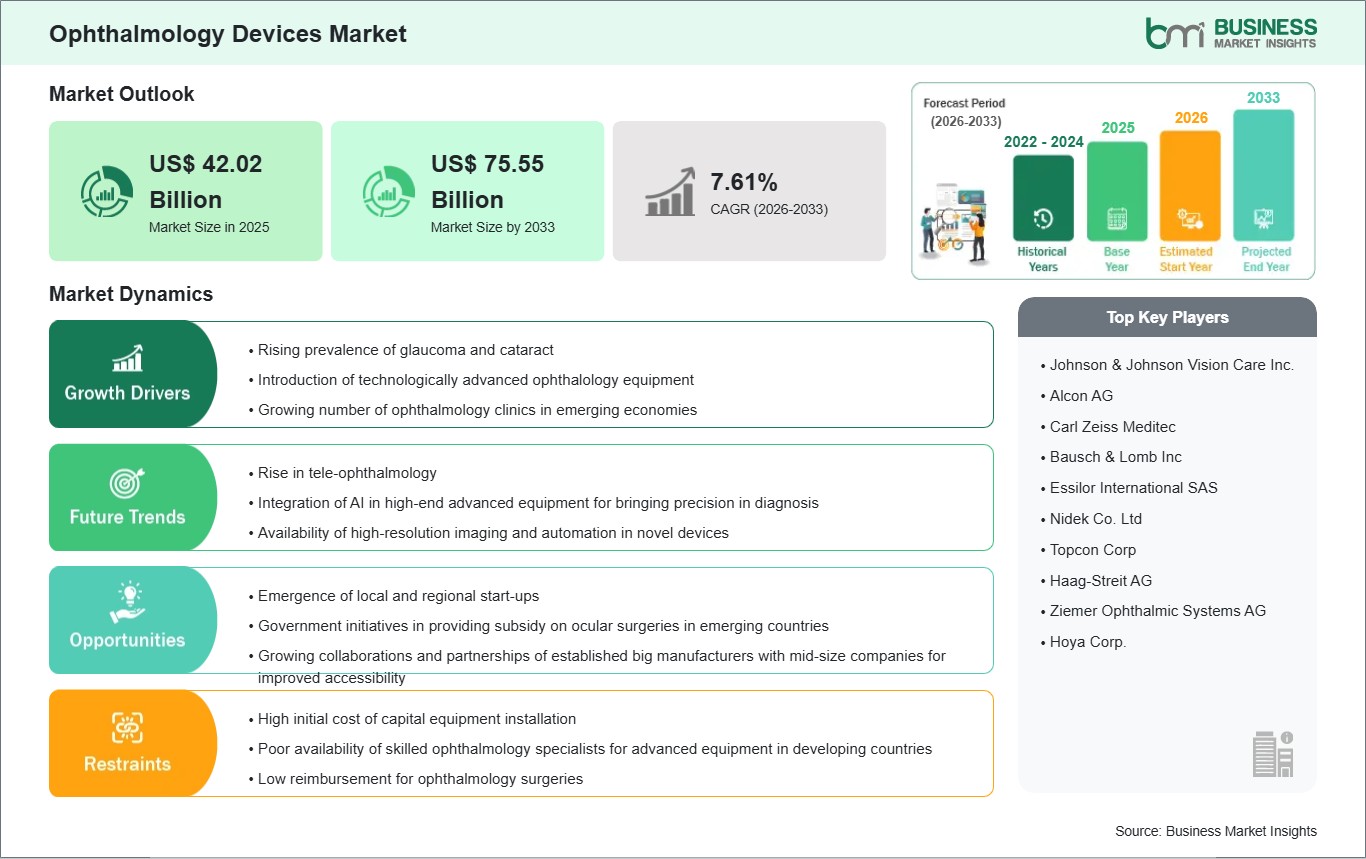
Ophthalmic devices support surgery, diagnosis, and vision correction. Their importance is increasing as the prevalence of cataracts, glaucoma, and other vision issues grows. Companies are launching advanced contact lenses and glasses to meet demand. The need for diagnostic and monitoring tools is rising due to new medical technologies, lifestyle-related eye diseases, higher rates of chronic illness, and an aging population. Innovations such as artificial intelligence, telemedicine, and the Internet of Things are making eye screenings faster, more accurate, more affordable, and more accessible.
Technology continues to play a vital role in life sciences, especially in eye care, by enabling more accurate diagnosis and treatment. Advances in drugs, diagnostic tools, laser systems, and surgical methods have improved the detection and management of glaucoma, cataracts, macular degeneration, and dry eye disease. The market is growing as the incidence of eye disorders rises and new products are introduced, acquired, or developed through partnerships. However, the high cost of eye surgeries remains a significant barrier to market growth.
Segment Analysis
Ophthalmology Devices Market Segmentation
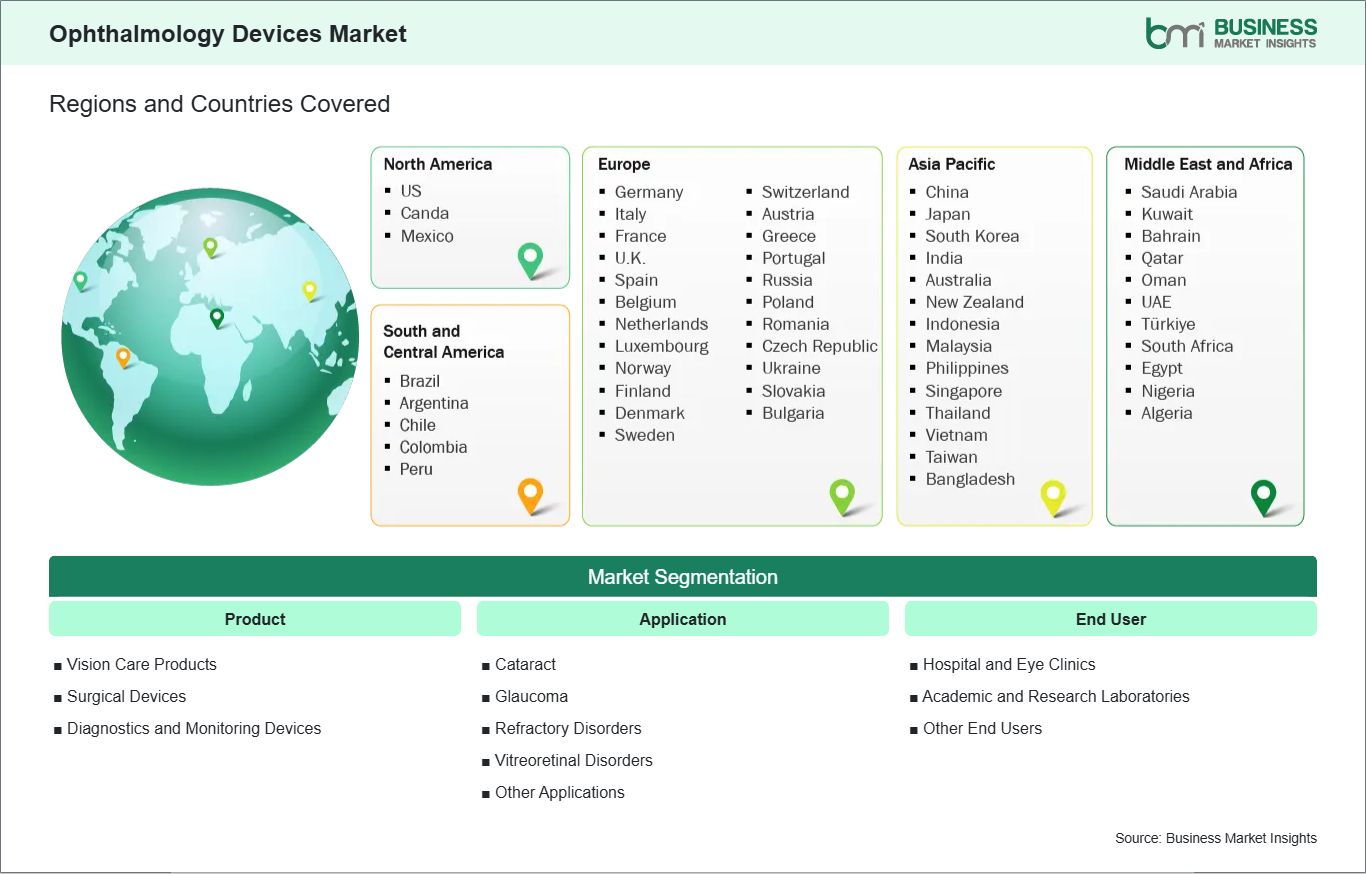
Key segments that contributed to the derivation of the ophthalmology devices market analysis are product, application, and end user.
- By product, the ophthalmology devices market is bifurcated into vision care products, surgical devices, and diagnostics and monitoring devices. The vision care devices segment dominated the market in 2025.
- By application, the market is bifurcated into glaucoma, cataract, vitreoretinal disorder, refractory disorder, and others. The glaucoma segment held the largest share of the market in 2025.
- By end user, the market is segmented into hospitals and eye clinics, academic and research laboratories, and others. The hospitals and eye clinics segment held the largest share of the market in 2025.
Market Forces
Ophthalmology Devices Market Drivers and Opportunities
Rising Aging Population and Growing Eye Disorders
The geriatric population worldwide is expected to double within the next 30 years (2019-2050), according to a 2025 article published by the WHO. With age, various ophthalmic disorders tend to develop, such as cataracts, macular degeneration, glaucoma, and diabetic retinopathy. These diseases are mostly advanced in nature and require diagnostic and therapeutic devices for their management and treatment.
There is an increasing demand for ophthalmology devices equipped with the capability to alleviate age-related visual impairment as the global population of elderly people grows rapidly. The demographic shift to an older population is facilitating the expansion of the market by innovations driven by healthcare providers and medical device manufacturers who are dedicating their efforts to the development and supply of technology products suitable for elderly patients. Therefore, the rise in the elderly population is likely to increase demand for ophthalmology devices, leading to market growth.
Advancements in Ophthalmology Devices
Technological innovation has been the main driver of the life sciences in a critical way, especially in the field of ophthalmology, where modern devices are indispensable for accurate diagnosis and better treatment outcomes. Improvements in drugs, diagnostic instruments, laser systems, and surgical methods have facilitated the diagnosis and treatment of glaucoma, cataracts, macular degeneration, and dry eye disease.
Among the technologies employed in the field, virtual reality, 3D imaging, big data, and artificial intelligence (AI) are being gradually adopted to process ophthalmological data, thereby increasing the precision and trustworthiness of the results. By way of illustration, AI is used to screen for diabetic retinopathy, detect lesions, and track the progression of diseases such as age-related macular degeneration and macular edema.
These technologies still need to prove their effectiveness in accurately identifying and predicting eye disorders, despite holding great potential. Minimally invasive interventions such as LASIK, femtosecond laser surgery, multi-wavelength diabetic retinopathy treatment, and ultrasound phacoemulsification are anticipated to stimulate the need for ophthalmology instruments and, consequently, support the growth of the market.
Size and Share Analysis
Ophthalmology Devices Market Size and Share Analysis
By product, the ophthalmology devices market is bifurcated into vision care products, surgical devices, and diagnostics and monitoring devices. The vision care devices segment dominated the market in 2025. Vision care devices are holding the largest share due to the prevalence of refractive errors, the strong demand for contact lenses and eyewear, and the ongoing introduction of new products by companies.
By application, the market is bifurcated into glaucoma, cataract, vitreoretinal disorder, refractory disorder, and others. The glaucoma segment held the largest share of the market in 2025. More people are developing the disease. The elderly population is growing. There is also a higher demand for advanced diagnostic, monitoring, and less invasive surgical devices.
By end user, the market is segmented into hospitals and eye clinics, academic and research laboratories, and others. The hospitals and eye clinics segment held the largest share of the market in 2025. Hospitals and eye clinics treat a large number of patients and possess advanced ophthalmic equipment. They also perform a greater volume of diagnostic and surgical procedures.
Report Coverage
Ophthalmology Devices Market Report Coverage and Deliverables
The Ophthalmology Devices Market Size and Forecast (2025-2033) report provides a detailed analysis of the market covering below areas:
- Ophthalmology devices market size and forecast at global, regional, and country levels for all the key market segments covered under the scope
- Ophthalmology devices market trends, as well as market dynamics such as drivers, restraints, and key opportunities
- Ophthalmology devices market analysis covering key market trends, global and regional framework, major players, regulations, and recent market developments
- Industry landscape and competition analysis covering market concentration, heat map analysis, prominent players, and recent developments for the ophthalmology devices market
- Detailed company profiles, including SWOT analysis
Geographic Insights
Ophthalmology Devices Market Geographic Insights
The geographical scope of the Ophthalmology Devices market report is divided into five regions: North America, Asia Pacific, Europe, Middle East & Africa, and South & Central America. The ophthalmology devices market in Asia Pacific is expected to grow significantly during the forecast period.
The Asia-Pacific Ophthalmology Devices market is segmented into China, Japan, South Korea, India, Australia, New Zealand, Indonesia, Malaysia, the Philippines, Singapore, Thailand, Vietnam, Taiwan, Bangladesh, and the Rest of Asia. The Asia-Pacific region is expected to be the largest market area for ophthalmology devices, with the highest compound annual growth rate (CAGR). The region's CAGR is expected to be driven by factors such as the growing elderly population, the rising prevalence of diabetes-related eye conditions, and improvements in healthcare access.
India, China, and Japan are rapidly developing ophthalmic services, driven by the construction of specialty hospitals, the introduction of vision screening programs, and the local production of affordable diagnostic devices. Japan remains a technology hub due to its early adoption of digital ophthalmic instruments. At the same time, China and India are expanding their vision care capacity through government-subsidized programs and public-private partnerships aimed at preventing avoidable blindness.
Report Guidance
Ophthalmology Devices Market Report Guidance
The report includes qualitative and quantitative data in the ophthalmology devices market across product, application, and end user, and geography.
The report starts with the key takeaways (chapter 2), highlighting the key trends and outlook of the ophthalmology devices market.
Chapter 3 includes the research methodology of the study.
Chapter 4 further includes ecosystem analysis.
Chapter 5 highlights the major industry dynamics in the ophthalmology devices market, including factors that are driving the market, prevailing deterrents, potential opportunities, as well as future trends. Impact analysis of these drivers and restraints is also covered in this section.
Chapter 6 discusses the ophthalmology devices market scenario, in terms of historical market revenues, and forecast till the year 2033.
Chapters 7 to 10 cover ophthalmology devices market segments by type, destination, and end user, and geography across North America, Europe, Asia Pacific, Middle East and Africa, and South and Central America. They cover the market volume revenue forecast and factors driving the market.
Chapter 11 describes the competitive analysis along with the heat map analysis for the key players operating in the market.
Chapter 12 describes the industry landscape analysis. It provides detailed descriptions of business activities such as market initiatives, new developments, mergers, and joint ventures globally, along with a competitive landscape.
Chapter 13 provides detailed profiles of the major companies operating in the ophthalmology devices market. Companies have been profiled on the basis of their key facts, business descriptions, products and services, financial overview, SWOT analysis, and key developments.
Chapter 14, i.e., the appendix is inclusive of a brief overview of the company, list of abbreviations, and disclaimer.
Industry Activity
Recent Developments
The Ophthalmology Devices market is evaluated by gathering qualitative and quantitative data post primary and secondary research, which includes important corporate publications, association data, and databases. A few of the key developments in the Ophthalmology Devices market are:
- In August 2025, Alcon agreed to acquire rival eyecare specialist STAAR Surgical in an equity deal valued at around USD 1.5 billion. The addition of STAAR’s EVO ICL will complement its laser vision correction business and positively impact profit margins in the years to come.
- In July 2025, Essilor Luxottica signed an agreement with PUcore, a South Korean-based Company, for the acquisition of all its assets and entities involved in the development, manufacturing, and sale of monomers used in the production of high-index ophthalmic lenses. The transaction is expected to close by the end of 2025, pending regulatory approvals and other customary closing conditions. The deal will enhance the company's industry positioning.
- In April 2025, Hoya launched its VisuPro All Day and VisuPro Flex advanced focus spectacle lenses. These lenses are designed to assist people who are beginning to experience presbyopia. This development may enable the company to cement its position in the regional market.
Trust & Transparency
Research Methodology
The market analysis combines proprietary research with secondary data from government agencies, company disclosures, regulatory filings, industry databases and expert interviews. Market estimates are validated through data triangulation, cross-market benchmarking and analyst
review.
View Full Research Methodology
Key Sources Referred:
World Bank – Global Trade Indicators
European Chemicals Agency
International Council of Chemical Associations
(International Monetary Fund )IMF
World Trade Organization (WTO)
International Trade Administration (ITA)
Company website
Company annual reports
Company investor presentations