Market Summary
Executive Summary and Global Market Analysis
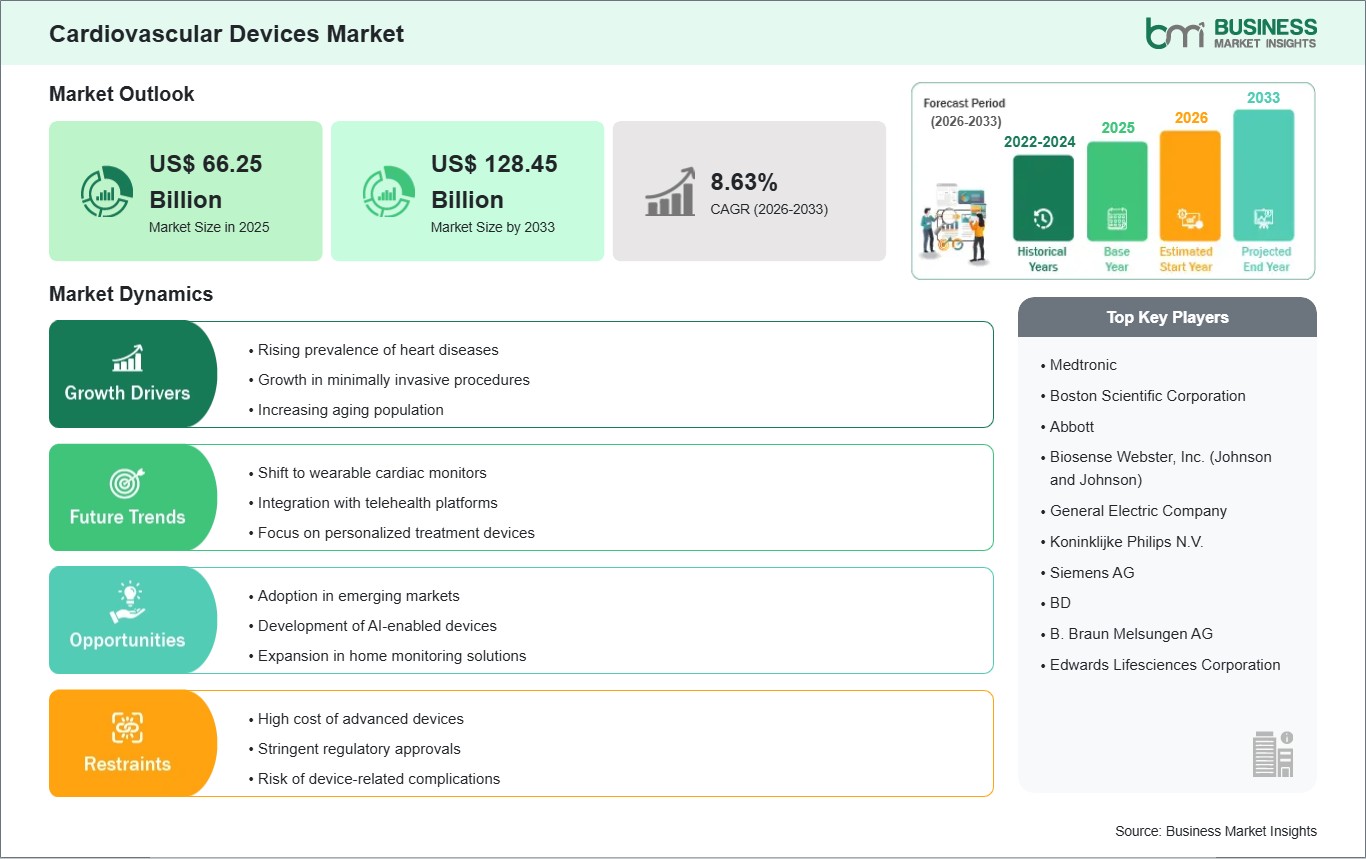
Cardiovascular devices encompass diagnostic, monitoring, and interventional solutions used to detect, manage, and treat heart and vascular conditions. The portfolio ranges from ECGs, cardiac ultrasound, and CT imaging software to implantable pacemakers/ICDs, stents, ablation catheters, transcatheter valves, and structural heart innovations, enabling minimally invasive therapies and continuous patient monitoring across care settings. As cardiovascular disease remains the leading cause of mortality worldwide, demand for devices that improve workflow efficiency, precision, and patient outcomes continues to rise, buoyed by aging populations, expanding transcatheter eligibility, and AI-enabled imaging and automation.
Despite the rising graph, there are numerous challenges and restraints in the market. First, regulatory complexity for high-risk implantables and novel energy modalities (e.g., pulsed field ablation, transcatheter replacements) requires rigorous clinical evidence and post-market surveillance. Second, cost and reimbursement variability can limit the adoption of advanced devices (e.g., TAVR/TMVR, leadless pacing) in lower-income regions. Lastly, operational constraints stemming from staff shortages and the need for accelerated training in cath labs and echo suites, even as case volumes for structural heart and electrophysiology procedures expand.
Despite these headwinds, lucrative opportunities persist, rapid uptake of AI-enhanced cardiology (automation in echo/CT, autonomous imaging workflows), next-generation transcatheter valves across mitral and tricuspid positions, wearable and handheld diagnostics for earlier detection, and software-driven planning tools that improve decision-making and reduce unnecessary invasive diagnostics. Vendors investing in integrated hardware–software platforms, clinical evidence, and scalable manufacturing are well-positioned to capture share across imaging, electrophysiology, interventional cardiology, and structural heart therapies.
Segment Analysis
Cardiovascular Devices Market Segmentation
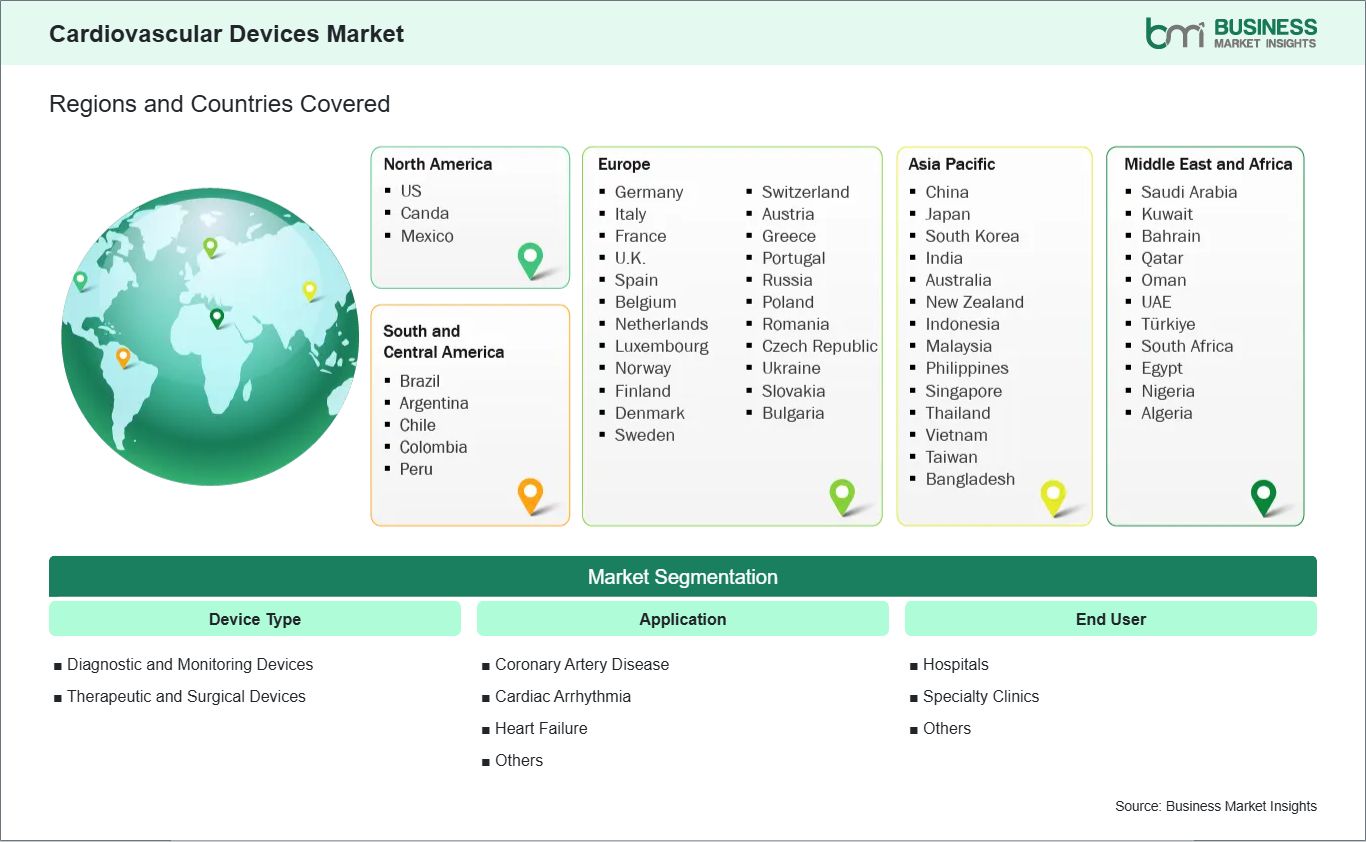
Key segments that contributed to the derivation of the Cardiovascular Devices market analysis are device type, application, and end user.
- By Device Type, the market is segmented into Diagnostic and Monitoring Devices (Electrocardiogram, Remote Cardiac Monitoring, and Others) and Therapeutic and Surgical Devices (Ventricular Assist Devices, Cardiac Rhythm Management Devices, Catheters, Stents, Heart Valves, and Others).
- By Application, the market is segmented into Coronary Artery Disease, Cardiac Arrhythmia, Heart Failure, and Others.
- By End User, the market is segmented into Hospitals, Specialty Clinics, and Others.
Market Forces
Cardiovascular Devices Market Drivers and Opportunities
Rising Prevalence of Cardiovascular Diseases
Cardiovascular diseases continue to be the leading cause of mortality worldwide, a trend that shows no signs of slowing down as populations age and lifestyle-related risk factors become more prevalent. Sedentary behavior, unhealthy dietary patterns, rising obesity rates, and the increasing global burden of diabetes all contribute to the steady expansion of cardiac conditions. As a result, healthcare systems across both developed and emerging markets are experiencing persistent pressure to enhance their cardiovascular care capabilities.
This growing epidemiological burden is fueling sustained demand for a wide range of diagnostic and therapeutic medical devices. Traditional tools such as ECG machines and Holter monitors remain essential, while remote patient monitoring technologies are becoming increasingly important for continuous assessment and early detection of abnormalities. On the interventional side, minimally invasive products—including drug-eluting stents, implantable cardiac devices, and transcatheter heart valves—are seeing rapid adoption due to their ability to reduce recovery times and improve patient outcomes.
Hospitals and clinics are placing greater emphasis on preventive care, early diagnosis, and advanced therapeutic solutions, which in turn drives investment in innovative devices and integrated digital platforms. Collectively, these factors ensure a strong and resilient foundation for market growth across all global regions.
Expansion of Minimally Invasive and Transcatheter Therapies
The shift toward less invasive procedures represents one of the most significant and lucrative growth avenues within the cardiovascular devices market. As healthcare providers increasingly favor approaches that minimize trauma and accelerate recovery, technologies such as transcatheter aortic valve replacement (TAVR), transcatheter mitral and tricuspid repair or replacement, and emerging modalities like pulsed field ablation (PFA) for atrial fibrillation are fundamentally reshaping clinical practice. These innovations allow cardiologists and cardiac surgeons to treat complex structural heart conditions without the need for open-heart surgery, greatly reducing perioperative risks and postoperative complications.
One of the most notable advantages of these minimally invasive solutions is their ability to expand treatment eligibility to high-risk and elderly patients who were previously considered unsuitable for traditional surgical interventions. This not only improves patient outcomes but also significantly increases the addressable market for device manufacturers. Furthermore, the integration of AI-driven imaging, pre-procedural planning, and real-time navigation tools enhances procedural precision, shortens procedure times, and contributes to better long-term outcomes. Together, these advancements open substantial new revenue opportunities for companies investing in structural heart and electrophysiology portfolios, reinforcing the sector’s strong growth trajectory.
Size and Share Analysis
Cardiovascular Devices Market Size and Share Analysis
The Cardiovascular Devices market demonstrates steady growth, with size and share analysis revealing evolving trends and competitive positioning among key players. The report further examines subsegments categorized within device type, application, and end user, offering insights into their contribution to overall market performance.
For instance, within device type, therapeutic and surgical devices, particularly heart valves, are gaining traction as transcatheter solutions expand beyond aortic into mitral and tricuspid positions, supported by clinical evidence and improved delivery systems. In terms of application, cardiac arrhythmia stands out due to the rising adoption of advanced ablation technologies, including pulsed field ablation, and next-generation cardiac rhythm management devices that enable safer, faster procedures. Among end users, hospitals remain the primary setting for complex interventions and integrated care, leveraging hybrid operating rooms and advanced imaging suites to support structural heart and electrophysiology procedures.
Report Coverage
Cardiovascular Devices Market Report Coverage and Deliverables
The Cardiovascular Devices Market Size and Forecast (2022–2033) report provides a detailed analysis of the market covering below areas:
- Cardiovascular Devices market size and forecast at global, regional, and country levels for all the key market segments covered under the scope
- Cardiovascular Devices market trends, as well as market dynamics such as drivers, restraints, and key opportunities
- Cardiovascular Devices market analysis covering key market trends, global and regional framework, major players, regulations, and recent market developments
- Industry landscape and competition analysis covering market concentration, heat map analysis, prominent players, and recent developments for the Cardiovascular Devices market
- Detailed company profiles, including SWOT analysis
Geographic Insights
Cardiovascular Devices Market Geographic Insights
The geographical scope of the Cardiovascular Devices market report is divided into five regions: North America, Asia Pacific, Europe, the Middle East & Africa, and South & Central America.
North America continues to advance with strong adoption of AI-enabled imaging and transcatheter therapies, supported by robust clinical infrastructure and regulatory clarity. Europe emphasizes compliance with evolving MDR standards while accelerating investments in structural heart and electrophysiology solutions. Asia Pacific is witnessing rapid growth in cath-lab installations and minimally invasive procedures, driven by expanding healthcare access and vendor partnerships. The Middle East & Africa is focusing on capacity-building initiatives and collaborations to improve diagnostic imaging and interventional capabilities. South & Central America is modernizing cardiovascular care through infrastructure upgrades and training programs, enabling broader access to advanced therapies.
Industry Activity
Recent Developments
The Cardiovascular Devices market is evaluated by gathering qualitative and quantitative data post primary and secondary research, which includes important corporate publications, association data, and databases. A few of the key developments in the Cardiovascular Devices market are:
- In July 2025, Boston Scientific Corporation received U.S. Food and Drug Administration (FDA) approval to expand the instructions for use (IFU) labeling for the FARAPULSE™ Pulsed Field Ablation (PFA) System.
- In December 2025, Edwards Lifesciences announced that the company's SAPIEN M3 mitral valve replacement system is the first transcatheter therapy utilizing a transseptal approach to receive U.S. Food and Drug Administration (FDA) approval for the treatment of mitral regurgitation (MR).
Trust & Transparency
Research Methodology
The market analysis combines proprietary research with secondary data from government agencies, company disclosures, regulatory filings, industry databases and expert interviews. Market estimates are validated through data triangulation, cross-market benchmarking and analyst
review.
View Full Research Methodology
Key Sources Referred:
World Bank – Global Trade IndicatorsWorld Trade Organization (WTO)International Monetary Fund (IMF)International Trade Administration (ITA)Company WebsitesCompany Annual ReportsCompany Investor Presentations