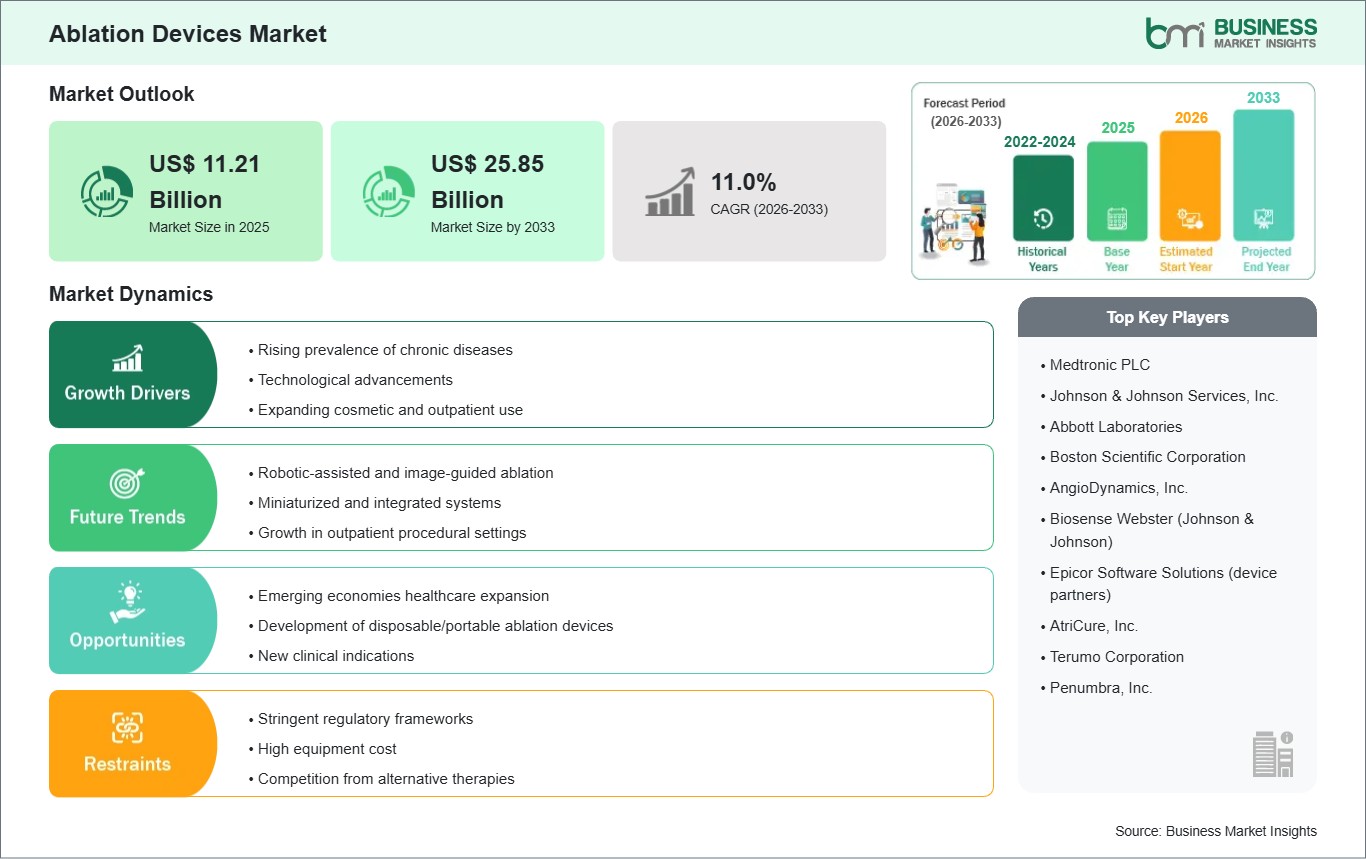
The Ablation Devices Market size is expected to reach US$ 25.85 Billion in 2033 from US$ 11.21 Billion in 2025. The market is estimated to record a CAGR of 11.0% from 2026 to 2033.
Ablation devices are among the most important tools in the medical field of today, as they destroy the abnormal tissue in a luminal fashion with the help of energy sources such as radiofrequency, microwave, laser, cryotherapy, and ultrasound. This is the fast way of treating a patient in various medical fields, such as cardiology (heart arrhythmia), cancer (tumor ablation), pain relief, gynecology, urology, and aesthetics. The patient’s comfort, precision, and speedy recovery times are among the main reasons why ablative devices are a must-have in the modern healthcare system.
The market for global ablation devices is on the path of consistent expansion, as the major factor behind it is the growing number of chronic and long-lasting diseases such as heart problems, cancer, and brain disorders. In this case, the increased use of minimally invasive procedures, along with favorable clinical outcomes and shorter hospital stays, is further driving demand. On the other hand, technological innovations such as imaging-guided ablation, robotic assistance, and advanced power platforms are not only enhancing the safety and efficiency of procedures but also enabling wider use of ablation therapy in clinical practice.
Moreover, the ever-increasing old age population globally is one of the factors that is pushing the market in a big way because old people are more likely to suffer from chronic diseases and degenerative conditions that need intervention. Also, the trend of moving to outpatient and ambulatory surgery centers, which has been made possible by the progress in portable and catheter-based ablation devices, is improving access to the treatment and making it available in larger volumes worldwide.
Nevertheless, the market is challenged by several factors, including the high prices of ablation systems and treatments, the lengthy and complex regulatory approval process, and the need for doctors to be specially trained in the procedure. Moreover, reimbursement variations in different geographical areas and competition from other treatment methods such as drug therapies and surgeries can also limit market growth. On the other hand, the ablation devices market is facing strong growth opportunities, which are supported by the healthcare infrastructure's expansion in emerging markets, the increase in medical technology innovation investment, and the raising of awareness of minimally invasive treatment options. Ongoing research and development together with digital health integration and precision medicine will be the driving forces behind sustained market growth throughout the forecast period.

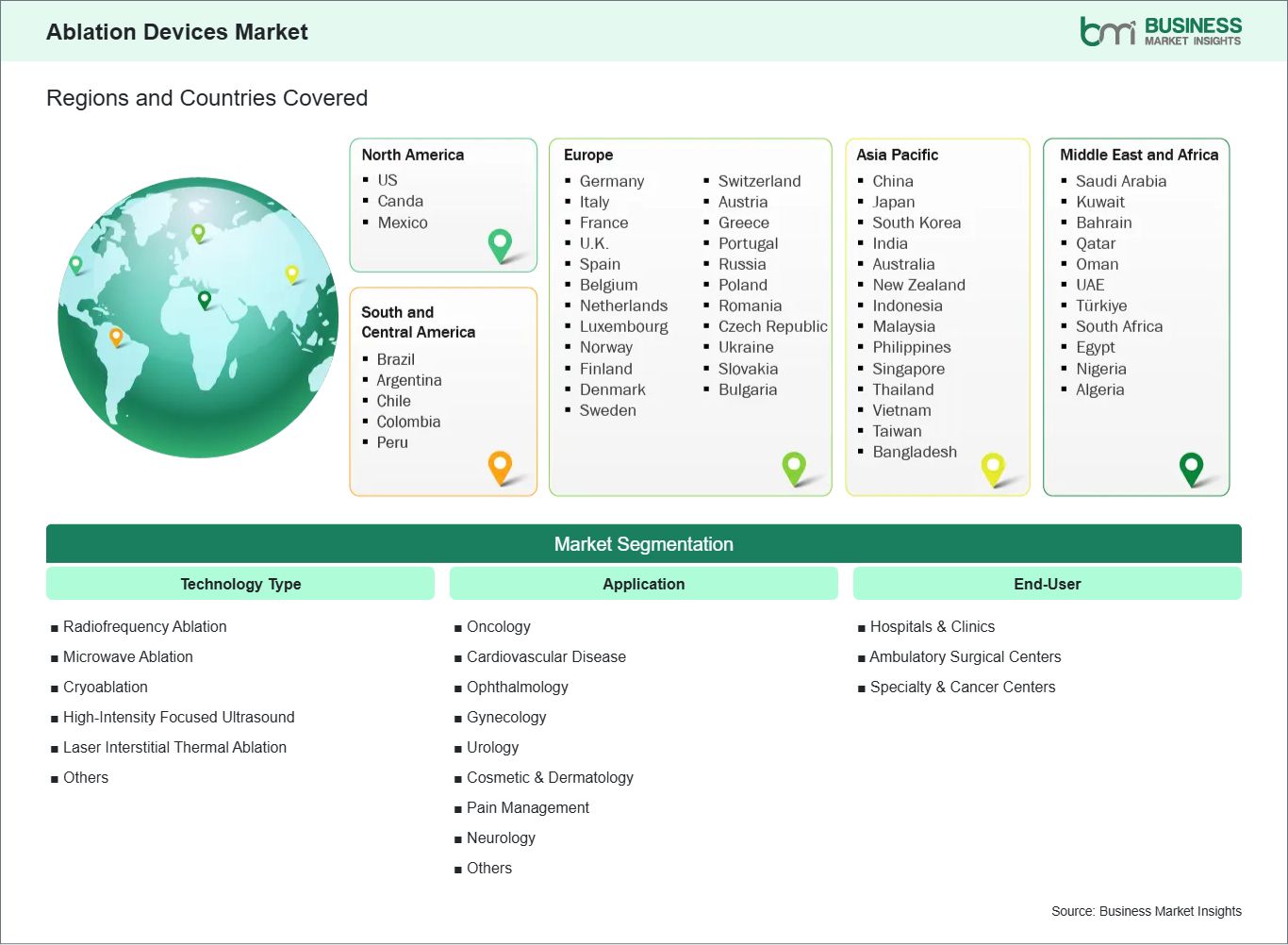
Key segments that contributed to the derivation of the ablation devices market analysis are technology type, application, and end user.
The increasing global burden of chronic diseases has emerged as a major driver of the ablation devices market. Cardiovascular diseases, cancer, and chronic pain conditions continue to rise due to aging populations, sedentary lifestyles, and lifestyle-related risk factors. Ablation therapies are increasingly preferred for treating conditions such as atrial fibrillation, liver and lung tumors, and chronic pain syndromes, owing to their effectiveness and minimally invasive approach.
For instance, the growing incidence of cardiac arrhythmias worldwide has significantly increased the demand for catheter-based cardiac ablation procedures. Similarly, in oncology, tumor ablation techniques are gaining traction as an alternative or adjunct to surgery, chemotherapy, and radiation therapy—particularly for patients who are not suitable candidates for invasive surgical procedures. This expanding clinical adoption directly supports sustained growth in the ablation devices market.
The continuous innovation of ablation technologies has opened new avenues for the market to grow significantly. The advanced energy modalities, which include pulsed-field ablation, microwave ablation, and next-generation cryoablation, are developing safety profiles and reducing the time it takes to perform a procedure. Robotic assistance, artificial intelligence, and real-time monitoring capabilities have been integrated, which is making the precision of the entire procedure and the results even better.
In addition, the devices that were used for ablation are being accepted more in the treatment of new areas like neurological disorders, pain management, and cosmetic and aesthetic procedures. As the clinical evidence supporting the use of these applications continues to grow, manufacturers will be able to not only expand their product line but also enter previously unexploited areas of therapy. As a result of the already mentioned factors, together with the rising healthcare investments in emerging markets and the growing physician awareness, the above-mentioned technological and application-based advancements are going to create long-term growth opportunities for the global ablation devices market.
By technology type, the ablation devices market is segmented into radiofrequency ablation, microwave ablation, cryoablation, high-intensity focused ultrasound (HIFU), laser interstitial thermal ablation, and others. The radiofrequency ablation (RFA) segment dominated the market in 2025. Radiofrequency ablation is extensively utilized in clinics, mainly because it is a technique that has been clinically proven to be effective, it is cost-effective, and it can be applied to various medical fields such as cardiology, oncology, and pain management. The technology's capability of destroying the whole tissue and, at the same time, keeping the surrounding tissues intact to a greater extent is what makes it the first choice for minimally invasive procedures.
By application, the market is segmented into oncology, cardiovascular disease, ophthalmology, gynecology, urology, cosmetic & dermatology, pain management, neurology, and others. The oncology segment held the largest market share in 2025. The global cancer burden that keeps on increasing and the preference for less invasive alternatives have come together to create a massive demand for ablation devices in the oncological sector. Cancer patients who are not surgical candidates are the primary target of ablation therapies for the treatment of liver, lung, kidney, and bone tumors. Besides, these procedures have the following benefits: shorter hospital stays, reduced complications, and quicker healing.
By end user, the ablation devices market is segmented into hospitals & clinics, ambulatory surgical centers, and specialty & cancer centers. The hospitals & clinics segment dominated the market in 2025. Hospitals and clinics are the first and foremost settings for the more complex ablation procedures due to being equipped with top-notch infrastructure, specialized instruments, and highly trained medical staff.
| Report Attribute | Details |
|---|---|
| Market size in 2025 | US$ 11.21 Billion |
| Market Size by 2033 | US$ 25.85 Billion |
| Global CAGR (2026 - 2033) | 11.0% |
| Historical Data | 2022-2024 |
| Forecast period | 2026-2033 |
| Segments Covered | By Technology Type
|
|
Regions and Countries Covered
| |
| North America | US, Canada, Mexico |
| Europe | Belgium, Austria, Finland, Denmark, Greece, Poland, Romania, Russia, Ukraine, Czech Republic, Slovakia, Bulgaria, Italy, Luxembourg, Germany, Switzerland, France, Netherlands, Norway, Portugal, Spain, Sweden, United Kingdom |
| Asia-Pacific | Australia, China, India, Japan, South Korea, Indonesia, Malaysia, Philippines, Singapore, Thailand, Vietnam, Bangladesh, New Zealand, Taiwan |
| South and Central America | Brazil, Argentina, Peru, Chile, Colombia |
| Middle East and Africa | Bahrain, Kuwait, Oman, Qatar, Saudi Arabia, United Arab Emirates, Turkiye, South Africa, Egypt, Algeria, Nigeria |
| Market leaders and key company profiles |
|
The "Ablation Devices Market Size and Forecast (2022 - 2033)" report provides a detailed analysis of the market covering below areas:
The geographical scope of the ablation devices market report is divided into five regions: North America, Asia Pacific, Europe, Middle East & Africa, and South & Central America. The Ablation Devices market in Asia Pacific is expected to grow significantly during the forecast period.
The Asia-Pacific Ablation Devices market is segmented into China, Japan, South Korea, India, Australia, New Zealand, Indonesia, Malaysia, the Philippines, Singapore, Thailand, Vietnam, Taiwan, Bangladesh, and the Rest of Asia. The Asia-Pacific ablation devices market is on a fast to grow, as the high incidence of chronic diseases such as cancer, cardiovascular problems, and arrhythmia is the major growth drive plus the fact that patients increasingly prefer less invasive treatment methods. The market encompasses the major countries such as China, Japan, South Korea, India, Australia, New Zealand, Indonesia, Malaysia, the Philippines, Singapore, Thailand, Vietnam, Taiwan, Bangladesh, and the Rest of Asia, each of which has a different level of influence based on how developed their healthcare infrastructure is and how widely the technology is accepted.
The three major economies of China, Japan, and India are the main drivers of market growth, as in these countries, the already very large patient populations are gaining access to continuously improving advanced healthcare services, and hospital infrastructure is increasingly being invested in. Furthermore, governments’ plans to make healthcare systems more efficient by providing insurance coverage, encouraging early disease diagnosis, etc., are also accelerating the adoption of ablation technologies in this region.
Moreover, the market is being aided by the extremely rapid development of ablation systems based on radiofrequency, cryoablation, microwave, laser, and ultrasound technologies. Developments such as image-guided ablation, AI-assisted procedural planning, and real-time monitoring are improving procedural precision, safety, and clinical outcomes—especially in oncology and cardiac electrophysiology applications.
In addition, the ongoing transition towards less invasive and outpatient procedures is a promising factor for future demand for ablation devices, since the techniques require fewer hospital days, cause fewer complications, and lead to quicker patient recovery. The proliferation of specialty clinics and ambulatory surgical centers, particularly in metropolitan areas, is another factor that is increasingly positively impacting the market

The Ablation Devices market is evaluated by gathering qualitative and quantitative data post primary and secondary research, which includes important corporate publications, association data, and databases. A few of the key developments in the Ablation Devices market are:
The Ablation Devices Market is valued at US$ 11.21 Billion in 2025, it is projected to reach US$ 25.85 Billion by 2033.
As per our report Ablation Devices Market, the market size is valued at US$ 11.21 Billion in 2025, projecting it to reach US$ 25.85 Billion by 2033. This translates to a CAGR of approximately 11.0% during the forecast period.
The Ablation Devices Market report typically cover these key segments-
The historic period, base year, and forecast period can vary slightly depending on the specific market research report. However, for the Ablation Devices Market report:
The Ablation Devices Market is populated by several key players, each contributing to its growth and innovation. Some of the major players include:
The Ablation Devices Market report is valuable for diverse stakeholders, including:
Essentially, anyone involved in or considering involvement in the Ablation Devices Market value chain can benefit from the information contained in a comprehensive market report.
Please tell us your area of interest
(Market Segments/ Regions and Countries/ Companies)